Dave runs a small pressure washing business in Florida, and for two years he blamed his sore hands on getting older. By the end of every driveway job his right hand ached, his wrist was stiff, and his last few passes were sloppy because he could not keep the trigger squeezed. The fix was not a new machine or a lighter wand. It was a $70 pressure washer gun handle with a soft overmolded grip and a light-pull trigger. Within a week the soreness was gone and his finish quality improved, all because the part he touched every second of every job finally fit his hand.
That is the thing most people miss about a pressure washer gun handle. It is the one component you never put down, yet it is often the cheapest plastic part on the whole rig. This guide covers what a gun handle is made of, the grip and trigger types worth knowing, how to match one to your machine, how to replace a worn or broken handle, and the common problems that show up right where your hand sits.
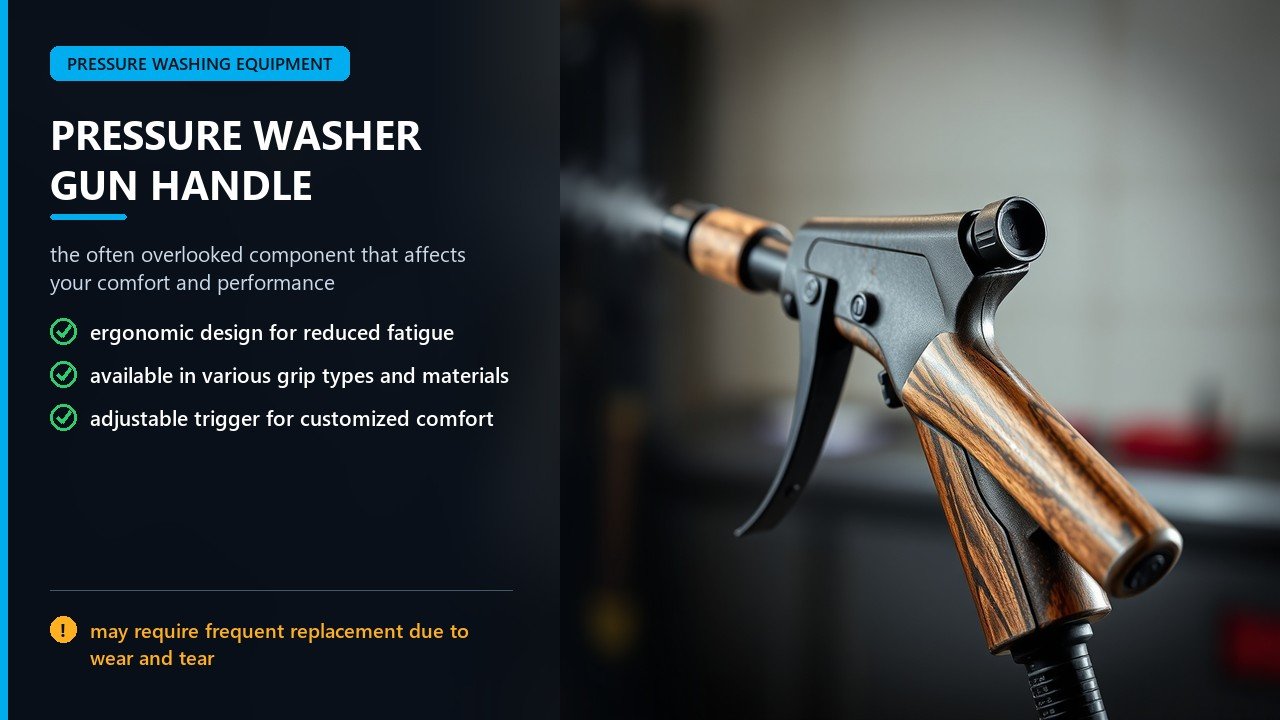
What a Pressure Washer Gun Handle Actually Is
The term “gun handle” gets used loosely. Sometimes it means the whole spray gun, and sometimes it means just the grip and frame you hold. For clarity, think of the handle as the body of the gun: the pistol-shaped housing that carries the trigger, the safety lock, the valve, and the inlet and outlet ports where the hose and wand connect.
Inside that housing sits a valve, usually a ball or poppet design, that opens when you squeeze the trigger and shuts the instant you let go. The grip is the outer shell around that mechanism, and it is the part your palm wraps around. So when someone talks about upgrading a “gun handle,” they usually mean a better-shaped, better-textured grip with a smoother trigger, not just a cosmetic part.
The handle connects to the high-pressure hose at the inlet and to a wand or accessory at the outlet. Get either connection wrong and you get a leak, a loose wand, or worse. Our guide to pressure washer handle, gun grip, trigger and control covers the full assembly if you want the complete picture.
Why the Handle Matters More Than You Think
Ergonomics sound soft until you have held a trigger for forty-five minutes straight. Contractors who clean six to eight hours a day cannot ignore the weight, grip shape, trigger position, and the angle between the gun and the lance, because those factors stack up into muscle fatigue and, over time, real strain in the hand, wrist, and forearm. Even a homeowner doing a single patio will notice the difference between a sharp-edged plastic grip and a soft, shaped one.
Control is the second reason. A handle that is too slippery when wet, too thick for your hand, or badly balanced makes the gun wander, which shows up as streaks, missed spots, and tired arms. A good grip keeps the nozzle steady so you can work faster and cleaner with less effort.
Safety is the third. A handle with an unreliable safety lock is a genuine hazard. At 3,000 PSI and above, an accidental trigger pull while you are swapping a nozzle can send water where you do not want it, or startle you into dropping the gun. A positive, easy-to-engage trigger lock is not a luxury; it is basic equipment.
Quick Note: The handle does not create pressure. The pump does. The handle only controls and directs it. Upgrading the handle will not make a weak machine stronger, but it can make a strong machine far more comfortable and precise to use.
Grip Types and Materials
Most gun handles fall into a few recognizable shapes. The standard pistol grip is the familiar drill-like form that suits most hands and most jobs. Ergonomic or contour grips curve to fit the palm and use rubber or overmolded texture to stay secure when wet or soapy. Some professional guns add a front handle forward of the trigger for two-handed control, which helps on long, high-pressure jobs where you want maximum stability.
Material matters as much as shape. Cheap all-plastic handles crack, feel harsh, and transmit vibration straight into your hand. Better handles use a metal frame wrapped in a soft rubber overmold, which absorbs shock and dampens vibration, a feature worth paying for if you use the machine often. Forged brass or stainless internals inside that grip outlast plastic valves and are the mark of a gun built for daily work.
There is also the question of where the hose enters. Rear-load handles connect the hose at the back of the grip, which balances the gun and reduces strain because the hose weight hangs behind your hand rather than pulling down in front of it. Front-load designs connect at the base and are common on entry-level machines. For long sessions, rear-load tends to feel better.
Trigger Feel: The Feature That Decides Comfort
If there is one spec to research before buying, it is trigger resistance. A conventional trigger must be held against spring pressure the entire time you spray, and on a long job that constant effort is what wears your hand out. Manufacturers have pushed hard on this: some guns now advertise reduced holding force, and a few, like the Kärcher EASY!Force trigger gun, use the water’s own recoil to hold the trigger open once you engage it, so your hand does almost nothing.
You do not need the most advanced system to feel a difference. A light-pull or easy-pull trigger with a regulated stroke reduces fatigue compared with a stiff economy gun, and it also gives you finer control, so you can feather the flow on delicate surfaces. When you shop, look for language like “easy pull,” “soft trigger,” or “reduced force,” and read reviews from people who use the gun for hours, not minutes.
Pair the trigger with a proper safety lock. A good lock stays engaged until you deliberately release it, then re-engages easily when you set the gun down. Test that it clicks positively and does not jam, because a lock that sticks open is as bad as no lock at all.
Matching the Handle to Your Machine
A handle that is not rated for your machine is not just a performance problem; it is a safety problem. Every spray gun has a maximum PSI and GPM rating, and running one that is underrated for your pump can cause it to fail under pressure. When a gun lets go at 4,000 PSI, the hose whips and water goes everywhere. Always choose a gun rated at or above your machine’s output.
Then confirm the connections. Handles differ in how they attach to the hose and the wand. Common inlet setups include M22 threaded fittings and various quick-connect sizes, while outlets are usually a standard 1/4-inch quick-connect that accepts most nozzles and accessories. Fitting families vary by brand and even between product lines, so check your machine before you order, or buy a gun with adapters in the box. Our article on matching PSI, GPM and threads on pressure washing guns walks through the thread types.
| Feature | Entry-Level Handle | Pro-Grade Handle |
|---|---|---|
| Body / grip | Hard plastic, thin | Metal frame, rubber overmold |
| Trigger | Stiff, high holding force | Light-pull, regulated stroke |
| Internal valve | Plastic | Brass or stainless |
| Swivel | Rarely | Often built in |
| Rebuildable | Usually replaced whole | Seals and valves serviceable |
Do You Need a Swivel on the Handle?
A live swivel between the hose and the handle is one of the cheapest upgrades with the biggest daily payoff. Without a swivel, every time you turn your body the hose twists and torques against the gun, fighting your hand and dragging the nozzle off line. A swivel lets the hose rotate freely so none of that twist reaches the grip. Detailers who move constantly around a vehicle consider it almost essential, and even a homeowner notices less wrist strain on a long driveway.
Some handles have the swivel built in; others accept a swivel as an adapter between the gun and the hose. If your current handle has no swivel and you like it otherwise, an add-on swivel is a low-cost way to smooth out the whole setup.
Short Handle, Long Handle: Getting the Reach Right
Handle and wand length work together. A short or stubby gun puts the nozzle right at your hand, which gives the most control and is ideal for car detailing, wheels, sills, and tight areas. A standard handle paired with a 24 to 36 inch wand is the everyday setup for most residential work, balancing control with reach. Long wands give distance and save your back on flatwork but are harder to steer and need more practice.
The right choice depends on your job. If you mostly clean patios and siding, a standard handle and mid-length wand are comfortable. If you wash cars or reach into wheel wells, a compact setup is worth adding. Many users keep two setups and swap the handle-to-wand connection in seconds using quick-connects.
Common Handle Problems and Fixes
When something goes wrong on a pressure washer, it often shows up at the handle because that is where the moving parts are. Knowing the usual failures saves time and money.
| Symptom | Likely Cause | Fix |
|---|---|---|
| Water drips from the gun | Worn O-rings or seals | Replace seals or the gun |
| Trigger sticks or jams | Grit in valve, weak spring | Flush and clean, or replace |
| Cracked handle after a drop | Impact damage | Replace the gun; not safe to glue |
| Losing pressure at the gun | Leaky inlet or loose fitting | Tighten, reseal, or swap fittings |
A drip from the handle sounds harmless, but it bleeds pressure and eventually worsens, so address it early. If the trigger sticks, flush the gun with clean water and work the trigger, since grit is a common culprit. A cracked housing, though, is a replace-and-move-on situation. Do not try to glue a pressure-bearing handle back together, because the failure mode is a burst of high-pressure water. Our troubleshooting guide on pressure washer gun problems goes deeper.
How to Replace a Gun Handle
Replacing a gun handle is one of the easiest repairs on a pressure washer, and most people can do it in under fifteen minutes with no special tools. First, shut off the machine, turn off the water, and squeeze the trigger to release any trapped pressure. Disconnect the hose and the wand, then note how everything was connected so you can reverse the process.
Unscrew or unclip the old handle from the hose fitting and detach the wand. If your handle uses thread sealant on the inlet, clean the threads. Fit the new handle, tightening the hose connection finger-tight plus a small nip rather than cranking it down, which strains the threads over time. Reconnect the wand, check the safety lock works, and run the machine briefly to check for leaks at the inlet.
Short Note: When you finish a job, disconnect the gun and let it hang free or store it off the hose. Leaving it dangling by the connection puts constant strain on the swivel and fittings, which are the first parts to fail.
If you are ordering a specific replacement, matching an OEM part number is the safest route. Parts sellers like eReplacementParts list handle and grip parts by brand and model, so you can confirm the exact fit before buying. For a broader look at what swaps and what does not, see our guide to identifying and ordering pressure washer gun parts.
Frequently Asked Questions
What is the handle on a pressure washer gun? It is the pistol-shaped body you grip, containing the trigger, safety lock, valve, and hose and wand connections. When people talk about a gun handle, they usually mean this whole control unit wrapped in its grip.
Are all pressure washer gun handles interchangeable? No. Inlet and outlet fittings, PSI and GPM ratings, and body shapes vary. Check compatibility with your machine and accessories before buying, and use an adapter if needed.
Will a better handle really reduce hand fatigue? Yes. A contoured, rubberized grip with a light-pull trigger reduces the constant effort of holding a stiff trigger and dampens vibration, which makes long sessions noticeably easier.
How do I stop the handle from leaking? Most handle leaks come from worn seals or O-rings at the inlet or valve. Replace the seals, reseal the threads, and check that fittings are snug but not over-tightened.
Can I repair a cracked handle? No. A cracked, pressure-bearing handle should be replaced. Glue and tape will not hold against thousands of PSI, and a failure there is dangerous.
Do I need a swivel on my gun handle? It is not required, but it is one of the best low-cost upgrades because it stops the hose from twisting and fighting your hand as you move around.
Final Thoughts
A pressure washer gun handle is the part that decides how comfortable, controlled, and safe your cleaning feels, yet it is often the cheapest plastic piece on the machine. Upgrading to an ergonomic handle with a light-pull trigger, a solid safety lock, and a live swivel transforms long jobs from a hand-cramping chore into steady, precise work.
Match the gun to your machine’s PSI and GPM and to your fittings, choose a grip that fits your hand, and keep the seals and connections clean so it stays dry and reliable. Repair a sticking trigger early, replace a cracked housing without hesitation, and store the gun off the hose so the connections last. Do these things and your hands, your finish quality, and your machines will thank you. For related reading, see our guides on the high-pressure power washer gun and on choosing a comfortable, safe power washer handle.