Nothing ruins a pressure washing session faster than a drip. You hook everything up, pull the trigger, and a thin spray of water escapes from the joint where the hose meets the gun. You tighten it, and it still leaks. You tighten it more, and now you worry about stripping the threads. The culprit is almost always a pressure washer hose connector female that does not quite match the male fitting it is threaded onto – and the reason is one detail almost nobody checks before buying a replacement.
That detail is the inside diameter. Two pressure washer connectors can wear the exact same threads, screw happily together, and still leak because the female connector’s internal stem is sized for a different bore. Once you understand how the female end of a hose works, why M22 connectors come in 14mm and 15mm versions, and how quick-connect sockets differ from threaded couplers, you can diagnose any leak and buy the right part the first time.
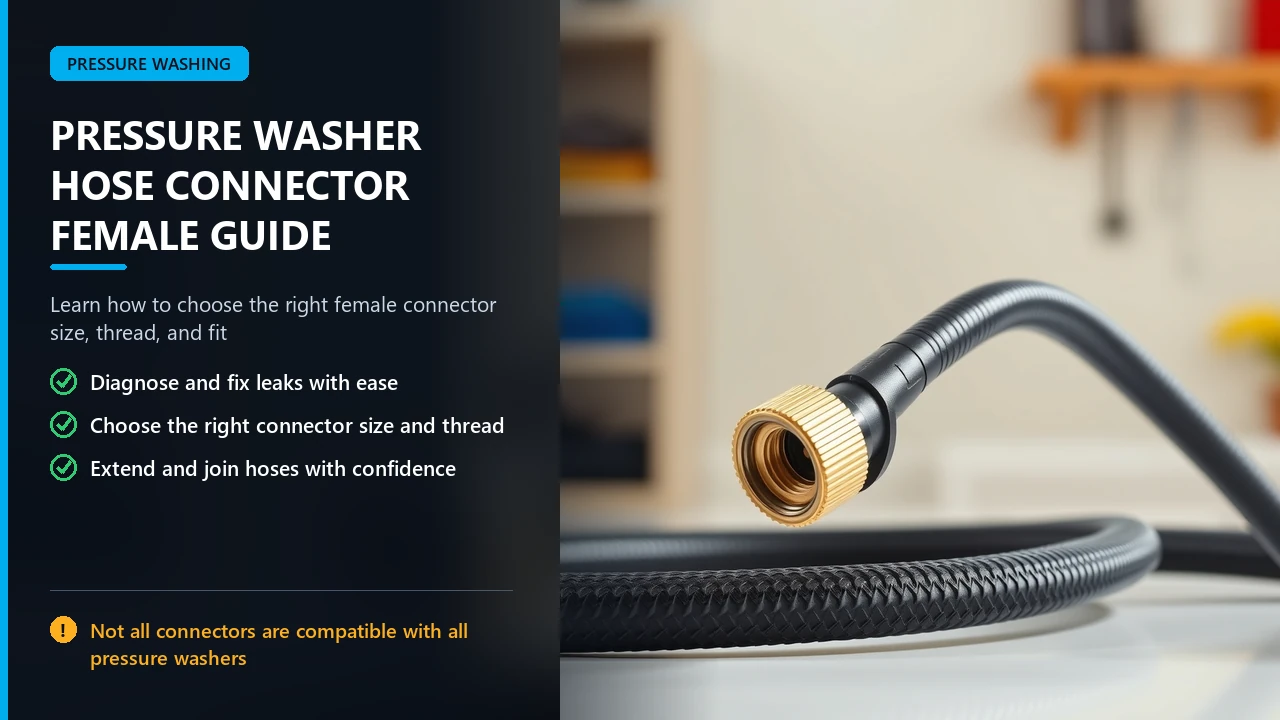
What a Female Hose Connector Actually Is
Every connection on a pressure washer joins a male part to a female part. Male fittings have external threads or a protruding plug; female fittings have internal threads or a recessed socket that accepts the male. Two male fittings cannot join, and neither can two female fittings – you always need one of each, which is why adapters exist.
On a pressure washer hose, the female connector is the end that receives a male fitting. Depending on the machine, the pressure washer hose connector female may sit at the machine end, at the gun end, or both. Hoses are sold with different combinations – male-to-female, female-to-female, or male-to-male – and getting this orientation wrong is one of the most common reasons a replacement hose will not fit. Before ordering, look at both the hose ends and the ports they must screw into, and note which is male and which is female.
Importantly, the female connector is the sealing half in most pressure washer designs. On threaded M22 connections, the female side contains the internal stem and O-ring that slide into the male bore to seal the joint. On quick-connect connections, the female socket holds both the O-ring and the locking ball bearings. When a connection leaks, the female side is usually where the problem lives.
The M22 Mystery: 14mm vs. 15mm
M22 is the dominant connector standard on residential and prosumer pressure washers. The name refers to the metric thread with a 22mm outer diameter. Because the outside threads are identical across M22 fittings, people assume all M22 connectors are interchangeable. They are not.
The difference is the inner diameter of the connection. M22 connectors come in two versions – M22 x 14mm and M22 x 15mm – where the number refers to the inner stem or bore size, not the outer thread. When the stem and bore match, the joint seals. When they do not, the parts still screw together but leak under pressure. A 14mm stem in a 14mm bore seals; a 14mm stem in a 15mm bore leaks; a 15mm stem will not even fit into a 14mm bore.
| M22 Version | Inner Diameter | Typical Machines | Common Brands |
|---|---|---|---|
| M22 x 14mm | 14mm stem and bore | Gas pressure washers and many electric units | Simpson, Generac, Briggs and Stratton, Craftsman, Karcher, Ryobi |
| M22 x 15mm | 15mm stem and bore | Select electric pressure washers | Sun Joe, AR Blue Clean, Stanley, MI-T-M, Campbell, Simoniz, Excell |
Historically, M22 x 15mm was more common on electric pressure washer outlets and spray guns, while M22 x 14mm became the standard on gas machines and much of the aftermarket. Because both are still in circulation, an adapter is frequently the fastest fix when your female connector and its mating male fitting come from different worlds. The threads will not tell you which you have – only the inner measurement will. Manufacturers such as AR Blue Clean confirm the same 14mm versus 15mm distinction in their own fitting guidance.
The Full Range of Connector Standards
M22 is not the only standard you will meet. Depending on whether your machine is a homeowner electric unit, a gas washer, or a commercial rig, the female connector on your hose may use one of several thread systems or a quick-connect socket. This table compares them by size, pressure rating, and sealing method.
| Connector Type | Size | Typical PSI Range | How It Seals | Where You See It |
|---|---|---|---|---|
| M22 x 14mm female | 22mm thread, 14mm bore | Up to about 3,200 PSI | Internal stem plus O-ring | Most gas and many electric machines |
| M22 x 15mm female | 22mm thread, 15mm bore | Up to about 3,200 PSI | Internal stem plus O-ring | Select electric machines |
| 1/4-inch NPT female | 1/4-inch tapered pipe | Up to about 3,000 PSI | Thread taper plus sealant | Pump outlets, light commercial |
| 3/8-inch NPT female | 3/8-inch tapered pipe | Up to about 4,000 PSI | Thread taper plus sealant | Commercial hose connections |
| 1/4-inch quick connect (socket) | 1/4-inch snap coupler | 2,000 to 4,000 PSI | Internal O-ring | Wands and nozzle connections |
| 3/8-inch quick connect (socket) | 3/8-inch snap coupler | 3,000 to 5,000 PSI | Internal O-ring | Hoses, pumps, and spray guns |
| Garden hose thread female | 3/4-inch GHT | Low pressure only | Rubber washer | Water inlet side only |
Two safety points fall out of this table. First, never use a garden hose fitting on the high-pressure side of the machine – it is built for inlet pressure only and will burst under a pump’s output. Second, match the pressure rating, not just the size: a fitting rated for 3,000 PSI does not belong on a 4,000 PSI machine, even if it threads on perfectly. Retailers such as Ferguson Home catalog the same connector families and stress that M22, 3/8-inch threaded, and quick-connect parts are not interchangeable.
Many of these standards and their compatibility rules are covered in more depth in our guide to pressure washer connectors and hose types, which pairs well with this section.
Female Quick-Connect Connectors
Quick-connect systems replace threads with a push-and-click joint, and the female half is called the socket or coupler. It contains the locking mechanism and the seal, so it deserves a closer look than most people give it.
A female quick-connect coupler has three working parts: a spring-loaded collar you pull back to release, a set of ball bearings that grip the male plug, and an internal O-ring that seals the joint. The male plug – sometimes called the plug or nipple – has a matching locking groove. Push the plug into the socket until the collar snaps forward over the ball bearings, and the connection is locked. The 3/8-inch size is the workhorse for hoses, pumps, and spray guns, while the 1/4-inch size handles wands and nozzle tips.
Quick connects are not universal across brands. The coupler body diameter and the locking geometry can vary between manufacturers, so a plug from one brand may not seat reliably in another brand’s socket. Distributors such as Kleen-Rite stock quick-connect couplers sorted by size, thread type, and pressure rating for exactly this reason. When in doubt, match the brand or bring the original fitting with you. Also note that quick connects seal internally and require no thread sealant – adding tape or paste to a quick connect does nothing useful and can disturb the O-ring seat.
For a full breakdown of how these joints work and why they save so much setup time, our article on pressure washer hose quick connect fittings is a useful companion.
How to Identify Your Female Connector Size
Because the outer threads of M22 fittings tell you nothing about the inner bore, identification requires a little care. Here is the practical order of operations.
- Check the manual or pump label. Many manufacturers state the fitting type outright, including the 14mm or 15mm designation. This is the fastest and most reliable route.
- Measure the inner bore with calipers. On the male fitting, measure the inner bore; on the female fitting, measure the stem. A 14mm bore is visibly narrower than a 15mm bore, but the difference is small enough that calipers are essential.
- Use the brand as a hint, then verify. Most gas units are M22 x 14mm, and certain electric brands (Sun Joe and AR Blue Clean among them) often run M22 x 15mm – but brands vary, so confirm before ordering.
- Measure the three key spots. Outside thread diameter, inner bore or stem, and the O-ring seat area. Do not round a 14mm measurement up to 15mm.
- Match the connection, not the hose. The hose’s own diameter says nothing about its fitting size. A 1/4-inch hose can carry an M22, a 3/8-inch threaded, or a quick-connect fitting at its ends.
If measuring is impractical, the safest move is to remove the existing female connector and take it to a supplier, or photograph both the connector and the port it attaches to. A one-millimeter mistake is all it takes to turn a leak-free joint into a constant drip.
Female Swivels and Why They Help
One specialized female connector earns a mention because it solves a problem every pressure washer user eventually faces: hose twist. A female swivel is a connector that rotates freely while staying sealed, letting the hose turn without kinking or fighting back as you walk around the job.
Without a swivel, the hose stores the twist you put into it every time you loop it around an obstacle, and that stored energy gradually kinks the hose and stresses the connectors. A swivel at the gun end lets the fitting turn instead, so the joint stays aligned and the hose stays relaxed. It is a small, inexpensive upgrade that meaningfully extends the life of both the hose and the connectors at its ends. Our guide to the flex hose upgrade that ends kinks and leaks explains the broader case for reducing strain on these joints.
Materials: Brass, Stainless, and Plastic
The material of a female connector matters as much as its size, because it decides how the part handles pressure, heat, chemicals, and time.
- Plastic belongs only on low-pressure electric units and inlet connections. It is fine for a garden hose inlet but will fail on the high-pressure side.
- Brass is the default for cold water residential and light commercial use. It threads cleanly, resists corrosion, and is affordable.
- Stainless steel is the choice for hot water, chemical injection, marine environments, and high-pressure industrial work. It costs more but lasts far longer under abuse.
One subtle trap with mixed metals: joining bare brass directly to stainless steel in the presence of water creates a galvanic couple that corrodes the brass and can seize the parts together. A rubber O-ring or a PTFE-taped joint between them breaks that electrical connection and prevents the problem. Whatever the material, always match the fitting’s rated pressure and temperature to the machine.
When the Female Connector Leaks
A leak at the female connector is nearly always one of four things, and you can work through them in order.
- A worn or missing O-ring. This is the most common cause by far. The O-ring is the part that actually seals the joint, and it cracks or flattens over time. Replace it before replacing anything else – it is a few cents versus a new hose or fitting.
- A 14mm versus 15mm mismatch. The parts screw together but the stem does not reach the bore, leaving a gap that weeps under pressure. The fix is a small M22 14mm-to-15mm adapter.
- Debris or damaged threads. Grit in the threads or a cross-threaded connection prevents a proper seal. Clean the threads and thread the parts by hand first, then tighten with a wrench – never force a fitting that feels tight before it is seated.
- A loose connection. Vibration can work a joint loose over time. Retighten it, and replace the fitting if the threads are already damaged.
To confirm a worn O-ring is the cause, our article on pressure washer gun O-rings that stop the leak walks through the same diagnostic logic at the gun end, where the failures look identical.
Pressure Washer Inlet vs. Outlet Connectors
People often confuse the two ends of the water path, so it helps to separate them clearly. They use completely different connectors and must never be mixed.
The water inlet is where the garden hose feeds the machine. It generally uses a garden hose thread (GHT) female connection, sometimes with a quick-connect or brand-specific inlet. This side sees only household water pressure, so a plastic or light brass GHT connector is perfectly adequate. It is also the side that often benefits from a filter screen to keep grit out of the pump.
The high-pressure outlet is where water leaves the pump for the hose and gun. This side operates at the machine’s full rated pressure, so it must use a high-pressure-rated connector – M22, NPT, or a quick connect rated for the machine’s PSI. Putting a garden hose fitting, a low-pressure plastic coupler, or an undersized part on the outlet side risks a burst connection and a dangerous whipping hose. Whenever you are unsure which side you are looking at, remember: inlet is low pressure and feeds the pump; outlet is full pressure and leaves it.
Female Connector Troubleshooting at a Glance
When something goes wrong with a female connector, the symptoms usually point straight to the cause. Use this table to diagnose the problem quickly before buying parts.
| Symptom | Most Likely Cause | Fix |
|---|---|---|
| Drip or mist at the joint under pressure | Worn, cracked, or missing O-ring | Replace the O-ring first |
| Steady leak that tightening will not stop | M22 14mm and 15mm mismatch | Add an M22 14mm-to-15mm adapter |
| Connector screws on but feels gritty or cross-threaded | Debris or damaged threads | Clean threads; replace if damaged |
| Leak returns after every use | Loose connection from vibration | Retighten; replace if threads are worn |
| Quick connect weeps or pops out | Plug not fully seated or worn O-ring | Reseat until it clicks; replace O-ring |
| No flow or weak flow at the gun | Fitting restricted or wrong inner size | Match the bore to the hose and machine |
Adapters That Solve Female Connector Mismatches
When the female connector on your hose simply will not match the port it needs to reach, an adapter bridges the gap without forcing you to buy a new hose or gun. These are the combinations worth knowing.
- M22 female to quick connect: converts a threaded hose end to a snap-on system, the most popular upgrade for faster setup.
- M22 male to 3/8-inch quick connect: adapts a threaded machine or gun to professional hoses.
- M22 14mm to 15mm reducer: the specific fix for the most common M22 mismatch.
- Female-to-female coupler: joins two male-ended hoses or accessories.
- Male-to-male coupler (nipple): joins two female hose ends to extend reach.
Our guide to pressure wash adapters and how to choose them maps out these combinations in more detail, and the M22 quick connect adapter guide focuses specifically on the threaded-to-quick-connect conversion.
Buying and Maintenance Tips
- Verify the thread and the inner size before buying – M22 alone is not a specification.
- Match the pressure rating to your machine, and prefer brass or stainless over plastic on the high-pressure side.
- Thread by hand first to avoid cross-threading, then snug with a wrench without overtightening.
- Do not use thread sealant on M22 or quick-connect fittings – they seal via O-ring or stem, and sealant only makes a mess.
- Depressurize before disconnecting anything, and confirm quick connects are fully seated before starting the pump.
- Inspect O-rings regularly and replace them at the first sign of hardening, cracking, or flattening.
- Keep spare O-rings and a known-good fitting on hand so a leak never ends your day.
Joining and Extending Hoses With Female Connectors
One of the most practical uses of understanding female connectors is extending your reach without buying a longer hose. Two hoses are joined by matching their ends with the right coupling, and the orientation of the female connectors decides which coupling you need.
If both hoses end in a female connector, you join them with a male-to-male coupler, often called a nipple – a short fitting with male threads on both ends that threads into each female end. This is the classic double-female hose extension setup. If both hoses end in a male fitting, you instead need a female-to-female coupler, sometimes called a union, which receives both male ends. Getting this backwards is why one of the two hoses inexplicably will not connect.
There is a subtle catch when adding length: every extra fitting and hose section adds a small pressure loss, and a very long hose can noticeably drop the pressure at the gun. Our guide to hose length and where pressure starts to drop explains how to extend reach without starving the nozzle. The practical rule is to use the largest practical hose inner diameter when extending, keep extra fittings to a minimum, and choose a coupling rated for your machine’s full pressure – a bargain coupler that fits is still a failure waiting to happen if it is underrated. Treat a pressure washer hose connector female as a rated component, not a generic plumbing part, and extensions will perform as well as the original hose.
Frequently Asked Questions
What is a female pressure washer hose connector?
It is the end of the hose with internal threads or a socket that receives a male fitting. On M22 connections it contains the internal stem and O-ring that seal the joint; on quick-connect systems it is the socket with the locking collar, ball bearings, and O-ring. A pressure washer hose connector female is the sealing half of the joint in most designs, which is why it is usually where a leak begins.
Are all M22 female fittings the same?
No. M22 fittings share a 22mm outer thread but come in two inner sizes, 14mm and 15mm. They look nearly identical and thread together, but only a matched stem and bore will seal. Always measure the inner bore or stem before buying a replacement.
How do I know if my pressure washer is 14mm or 15mm M22?
Check the manual or pump label first, since many state the size directly. If that is unavailable, measure the inner bore of a male fitting or the outer diameter of the female stem with calipers. Most gas machines are 14mm; some electric brands such as Sun Joe and AR Blue Clean are 15mm.
Can I connect a 14mm M22 hose to a 15mm M22 gun?
They will thread together, but they will not seal, and the connection will leak under pressure. Use a small M22 14mm-to-15mm adapter to bridge the two sizes properly.
Why is my female hose connector leaking?
Most often a worn or missing O-ring. Check that first, then look for a 14mm versus 15mm mismatch, debris or damaged threads, or a connection that has worked loose. Replace the O-ring before replacing the whole hose or fitting.
How do I stop a female connector from leaking under pressure?
Confirm the inner sizes match, inspect and replace the O-ring, clean any debris from the threads, and tighten by hand first before using a wrench. Never apply thread sealant to M22 or quick-connect fittings, as they seal by O-ring rather than by thread.
The Bottom Line
The female connector is the half of a pressure washer joint that carries the seal, and that is why it deserves more attention than the threads on the outside. Understanding male versus female, knowing that M22 comes in 14mm and 15mm versions, recognizing the quick-connect socket and its O-ring, and matching a fitting’s pressure rating to your machine will end almost every leak before it starts.
When buying a replacement pressure washer hose connector female, measure the inner bore, not just the thread; check whether the part is female or male; match the rating to your PSI; and keep spare O-rings within reach. Do that and the drip that once derailed your afternoon becomes a two-minute fix – or, better yet, never happens at all.