There is a particular kind of frustration that only pressure washer owners know. The machine runs perfectly, the nozzle sprays with full force, and yet a steady drip runs down the hose coupling, pooling in the grass and slowly soaking your shoe. You tighten the fitting, and it still leaks. You wrap it with thread tape, and it still leaks. Eventually someone points out the real culprit – a rubber ring the size of a pencil eraser that costs less than a dollar and has quietly dried out, cracked, or vanished altogether. That part is the pressure washer hose o’ring, and it is responsible for more pressure losses, more mystery leaks, and more wasted weekends than any other component in the entire system.
O-rings are the simplest possible solution to a hard engineering problem: how to seal a high-pressure water connection that must also come apart by hand. They are cheap, replaceable, and almost invisible, which is exactly why so many owners ignore them until something fails. Understanding what they do, where they live, which sizes fit which fittings, and how to replace them turns a recurring annoyance into a five-minute fix.
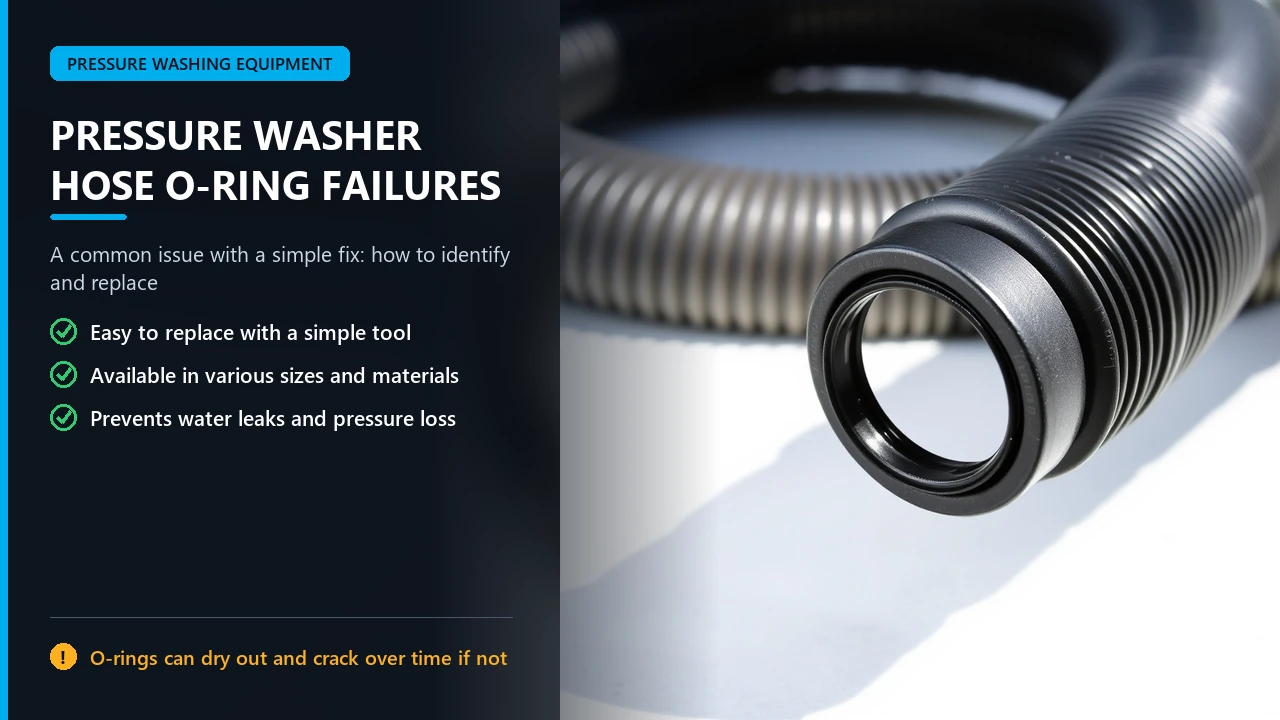
What an O-Ring Actually Does
Every high-pressure connection in a pressure washer has two jobs: hold mechanical pressure and prevent water from escaping. Metal threads handle the first job. The o-ring handles the second. When you connect a hose to a gun or a nozzle to a wand, the o-ring is squeezed between two flat or angled sealing surfaces. That compression forces the rubber to fill every microscopic gap, forming a watertight barrier that can hold thousands of pounds per square inch.
Remove the o-ring and no amount of tightening will stop the leak, because metal-to-metal contact is never perfectly smooth. Add a worn or wrong-sized o-ring and the same thing happens – the seal cannot fill the gap. This is why threading the connection tighter or wrapping it in tape so often fails: the problem is a missing or degraded seal, not a loose fit.
O-rings work because rubber is elastic. It deforms under pressure and springs back when the connection is released, which allows the fitting to be disconnected and reconnected countless times. That same elasticity is also the weakness – heat, chemicals, sunlight, and time all degrade rubber, and a degraded o-ring stops springing back.
Where O-Rings Hide in a Pressure Washer
Most owners know about one or two. In reality, o-rings sit at nearly every junction in the water path.
- Hose to gun connection – often the culprit for a leak near the trigger.
- Hose to pump outlet – where the high-pressure hose meets the machine.
- Wand to gun – at the quick-connect joint.
- Nozzle to wand – a tiny o-ring inside each quick-connect tip socket.
- Garden hose inlet – the filter washer with an o-ring that seals the supply connection.
- M22 fittings – threaded connections throughout the system, each with its own seal.
- Pump and unloader – internal o-rings that seal moving parts under pressure.
That is easily a dozen or more o-rings on a typical machine, each one a potential leak point. When a leak appears and tightening does not help, the diagnosis starts with locating the nearest o-ring to the drip.
O-Ring Sizes: The Numbers That Matter
O-rings are specified by three dimensions: inner diameter, outer diameter (or cross-section thickness), and the material. For pressure washers, a handful of standard sizes cover nearly every fitting.
| Connection Type | Typical O-Ring Size | Common Material | Notes |
|---|---|---|---|
| 1/4″ quick connect | About 8-9 mm ID | Buna-N (NBR) | Most common; found in nozzle sockets |
| 3/8″ quick connect | About 1/2″ ID | Buna-N or EPDM | Larger QC hose and gun fittings |
| M22 (14 mm) | About 14 mm | Buna-N | Standard threaded connection seal |
| M22 (15 mm) | About 15 mm | Buna-N or Viton | Special-sized; do not mix with 14 mm |
| Garden hose inlet | Filter washer with screen | Rubber / mesh | Seals supply and filters debris |
| Hot water / high-temp | Fitting-specific | Viton (FKM) | Withstands 300°F+ where Buna fails |
The critical warning is the M22 size split. M22 is a common threaded standard, but it comes in 14 mm and 15 mm seat variants, and they are not interchangeable. A 14 mm o-ring in a 15 mm seat leaks no matter how tight you turn the fitting, and the reverse also fails. Many people order "M22 o-rings" only to find they bought the wrong depth. Measure or check the machine’s manual before ordering.
O-rings also come in colors that hint at material, though it is not a strict standard. Yellow or tan rings are often 14 mm M22 seals, green or black rings are commonly 1/4-inch sizes, and blue rings are often 3/8-inch. Red rings frequently indicate the special 15 mm M22 size. Color is a convenience, not a guarantee – confirm dimensions rather than trusting appearance alone.
O-Ring Materials: Why Some Last Longer
The rubber compound matters as much as the size, especially in hot-water and chemical applications.
- Buna-N (NBR, Nitrile). The default for cold-water pressure washers. Resists water, oils, and moderate temperatures up to roughly 210°F. Affordable and widely available.
- EPDM. Excellent water and steam resistance, good for hot water and outdoor exposure. Slightly less oil-resistant than Buna.
- Viton (FKM, fluorocarbon). The premium choice for high temperature – rated to 300°F and beyond – and harsh chemicals. More expensive but essential for hot water pressure washers and aggressive detergents.
- Silicone. Very temperature-tolerant but swells in some oils. Rarely the best choice for pressure washer pumps.
For a cold-water home machine, Buna-N is fine and cheap. For a hot-water unit or one that runs degreasers, Viton pays for itself by not failing mid-job.
How to Identify a Failing O-Ring
O-rings rarely fail dramatically. They degrade slowly, and the symptoms are easy to misread as something else.
- Steady drip at a coupling. The classic sign. Water weeps from a joint that looks tight.
- Loss of pressure. Water escaping past a bad seal drops the pressure reaching the nozzle.
- Spraying from the side of a nozzle. A missing or deformed nozzle o-ring sends water sideways instead of forward.
- Difficulty building pressure. A leaking pump-side seal can prevent the system from reaching full pressure.
- Visible damage. A cracked, flattened, hardened, or swollen ring – or a groove left behind where the ring used to sit.
To check, disconnect the fitting and look. A healthy o-ring is soft, pliable, and sits proud in its groove. A failing one is hard, flattened, cracked, or gone. If the fitting was leaking and the ring is visibly worn, replacement is the answer. If the ring looks fine but still leaks, check the size and material against the fitting’s requirements.
Replacing an O-Ring: Step by Step
- Shut down and relieve pressure. Turn off the machine and water supply, then squeeze the trigger to bleed the line. Never work on a pressurized connection.
- Disconnect the leaking fitting. Separate the hose, wand, gun, or nozzle at the joint.
- Remove the old o-ring. Use a small pick, a flat screwdriver, or your fingernail. Inspect the groove for debris, grit, or damage.
- Clean the groove. Wipe out sand, mineral deposits, or old seal fragments. A clean groove is essential – trapped grit prevents the new ring from sealing.
- Match the new o-ring. Confirm size (diameter and thickness) and material for the connection and temperature.
- Lubricate lightly. A thin film of silicone grease or clean water helps the ring seat and prevents pinching during assembly.
- Install the ring evenly. Seat it flat in its groove. A twisted or pinched ring will leak.
- Reconnect and test. Tighten properly – snug, not gorilla-tight – and run the machine to confirm the leak is gone.
Resist the urge to overtighten. Compression fittings seal because the o-ring is compressed the right amount, not because the metal parts are mashed together. Over-tightening can damage the ring, deform the seat, or crack a fitting – turning a one-dollar fix into a replacement part.
O-Ring Kits vs Buying Individually
| Option | Best For | Pros | Cons |
|---|---|---|---|
| Assorted kit (multiple sizes) | Owners with several fittings and machines | Always have the size on hand; low cost per ring | Some sizes may go unused |
| Manufacturer-specific kit | One machine, exact fit guaranteed | Correct sizes and materials; fits perfectly | Costs more; only fits that model |
| Individual rings | A single known-size connection | Cheapest for one job | Requires knowing the exact size; slow to source |
| Nozzle o-ring multi-packs | Owners who lose nozzle rings often | Bulk quantity for the most common loss point | Only covers one size |
For most owners, a general assortment kit plus a bag of the specific nozzle o-ring is the practical answer. It covers the common sizes, guarantees you never lose a job to a missing ring, and costs less than a single service call.
Preventing Premature O-Ring Failure
- Keep connections clean. Sand and grit are the number one killer. A dirty groove shreds a new ring quickly.
- Do not overtighten. Snug is enough. Excessive force deforms the seal and the seat.
- Rinse after chemicals. Detergents and degreasers degrade rubber over time. A clean-water flush after every chemical job extends ring life.
- Store fittings protected. Dust caps and dry storage prevent grit and UV exposure.
- Match material to heat. Use Viton for hot water, EPDM or Buna for cold. The wrong compound fails early.
- Replace as a set. When one ring in a coupling fails, replace both sides if applicable, so you are not back next week.
Common O-Ring Mistakes
- Threading tape on a quick connect. Thread tape is for tapered threads, not for o-ring-sealed quick connects or M22 fittings. It does nothing and can make things worse.
- Wrong M22 size. Mixing 14 mm and 15 mm causes endless leaks. Confirm the seat depth before ordering.
- Wrong material for hot water. Buna rings on a hot water machine harden and leak quickly.
- Skipping the groove cleaning. Installing a new ring over grit guarantees a short life.
- Overtightening to stop a leak. If tightening does not fix it, the problem is the seal, not the torque.
- Ignoring the missing ring. A nozzle that sprays sideways usually just needs its ring replaced or reinstalled.
Frequently Asked Questions
What size is a pressure washer hose o-ring?
It depends on the connection. 1/4-inch quick connects typically use about an 8-9 mm inner diameter ring, 3/8-inch quick connects use roughly a 1/2-inch ID ring, and M22 fittings use a 14 mm or 15 mm ring depending on the seat. For hot water, specify a Viton ring. Measure or check the manual when unsure.
Why does my pressure washer hose keep leaking at the connection?
In almost every case, the o-ring is worn, missing, the wrong size, or the wrong material. Tightening will not help if the seal is compromised. Disconnect the fitting, inspect and clean the groove, and install a correctly sized, correctly rated o-ring.
Can I use thread tape instead of an o-ring?
No. Thread tape seals tapered pipe threads, not o-ring-sealed quick connects or M22 fittings. On those connections the o-ring does the sealing, and tape will not stop a leak caused by a bad ring. Use the correct o-ring instead.
How often should I replace pressure washer o-rings?
Replace them whenever they show wear – cracking, flattening, hardening, or swelling – or whenever a coupling leaks despite being properly assembled. As routine maintenance, replacing the nozzle and hose o-rings once a season keeps a machine leak-free and protects pressure.
Do hot water pressure washers need different o-rings?
Yes. High temperatures destroy standard Buna-N rings quickly. Hot water machines should use Viton (FKM) or EPDM rings rated for 300°F and above. Using cold-water rings on a hot-water unit leads to frequent failures.
What is the difference between 14 mm and 15 mm M22 o-rings?
They are different seat depths for the same M22 thread standard. A 14 mm ring will not seal a 15 mm seat and vice versa. This mismatch is one of the most common causes of persistent leaks at M22 connections, so confirm which your machine uses before buying.
The Bottom Line
The pressure washer hose o’ring is the smallest, cheapest, and most underappreciated part of the entire system. It is the reason a connection seals, and it is the reason a connection leaks when it fails. No amount of tightening or thread tape will substitute for a correct, clean, properly sized seal.
Learn where your o-rings live, keep a small assortment on hand, match material to temperature, and replace worn rings the moment a coupling drips. Do that, and the drip that used to ruin an afternoon becomes a two-minute fix – and your machine keeps delivering the full pressure it was built to produce.