Kim runs a small pressure washing route on weekends, mostly driveways and house washes. For two seasons she dragged a 100-foot hose through grass, over curbs, and around corners, and every single job started with ten minutes of untangling. Then a fellow contractor showed her a cart setup with a hose reel bolted to the frame. One pull and the hose came off clean. One crank and it went back. Her setup time dropped from ten minutes to one, and her hose – previously replaced every spring – was still going strong two years later. That is the practical case for a pressure washer hose with reel: less frustration, longer hose life, and a workspace that stops fighting you.
The combination of a high-pressure hose and a reel is not a luxury accessory. It is a system that protects your most commonly replaced component, speeds up every job, and removes the trip hazard that a coiled hose on concrete represents. Whether you buy a reel and hose together or build the pairing yourself, understanding the differences between options saves both money and rework.
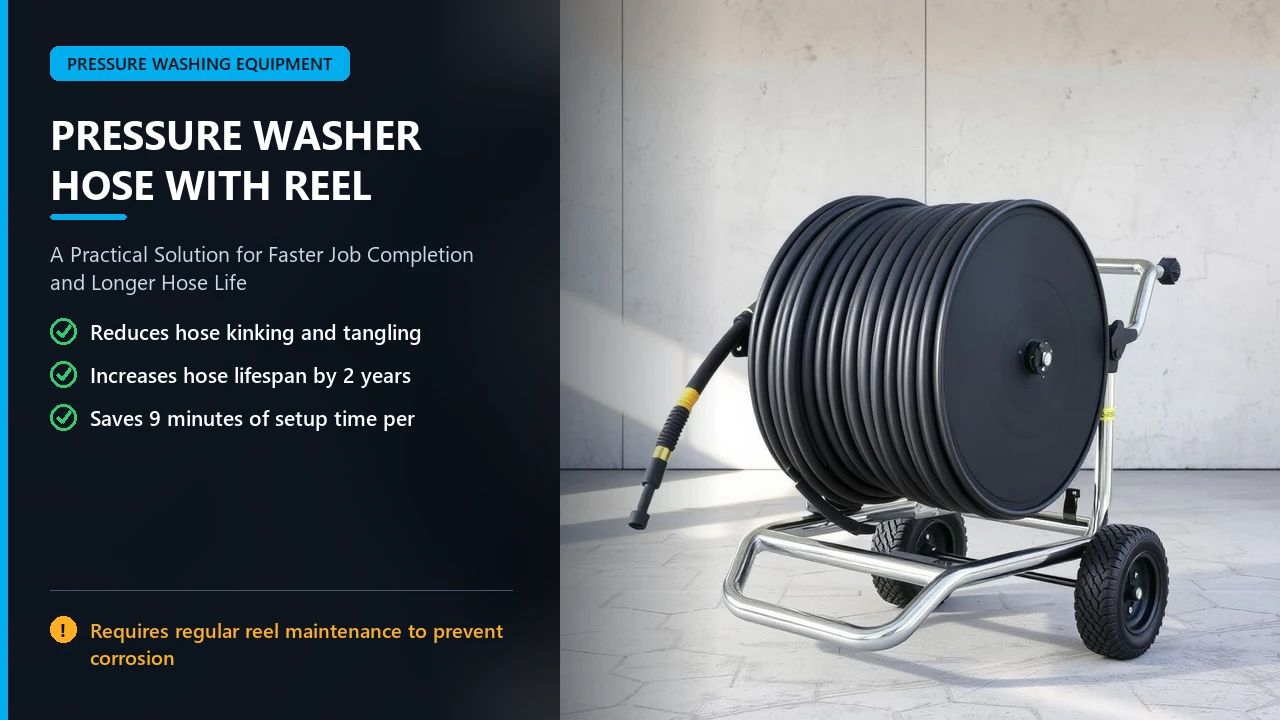
Why Pair a Hose With a Reel
A pressure washer hose is a wear item. The cover abrades against concrete, the inner braid fatigues from repeated tight coiling, and the fittings take stress every time you drag the hose around a corner. A reel changes how the hose is stored and deployed, and that changes how long it lasts.
- No more kinks. A reel guides the hose into smooth, consistent loops. Hand-coiling produces kinks and tight bends that pinch the inner core and permanently reduce flow.
- Protection from the ground. The hose sits on the reel instead of being dragged over pavement, gravel, and sharp lawn edges.
- Faster setup and teardown. Pull out what you need, work, retract. No untangling, no figure-eights in the driveway.
- Safer work area. Loose high-pressure hose is a fall hazard and can snag on vehicles and equipment. A reel keeps most of it off the ground.
- Better organization. On a trailer or cart, everything lives in one place, which matters when you are setting up at a customer’s property.
The time saved compounds. A job that previously cost ten minutes of hose wrangling at the start and ten more at the end saves roughly twenty minutes per visit. Across a season of weekly work, that is many hours returned.
Types of Hose Reels for Pressure Washers
| Reel Type | How It Operates | Best For | Typical Cost Level |
|---|---|---|---|
| Manual crank | Hand crank winds the hose | Homeowners, light duty, budget builds | Low |
| Spring-return (auto-rewind) | Internal spring retracts the hose | Frequent use, quick cleanup | Mid |
| Motorized / electric | Motor rewinds with a switch | Long hoses, commercial trailers, large fleets | High |
Manual crank reels are the simplest and the most reliable. Fewer moving parts means less to fail, and there is nothing to wear out beyond the bearing and the swivel. They are the correct choice for anyone who values dependability over convenience.
Spring-return reels add a spring mechanism that pulls the hose back when you release tension. Cleanup becomes a one-handed motion. The trade-off is a spring that can weaken over years and a mechanism that needs occasional adjustment – but for weekly users, the convenience is real.
Motorized reels wind long, heavy high-pressure hose with the press of a button. On a commercial truck mount pressure washer running a 200-foot hose that weighs over 40 pounds, hand winding is exhausting after several jobs. A motorized reel pays for itself in reduced labor and reduced injuries.
Hose and Reel: Matching the Pair
If you are buying the combination, the hose matters as much as the reel. The two must be sized together.
| Hose Spec | What It Means | Reel Consideration |
|---|---|---|
| Inner diameter (1/4″, 5/16″, 3/8″) | Water volume and pressure loss over length | Reel must fit the diameter so it does not crush the hose |
| Length (25-200 ft) | Reach from machine to work area | Reel capacity must match or exceed your length |
| Pressure rating (psi) | Maximum safe working pressure | Reel and swivel must be rated at or above this |
| Burst pressure | Failure threshold (usually 3-4x working pressure) | Confirms safety margin against pressure spikes |
| Style (braided, non-marking, wire-braid) | Durability and surface safety | Non-marking covers protect driveways and pool decks |
Two common mismatch problems stand out. First, buying a reel sized for a 50-foot hose and then trying to fit 100 feet on it – the drum overfills, the hose does not lay flat, and the swivel takes side load it was not designed for. Second, mounting a large reel with a small swivel: the pressure rating must come from the swivel, not the bracket.
Hose diameter affects pressure as well. A 1/4-inch hose loses more pressure over distance than a 3/8-inch hose at the same flow, because smaller diameter means more friction. For long runs of 100 feet or more, 3/8-inch is the standard choice, and many reel capacities are built around it.
Mounting: Where the Reel Lives
- Wall mount. Best for a fixed wash bay or garage, with the reel positioned close to where the hose exits toward the work area. Anchor into studs or steel – a full hose is heavy, and leverage increases as it unspools.
- Cart mount. Pairs with a portable washer for homeowners and light commercial work. Keeps everything together and rolls to the job.
- Trailer or skid mount. Standard on professional setups. Positioning the reel high and forward keeps the hose clear of the wheels and the operator’s path.
- Floor stand. Freestanding base for flexibility in a bay that has no good wall location.
Whichever mount you choose, plan the hose path so it runs in a straight line away from the reel. A reel positioned around a corner forces the hose to rub an edge every time it comes off, which wears the cover and eventually the reinforcement.
Installation and Setup
- Confirm ratings. Reel, swivel, and hose must all be rated above your washer’s maximum psi and matched to your gpm.
- Choose the mount location. Straight hose run, structural anchor points, and easy reach.
- Secure the reel firmly. Use lag bolts or machine screws into framing – never drywall anchors for a loaded hose reel.
- Connect the inlet. A short feeder hose runs from the reel’s inlet (usually a swivel or threaded port) back to the machine. Keep this run short.
- Feed the hose onto the drum evenly. Guide it on by hand the first few turns so it lays flat and does not cross over itself.
- Test under pressure. Run the machine and check every connection and the swivel for drips. Tighten or replace seals before trusting it on a job.
Maintenance That Keeps It Working
A hose reel is a simple device, but the swivel and the mechanism need attention to stay leak-free and smooth.
- Inspect the swivel monthly. Look for weeping at the rotating joint. Replace seals at the first sign of a drip – a small leak works its way into a pressure loss.
- Lubricate the crank or bearing. A drop of lubricant annually keeps a manual reel turning freely and prevents corrosion in the pivot.
- Clean the hose before winding. Mud and grit dragged onto the drum abrade the hose every time it moves. A quick rinse prevents it.
- Check for kinks and cover damage. Any cut, blister, or soft spot in the hose is a failure point under pressure. Replace the hose, not just the fitting.
- Winterize the reel too. Water trapped in the swivel freezes and cracks it. Run pump protector through and drain before freezing weather.
Common Mistakes to Avoid
- Overloading the drum. Forcing more hose length onto a reel than it is rated for damages the hose and stresses the swivel.
- Ignoring the swivel rating. The bracket often looks heavy-duty while the swivel is the actual pressure limit.
- Mounting into drywall. A loaded 100-foot hose is far heavier than it appears. It will pull anchors out.
- Winding under pressure. Retracting a live line wears the mechanism and can force a fitting loose.
- Running the hose around sharp corners. Every edge the hose rubs against shortens its life.
- Buying a reel with no replacement seal option. Reels with serviceable swivels last far longer than sealed throwaway designs.
Frequently Asked Questions
What kind of hose reel works with a pressure washer?
Any reel rated for high pressure – typically 3,000 to 5,000 psi depending on your machine – with a swivel and capacity matching your hose length and diameter. Garden hose reels are not built for pressure washer loads and will leak or burst. Confirm the psi rating and hose size before buying.
Can I use a 100-foot hose with a reel?
Yes, if the reel’s capacity supports it and the swivel is rated for the pressure. A 100-foot hose at 3/8-inch diameter is common for home and light commercial work. A reel sized for 50 feet will not hold it properly.
How do I stop the hose from kinking on the reel?
Feed it on evenly by hand the first few turns, avoid overlapping layers, and use a swivel at the inlet so the hose does not twist as it spools. Kink-resistant hose styles also help, but even the best hose kinks if wound carelessly.
Does a longer hose reduce pressure?
Yes. Friction inside the hose drops pressure over distance, and smaller diameters lose more. For long runs, choose a larger inner diameter like 3/8-inch and account for the drop at the nozzle.
Is a manual reel as good as an auto-rewind?
For dependability, often better – fewer parts means less to fail. Auto-rewind saves effort and is great for frequent use, but the spring can weaken. Choose manual for reliability on a budget, spring-return for convenience, and motorized for long commercial hoses.
Can I mix brands of hose and reel?
Usually, yes. What matters is matching thread type, pressure rating, hose diameter, and length. A brand-name reel will work with any properly sized hose as long as the inlet fittings can be adapted.
The Bottom Line
A pressure washer hose with reel is one of the highest-return upgrades in the whole cleaning kit. It protects the hose you would otherwise replace annually, removes a fall hazard from the work area, and cuts setup and teardown time on every job. Match the reel’s pressure rating, hose capacity, and swivel quality to your machine, mount it where the hose runs straight, and relieve pressure before you wind it up.
Manual reels deliver the most reliability per dollar, spring-return reels add convenience, and motorized reels handle commercial hose lengths that would exhaust a person by hand. Pick the one that fits how often you work, keep the swivel sealed and the bearing lubricated, and the reel will outlive several hoses it was bought to protect.