When a customer called me because his brand-new pressure washer was underperforming, I expected a pump problem. Instead, the trouble was at the inlet. He had connected it to a long, thin garden hose that could not deliver enough water, starving the machine of the flow it needed. Once he switched to a short, wide hose, the pressure washer came to life. The inlet, where water enters the machine, is the pressure washer’s lifeline, and an inadequate water supply at the inlet causes more performance problems than most owners realize. This guide explains the pressure washer inlet, the connection, the filter, the water supply requirements, and the common problems that begin at this critical point.
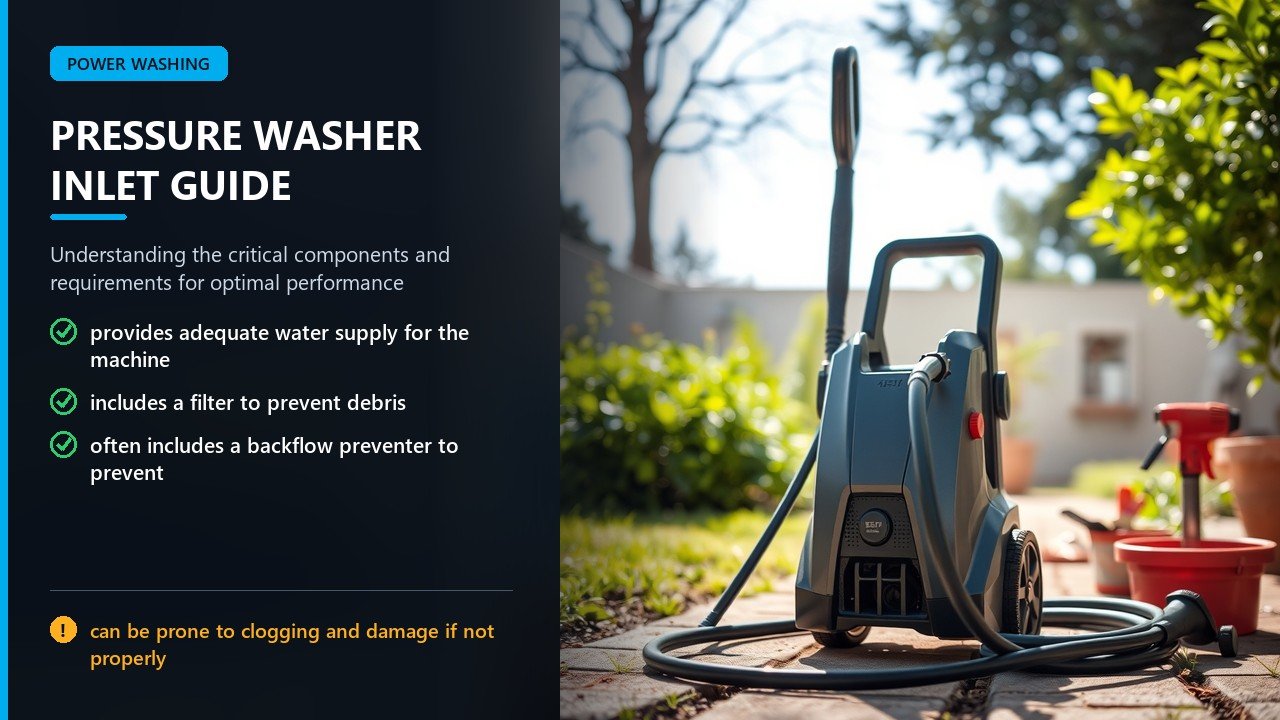
What the Pressure Washer Inlet Is
The inlet is the point where water enters the pressure washer, connecting the water supply to the pump. It is the beginning of the water path that ends at the nozzle, and everything the machine does depends on a proper supply entering here.
The inlet typically consists of a connection for the water supply, most often a threaded fitting sized for a garden hose, an inlet filter or screen to keep debris out of the pump, and often a quick-connect fitting for convenience. On some machines, the inlet also includes a backflow preventer to protect the water supply from contamination. The inlet feeds the pump, and the pump draws water through it, so the inlet must supply clean water at adequate flow and pressure for the pump to function as designed.
Because the inlet is where the machine meets the water supply, its quality and the adequacy of the supply determine the machine’s performance. A good inlet connection, a clean filter, and a sufficient supply let the pump draw the flow it needs, while a restricted or inadequate inlet starves the pump and ruins performance. Understanding the inlet, its components, and the water supply requirements helps owners avoid the common problems that begin here and keeps the machine working at its best. It is an unglamorous part of the machine, but the inlet is where many performance issues are born. Our guide to pressure washer components places the inlet in the context of the whole machine.
The Inlet Connection
The inlet connection is where the water supply hose attaches, and it uses a standard thread in most cases.
Most pressure washers have an inlet connection with garden hose thread, the familiar thread found on outdoor faucets, so a standard garden hose can connect directly. The connection may be a threaded fitting or a quick-connect fitting, with quick-connect allowing fast attachment and detachment. Some machines use different inlet threads and require adapters, particularly imported machines, and a threaded-to-quick-connect adapter can make connecting and disconnecting easier. The inlet connection must match the supply hose’s thread, or an adapter is needed, and the connection must seal to prevent leaks and air entry.
Air entering at the inlet is a problem, because the pump is not designed to pump air, and air leaks at a loose or poorly sealed inlet connection cause loss of prime and erratic performance. Ensuring the inlet connection is secure and sealed, with a good washer or o-ring where required, prevents this. The inlet connection also sees the full flow the machine demands, so it should be sized adequately and not restricted by narrow fittings or adapters that choke the supply. For convenience and reliability, many owners standardize the inlet on a quick-connect fitting, which simplifies connecting the supply. Our guide to pressure washer hose connector types explains inlet fitting options and matching. The connection is a simple part, but a poor one restricts flow or admits air, and both undermine the machine, which is why the inlet connection deserves attention.
The Inlet Filter
The inlet filter, also called the inlet screen or strainer, is a small mesh screen that traps debris before it reaches the pump.
Positioned at the inlet, the filter catches dirt, sand, rust, and other particles in the water supply, preventing them from entering the pump where they would damage seals, valves, and plungers. This simple, inexpensive screen is one of the most important protective parts on the machine, because particles that reach the pump accelerate wear and cause the pressure loss and leaks that shorten pump life. Even a clean-looking water supply can carry debris, especially from wells, aging pipes, or outdoor sources, so the filter serves a vital function on every machine.
The inlet filter needs regular attention. It should be cleaned periodically, more often when using dirty or questionable water, and replaced when worn or damaged. A clogged filter restricts flow, starving the pump and causing the very pressure loss that, ironically, prompts many owners to blame the pump, when the real problem is a dirty screen. Recognizing this, checking and cleaning the inlet filter should be part of routine maintenance, and it is one of the easiest ways to protect the pump and maintain performance. A damaged filter should be replaced immediately, since a torn screen lets debris pass through. Because the filter is cheap and its maintenance is quick, there is no reason to neglect it, and doing so is one of the most common causes of preventable pump damage and performance problems.
Water Supply Requirements
The inlet must receive enough water at adequate pressure for the machine to work, and understanding the requirements prevents most inlet problems.
Flow. The machine has a rated flow, expressed in gallons per minute, and the supply must deliver at least that much, with margin. A common rule is that the water supply should exceed the machine’s rated output by about twenty percent, so a machine that outputs 4 gallons per minute needs a supply that can deliver roughly 5. This margin ensures the pump always has enough water and does not starve under the dynamic conditions of operation. A supply that is exactly at the limit may falter, causing cavitation and performance loss.
Pressure. The supply needs adequate pressure to push water into the machine at the required rate. Most pressure washers are designed for a pressurized supply such as a city water faucet, and insufficient supply pressure reduces flow and starves the pump. Very high supply pressure is also undesirable, and some machines specify a maximum. The supply pressure, combined with the hose and fittings, determines whether the inlet receives enough flow.
Cleanliness. The supply should be reasonably clean, or at least the inlet filter should handle its debris. Dirty water sources require more frequent filter cleaning and possibly additional filtration.
Meeting these requirements, adequate flow with margin, adequate pressure, and clean water, ensures the inlet feeds the pump properly. Most inlet-related performance problems trace to a supply that fails one of these requirements, and understanding them helps owners diagnose and fix issues at the source. Our guide to a portable power washer with water tank covers supplying a machine from a tank when a faucet is unavailable.
Water Sources for the Inlet
Pressure washers can draw from several water sources, each with considerations.
City water faucet. The most common source, a household faucet provides pressurized water, usually adequate for most machines. The hose and fittings must be large enough to deliver the required flow without excessive pressure loss, which is why a long, thin hose can starve even a good supply.
Well water. A well can supply a pressure washer, but the well pump’s flow and pressure must meet the machine’s demand, and well water may carry more debris, demanding more frequent filter cleaning. Low-yield wells may not keep up with a high-flow machine.
Water tank. A tank supplies water for mobile or remote use, often with a transfer pump to feed the machine. Tank setups require careful sizing and a pump capable of the machine’s flow, and the inlet filter still matters.
Gravity feed. Some setups use gravity from an elevated tank, but gravity feed provides limited pressure and flow, so it suits only low-demand machines or requires a boost pump.
Other sources. Water from ponds, rain barrels, or recycled sources can feed a machine for certain tasks, but these sources are dirtier and demand robust filtration and may have regulatory considerations.
| Water Source | Considerations |
|---|---|
| City faucet | Pressurized, usually adequate; watch hose size and length |
| Well | Must meet flow and pressure; may carry more debris |
| Water tank | Mobile use; requires proper sizing and often a transfer pump |
| Gravity feed | Limited pressure; suits low demand or needs a boost pump |
Each source must ultimately deliver clean water at the machine’s required flow and pressure to the inlet. Choosing and setting up the source correctly, with adequate hose size, proper pressure, and good filtration, prevents the inlet starvation that causes poor performance. The source is the beginning of the water path, and a weak source undermines everything downstream. Our guide to pressure washer on trailer covers mobile setups where the inlet is fed from an onboard tank.
Backflow Prevention at the Inlet
Connecting a pressure washer to a potable water supply raises an important safety concern: backflow.
Without protection, water could flow backward from the pressure washer or its chemical system into the household water supply, potentially contaminating drinking water with cleaning chemicals or dirty water. A backflow preventer, often a vacuum breaker, is a device that prevents this reverse flow, protecting the water supply. Many pressure washers include a backflow preventer at or near the inlet, and where one is not built in, an external vacuum breaker should be used, especially when chemicals are involved. Some plumbing codes require backflow protection for hose connections, and using one is both a safety measure and, often, a legal requirement.
Backflow prevention is a genuinely important consideration, because the consequences of contamination are serious. A machine drawing chemical through its injector could, under the wrong conditions, allow that chemical to siphon back into the home’s water, which is why a backflow preventer or vacuum breaker is standard practice. It is a small, inexpensive device with a substantial safety role, and it belongs at the inlet. Owners should ensure their machine has backflow protection, and add one if it does not. Considering the safety and regulatory reasons, backflow prevention is not optional for machines connected to potable water, and it is one of the inlet’s most important responsibilities. Our guide to a diesel hot water pressure washer and other commercial machines notes that these are often connected to fixed water supplies where backflow protection is essential.
Common Inlet Problems
Because everything starts at the inlet, many performance issues originate here.
Insufficient flow. A hose that is too long, too narrow, or kinked restricts flow, starving the pump and causing pressure loss and cavitation. Use a short, large-diameter hose.
Low supply pressure. If the water supply pressure is too low, the machine cannot draw enough water. Check the supply and consider a tank or boost pump if inadequate.
Clogged inlet filter. A dirty screen restricts flow, causing pressure loss that mimics a pump problem. Clean or replace it.
Air leaks at the inlet connection. A loose or poorly sealed connection admits air, causing erratic performance and loss of prime. Check the connection and its seals.
Damaged inlet fitting. A cracked or cross-threaded fitting leaks or fails to seal. Replace it.
Debris reaching the pump. A missing or torn filter lets debris through, wearing the pump. Replace the filter.
Recognizing these problems and addressing them at the inlet often resolves performance issues that owners mistakenly attribute to the pump. The inlet is the first place to check when a machine loses pressure or performs erratically, because it is where the water supply begins and where restrictions or air most often arise. Our guide to a pressure washer repair kit covers the pump repairs that result when inlet problems are neglected. Checking the supply, the hose, the filter, and the connection, in that order, diagnoses most inlet issues quickly, and fixing them at the source restores the machine’s performance without touching the pump. This diagnostic instinct, to look at the inlet first, saves time and money and prevents unnecessary pump work.
Maintaining the Inlet
Simple maintenance keeps the inlet supplying the pump properly.
Check and clean the inlet filter regularly, more often with dirty water, and replace it when worn or damaged. Inspect the inlet connection and its seals for leaks or damage, and ensure it is secure and sealed to prevent air entry. Use an adequately sized, short supply hose to minimize pressure loss, and avoid kinks and restrictions. Confirm the water supply meets the machine’s flow and pressure requirements, and add a tank or boost pump if it does not. Ensure backflow protection is in place and functioning. During winterizing, drain the inlet and protect it from freezing, and inspect it at the start of the season.
These simple steps keep the inlet reliable and prevent the starvation and debris problems that originate here. Because the inlet is the machine’s water lifeline, its condition directly affects performance and pump life, and because inlet maintenance is easy and cheap, there is no reason to neglect it. A clean filter, a sealed connection, an adequate supply, and backflow protection cover the inlet’s essential needs, and attending to them protects the pump and ensures the machine performs as designed. The customer whose machine underperformed because of a restrictive hose learned that the inlet deserves as much attention as any part of the machine, and a little care here prevents a great deal of trouble downstream.
Priming Through the Inlet
Before starting the machine, the inlet and water path must be primed, meaning filled with water and free of air, because a pressure washer pump cannot draw or compress air.
To prime the machine, connect the water supply with the machine off and the spray gun open, and let water flow through the inlet, pump, hose, gun, and wand until it emerges steadily from the wand. This fills the system and pushes out air. Only then should the machine be started. Starting a pump that is dry or full of air causes it to run without proper lubrication and cooling, which damages it, and it also fails to build pressure. Priming is a simple step that many owners skip, to the pump’s detriment, and doing it properly protects the pump and ensures the machine builds pressure immediately.
The inlet is central to priming, because it is where the water enters and where air is expelled. If the inlet supply is weak or the connection admits air, priming becomes difficult or impossible, and the machine will perform poorly or not at all. Ensuring a strong, sealed supply at the inlet and opening the gun to bleed air completes priming reliably. After priming, keep the supply flowing adequately so the machine stays primed during operation, because a supply that falters can reintroduce air and starve the pump mid-job. This is why the inlet’s flow and sealing are so important: they keep the machine primed. A pump that seems weak or noisy may simply be air-starved from the inlet, and rechecking the supply, connection, and priming often resolves it. Treating priming as a standard step and ensuring the inlet supports it keeps the machine performing as designed. Our guide to pressure washer inlet water filter covers the protective element that also aids a clean, reliable inlet flow.
Setting Up the Inlet for Best Performance
A few setup choices at the inlet make a noticeable difference in performance.
Use a short, large-diameter supply hose rather than a long, thin one, since hose length and diameter determine how much pressure is lost before the water reaches the inlet. A short, wide hose delivers more flow at higher pressure to the machine, while a long, narrow one starves it. Keep the hose free of kinks and sharp bends, which restrict flow. Use full-flow fittings and avoid adapters that narrow the passage, since a restricted inlet limits the whole machine. Confirm the supply meets the flow requirement with margin, and add a tank or boost pump if the supply is marginal.
Ensure the inlet connection is sealed and secure to prevent air entry, and keep the inlet filter clean. Standardizing the inlet on a quick-connect fitting makes connecting the supply fast and consistent. For machines used from tanks, size the tank and any transfer pump to the machine’s flow, and ensure the feed to the inlet is unrestricted. For faucet supply, use a faucet with adequate flow and a hose sized to match. These setup choices ensure the inlet receives the water the pump demands, which is the foundation of strong performance.
Because the inlet is the start of the water path, getting it right sets up everything downstream for success. A machine with a perfect pump still underperforms if the inlet is starved, and a machine with a modest pump performs well if the inlet is generous. The inlet is therefore one of the most impactful places to optimize. Choosing the right hose, fittings, filter, and supply, and sealing the connection, delivers full performance and protects the pump from the starvation that causes damage. For any owner chasing better performance, the inlet is the first place to look, and optimizing it is usually the most rewarding fix. Our guide to pressure washer hose connector types helps match the inlet fittings for an unrestricted connection.
Frequently Asked Questions About the Pressure Washer Inlet
What is the pressure washer inlet? The inlet is where water enters the machine from the supply, typically a garden-hose-thread connection, with an inlet filter and often a backflow preventer. It feeds water to the pump.
How much water flow does a pressure washer need? The supply should exceed the machine’s rated flow, commonly by about twenty percent, so a 4 GPM machine needs roughly 5 GPM available. Insufficient flow starves the pump.
Why does my pressure washer lose pressure at the inlet? Common causes are a hose that is too long or narrow, low supply pressure, a clogged inlet filter, or an air leak at the connection. Check the supply, hose, filter, and connection.
Do I need a filter at the inlet? Yes, an inlet filter traps debris that would otherwise damage the pump. It should be cleaned regularly and replaced when worn or damaged.
Do I need a backflow preventer? When connecting to a potable water supply, yes, to prevent contamination of the water supply, especially when chemicals are used. Many machines include one, and codes often require it.
Can I run a pressure washer from a water tank? Yes, with a tank and often a transfer pump sized to the machine’s flow. Tank setups are common for mobile and remote use.
Final Verdict on the Pressure Washer Inlet
The pressure washer inlet is the machine’s water lifeline, and everything downstream depends on it receiving clean water at adequate flow and pressure. The inlet connection, the inlet filter, the water supply requirements, and backflow protection are the key elements, and problems here, insufficient flow, low pressure, a clogged filter, or an air leak, are among the most common causes of poor performance and pump damage.
Feed the inlet properly with an adequately sized hose and a sufficient, clean supply, keep the filter clean, seal the connection, and ensure backflow protection. When something goes wrong, check the inlet first, because it is where many issues begin and where the fixes are usually cheap and quick. The customer whose new machine underperformed because of a thin, long hose discovered that the inlet is not a trivial detail but a foundational one. Attend to it, and the machine runs at full strength; neglect it, and even a good pump cannot perform. The inlet is where great pressure washing starts.