Every pressure washer user knows the moment the wand is simply not enough, the gutter overhead, the sill tucked under a deck, or the underside of a trailer that a normal lance cannot kiss. The tool that rescues the moment is the pressure washer lance extension, a length of rigid pipe that slides the nozzle farther out and farther up the surface without sacrificing the control of a solid grip. It is the quiet workhorse between the gun and the nozzle, and choosing and using it well makes the difference between clean corners and a stiff back.
The story of the lance extension is the story of reach done right. A fixed four-foot section gives the operator the stretch to soffits and gutters, a telescopic pole reaches a second story, and a short elbow reaches around a hatch without a ladder, all while the machine’s pump stays silent on the ground. This guide covers what a lance extension is, the types that exist, how to match one to the machine, and the technique that keeps the new reach safe and productive.
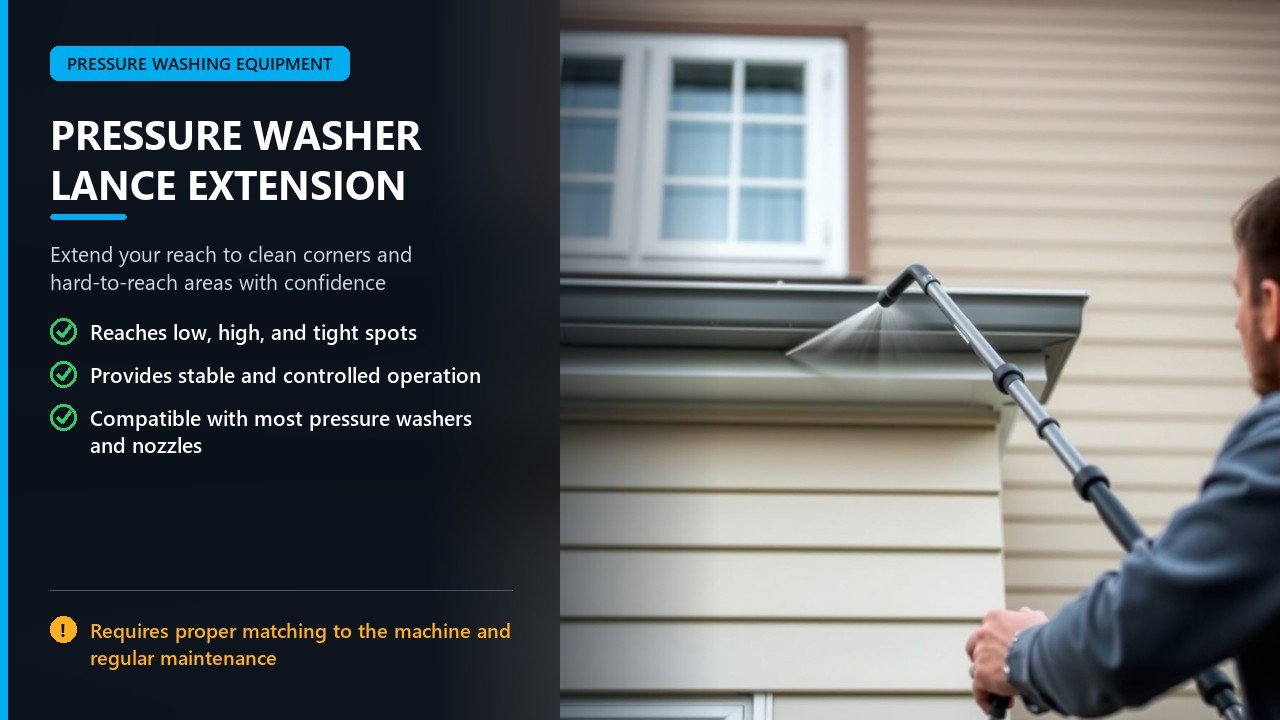
What a Lance Extension Is and What It Adds
A pressure washer lance extension is a rigid tube fitted with pressure washer fittings on both ends, one end connecting to the gun or the existing wand and the other carrying the quick-connect nozzle. Extensions come in fixed lengths, from short 18-inch stubs to four-foot sections that stack together, and in telescopic poles that reach many feet, and each does the same thing by the same mechanical trick, moving the nozzle farther from the operator while keeping the stream aimed and the grip grounded.
The rigid pipe earns its place over a flexible hose because it holds the spray’s direction. A hose flopping under pressure sways the nozzle and wastes the blast, while a stiff lance carries the stream straight, lets the operator brace the tip against the target, and gives the wrist a solid handle to steer the fan. That is why professionals keep a set of lance extensions for the high, low, and tight spots, and why the accessory feels like an arm extension once the user is used to it.
The added reach trades a little pressure for a lot of range. The extra pipe, the joints, and the longer path add friction and a little flow loss, softening the delivered pressure at the tip by a modest amount, which high work often welcomes. The trade is the same one every extender makes, analyzed in the extension guide on this site, and the operator budgets it by opening the nozzle angle or shortening the distance.
Fixed Sections Versus Telescopic Poles
Fixed lance extensions are simple, robust, and predictable. A two-foot or four-foot section of aluminum or stainless pipe with threaded or quick-connect collars bolts to the gun or to another section, building the exact reach the job needs, and the rigid stack carries force straight and holds its angle. Their weakness is in the carry, since a four-foot stack rides awkwardly, but on the job the fixed sections behave like a solid extension of the arm, which is why they dominate commercial wands and poles.
Telescopic poles collapse to a short travel length and extend with a twist or a lock, reaching many feet from a compact package, and they shine on the single-story work on siding, gutters, and soffits where a ladder should never be the tool. They give back some stiffness for the reach, so at full extension a telescope wiggles more than a fixed stack, and the wall-following technique below tames most of it. The telescopic wand guide covers the tall end of the category in detail.
Choosing between them follows the reach and the load. Jobs that repeatedly need a fixed, heavy-duty reach, fascia, conservatories, and high painted trim, favor the fixed stack; jobs that need portability and occasional height favor the telescopic pole. Many operators carry both, a fixed section for the everyday stretch and a telescopic pole for the tall extras, and the two together cover the whole reach envelope without a single ladder creak.
Matching the Extension to the Machine
The pressure rating is the first spec that must match. A lance built for 2,500 PSI does not belong on a 3,500 PSI machine, since a burst at the extended end sends hot spray and shrapnel toward the operator, so buy extensions rated at or above the machine’s PSI and inspect the collars before every high job. The rating, plus the fitting type, are the two non-negotiables, and the rest of the match is comfort and length.
The fittings decide whether the extension clicks into the existing kit. Most guns and wands take a 1/4-inch quick connect or a threaded M22, and the extension must wear the same connector at the gun end and a quick-connect seat at the nozzle end so the color-coded tips swap at the top without adapters. Measuring the gun’s connector before ordering avoids the adapter-stack wobble that wastes pressure and control, and a matched extension clicks straight in, the quick connect guide explains the family of fittings.
Length and balance close the fit. A reach tool should cover the job’s highest point with a little margin but not so much length that it becomes cumbersome on the ordinary work, and the added weight should feel steady in the hand rather than nose-heavy. Aluminum balances lightness against rigidity, stainless and steel add weight and durability, and the user who tests a length in hand before committing ends up with the tool that feels like part of the arm, which is the real test of a good match.
Reaching Low, High, and Around the Obstacles
Low work surprises new owners, and the lance extension earns its keep under decks, trailers, and skids. A short extension with a 40 degree fan reaches under a lip or through a gap, deflecting off the underside at an angle that rinses without blasting the laundering wood, and the rigid length keeps control where a hose would tangle. The same short sections curl around hatchbacks, inside wheel wells, and along fence bottoms, turning the awkward spots into regular passes.
High work is the extension’s headline. A four-foot fixed section reaches single-story soffits, fascia, and upper siding from a stable stance, and stacking sections or the telescopic pole climbs to a second story without the ladder that turns a wash into a balancing act. The technique is the same as the tall wand playbook, brace the tip lightly against the wall, work in even passes, and start from the bottom so the rinse runs over clean rather than dirty, and the reach does the rest.
The tight spots demand bending the rules of angle. Elbows and swivels built for the pressure class aim a nozzle around a corner or down a channel, and a 15 or 25 degree tip threaded through the opening cleans where no straight lance could point. The wand guide on the site maps the angled accessories, and the operator who pairs a short extension with the right elbow and tip turns every awkward corner into a finished one.
Technique for a Stable Extended Lance
A long lance in the hand behaves like a flag in the wind unless the technique steadies it. Grip the gun or the base of the extension with the support hand near the middle of the rig, brace the tip lightly against the surface being cleaned, and drive the movement from the shoulders rather than the fingertips, so the spray tracks a straight line instead of waving. The wall contact damps the flex, and the steady stance holds the fan where the surface needs it.
Pace and overlap keep the finish even. Move the nozzle in slow, overlapping rows at a distance that spreads the fan evenly, hold each pass the same length, and avoid the temptation to rush, because a long reach amplifies every twitch of the wrist into a sweeping arc on the wall. Starting low and working the fan up the structure keeps the run-off off the clean area, and a consistent rhythm produces a streak-free result at any height.
Stance and feet are the silent partners. Stand with the weight balanced and the base of the rig braced at the hip, plant the feet wide enough to counter the lever arm, and never crane the head back under a live stream, because rebound off a hard surface finds the face of anyone standing under the work. A hat brim and safety glasses keep the operator dry and clear, and the comfortable stance is what lets a full height of cleaning feel effortless rather than exhausting.
Safety Rules for the Extended Reach
Reach tools dodge most ladder work, but they impose their own rules. Never extend a live, pressurized lance vertically over the head and look up into it, never point the extended tip at a person, pet, or window across the yard, and never let the long lever swing where someone stands blind to it. The stream at the tip of a long lance still carries the machine’s full power, and the extra length multiplies the area a careless sweep can cover, so distance discipline rises with the reach.
The joints deserve the preflight. Check every collar, o-ring, and quick connect before a high job, because a loose coupler at 3,000 PSI unscrews and whips, and inspect the tube for cracks and bends that a truck or a garage bump could have made. The NIOSH hearing guidance and the machine’s own safety notes stand as the baseline, and the operator’s job is the same every shift, rated gear, inspected joints, and a clear perimeter, applied to the extended rig as to any part of the kit.
Finally, know when the extension is not the answer. On genuine two-story roofs, power lines overhead, or sloped ground with no stable stance, the ladder and even a professional scaffold become the correct tool, treated with their own discipline, and the operator falls back on the expert solution rather than overreaching a tool designed for reach, not for climbing. The lance extension is the right answer to a huge share of high work, and the honest operator uses it for exactly the jobs where it wins.
Accessories That Extend the Lance’s Range
The right add-ons multiply what a single lance extension can do. A swivel between the gun and the extension lets the operator rotate the rig without twisting the hose, and it kills the kink that steals pressure on a long pass, making it the highest-value add-on for any extended setup. A spring clamp or a wand clip holds the extension to the frame between uses, and a lugged nozzle guard protects the tip seat when the rig rides in the truck, each a small part that pays off on every deployment.
Angle adapters open the geometry. A rated elbow at the tip tips a nozzle down a gutter, around a corner, or under a sill where a straight pipe could never point, and the 15 and 25 degree families fit the standard quick connects, so the same tips swap between straight and angled runs. The angled nozzle guides on the site map the family, and the operator who carries one elbow turns the lance from a reach tool into a beam that follows the work.
Specialty tips round the kit. A rotating turbo tip at the end of an extended lance scrubs flat surfaces with the reach of the pipe and the aggression of the cone, and a foam or low-pressure tip soaks tall work from the ground. Each rides the same collar, so the extended rig never needs a separate inventory; the existing tip set, the extension, and the couplers cover the whole reach envelope, which is the quiet efficiency of a well-built pressure washer kit.
Buying Guide: What to Look For
Shopping for a lance extension comes down to four checks. The rating handles the machine, so the tube and its joints carry at least the machine’s PSI; the fittings match gun and nozzle seat in the same quick-connect family; the material, aluminum for balance, stainless steel for durability, suits the work; and the length covers the job without ballooning the flex. Any extension that fails one check fails the whole purchase, no matter the price.
The joint quality decides the daily life. Collars with a positive click that seat squarely and release cleanly beat loose, sloppy couplers that wobble under pressure, and threaded sections with clean, burr-free threads thread smoothly without stripping. Read reviews for the specific model’s flex and its fit on real machines, because a collar that rattles at the store ledge flexes embarrassingly when it holds a live nozzle at full length, and the honest owner decides on test and feel, not the sticker.
Accessories and warranty close the deal. A kit that includes a spare tip, a clip, and a collar wrenches ahead of the bare-bones stick, and a seller behind the product, warranty or a real return policy, stands out from the anonymous box. The price is the last consideration after the rating and the fit work, because a cheap extension that fails mid-job costs more than the difference in price ever saved, and the well-built tool stays the standard, checked once and relied on for years.
Maintenance and Storage of the Lance
A lance extension repays the same ten minutes the machine gets. Rinse the tube and the fittings after each job so detergent and grit do not dry into the collars, wipe the o-rings dry before storage, and collapse telescopic poles before they pick up grime between the sections. Check the tips at the seat, replace worn o-rings, and keep the whole set in a clean rack or a bag so the reaches ride to the next site without a nick.
The collars take the punishment of the extended lever arm, so they get the inspection. A bullet on a quick connect that clicks home is a collar that holds; a pop-out or a wobble is a collar bound for a mid-job blast, and the fix is a new spring or a replacement coupler, both cheap. Never tighten a threaded connection with the machine live, and never twist an extended pole at the joint, since the lever torque strains where the metal is thinnest.
Winter settles the storage debate. Drain any water from the tube, dry the sections, and store the set indoors where no freeze can split a collar, and the same dry habit that protects the pump in the winterizing guide protects the reach tool. A lance that rides clean, dry, and sorted is a lance that clicks into effect for years, which is the quiet reliability behind every tall, clean job it finishes.
Common Lance Extension Mistakes
The mistakes follow the physics of leverage. The first is over-length, buying a sixteen-foot pole for a one-story row and then fighting its flex, when a four-foot section would have been steadier and faster; match the reach to the work. The second is mismatched fittings, an adapter stack that wobbles pressure away and angles the spray, when a correctly threaded extension clicks home without a single stealth wand part. The third is pushing a lance past its rating, which is how collars burst over heads.
The fourth is crude aiming, firing the extended lance at screaming heights without a plan, banking off trim at odd angles and streaking the work; the fixed rows and overlapping passes technique fixes the finish. The fifth is storing the reach wet and forgotten, greeting the spring with a rusted joint and a split collar, when a dry rack would have preserved it. Each fix is a habit not a purchase, and together they keep the extended rig safe and productive season after season.
Finally, forgetting the reach’s limits. A lance extension reaches surfaces; it does not make ladders vanish from ever higher-roof, power-line, or slippery-slope work, and the operator who lets the tool overreach its class pays in rebound, strain, and the occasional paint mark. The discipline is the same as every pressure tool, choose the right length, respect the rating, and call in the expert solution when the tool’s reach ends.
Frequently Asked Questions
What is a pressure washer lance extension? It is a rigid tube fitted with pressure washer fittings that extends the wand’s reach, carrying a quick-connect nozzle at the far end and connecting to the gun or wand at the near end, used to clean high, low, and tight spots without ladders.
Will a lance extension reduce the pressure? Somewhat. The added pipe, joints, and path length add friction and a little flow loss, slightly softening the spray at the tip, which is usually a help for high, delicate work. Match the extension’s rating to the machine.
How long should my lance extension be? Match the length to your routine work. Short sections, 18 inches to four feet, handle low and tight reaches; a telescopic pole reaches a second story. Excess length adds flex and fatigue, so size to the job.
Does a lance extension fit my pressure washer? Check the gun connector, usually a 1/4-inch quick connect or threaded M22, and the nozzle seat at the tip. A matched extension clicks in without adapters, and the fitting and PSI rating must both match the machine.
How do I stop the extended lance from swaying? Grip the base with the support hand nearer the middle, brace the tip lightly against the surface, and drive the movement from the shoulders in steady rows. Stiffer sections and snug collars also reduce the whip.
Final Thoughts on the Pressure Washer Lance Extension
The pressure washer lance extension is the reach the machine never came with, a rigid, rated length of pipe that slides the nozzle to the soffits, the undersides, and the corners a normal wand cannot touch. It trades a little pressure for a lot of range, and when it is matched to the machine, used with a steady technique, and kept clean and dry, it earns its place in every serious kit. The ladder it replaces was never the tool for a spray job anyway.
Buy the length your work covers, match the rating and the fittings, and keep a fixed section and a telescopic pole to span the whole reach envelope. Brace, pace, and pass evenly, check the collars before the high jobs, and store the set dry through the winter. The result is a pressure washer that cleans from the ground to the second story, low under the deck and around the obstacles, and does it with the machine staying right where it belongs, on the ground, doing the work.