Grabbing the wrong nozzle is one of the fastest ways to either waste time or damage a surface. Too narrow and you can gouge wood or strip paint. Too wide and you’re still scrubbing an hour later. The right nozzle makes all the difference. That’s why every pressure washer owner needs a simple pressure washer nozzle guide to pick the perfect tip for every job.
A pressure washer nozzle guide helps you match spray angle and orifice size to the surface you’re cleaning. The standard color-coded tips (red 0°, yellow 15°, green 25°, white 40°, black soap) cover most jobs, but there’s more to know. This guide breaks down each nozzle type, when to use it, when to avoid it, how to size nozzles for your machine, and tips to get professional results safely.
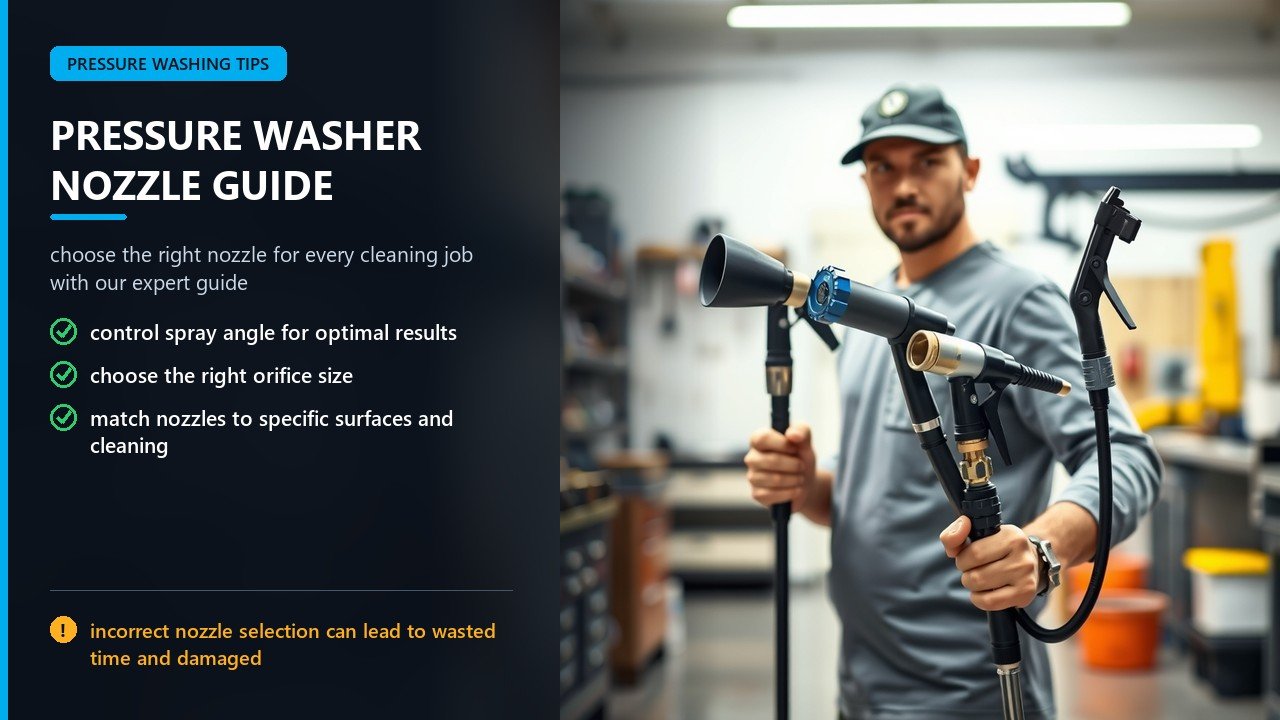
Why You Need a Pressure Washer Nozzle Guide
Spray angle controls impact. A 0° pencil jet concentrates all pressure into a tiny spot — great for concrete stains, terrible for siding. A 40° fan spreads pressure over a wide area — gentle enough for cars, but too weak for heavy grease. Using the right nozzle saves time, prevents damage, and helps your pump run efficiently.
Nozzles also control flow. Each orifice is sized for specific GPM/PSI. The wrong size can choke your pump or drop pressure too low. A good guide covers both angle and sizing.
The Standard Nozzle Color Code (Quick Reference)
Most pressure washers use 1/4″ quick-connect tips color-coded by spray angle:
| Color | Angle | Power | Best For | Avoid On |
|---|---|---|---|---|
| Red | 0° | Max | Concrete spots, rust, metal, heavy equipment | Wood, paint, siding, glass, vehicles |
| Yellow | 15° | High | Driveways, brick, concrete, stubborn grime | Soft wood, painted finishes |
| Green | 25° | Medium-High | Patios, walkways, fences, general cleaning | Very delicate surfaces |
| White | 40° | Gentle | Cars, siding, wood decks, windows, rinsing | Heavy embedded stains |
| Black | 65° (Low Pressure) | Lowest | Applying soap/detergent | Not for heavy cleaning/rinsing |
Spray Angles Explained
0° (Red): Pinpoint stream. Maximum impact, smallest coverage. Only for spot-cleaning hard, unpainted surfaces. Keep moving, never dwell.
15° (Yellow): Narrow fan, aggressive. Great for stripping hard grime off concrete/brick. Use cautiously on older masonry.
25° (Green): Balanced coverage and power. The go-to for most outdoor cleaning jobs.
40° (White): Wide, gentle fan. Safest for delicate surfaces and rinsing. Best starting point if unsure.
65°/Soap (Black): Very wide, low pressure. Designed for detergent application only.
Beyond Tips: Specialty Nozzles
A complete pressure washer nozzle guide includes specialty tips. Turbo (rotary) nozzles spin a 0° stream in a circle, combining impact with coverage — great for concrete, terrible for wood/paint. Surface cleaner nozzles aren’t hand tips but attachments (work on flat slabs). Foam cannons use a different orifice for thick suds. Some washers also use variable nozzles (adjustable spray), but fixed quick-connect tips give more consistent performance.
For most users, the 5-color set plus a turbo nozzle covers nearly everything.
Nozzle Orifice Size: Why It Matters
Color = angle. Orifice size = hole diameter (measured in thousandths of an inch), usually stamped as a number (e.g., 3.5, 4.0, 5.5). It determines GPM at a given PSI. Using too small an orifice restricts flow, overheats the pump. Too large drops pressure and cleaning power. Always match orifice size to your machine’s PSI and GPM per the manufacturer’s nozzle chart.
If your manual gives a recommended size, stick to it. Never guess — pump damage from incorrect sizing is expensive.
How to Size Nozzles Correctly
Find your pressure washer’s max PSI and GPM (on label/spec sheet). Use a nozzle sizing chart to pick the correct orifice for those numbers. For example, 3000 PSI @ 2.5 GPM often uses a #4.0 tip. All tips in a matched set for that machine share the same orifice size but different angles. If you buy replacements, buy a set matched to your specs.
Worn nozzles are a common issue — if pressure drops or spray pattern becomes uneven, replace the tips as a set.
Quick Job Selector
Use this pressure washer nozzle guide by surface:
| Cleaning Job | Recommended Nozzle | Notes |
|---|---|---|
| Cars, Trucks, RVs | White 40° | Keep 12–18″ away, avoid direct spray on trim seals |
| Concrete Driveway | Green 25°, Yellow 15° for spots | Surface cleaner best for large areas |
| Wood Deck | White 40° | Low pressure, sweep along grain, test first |
| Vinyl/Aluminum Siding | White 40° | Spray downward, never upward into seams |
| Brick/Stone | Green 25°, Yellow 15° | Test on old/mortar, avoid red 0° on loose joints |
| Heavy Equipment | Yellow 15°, Turbo | Red 0° only for pinpoint, hard metal |
| Apply Soap | Black Soap | Switch to rinse tip after dwell |
Safety Tips
Always start with the widest, gentlest nozzle (40°) when unsure. Test in an inconspicuous spot first. Never point nozzles at people, pets, or electrical outlets. Wear eye protection and closed-toe shoes. Keep the wand moving — don’t dwell with narrow jets. Engage gun safety lock before changing tips. Release pressure before swapping quick-connect nozzles.
Maintenance Tips
Rinse tips after each use to clear debris. Check for wear — a worn orifice sprays erratically and increases pressure/load. Replace tips as a matched set when worn. Store in a clean, dry holder to avoid loss/damage. Keep O-rings on quick-connects clean/lubed to prevent leaks.
Final Thoughts
This pressure washer nozzle guide keeps it simple: white for delicate, green for general, yellow for tough, red for spot-only, black for soap. Match orifice size to your GPM/PSI, start gentle, and test first. Do that, and you’ll clean faster, safer, and with far less risk of damage.