Pressure washer pipe fittings are the threaded connectors that join the parts of a pressure washer system, from the pump outlet to the hose, gun, and wand. Most leaks in a pressure system start at these joints, so understanding pipe fittings, thread types, and how to seal them properly is one of the most useful skills a pressure washer owner can have.
This guide covers the pipe fittings used on pressure washers, the threads and seals involved, and how to build a leak-free setup.
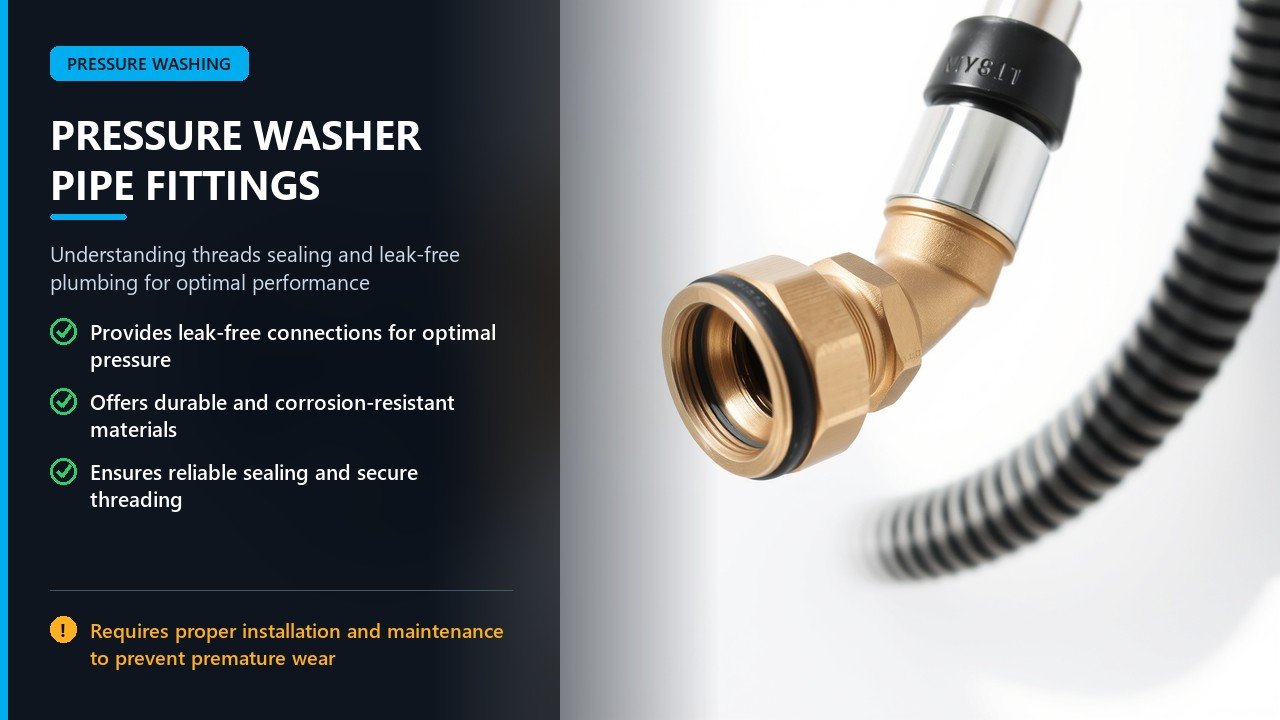
What Pipe Fittings Do
A pressure washer system is a chain of connections, and pipe fittings join each link. They connect the pump to the hose, the hose to the gun, the gun to the wand, and any accessories in between. Nipples, couplings, elbows, tees, reducers, and adapters are all pipe fittings, and each carries pressurised water, so each must be rated for the pressure and sealed correctly.
Because they carry the full pressure of the machine, pipe fittings on a pressure washer are not ordinary plumbing parts. They must withstand thousands of PSI, resist corrosion, and seal reliably. A fitting that is under-rated or poorly sealed will leak, weaken the pressure at the nozzle, and may fail under load.
The job of a pipe fitting is simple but critical: connect two parts with a joint that does not leak. When every fitting does this well, the machine delivers full pressure and stays dry. When one fails, it lets water out and pressure down, and the whole system suffers.
Thread Types and Sealing
Pressure washer fittings use a few thread types, and matching them is essential. NPT, the National Pipe Thread used in North America, is a tapered thread that seals on the threads themselves, assisted by thread sealant such as PTFE tape. Its tapered shape is what lets it seal as it tightens. BSPT is a similar tapered pipe thread used in many other countries, and it is close to but not identical to NPT, so they should not be mixed.
Other fittings use parallel threads with a sealing washer, or the M22 and quick-connect systems found on pressure washer hose and gun connections. These seal on an O-ring or washer, not on the threads, so they need the correct seal and, in most cases, no thread tape. Getting the sealing method right is what stops leaks.
The key rule is to seal each joint by its type. A tapered pipe thread seals with thread sealant. A joint that seals on an O-ring or washer needs a sound seal and no tape. Mixing these up, such as taping an O-ring joint or omitting tape on a tapered pipe thread, is a common cause of persistent leaks.
Pipe Fittings and Connection Fittings
It helps to separate two families of fittings on a pressure washer. Pipe fittings are the threaded plumbing parts, such as nipples, couplings, elbows, and reducers, that build the fixed runs and let you connect different threads or bring accessories into the line. They typically seal on tapered threads with sealant or on parallel threads with a washer.
Connection fittings are the quick joints between components: the M22 and quick-connect couplings that let you attach the hose to the pump, the gun to the hose, and the wand to the gun. These seal on an O-ring, not on threads, and are designed for frequent connecting and disconnecting.
The two families are used differently. Pipe fittings are semi-permanent, tightened once and left alone, while connection fittings are made to be removed and refitted often. Confusing the two leads to errors: thread-taping a quick-connect, or expecting an M22 coupling to seal like a pipe thread. Knowing which kind of fitting you are holding tells you how to treat it and how to stop it leaking.
Sizes and Materials
Pipe fitting sizes are stated by nominal pipe size and thread, such as one-quarter inch or three-eighths inch NPT, and the actual measurement can be confusing because nominal sizes do not match the outside diameter. The safe approach is to match the fitting to the thread it will join, testing it by hand first. If a fitting starts easily and tightens smoothly, the threads match; if it binds or wobbles, it likely does not.
Materials matter for pressure and corrosion. Brass is common and works well with water, resisting corrosion and sealing reliably, though it is softer. Stainless steel offers high strength and excellent corrosion resistance, suiting harsh conditions. Plated steel is widely used but can rust if the plating wears. For pressure washer use, brass and stainless are the usual quality choices.
Every fitting also carries a pressure rating, which must meet or exceed the machine’s output. A low-pressure fitting, such as one intended for domestic plumbing, is not suitable for a pressure washer and may burst. Always choose fittings rated for the system’s pressure, and favour quality brands, since a failed fitting under high pressure is a safety matter. When in doubt, choose the higher-rated part.
Common Pipe Fittings
The most common pipe fittings on a pressure washer are nipples and couplings, which join two threaded parts; elbows, which change direction; tees, which branch the flow; and reducers and adapters, which connect different sizes or thread types. Quick-connect and M22 fittings, though not traditional pipe fittings, perform a similar joiner role and are treated with the same care.
Adapters are worth special mention. They let you connect parts that would otherwise not fit, such as a machine with one thread type to a hose with another. Every adapter, however, is an extra joint and a potential leak, and stacking several is a recipe for trouble. Use the fewest, best-quality adapters you can, and avoid chains of them. Where you can, buy a hose or accessory with the right connection built in rather than adapting.
The table below summarises how to seal the main joint types.
| Joint Type | How to Seal |
|---|---|
| NPT / BSPT tapered pipe thread | Thread sealant tapes or paste; seals on the threads |
| Parallel thread with washer | Correct sealing washer, seated cleanly |
| M22 | O-ring; do not use thread tape |
| Quick-connect | O-ring; do not use thread tape |
Reading the joint type first, then sealing it the right way, prevents the leaks that plague pressure washer plumbing.
Building a Leak-Free Setup
Assemble fittings carefully. Clean the threads and check them for damage, then, on a tapered pipe thread, apply thread sealant tape or paste in the correct direction and tighten to a firm, snug fit without over-torquing, which can split a fitting or distort a thread. On O-ring joints, fit a sound, correctly sized seal, lubricate it lightly with water or a suitable lubricant, and hand-tighten, using a tool only to finish.
Test as you go. Pressurise the system and watch each joint you have made, then check again after a short run, because some leaks show only once the system warms or the pressure settles. Fix any weeping joint immediately rather than hoping it will seal itself, since a small leak under high pressure can grow quickly.
Avoid strain on fittings. A hose pulling on a fitting, or a heavy accessory hanging from a joint, can loosen it or crack the connection over time. Support the hose and any load, and route it so it does not put constant stress on a fitting. Mechanical strain loosens joints as surely as poor sealing does.
Troubleshooting Leaks
When a pipe fitting leaks, identify the joint and the sealing method first. A leaking tapered pipe thread usually needs fresh thread sealant tape or paste and a proper tighten. A leaking M22, quick-connect, or parallel joint usually needs a new O-ring or washer, not more tape. Applying the wrong fix wastes time and often makes the leak worse.
Check for the real cause, not just the symptom. A joint that keeps leaking may have a damaged thread, a cracked fitting, or the wrong thread type that never sealed properly. Compare NPT and BSPT carefully, since they look similar but do not seal together. If a fitting is cracked or its threads are stripped, replace it rather than fighting it.
Also watch for thread tape mistakes. Tape wound the wrong way unwinds as you tighten, and too much tape can crack a fitting or block a small passage. Keep tape off O-ring and quick-connect joints entirely, where it can dislodge and cause a leak rather than stop one. Correct sealing technique solves most pressure washer pipe-fitting leaks.
Frequently Asked Questions
What are pressure washer pipe fittings? The threaded connectors that join the parts of a pressure washer system, such as nipples, couplings, elbows, tees, reducers, and adapters, plus M22 and quick-connect joints. They carry full pressure and must be rated and sealed for it.
What thread types are used? NPT and BSPT are tapered pipe threads that seal on the threads with sealant. M22 and quick-connect joints seal on an O-ring. Parallel-thread fittings seal with a washer.
Can I use thread tape on every fitting? No. Use tape or paste only on tapered pipe threads. M22 and quick-connect joints seal on an O-ring and should not be taped.
How do I match fitting sizes? Match the fitting to the thread it joins and test by hand. If it starts easily and tightens smoothly, it fits. Nominal sizes can be misleading, so confirm the actual thread.
What material is best? Brass and stainless steel are the usual quality choices. Brass seals well and resists corrosion; stainless adds strength and corrosion resistance for harsh conditions. Match the pressure rating too.
Why does my fitting keep leaking? Often the wrong sealing method, a worn O-ring, a damaged thread, or a mismatched thread type. Use the correct seal for the joint and replace cracked or stripped fittings.
Are cheap fittings safe? Only if rated for the system’s pressure. Under-rated or poor-quality fittings can burst under high pressure, which is a real safety risk. Buy rated, quality fittings.
How do I stop leaks at a new joint? Seal by type, tighten snugly without over-torquing, support the hose to avoid strain, and test under pressure. Fix any weep before relying on the system.
Final Thoughts
Pressure washer pipe fittings are small parts with a big job. They carry the machine’s full pressure and are where most leaks begin, so matching the thread type, size, material, and pressure rating, and sealing each joint by its design, is what keeps a system dry and strong.
Use tape or paste on tapered pipe threads and the correct O-ring or washer on the rest, never mixing the two methods. Tighten snugly, avoid over-torquing and strain, and test every joint under pressure. Use the fewest adapters you can and buy quality, rated fittings. Done right, your pressure washer plumbing stays leak-free and delivers full cleaning power. For related reading, see our guides on power washing fittings and pressure washer connections.