Water is the lifeblood of a pressure washer pump — and its greatest enemy. Left sitting in the pump through winter, water freezes, expands, and cracks the housing. That is exactly the problem pressure washer pump protector fluid is designed to solve.
This guide explains what pump protector fluid is, how it works, when to use it, how it compares to antifreeze alternatives, and the step-by-step winterizing routine that keeps a pump alive season after season.
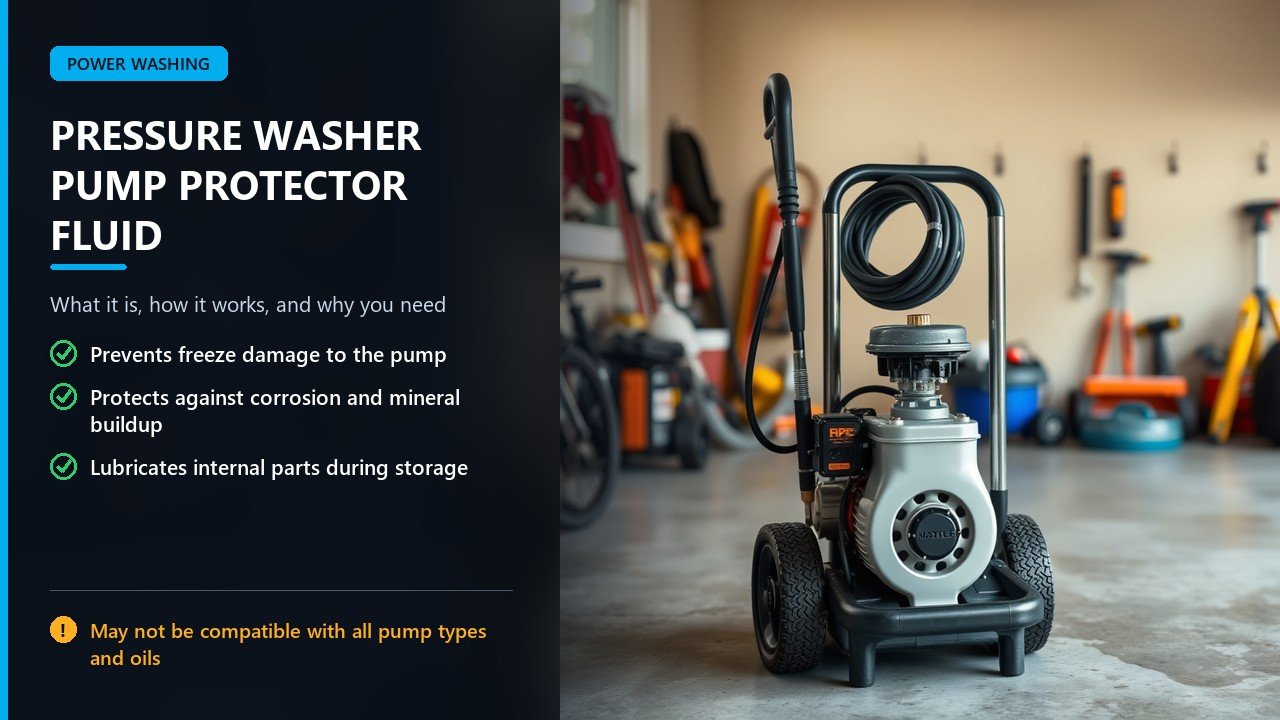
What Pump Protector Fluid Is
Pressure washer pump protector fluid is a specially formulated liquid pumped through the pump at the end of the season to displace water, prevent freezing, and lubricate internal parts during storage.
- Freeze protection — prevents water from expanding and cracking the pump.
- Corrosion protection — coats metal parts against rust.
- Lubrication — keeps seals and valves supple during storage.
- Scale inhibition — helps prevent mineral deposits.
- Easy prep — no draining or disassembly required.
Quick Note: Pump protector fluid is used for storage, not as a running lubricant. It is a winterizing and preservative product, not an additive for daily use.
Why Pumps Need Protection
| Risk | Consequence |
|---|---|
| Freezing water | Cracks the pump, manifold, and lines |
| Standing water | Corrosion of valves and internal metal |
| Dried seals | Brittle seals leak on the next start |
| Mineral scale | Hard water deposits restrict flow |
Short Note: Freeze damage is the leading cause of avoidable pump death. A few dollars of protector fluid prevents a pump replacement that costs far more.
How It Works
| Step | What Happens |
|---|---|
| Introduce fluid | Pull it into the pump inlet |
| Displace water | Fluid pushes water out of the pump |
| Coat internals | Leaves a protective film on parts |
| Store safely | Remaining fluid resists freezing |
The fluid replaces the water inside the pump with a solution that resists freezing and corrosion, protecting the pump over the off-season.
When to Use It
| Situation | Use Protector? |
|---|---|
| Winter storage | Yes — essential |
| Long-term storage | Yes — recommended |
| Freezing climate | Yes — before first frost |
| Mild climate, frequent use | Optional, still good practice |
| Daily use in warm weather | Not needed; drain instead |
Note: If there is any chance of freezing, protect the pump. The cost of fluid is trivial next to the cost of a cracked pump.
Pump Protector vs Antifreeze
| Product | Safe for Pumps? |
|---|---|
| Pump protector fluid | Yes — purpose-made |
| RV / marine antifreeze | Often yes — non-toxic, pump-safe |
| Automotive antifreeze | No — toxic and damaging |
| Windshield washer fluid | No — not for pumps |
Warning: Never use automotive antifreeze, even in a washer. It is toxic, harms pump seals, and contaminates surfaces you clean.
How to Use Pump Protector Fluid
| Step | Action |
|---|---|
| 1. Gather materials | Protector fluid, funnel, short hose |
| 2. Disconnect water | Remove the garden hose from the inlet |
| 3. Drain gun and hose | Empty the high-pressure line |
| 4. Set up a siphon | Short hose from fluid jug to the inlet |
| 5. Start and pull fluid | Run briefly until fluid exits the outlet |
| 6. Stop and store | Shut down and store the machine |
Note: Run the engine only long enough to draw fluid through. Do not run the pump dry after the fluid is pulled.
Using a Pump Protector Bottle
| Tool | Benefit |
|---|---|
| Siphon bottle | Feeds fluid directly to the inlet |
| Short hose | Connects bottle to the garden-hose port |
| Inline valve | Controls flow while you work |
A siphon bottle with a short hose is the cleanest way to feed protector fluid. Many kits include exactly this setup.
How Much Fluid to Use
| Machine | Typical Amount |
|---|---|
| Small electric washer | A few ounces |
| Gas washer | About 4–8 ounces |
| Large / commercial | More, per pump size |
Short Note: You do not need to fill the entire pump with fluid. Enough to displace the water and coat the internals is enough.
Signs You Skipped Winterizing
| Symptom | Likely Cause |
|---|---|
| Water leaking from the pump | Cracked housing from freezing |
| No pressure after storage | Damaged valves or seals |
| Water in the pump oil | Cracked seal area |
| Leaks from multiple points | Widespread freeze damage |
If a pump leaks or loses pressure right after winter, freeze damage is the first suspect. Prevention with protector fluid would have avoided it.
Beyond Winterizing: Getting Ready to Store
- Run clean water through the system to flush detergent.
- Drain the gun and hose completely.
- Pull protector fluid through the pump.
- Change pump oil if due.
- Store the machine above freezing if possible.
- Cover the unit to keep out dust and debris.
- Label the date so next season’s prep is timely.
Winterizing is more than fluid. Flushing detergent, draining lines, and changing oil all extend the pump’s life.
Pump Protector vs Draining
| Method | Effectiveness |
|---|---|
| Drain only | Water can remain in low spots; risk of freeze |
| Blow out with air | Better; still misses some pockets |
| Protector fluid | Displaces water and protects internals |
| Fluid + indoor storage | Best protection available |
Protector fluid beats draining alone because it reaches the places water hides and leaves a protective film behind.
Where Freeze Damage Happens
| Part | Risk |
|---|---|
| Pump manifold | Cracks from trapped water |
| Valves | Ice can distort or crack seats |
| High-pressure hose | Fittings and lining can split |
| Gun and lance | Trapped water cracks the valve body |
| Chemical injector | Small passages crack easily |
Freeze damage is rarely limited to the pump. Treating the whole system — hose, gun, and pump — prevents multiple failures.
Choosing a Protector Fluid
- Purpose-made — buy pressure-washer pump protector, not a generic fluid.
- Non-toxic — safe if traces reach a cleaned surface.
- Rated for the temperature in your storage area.
- Pump-safe formula — protects seals, not just water.
- Reputable brand — consistent formulation.
- Right quantity — enough for one or two winterizings.
Short Note: Purpose-made protector fluid is inexpensive and widely available. Matching it to a pump-safe, non-toxic product is the main choice to make.
Common Mistakes to Avoid
- Using automotive antifreeze. Toxic and harmful to seals.
- Skipping winterizing in freezing climates. Guaranteed risk.
- Leaving water in the hose and gun. They crack too.
- Not flushing detergent first. Residue can dry and clog.
- Running the pump dry after adding fluid. Defeats the purpose.
- Forgetting to change pump oil. Old oil harms the pump.
- Storing wet in a freezing garage. Defeats the protection.
Safety Notes
- Read the fluid label and follow the maker’s instructions.
- Keep fluids away from children and pets.
- Do not mix protector fluid with incompatible products.
- Dispose of used fluid according to local rules.
- Disconnect the engine before working on the pump.
- Dispose of contaminated rinse water responsibly.
For general environmental and safety context, see the U.S. Environmental Protection Agency and the U.S. Consumer Product Safety Commission.
Storing the Machine Properly
- Indoor or above-freezing storage is ideal.
- Cover the unit to keep dust out.
- Store the hose coiled and drained.
- Keep the gun and lance dry and indoors.
- Note the date of winterizing.
- Check oil before the next first start.
Good storage is the second half of pump protection. Even with protector fluid, a dry, covered, above-freezing location is best.
The Full Winterizing Routine
Pump protector fluid is one step in a routine. Doing all of it takes minutes and prevents the freeze and corrosion damage that ends pumps.
| Order | Task |
|---|---|
| 1 | Flush detergent with clean water |
| 2 | Drain the gun, wand, and hose |
| 3 | Change or top off pump oil |
| 4 | Draw protector fluid through the pump |
| 5 | Store above freezing and cover |
Note: Flushing detergent first prevents it from drying and gumming the valves while the machine sits.
Signs You Used the Wrong Product
| Symptom | Likely Cause |
|---|---|
| Swollen or brittle seals | Automotive antifreeze damage |
| Persistent residue in the pump | Wrong fluid left behind |
| Foul smell or contamination | Toxic antifreeze used |
| Loss of pressure after flush | Internal damage from the wrong fluid |
If you realize the wrong product was used, flush the pump thoroughly with clean water and, if seals are damaged, plan a rebuild or replacement.
Protector Fluid and Pump Oil
| Fluid | Purpose |
|---|---|
| Pump protector | Water-side protection for storage |
| Pump oil | Crankcase lubrication during operation |
| Detergent | Cleaning chemical, not a protectant |
Short Note: Protector fluid and pump oil do different jobs. One protects the water side during storage; the other lubricates the crankcase while running. You need both.
Choosing Between Sizes and Kits
| Option | Best For |
|---|---|
| Single-use bottle | One machine, one winter |
| Quart or gallon | Multiple machines or seasons |
| Siphon kit | Cleaner, easier application |
| Antifreeze combo kit | Value for regular winterizing |
If you winterize every year, buying a larger container or a kit with a siphon bottle saves money and mess.
Storing Around Other Equipment
- Keep protector fluid sealed and out of reach of children and pets.
- Store the machine dry and covered.
- Avoid storing next to engines that may leak oil or fuel.
- Keep hoses coiled and off damp floors.
- Label the fluid so no one mistakes it for a beverage or antifreeze.
- Dispose of used fluid at a proper facility.
Safe storage protects both the machine and the people who share the space.
Spring Startup After Storage
| Step | Action |
|---|---|
| 1. Check pump oil | Top up or change if needed |
| 2. Inspect seals and fittings | Look for leaks or cracks |
| 3. Flush the protector fluid | Run clean water through the pump |
| 4. Connect water and bleed | Gun open until flow is steady |
| 5. Start and test | Check pressure and look for leaks |
Note: Flush the protector fluid out before normal use, and recycle or dispose of it responsibly. It is not a cleaning additive.
Compatible Products and Substitutes
| Product | Verdict |
|---|---|
| Dedicated pump protector | Best choice |
| Non-toxic RV antifreeze | Acceptable pump-safe substitute |
| Automotive antifreeze | Avoid — toxic and harmful |
| Washer fluid | Avoid — not for pumps |
| Plain water | No protection; freezes |
When in doubt, use a purpose-made protector. The cost is small and the risk of the wrong product is a ruined pump or a contaminating spill.
Cost and Value
| Item | Typical Cost |
|---|---|
| Protector fluid (pint/quart) | $6–$20 |
| Siphon bottle kit | $8–$25 |
| Replacement pump (if frozen) | $60–$350 |
The math is simple. A few dollars of fluid prevents a repair that costs many times more — which is why pump protector pays for itself many times over.
Frequently Asked Questions
What is pressure washer pump protector fluid? A storage fluid that displaces water, prevents freezing, and protects pump internals from corrosion between seasons.
Do I really need pump protector fluid? In freezing climates, yes. It prevents the freeze damage that is the leading cause of avoidable pump failure.
Can I use antifreeze instead? Use only non-toxic, pump-safe RV or marine antifreeze. Never use automotive antifreeze, which is toxic and harms seals.
How often should I use it? At least once a year before winter, and any time the machine will be stored for a long period.
How much fluid do I use? Just enough to draw it through the pump and displace water — typically a few ounces to about half a pint.
Is protector fluid safe for the surfaces I clean? Pump-safe protectors are non-toxic, but flush the fluid out before normal use and dispose of it properly.
Final Thoughts
Pressure washer pump protector fluid is a small, inexpensive product that prevents one of the most common and costly pump failures: freeze damage. It displaces water, lubricates internals, and protects metal from corrosion during storage.
Use it every winter, avoid automotive antifreeze, flush it out before spring, and combine it with good storage and oil maintenance. For related reading, see our guides on the pressure washer pump 3000 psi and the 3500 PSI pressure washer pump.