A pressure washer soap tank is the reservoir that holds detergent or cleaning chemical and feeds it into the water stream so the machine can apply soap as you work. It turns a pressure washer from a plain water blaster into a cleaning system that can pre-treat grime, lift dirt chemically, and rinse, which is far more effective than water alone on many surfaces.
This guide explains what a soap tank is, how it feeds soap into the water, and how to use one for the best results.
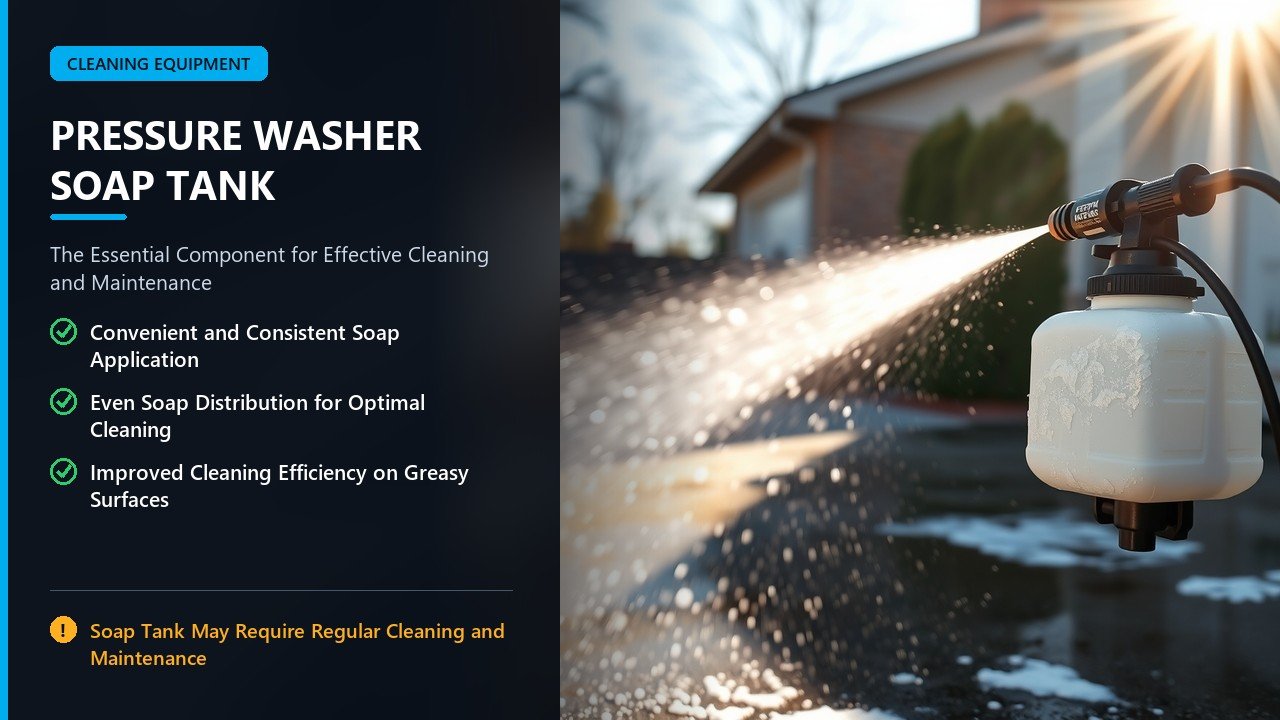
What a Soap Tank Is
A soap tank is a container for the cleaning solution the pressure washer applies. On many machines it is built into the unit, with a small tank or bottle that holds detergent; on others it is an external tank or bottle connected to the machine. Some setups use a separate downstream injector with a hose that draws from a jug or drum instead of an onboard tank.
Whatever its form, the soap tank holds the diluted chemical ready for the machine to draw on. You fill it with detergent mixed to the right strength, and the machine meters it into the water stream so it reaches the surface as a soapy spray. Without a tank, you would have to apply detergent by hand and then rinse with the washer.
The benefit is convenience and consistency. With a soap tank, soap is applied evenly through the same wand you use to rinse, so you can pre-treat, dwell, and rinse in one flow. For cleaning cars, buildings, driveways, and anything greasy or grimy, this is a large improvement over water alone.
How It Works
Most pressure washer soap systems work by drawing the chemical into the water using a Venturi effect. As water flows through a narrow point, it creates a pressure drop that siphons detergent from the tank or bottle into the stream. This is the same principle used by downstream injectors, and it means the soap is mixed after the pump, not inside it, protecting the pump from the chemical.
The key feature of soap application is low pressure. Soap is applied with the machine’s low-pressure setting, often by fitting a soap nozzle or by the design of the injector, because high pressure would blast the chemical straight off before it could work. Once the soap has dwelled and lifted the dirt, you switch to high pressure with a clean-water nozzle to rinse.
Some machines let you adjust how much soap is drawn in, by a metering screw or by changing the dilution in the tank. This control matters, because too little soap does not clean and too much wastes product, leaves residue, and can damage sensitive surfaces if the chemical is strong.
Types of Soap System
Soap systems come in a few forms. The onboard tank is a built-in reservoir on the machine, often small, holding enough solution for a short job. An external tank or bottle holds more and can be refilled without stopping, useful for larger areas. A downstream injector with a draw hose is a common add-on, pulling chemical from any container you place beside the machine.
Foam cannons are a related device. Instead of a plain soap spray, a foam cannon mixes detergent with air to produce a thick, clinging foam that dwells on the surface far longer than a thin spray. This is especially useful on vertical surfaces and for cars, where the foam clings and gives the chemical time to work before it runs off.
Some pressure washers have a built-in chemical injector with a soap nozzle, while others require you to fit one. The best choice depends on your machine and tasks: an onboard tank for occasional soap, an external or injector setup for more or stronger solutions, and a foam cannon for clinging foam on vehicles and walls.
Filling and Diluting
Always dilute detergent according to the product’s instructions and the machine’s soap draw. The tank usually holds a concentrated mix, and the injector further dilutes it into the water stream, so the strength that reaches the surface depends on both. Mixing too strong can damage surfaces and waste product; too weak does little.
Use a detergent intended for pressure washers, and be careful with harsh chemicals such as caustic degreasers, which may be unsuitable for an onboard tank or pump. For strong alkaline or solvent products, a downstream injector that keeps the chemical out of the pump is safer, and some machines should not draw certain chemicals at all.
Fill the tank cleanly and avoid mixing chemicals. Never combine detergents with bleach or acids, which can release dangerous vapours, and label tanks so you know what is in them. After use, empty and rinse the tank and injector, since leftover soap can clog the system or leave residue.
Choosing a Soap Setup
Match the setup to how much you clean. For occasional soap on a home machine, a small onboard tank or a simple bottle attachment is enough. For larger areas or repeated jobs, an external tank that holds more solution saves refilling, and a downstream injector with a draw hose lets you use any container, including a large one, for long sessions.
If you clean vehicles or walls often, a foam cannon is worth considering. It produces clinging foam that stays on the surface far longer than a thin spray, giving the detergent more time to work and making the wash more effective and gentler. For a car detailer or anyone washing vertical surfaces regularly, it is a worthwhile addition.
Also consider the chemicals you use. If you rely on strong degreasers, an injector that keeps the product out of the pump is the safe choice; if you use mild pressure-washer detergent, an onboard tank is fine. Matching the setup to both the volume and the chemical keeps the system effective and the pump protected.
Applying Soap Effectively
Apply soap at low pressure, usually from the bottom up on vertical surfaces so the foam clings and does not streak, and let it dwell for the time the product recommends. The dwell is when the chemical lifts the dirt; rushing to rinse before it has worked wastes the soap and leaves grime behind. On a warm day, keep the surface wet so the soap does not dry.
Work in manageable sections, applying soap, letting it dwell, then rinsing at high pressure before moving on. Rinsing from the bottom up on walls, or in one direction on flat surfaces, carries the loosened dirt away rather than over cleaned areas. On cars, a two-stage approach, foam then a gentle rinse, is far safer than high pressure alone.
Rinse thoroughly at the end, since residue can dry to streaks or attract dirt. And after the job, flush the soap system: run clean water through the injector and tank so no detergent is left to clog or corrode. This simple step keeps the soap system working for next time.
Care and Common Issues
Soap systems are simple, but they can clog. Detergent residue, especially in hard-water areas, can block the injector or pickup tube, so flush the system after each use and clean the tank and any filter regularly. If the machine stops drawing soap, a blocked injector or pickup is the likely cause.
Another issue is the soap nozzle or low-pressure setting. If you fit the wrong nozzle or the machine does not drop to low pressure, soap will not be drawn or will blast off instantly. Check that you are using the soap setting and the right nozzle, and that the injector is set to draw.
Finally, use the right chemical and strength for the surface. The table below sums up the main points about a pressure washer soap tank.
| Point | Detail |
|---|---|
| Purpose | Holds and feeds detergent to the water |
| How it feeds | Venturi injector draws soap after the pump |
| Pressure | Apply soap at low pressure to let it cling |
| Dilution | Mix as directed; the injector dilutes further |
| After use | Flush the tank and injector with clean water |
Mind these and the soap tank works reliably.
When Soap Helps Most
Soap helps most where plain water struggles. On greasy or oily surfaces, on vehicle paint and glass, on painted walls and fascia, and on anything with clinging dirt or biological growth, a detergent pre-treatment loosens the grime so the rinse can carry it away. In these cases soap is not a luxury but the difference between clean and merely wet.
For plain mud, loose soil, and concrete with no grease, water pressure alone often suffices, and soap adds little. Knowing when soap earns its place saves time and product: use it for greasy, clinging, or delicate jobs, and skip it for simple rinse-down work where a jet is enough.
Combined with warm water, where available, a soap system becomes very effective, since heat helps the detergent act. Even with cold water, though, the right soap and enough dwell time handle most cleaning well, making the soap tank a small feature with a large effect.
Frequently Asked Questions
What is a pressure washer soap tank? A reservoir that holds detergent and feeds it into the water stream, so the machine can apply soap as you clean, instead of water alone.
How does it work? A Venturi injector creates a pressure drop that draws soap from the tank into the water after the pump, keeping the chemical out of the pump itself.
Why does soap apply at low pressure? High pressure blasts the soap off before it can work. Low pressure lets the detergent cling and dwell, lifting the dirt before a high-pressure rinse.
How much soap should I mix? Dilute according to the product’s instructions. The injector dilutes it further, so the strength at the surface depends on both the mix and the draw setting.
Can I use any detergent? Use one intended for pressure washers. Harsh alkaline or solvent chemicals may be unsuitable for an onboard tank or pump, so use an injector or check the machine’s guidance.
Why is my machine not drawing soap? Likely a blocked injector or pickup tube, the wrong nozzle, or the machine not set to low pressure. Flush the system and check the soap setting.
Should I clean the tank after use? Yes. Empty and flush it with clean water so detergent residue does not clog the injector or corrode parts.
Is a foam cannon better than a soap tank? Not better, but different. A foam cannon makes clinging foam, ideal for cars and walls, while a soap tank gives a simpler soap spray. Choose by the job.
Final Thoughts
A pressure washer soap tank turns a water-only washer into a proper cleaning system. By holding detergent and metering it into the stream, it lets you pre-treat, dwell, and rinse in one flow, and it makes light work of grime that water alone only spreads around.
Mix to the right strength, apply at low pressure to let it work, rinse at high pressure, and flush the system afterwards. Choose the setup that fits your machine and tasks, whether an onboard tank, an external one, or a foam cannon. For related reading, see our guides on a pressure washer degreaser and on a pressure washer and tank.