The spray wand is the part of a pressure washer you hold in your hands and point at the work. It seems simple — a metal tube between the gun and the nozzle — but it plays a central role in reach, control, safety, and cleaning results. Choosing the right wand, and using it correctly, makes a real difference.
This guide explains what a pressure washer spray wand is, the types available, how to match a wand to your machine and nozzles, how to use it safely and effectively, and how to care for it so it lasts.
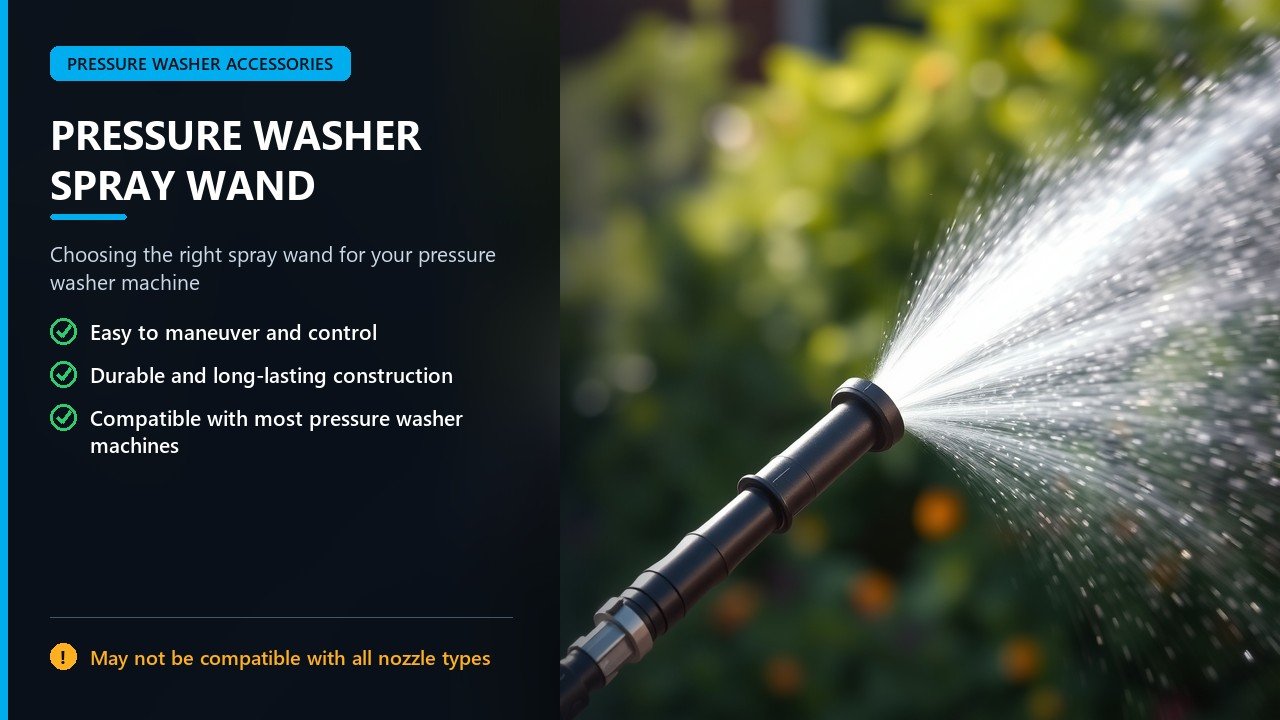
What Is a Spray Wand
A pressure washer spray wand, sometimes called a lance or wand, is the rigid tube that extends from the spray gun to the nozzle. Water travels from the pump, through the high-pressure hose, into the gun, and out through the wand and nozzle. The wand gives you leverage and reach, letting you direct the spray at the ground, a wall, or a vehicle without stretching or bending.
Wands are rated to the machine’s pressure and are made to hold nozzles at the tip, usually through a quick-connect fitting. The wand is not just a pipe — its length, material, and fittings all affect how the machine handles and how safely you can use it.
Because the wand is the last piece before the nozzle, it is also where many quick-connect problems, leaks, and safety incidents occur. Understanding it helps you keep the whole machine working properly.
Types of Spray Wands
The most common wand is the standard straight wand, a fixed-length tube that accepts quick-connect nozzles at the tip. It is simple, durable, and found on most consumer and many commercial machines. Some wands are one-piece with a molded grip, while others are part of a two-piece gun-and-wand set.
Telescoping or extendable wands slide out to add length, which is useful for reaching siding, gutters, roofs, and other high or distant spots without a ladder. They are convenient but tend to be less rigid, and the sliding joint is a common leak point if the seals wear.
Angled wands bend at the tip so you can direct the spray at an angle — handy for undercarriages, wheel wells, and the tops of walls. Turbo or rotating nozzles are often used with standard wands and spin a jet of water to clean faster. Some wands are pressure-rated higher than others, and some include built-in grips, swivels, or extension quick-connects.
Materials and Construction
Wands are usually made from stainless steel, brass, aluminum, or occasionally plastic. Stainless steel is the most durable and corrosion-resistant, making it the best choice for frequent use and higher pressures. Brass is corrosion-resistant and strong but heavier. Aluminum is light but softer and can corrode over time if its coating is damaged. Plastic wands are inexpensive and light, suited to light-duty electric machines, but they can crack under high pressure or impact.
Construction details matter as much as the material. Look for a properly rated wand with a secure grip, a robust quick-connect coupler, and a collar or trigger lock that helps prevent accidental spraying. Overmolded rubber grips make long jobs more comfortable and safer when hands are wet.
The fittings tie the wand to the rest of the system. Most consumer wands use 1/4-inch quick-connect fittings, while heavier professional equipment may use larger M22 or specialty connections. Matching the wand’s fittings to your gun and nozzles avoids adapters and leaks.
Matching a Wand to Your Machine
Start with pressure and flow ratings. A wand must be rated at or above the machine’s maximum pressure so it does not fail under load. Check the fitting type and size on both the gun and the nozzles, and confirm the wand uses the same standard so everything connects without adapters that add leak points.
Consider length next. A standard-length wand is easiest to control. A longer or telescoping wand adds reach but is less rigid and harder to control, especially at higher pressure. For most household jobs, a standard wand plus a modest extension covers reach needs without sacrificing control.
Finally, think about the nozzle interface. The wand should accept your nozzle set — commonly the color-coded quick-connect tips — and hold them securely. A loose or worn coupler lets the nozzle fly off under pressure, which is both a performance and a safety problem.
Do You Need a Longer Wand
Longer wands exist to solve reach problems. Cleaning the second story of a house, washing the top of an RV, or rinsing a high wall is awkward with a short wand, and a longer or telescoping wand keeps your feet on the ground. For these jobs, reach is the whole point, and the extra length is worth the trade-off in control.
But length has costs. A longer wand is heavier and floppier, so it is harder to hold steady, especially with the recoil of a high-pressure spray. It also increases the chance of bumping the nozzle, and its sliding joints or extension couplers are additional places to leak. For everyday jobs at ground level, a standard wand is usually the better tool.
A sensible approach is to keep a standard wand for routine cleaning and add an extension or telescoping wand for the occasional high or distant job, rather than using one long wand for everything. That way you get reach when you need it without giving up control the rest of the time.
Using a Spray Wand Effectively
Good technique starts with distance and angle. Hold the nozzle a consistent distance from the surface — far enough to avoid damage, close enough to clean — and move in steady, overlapping passes. Rushing or holding the wand still in one spot can etch concrete, strip paint, or damage wood. Let the flow and the right nozzle do the work.
Match the nozzle to the surface. Wider angles (25, 40 degrees) and soap tips are safe for vehicles, wood, and siding, while narrow angles (0, 15 degrees) are for tough spots on hard surfaces like concrete. The narrower the spray, the more concentrated and damaging it becomes, so use it sparingly and with care.
Work top to bottom so dirty water runs over already-cleaned areas, and use a consistent overlap between passes to avoid streaks. Keep the wand pointed at the work, never at people, animals, or yourself, and treat the high-pressure spray like a cutting tool. On vertical surfaces, angle the spray slightly downward to push debris off rather than into crevices.
Safety With Spray Wands
High-pressure spray can cause serious injury, so safety habits matter. Never point the wand at a person or pet, even briefly. Wear eye protection, keep your footing secure, and be aware of the wand’s recoil, which can push you off balance at high pressure. Expect the kickback and brace for it.
Never spray toward electrical outlets, fixtures, or the machine itself. Keep water away from the power source, especially with electric washers. Use a ground-fault-protected outlet and keep connections dry and off the ground. If the wand or gun develops a leak or a fitting fails, stop and fix it rather than continuing with a compromised tool.
Watch for the accidental-trigger risk. A trigger lock or safety catch prevents the gun from firing if you bump it while moving or setting it down. Engage it whenever you are not actively spraying, and never leave a pressurized wand lying on the ground pointing at anything.
Common Problems and Fixes
The most common wand problem is a leaking quick-connect, usually caused by a worn or missing O-ring. Replacing the O-ring is quick and cheap and typically stops the drip. If the coupler itself is worn, replacing the wand or coupler solves the problem. A nozzle that keeps popping out points to a worn coupler or a mismatched fitting.
Reduced pressure at the nozzle can mean a clogged nozzle, a partially closed valve, or a worn wand seal, so check the simple causes first. A bent wand, common after being dropped, restricts flow and should be replaced rather than straightened, because straightening weakens the metal. A cracked plastic wand under pressure is a failure waiting to happen and should be retired immediately.
Preventive care is simple. Rinse and dry the wand after use, protect the tip, and store it where it will not be crushed or bent. A little care keeps the quick-connect clean and the wand ready for the next job.
Spray Wand Accessories
A few accessories expand what a spray wand can do. Extension sections add reach quickly. Swivel fittings let the wand rotate freely so the hose does not kink or fight you as you move. Grip covers improve comfort and control on long jobs. Foam cannons and undercarriage cleaners attach at the wand or gun and turn the machine into a specialized cleaning tool.
Nozzle sets are the most useful accessory, because the nozzle does most of the work of matching the spray to the surface. A quality set of color-coded tips — 0, 15, 25, 40 degrees and a soap tip — covers almost every job. Additional tips such as turbo nozzles speed up tough flatwork.
When buying accessories, confirm they use the same quick-connect standard as your wand and are rated for your machine’s pressure. A cheap accessory that leaks or fails under pressure costs more in frustration than a well-matched one costs up front.
Wand, Lance, and Gun: What Is the Difference
These three terms are often used loosely, but they refer to distinct parts. The spray gun is the trigger handle that controls the flow of water. The wand, or lance, is the rigid tube attached to the gun that carries water to the nozzle. The nozzle is the tip that shapes the spray. Together they form the working end of the pressure washer, and each can be replaced or upgraded separately on most machines.
Understanding the difference helps when buying parts. If the trigger is stiff or leaking, you need a gun; if the tube is bent or the quick-connect is worn, you need a wand; if the spray pattern is wrong or uneven, you need a nozzle. Buying the right component saves money compared with replacing the whole assembly.
On many consumer machines, the gun and wand come as a matched set with a fixed connection, while professional machines often use separate gun and wand components joined by a standard fitting. Choosing a machine with separate, standard parts makes future repairs easier and cheaper.
Nozzle Angles and Where to Use Them
The nozzle at the tip of the wand determines the spray pattern, and matching that pattern to the surface is the single most important habit for good results and safe cleaning. The table below summarizes the common angles and their typical uses.
| Nozzle Angle | Typical Use |
|---|---|
| 0 degrees (red) | Stubborn spots on hard surfaces; use with care |
| 15 degrees (yellow) | Concrete, tough grime, stripping |
| 25 degrees (green) | General cleaning on many surfaces |
| 40 degrees (white) | Vehicles, wood, siding, gentle rinsing |
| Soap (black) | Applying detergent at low pressure |
| Turbo / rotary | Faster cleaning of flat, hard surfaces |
The narrower the angle, the more concentrated and potentially damaging the spray. Where a surface is painted, sealed, or soft, choose a wider angle or a soap tip. Where the surface is bare concrete and the grime is heavy, a narrower angle is appropriate. When in doubt, start with a wider angle and a greater distance, then adjust.
Maintenance and Storage
Spray wands are simple to maintain, but a few habits extend their life. Rinse the wand with clean water after use to remove detergent and debris, then dry it and protect the tip. Inspect the O-rings and quick-connect couplers for wear and replace them at the first sign of leaking. Lubricate the coupler occasionally with a little silicone grease if the manufacturer allows.
Store the wand where it will not be bent, crushed, or stepped on. Hang it or lay it flat rather than leaning weight on the tip. Before storing the machine for the season, remove the nozzle and dry the fittings so they do not corrode or seize. Winterize the machine itself by draining water and protecting the pump.
If the wand is telescoping or has extension joints, inspect those seals, because they are the most likely leak points. A drop of lubricant on the sliding sections keeps them moving smoothly and helps the seals last.
Upgrading a Spray Wand
Upgrading a wand is one of the cheapest improvements you can make to a pressure washer. Replacing a cracked plastic wand with a stainless-steel one improves durability, control, and safety, especially on a machine that sees frequent use. Adding a shorter wand improves control for close work, while an extension adds reach for high surfaces.
When buying an upgrade, match the pressure rating, the fitting type, and the nozzle interface to your existing gun and accessories. Standard 1/4-inch quick-connect systems make this easy on most consumer machines, but check before buying to avoid adapters and leaks. A good wand turns a basic machine into a more capable and pleasant tool to use.
Frequently Asked Questions
What is a pressure washer spray wand? It is the rigid tube, also called a lance, that connects the spray gun to the nozzle and directs the high-pressure water at the surface.
Are spray wands universal? No. They vary in pressure rating and fittings. Most consumer wands use 1/4-inch quick-connect fittings, but professional machines may use larger connections.
Can I use any nozzle on my wand? Only nozzles that fit the wand’s coupler and match the machine’s flow and pressure. Mismatched nozzles leak, fly off, or perform poorly.
How long should a spray wand be? A standard-length wand is best for most jobs. Use a longer or telescoping wand only when you need reach for high or distant surfaces.
Why is water leaking from my wand? Usually a worn or missing O-ring at the quick-connect. Replace the O-ring first, then the coupler or wand if the leak continues.
Is a stainless-steel wand better? It is more durable and corrosion-resistant than plastic or aluminum, which makes it a worthwhile upgrade for frequent or higher-pressure use.
Can a spray wand cause injury? Yes. High-pressure spray can cut skin and damage eyes, so never point it at people, pets, or yourself, and always wear eye protection.
How do I store a spray wand? Rinse and dry it, remove the nozzle, protect the tip, and store it flat or hanging so it is not bent, crushed, or stepped on.
Final Thoughts
A pressure washer spray wand is the link between the machine’s power and the surface you clean. Its length, material, and fittings shape how easily you reach the work, how safely you clean, and how long the tool lasts. Match the wand to your machine, pair it with the right nozzles, and use good technique.
Keep the quick-connect clean, replace worn O-rings, store the wand flat, and upgrade to stainless steel if you use the machine often. A good wand costs little and makes every cleaning job safer and more effective. For related reading, see our guides on the 4000 PSI pressure washer gun and pressure washer gun attachments.