Ask ten pressure washing professionals what single upgrade made the biggest difference to their daily comfort, and a surprising number will say the same unglamorous thing: a swivel. Not a bigger pump, not a hotter burner – a $30 part that lets the hose rotate freely at the gun. The first time you use one, you notice that your wrist is not fighting the hose anymore. By the end of the day, you notice that you are not exhausted. That quiet improvement is the entire case for a pressure washer swivel gun, and it explains why the upgrade has spread from commercial crews to serious homeowners.
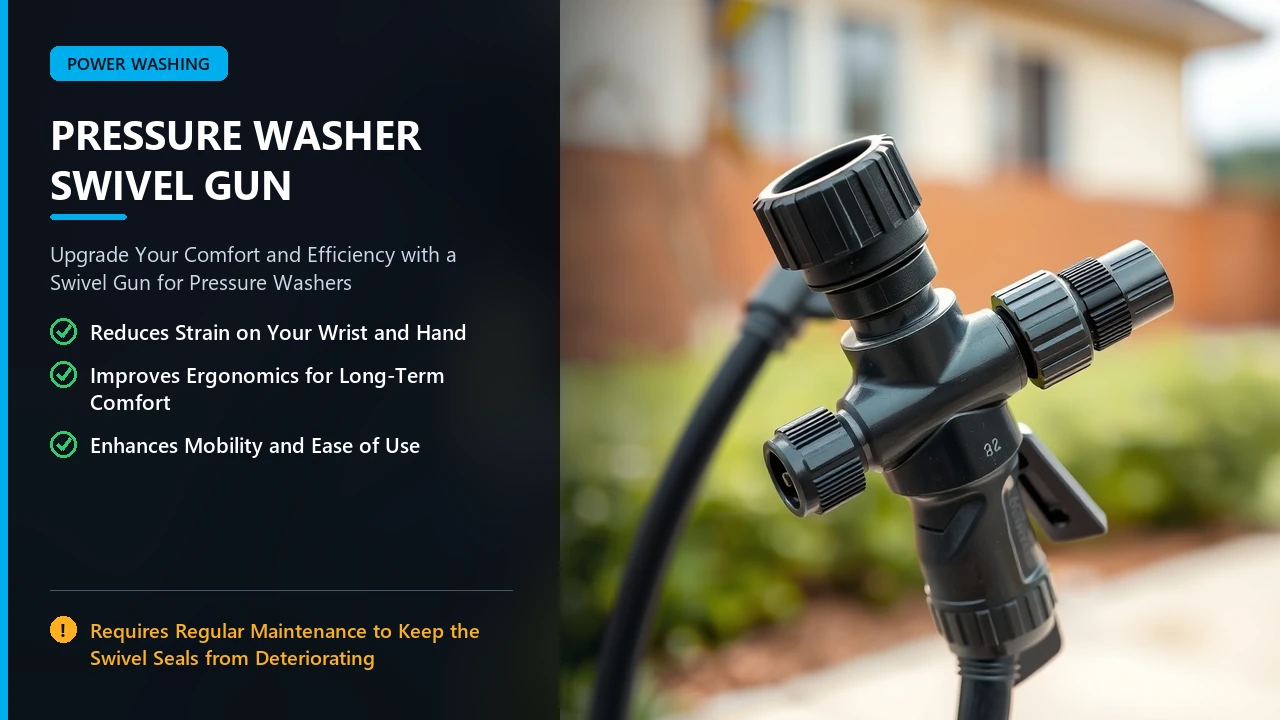
A swivel gun looks almost identical to a standard trigger gun. The difference is invisible until you connect a stiff high-pressure hose and start moving. The swivel at the inlet rotates, so the hose follows wherever you point the gun instead of pulling back against your hand. On a job that involves constant movement – cleaning around a car, working along a fence line, circling a driveway – that freedom is transformative.
The Problem With a Fixed Inlet
To appreciate a swivel, you have to understand why a normal gun fights you. High-pressure hose is stiff. It has a memory from being coiled, and it resists bending. When it connects to a fixed gun inlet, every time you turn the gun, you twist the hose. Twist it enough and two things happen: the hose kinks, and the twist transmits back through the hose to your wrist.
The result is a constant, low-level wrestling match. You aim the gun, the hose torques against you, you correct, the hose kinks, pressure drops, you un-kink it, and the cycle repeats. Over an hour it is annoying. Over a full day it is genuinely tiring, and it is a common cause of wrist and forearm fatigue among professional washers.
Kinking has a cost beyond annoyance. Every kink pinches the inner core, and repeated kinking at the same spot permanently weakens the hose. A hose that kinks constantly fails early, and the failure often happens – naturally – mid-job.
How a Swivel Gun Works
A swivel gun has a rotating joint at the hose inlet, engineered to carry full system pressure while turning. Inside that joint is a bearing surface and a set of seals – the same principle as a garden hose swivel, but built to withstand thousands of pounds per square inch.
When you move the gun, the swivel rotates and the hose stays put relative to the ground. No torque reaches your wrist, and the hose does not twist or kink. The water still flows at full pressure through the swivel’s internal passage.
The quality of a swivel gun comes down to the swivel itself. Cheap swivels leak within months because their seals are not rated for the pressure or the cycle count. Quality swivels use proper high-pressure seals, and the best ones have serviceable – replaceable – seals, so the gun lasts for years of daily use.
- Sealed bearing joint. Carries pressure while rotating freely.
- Rated for your psi and gpm. The swivel is the pressure-limiting component – it must exceed your machine’s maximum.
- Serviceable seals. Replaceable seals dramatically extend gun life.
- Standard connections. 3/8″ quick connect inlet and 1/4″ quick connect outlet are the common, flexible choice.
Benefits of a Swivel Gun
| Benefit | What Changes | Who Feels It Most |
|---|---|---|
| Less wrist fatigue | No counter-rotation against hose torque | Anyone working more than an hour |
| Fewer kinks | Hose stays untwisted as the gun moves | Users with stiff or long hoses |
| Longer hose life | Reduced kinking damage at the same spot | High-use and commercial operators |
| Faster, smoother work | Gun points where you aim without correction | Detailing and around-vehicle work |
| Reduced hose wear at joints | Torque does not concentrate at the connection | All users |
The biggest beneficiary is anyone doing circular or perimeter work. Detailing a car, cleaning around a building, or working a fence line all involve constant direction changes. With a fixed inlet, every change is a small fight. With a swivel, the movement is natural and the hose simply follows.
Swivel Gun vs Standard Gun
| Factor | Swivel Gun | Standard Fixed Gun |
|---|---|---|
| Hose rotation | Free – swivel inlet lets the hose follow | None – hose twists with the gun |
| Fatigue over long jobs | Lower | Higher |
| Kinking | Much less common | Frequent on stiff hoses |
| Cost | Slightly higher | Lower |
| Maintenance | Seals must be serviced | Fewer parts to service |
| Best use | Mobile, high-volume, around-object work | Occasional, stationary work |
For occasional light use, a fixed gun is perfectly adequate. For anyone who works regularly or moves the gun constantly, the swivel earns its small extra cost within the first few jobs.
What to Check Before Buying
- Pressure rating. The swivel and the gun body must both be rated at or above your machine’s maximum psi. Common quality ratings run 4,000 to 5,000 psi.
- Flow capability. Ensure the gun passes your gpm without restriction, especially on 4 gpm and larger machines.
- Inlet fitting. Match your hose end – 3/8″ quick connect is most flexible, or M22 (confirm 14 mm vs 15 mm) for many consumer machines.
- Outlet fitting. 1/4″ quick connect accepts the widest range of nozzles and wands.
- Swivel seal quality. Prefer guns with serviceable seals; a swivel is only as good as its seal.
- Trigger and grip. A light trigger and textured grip matter, because a swivel gun is meant for extended use.
Maintenance That Keeps a Swivel Working
- Replace swivel seals on schedule. This is the key maintenance item. A weeping swivel is the first sign the seals are done.
- Keep grit out. Sand around the swivel accelerates seal wear. Store the gun with the inlet capped or clean.
- Rinse after chemicals. Detergents attack seals. Flush with clean water after every chemical job.
- Lubricate the trigger pivot. A drop of silicone lubricant keeps the trigger smooth.
- Relieve pressure before disconnecting. Always bleed the line before removing the gun from the hose.
- Store dry, trigger unlocked. Prevents corrosion inside the swivel and a set in the trigger spring.
Common Mistakes
- Buying a swivel rated below your pressure. The swivel is a pressure joint; under-rating it is a safety and reliability problem.
- Ignoring the M22 size. 14 mm versus 15 mm mix-ups cause leaks that no amount of tightening fixes.
- Never servicing the seals. A swivel gun is a wear item; its seals eventually need replacement.
- Storing with grit in the joint. Grit is the fastest way to destroy a swivel seal.
- Assuming the swivel adds power. It does not – it adds comfort and control. Power comes from the pump and nozzle.
Frequently Asked Questions
What is a pressure washer swivel gun?
A trigger gun with a rotating joint at the hose inlet. The swivel lets the high-pressure hose rotate freely as you move the gun, so the hose follows your aim instead of twisting against your wrist. It reduces fatigue and hose kinking without changing pressure or flow.
Does a swivel gun reduce pressure?
No. A quality swivel is a sealed high-pressure joint that holds full system pressure while rotating. When rated correctly for your machine, it delivers the same pressure as a fixed gun. Only a worn or under-rated swivel causes pressure loss.
Is a swivel gun worth it?
For regular users and anyone who moves the gun constantly, yes. It reduces wrist fatigue and kinking, which improves comfort and hose life. For occasional light use, a standard gun is adequate.
Will a swivel gun fit my pressure washer?
It depends on your hose connection. Match the inlet – 3/8″ quick connect or M22 (verify 14 mm vs 15 mm) – and confirm the gun’s pressure rating meets or exceeds your machine’s maximum psi. The 1/4″ quick connect outlet accepts standard nozzles.
How often do swivel seals need replacing?
It varies with use and water quality. A weeping swivel is the signal to replace seals. In regular use, expect to service the swivel periodically – choosing a gun with replaceable seals makes this a quick, inexpensive task instead of a gun replacement.
Can I add a swivel to my existing gun?
Yes. You can buy a standalone swivel fitting that installs between the hose and a standard gun. It works well, though a dedicated swivel gun often integrates the joint more cleanly and durably than a bolt-on fitting.
The Bottom Line
A pressure washer swivel gun solves a problem most owners do not realize they have until it is gone: the constant fight between a stiff hose and a fixed gun. The swivel lets the hose follow instead of resist, cutting wrist fatigue and kinking without touching your pressure or flow.
Buy a gun rated above your machine’s maximum psi, match the inlet to your hose, prefer one with serviceable seals, and keep grit away from the joint. For anyone who works regularly, it is one of the smallest investments that produces a noticeably better day – and for professionals, it is quickly the difference between ending a shift tired and ending it sore.