The wand is the part of a pressure washer you hold — and the place where most upgrades begin. Adding the right attachments to your wand transforms a single-purpose machine into a cleaning system for vehicles, siding, gutters, decks, and more. If you are shopping for pressure washer wand attachments, this buying-focused guide will help you choose wisely.
We will cover the connection standard that governs compatibility, the main categories of attachments, how to match them to your machine and gun, a job-by-job recommendation table, costs, and the mistakes that waste money.
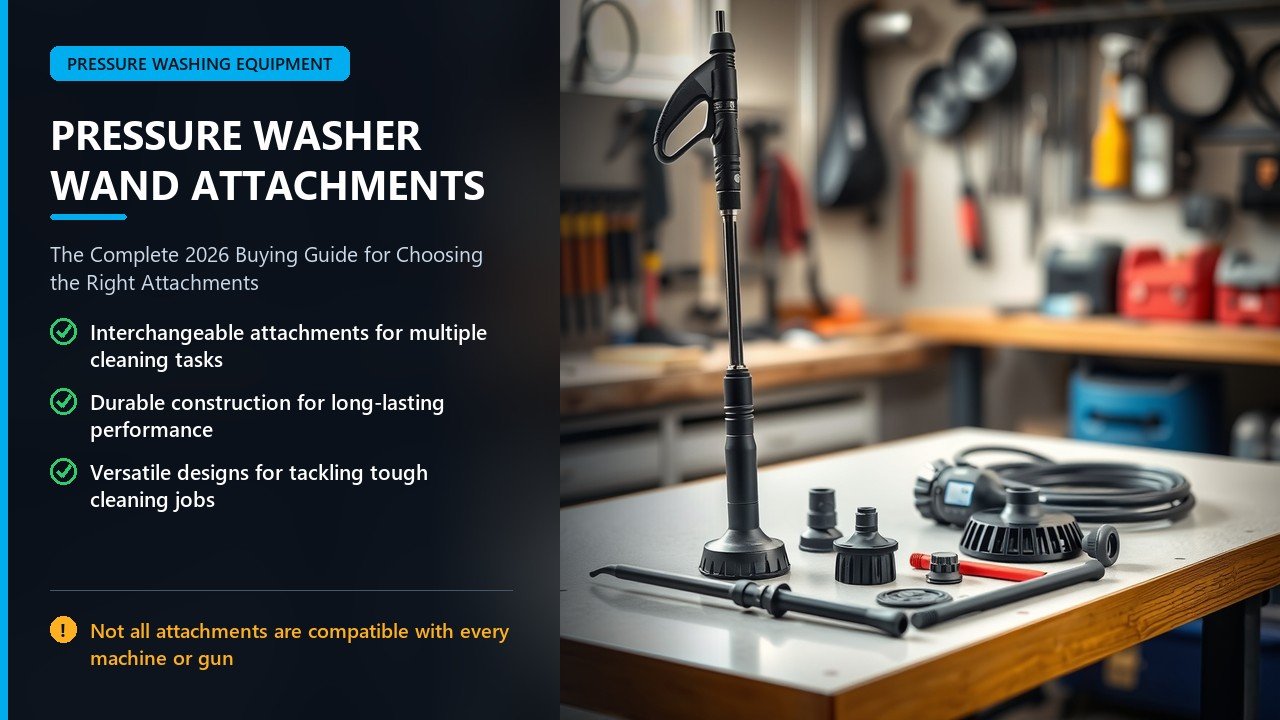
The Connection That Governs Everything
Almost all wand attachments connect through a standard fitting, which makes them broadly interchangeable — but only if your machine uses the same standard.
- 1/4-inch quick-connect — the most common fitting on spray guns and wands.
- M22 threaded — a screw connection found on many machines and some guns.
- Adapters — cheap parts that convert between quick-connect and M22.
- Proprietary fittings — some brands use unique connections needing special adapters.
Quick Note: Before buying any attachment, confirm your gun or wand connection type. The 1/4-inch quick-connect standard covers most attachments, but not every machine.
Categories of Wand Attachments
| Category | Examples |
|---|---|
| Nozzles | 0°, 15°, 25°, 40°, soap, turbo |
| Wand extensions | Straight extensions, telescoping wands, pivot wands |
| Detergent applicators | Foam cannons, downstream injectors |
| Surface cleaners | Rotary and water-broom style |
| Specialty tools | Gutter cleaners, undercarriage cleaners, brushes |
Short Note: Most people start with nozzles, then add an extension, then a detergent applicator and a surface cleaner. Specialty tools come last, as specific needs appear.
Nozzles: The Foundation
| Nozzle | Angle | Best Use |
|---|---|---|
| Red | 0° | Stubborn spots — high damage risk |
| Yellow | 15° | Concrete and hard stains |
| Green | 25° | General hard-surface cleaning |
| White | 40° | Delicate surfaces and rinsing |
| Black | Soap | Applying detergent at low pressure |
| Turbo | Rotating 0° | Aggressive concrete cleaning |
Nozzles are the highest-value attachment you can own. A full set costs little and covers nearly every surface, because the right angle matches the pressure to the job.
Extension and Telescoping Wands
Reach is the second thing most owners want. Extensions let you clean higher, farther, and into places the base wand cannot touch.
| Type | Best Use |
|---|---|
| Short extension | Cleaning under vehicles and low objects |
| Medium extension | Patios and mid-height siding |
| Telescoping wand | Second-story siding and roofs |
| Pivot / swivel wand | Reaching behind obstacles and into gutters |
Note: Longer wands reduce pressure at the tip and increase recoil. Use a wider nozzle and both hands, and always keep extension wands clear of power lines.
Detergent Applicators
- Foam cannon — uses the pressure washer to spray thick foam; ideal for vehicles and siding.
- Downstream injector — draws detergent into the stream at low pressure after the pump.
- Soap nozzle + bottle — a simple, low-cost way to apply detergent.
- Upstream injection — mixes detergent before the pump (requires a chemical-rated pump).
Detergent application makes cleaning faster and gentler — the soap loosens dirt before high pressure touches the surface.
Matching Attachments to Your Machine and Gun
| Check | Why It Matters |
|---|---|
| Pressure rating | Attachments must survive your machine’s PSI |
| Flow rating (GPM) | Undersized attachments reduce performance |
| Connection type | Quick-connect vs M22 vs proprietary |
| Nozzle size | Orifice must match the machine’s flow |
| Adapter availability | Needed if fittings differ |
Short Note: An attachment rated below your machine’s pressure can fail dangerously. Always check ratings before connecting anything.
Which Attachment for Which Job
| Job | Best Attachment |
|---|---|
| Driveway concrete | Surface cleaner or turbo nozzle |
| Vehicle body | Foam cannon plus 40° nozzle |
| Second-story siding | Telescoping wand with wide nozzle |
| Gutters | Gutter-cleaner or pivot wand |
| Undercarriage | Undercarriage cleaner |
| Deck or fence | 40° nozzle and/or brush attachment |
Buying by job keeps your attachment collection focused and useful rather than a drawer full of parts you never use.
Attachment Costs
| Attachment | Typical Price |
|---|---|
| Nozzle set | $10–$30 |
| Turbo nozzle | $15–$40 |
| Extension wand | $15–$40 |
| Foam cannon | $20–$60 |
| Telescoping wand | $40–$150 |
| Surface cleaner | $40–$200 |
| Gutter / undercarriage cleaner | $20–$60 |
Wand attachments are among the cheapest upgrades in pressure washing. A modest budget covers a kit that handles nearly every common job.
Using Attachments Effectively
- Start with wider angles and narrow only when needed.
- Keep the wand moving to prevent streaks and etching.
- Increase distance on delicate surfaces.
- Let detergent dwell before rinsing.
- Use both hands with extensions and turbo nozzles.
- Test in a hidden area before aggressive cleaning.
- Rinse as you go to carry dirt away.
Technique matters as much as the attachment. The power is only as safe and effective as the way you direct it.
Maintenance of Wand Attachments
- Rinse and dry after every use to prevent clogs and corrosion.
- Clear nozzle tips with a tip cleaner when flow drops.
- Check O-rings and replace worn seals.
- Lubricate telescoping sections so they slide freely.
- Store nozzles in a case so they aren’t lost or dinged.
- Inspect wands for bends and cracks.
- Keep the machine’s inlet filter clean to protect attachments.
Attachments are small investments that repay good care many times over. Basic habits keep a kit performing like new for years.
Mistakes That Waste Money
- Buying attachments with the wrong fitting. Check connection type first.
- Ignoring pressure and flow ratings. Underrated parts fail dangerously.
- Overspending on specialty tools. Buy them only for jobs you actually do.
- Using the 0° nozzle on the wrong surface. Causes permanent damage.
- Neglecting nozzle sizing. Wrong orifice wastes pressure or strains the pump.
- Skipping maintenance. Clogged tips and worn O-rings ruin performance.
Safety With Wand Attachments
- Never point the wand at people or pets.
- Never touch a pressurized leak. Water can penetrate skin.
- Wear eye and face protection.
- Keep clear of power lines with extension wands.
- Control recoil with both hands and firm footing.
- Shut off before changing attachments.
- Match ratings across all components.
Surface Cleaners and Water Brooms
For flatwork, nothing beats an attachment with an enclosed rotating spray head. Surface cleaners clean faster and more evenly than a wand, with no streaks.
| Tool | Best Use |
|---|---|
| Rotary surface cleaner | Driveways, patios, sidewalks |
| Water broom | Quick rinsing of large areas |
| Undercarriage cleaner | Rinsing under vehicles |
Note: Surface cleaners need adequate flow to spin correctly. If yours rotates slowly or unevenly, check your machine’s GPM and the nozzle sizing.
Brush and Scrubber Attachments
Sometimes agitation is what a surface needs, not more pressure. Brush attachments combine water and mechanical scrubbing for heavy soil.
- Fixed brush attachment — ideal for siding, decks, and vehicles.
- Rotary brush — powered by water flow for faster scrubbing.
- Soft-bristle version — for paint and delicate finishes.
- Stiff-bristle version — for concrete and heavy grime.
Brushes let you clean effectively at lower pressure, which is safer for wood, paint, and composite surfaces that high pressure can damage.
Choosing Between Pressure and Agitation
| Surface | Better Approach |
|---|---|
| Concrete | High pressure and surface cleaner |
| Wood decking | Lower pressure with detergent and brush |
| Painted siding | Soft brush and detergent at low pressure |
| Vehicles | Foam and soft brush or mitt |
Short Note: Where high pressure risks damage, agitation plus detergent often cleans better and safer. Brushes are the underrated attachment for delicate surfaces.
Building a Kit Over Time
| Priority | Item |
|---|---|
| 1 | Nozzle set |
| 2 | Extension wand |
| 3 | Turbo nozzle |
| 4 | Foam cannon |
| 5 | Surface cleaner |
| 6 | Specialty tools (gutter, undercarriage, pivot, brush) |
Building in this order covers the widest range of tasks for the least cost, and you can add specialty attachments as specific needs arise.
Troubleshooting Attachment Problems
| Symptom | Likely Cause |
|---|---|
| Weak spray | Clogged tip or wrong nozzle size |
| Leak at the connection | Worn or missing O-ring |
| Attachment won’t fit | Mismatched fitting — use an adapter |
| Turbo nozzle won’t spin | Debris or insufficient flow |
| Foam cannon foams poorly | Wrong detergent or clogged orifice |
| Telescoping wand is stiff | Dry or dirty sections |
Almost every attachment problem traces to a clogged tip, a worn O-ring, or a mismatched fitting — all simple, inexpensive fixes.
Storage and Long-Term Care
How you store wand attachments decides how long they last. Small habits protect small, easily lost parts.
| Practice | Benefit |
|---|---|
| Store nozzles in a case | Prevents loss and damage |
| Keep wands dry | Prevents rust and corrosion |
| Coil hoses loosely | Avoids kinks and memory breaks |
| Lubricate telescoping sections | Keeps extensions moving freely |
| Replace worn O-rings promptly | Stops leaks before they cost time |
| Inspect before each use | Catches damage before it causes injury |
Quick Note: Keep a small organizer box for nozzles, adapters, and O-rings. Having spares on hand means a clogged tip or leaky seal never ends a job early.
Building a Complete Attachment System
- Nozzle set — the foundation for every surface.
- Extension and telescoping wands — for reach and height.
- Turbo nozzle — for aggressive concrete cleaning.
- Foam cannon — for detergent application.
- Surface cleaner — for fast, even flatwork.
- Brush attachments — for gentle cleaning of delicate surfaces.
- Specialty tools — gutter, undercarriage, and pivot wands.
- Adapters and spare seals — the unseen parts that keep everything working.
Assembled over time and matched to real jobs, a complete attachment system makes a single pressure washer capable of work that would otherwise require several machines.
Where to Buy Wand Attachments
- Online marketplaces. Huge selection and low prices; check specs and reviews.
- Hardware stores. Convenient for nozzles, O-rings, and adapters.
- Specialty suppliers. Professional-grade attachments and advice.
- OEM sellers. Guaranteed fit at higher prices.
Guidance on safe high-pressure practice from the Occupational Safety and Health Administration (OSHA) is worth reviewing for any serious operation.
Cost and Value Summary
| Goal | Best Attachments |
|---|---|
| Maximum versatility, low cost | Nozzle set + extension wand |
| Vehicle cleaning | Foam cannon + 40° nozzle |
| Flatwork productivity | Surface cleaner |
| Height and reach | Telescoping wand |
| Tough stains | Turbo nozzle |
Value comes from matching attachments to real jobs, not from owning every accessory. A focused kit outperforms a random collection.
Real-World Scenarios
Scenario 1: A homeowner with a two-story house. A telescoping wand and wide nozzle let them rinse siding and reach gutters from the ground, avoiding ladders.
Scenario 2: A car enthusiast. A foam cannon, 40° nozzle, and undercarriage cleaner give a complete wash routine from one pressure washer.
Scenario 3: A cleaning contractor. A turbo nozzle, surface cleaner, and pivot wand cover nearly every job — all through the same quick-connect fitting.
Frequently Asked Questions
Will wand attachments fit my pressure washer? Most use standard 1/4-inch quick-connect, so they fit most gun-and-wand setups. Check your connection or use an adapter.
What should I buy first? A nozzle set, then an extension wand — the most versatility for the least money.
Do long wands reduce pressure? Yes, a longer wand lowers pressure at the tip and increases recoil. Use a wider nozzle and adjust technique.
Can I use a turbo nozzle on wood? No. Turbo and 0° nozzles damage wood. Use a wide fan nozzle at lower pressure.
How do I keep attachments working? Rinse and clear tips after use, replace worn O-rings, and keep the machine’s inlet filter clean.
Final Thoughts
Pressure washer wand attachments are the most cost-effective way to expand what your machine can do. Nozzles, extensions, telescoping wands, foam cannons, surface cleaners, and specialty tools each solve a specific problem — and most share the same quick-connect fitting.
Buy by job, match every attachment to your machine’s pressure and flow, and respect the power you are controlling. Done well, a modest attachment kit turns one pressure washer into a cleaning system. For related reading, see our guides on the attachment for power washer and scrubber attachments for pressure washers.