The pressure washing gun is the one part of the system that lives in your hand all day, and it is where two streams of incompatibility meet: the wrong gun will not thread onto your hose, and even if it does, it can rob your washer of flow or fail under the temperature you run. Most buyers compare price and grip and ignore the numbers that actually matter. This guide covers them.
Choosing a pressure washing gun comes down to matching three things — pressure, flow, and temperature — and getting the connections right. Do that and the gun becomes invisible, doing its job for years; get it wrong and you are chasing leaks, drips, and a trigger that tires your hand by noon.
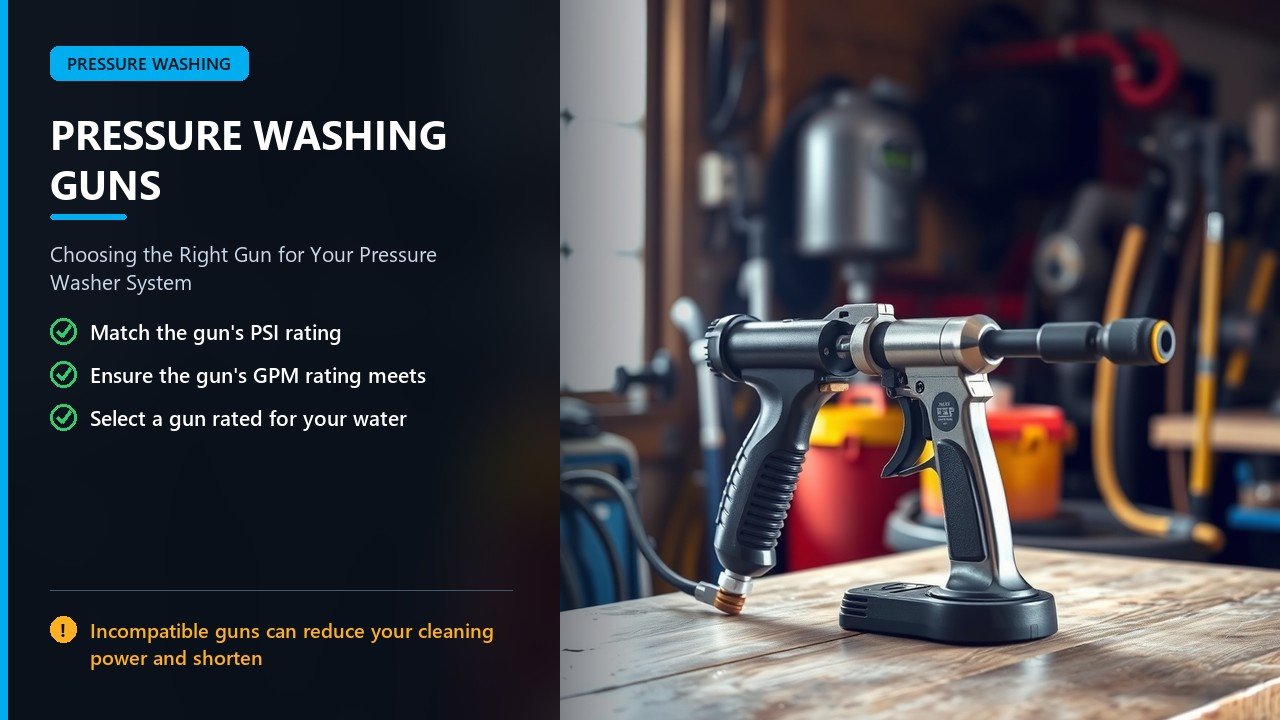
The Two Numbers Most Buyers Ignore
Everyone looks at the PSI rating on a gun. Far fewer look at the flow rating, measured in GPM, and that is a mistake. A gun is a restrictor: if its internal passage and outlet are too small for your machine’s flow, it will choke the water, and your cleaning power drops even though the pressure gauge still reads fine.
The rule is that the gun’s PSI and GPM ratings should both meet or exceed your washer’s output. A consumer gun rated to 3,000 PSI and 2.5 GPM is not the right choice for a machine pushing 4,000 PSI and 4 GPM, no matter how good the price is. Professional guns commonly cover 4,000 to 5,000 PSI and 8 to 12 GPM, and high-flow washdown guns are built for even higher flow with lower pressure.
The third number is temperature. If you run hot water, the gun must be rated for that heat — many professional guns handle around 300°F, while others are limited closer to 200°F. Running hot water through a cold-water-only gun destroys its seals and springs. Check all three ratings against your machine before you buy.
Under-specifying any of these is the classic way to end up with a gun that leaks, pulses, or fails early. Mismatched components can also cause sudden hose movement when a fitting lets go under pressure, which is a safety problem, not just an annoyance.
It helps to think of the gun as part of one hydraulic loop. The pump pushes a volume of water at a pressure; the hose carries it; the gun passes it to the wand; the nozzle shapes it. If the gun’s passage is narrower than the hose, the flow backs up and the system loses efficiency. That is why a gun that looks fine on paper but has a small outlet can make an expensive washer behave like a cheap one.
Connections: Where Most People Get Stuck
The threads and quick connects on a gun are the second source of trouble, because there is no single standard across the industry. Consumer and light-commercial machines mostly use M22 threaded connections, while industrial and high-pressure systems use 3/8-inch or 1/2-inch NPT threaded connections. Professional guns typically have a 3/8-inch NPT inlet and a 1/4-inch NPT outlet.
Quick connects add a second layer. A 3/8-inch quick connect is common at the hose, and a 1/4-inch quick connect is common at the wand and nozzle. Converting between M22 and NPT or quick connect is easy with the right adapters, but you have to know your sizes before you buy, or you will be ordering adapters the day the gun arrives.
One detail that trips people up is that M22 comes in two lengths: M22 x 14mm and M22 x 15mm. They look alike but do not always interchange, so confirm which your machine uses. Also note the pressure ceiling: standard M22 fittings are typically rated to about 3,200 PSI, so machines above that are better served by NPT threaded connections.
Common Connection Types at a Glance
The table below summarizes the fittings that decide whether a gun will connect and how much pressure it can safely carry.
| Fitting | Typical PSI ceiling | Where you see it |
|---|---|---|
| M22 x 14mm / 15mm | ~3,200 PSI | Consumer and light-commercial guns, hoses, wands |
| 1/4″ NPT (brass) | ~3,000 PSI | Pump outlets, light commercial |
| 3/8″ NPT (brass) | ~4,000 PSI | Commercial and industrial connections |
| 3/8″ NPT (stainless) | 6,000+ PSI | Hot water, chemical, high-pressure industrial |
| 1/4″ quick connect | 2,000-4,000 PSI | Wand and nozzle side, accessory swaps |
| 3/8″ quick connect | 3,000-5,000 PSI | Hose side, high-flow systems |
Brass and stainless steel are the materials to look for; plastic and cheap pot metal fittings are the ones that crack and round off. The pressure rating is usually stamped or molded on quality fittings, so check it rather than assuming.
Form, Trigger, and Features
Beyond connecting, a gun has to feel right in your hand. The most common form is the pistol grip, which is familiar and easy to aim. Short “stubby” guns trade reach for maneuverability and fit into tight spaces, while longer assemblies with integrated lances give you reach without extra parts. Match the form to the work: close-up detailing favors a short gun, high walls and roofs favor a longer one.
The trigger matters more than people expect. A stiff, cheap trigger forces your hand to work hard on every pull, and over a long shift that becomes real fatigue. Easy-pull triggers reduce the effort, and a trigger with a proper safety lock is a basic safety requirement, not a luxury.
A swivel inlet is a small feature with an outsized benefit: it lets the hose rotate at the gun instead of twisting and fighting you, which reduces wrist strain and hose kinking. For anyone running long hoses, a swivel inlet and a comfortable grip are worth paying for.
Finally, consider O-rings and seals. They are the parts that actually seal the connections, and they wear out. Quality guns use replaceable O-rings, and keeping a spare set on hand means a drip at the connection is a two-minute fix instead of a new fitting.
Keeping the Gun Working
A pressure washing gun is simple, but its seals, spring, and trigger pin wear, and most failures trace back to neglect rather than manufacturing. The single best habit is to rinse the gun with clean water after using detergent or chemicals, especially salt-based or aggressive cleaners, because residue attacks the seals and springs from the inside.
Inspect the wear points regularly during heavy use: the trigger pin, the safety lock, and the quick connects. A sticking trigger or a quick connect that no longer snaps firmly is a warning. Replace O-rings at the first sign of a drip rather than letting a leak erode the fitting, and apply high-pressure-rated sealant on threaded connections, never on quick connects.
Store the gun so it is not crushed or left under load, and drain it before freezing weather along with the rest of the system. Trapped water cracks seals and housings when it freezes, which is a needless way to lose a gun that was working perfectly.
Matching the Gun to Your Whole System
A gun does not work in isolation. It has to match the flow and pressure the pump delivers, the temperature the heater produces, and the threads the hose and wand use. A gun that is right on all four counts makes the whole system feel seamless; a gun that is wrong on any one of them shows up as a drip, a weak spray, or a hard-to-pull trigger.
The most common mistake is treating the gun as a generic accessory. It is not. A 3,000 PSI consumer gun and a 5,000 PSI, 10 GPM professional gun are different tools for different machines, and the threads on each differ too. Buying by price alone almost guarantees a mismatch somewhere.
The second mistake is ignoring the operating conditions. A cold-water-only gun on a hot-water machine, or a low-flow gun on a high-flow pump, will fail or underperform no matter how well it is made. Match the specifications to your actual use, not to the label on a box.
Why the Wrong Gun Costs More Than It Saves
Start with your machine’s specs: its PSI, its GPM, and whether you run hot water. Then confirm the connections the gun needs — typically M22 on consumer machines and 3/8-inch NPT with a 1/4-inch outlet on professional ones — and buy adapters only when you must bridge standards.
Only after the specs match should you choose the form and features: pistol or stubby, easy-pull trigger, swivel inlet, replaceable O-rings. That order matters, because a beautifully ergonomic gun that leaks or chokes your flow is still the wrong gun.
Buy once, matched correctly, and a quality pressure washing gun will outlast several machines. Buy on price alone and you will be back at the parts counter within a season, hunting adapters and O-rings for a gun that never quite fit.
Frequently Asked Questions
How do I choose a pressure washing gun? Match its PSI, GPM, and temperature ratings to your machine, confirm the connection types, then choose the form and features such as trigger and swivel inlet.
Why does the GPM rating matter? A gun with too small an internal passage restricts flow and robs cleaning power even when pressure looks fine. The gun’s GPM rating should meet or exceed your machine’s output.
What connections do pressure washer guns use? Consumer and light-commercial guns typically use M22, while professional guns usually have a 3/8-inch NPT inlet and a 1/4-inch NPT outlet. Quick connects are 3/8-inch at the hose and 1/4-inch at the wand.
What is the difference between M22 14mm and 15mm? Both are metric M22 threads but with different lengths. They look alike and do not always interchange, so confirm which your machine uses before buying.
Can I use any gun with hot water? No. The gun must be rated for the temperature you run. Many pro guns handle about 300°F, others closer to 200°F. Hot water through a cold-water-only gun ruins its seals.
What is a swivel inlet? A fitting that lets the hose rotate at the gun instead of twisting, reducing wrist strain and hose kinking. It is a worthwhile feature for long hoses.
How do I stop leaks at the connections? Replace worn O-rings, use high-pressure-rated sealant on threaded joints, and never put sealant on quick connects. Tighten with the right wrench and support the fitting.
How do I make a gun last? Rinse it with clean water after detergent, inspect the trigger and quick connects, replace O-rings early, and drain it before freezing weather.
Final Thoughts
A pressure washing gun is where pressure, flow, temperature, and threads all have to agree. Match the gun’s PSI and GPM ratings to your machine, confirm it can handle your water temperature, and get the connections right — M22 for consumer machines, 3/8-inch NPT for professional duty — then choose the grip, trigger, and swivel that suit your work.
Do that and the gun disappears into the job, comfortable and leak-free for years. Skip it and you will spend a season chasing drips, adapters, and a trigger that tires your hand. Buy matched, maintain it, and a good gun will outlast several washers. For related reading, see our guides on a 4000 PSI pressure washer gun and pressure washer gun attachments.