Pressure alone does not always win the cleaning battle. Some surfaces hold onto dirt with a stubborn grip that a spray of water cannot break — algae clinging to a fence, grease baked onto concrete, or grime embedded in a textured deck. That is where scrubber attachments for pressure washers come in. By adding mechanical agitation to high-pressure water, these attachments lift and loosen grime that water alone would only wet.
This guide explains what scrubber attachments are, the types available, how they work with your machine, how to choose the right one, where they shine, and how to use and maintain them safely and effectively.
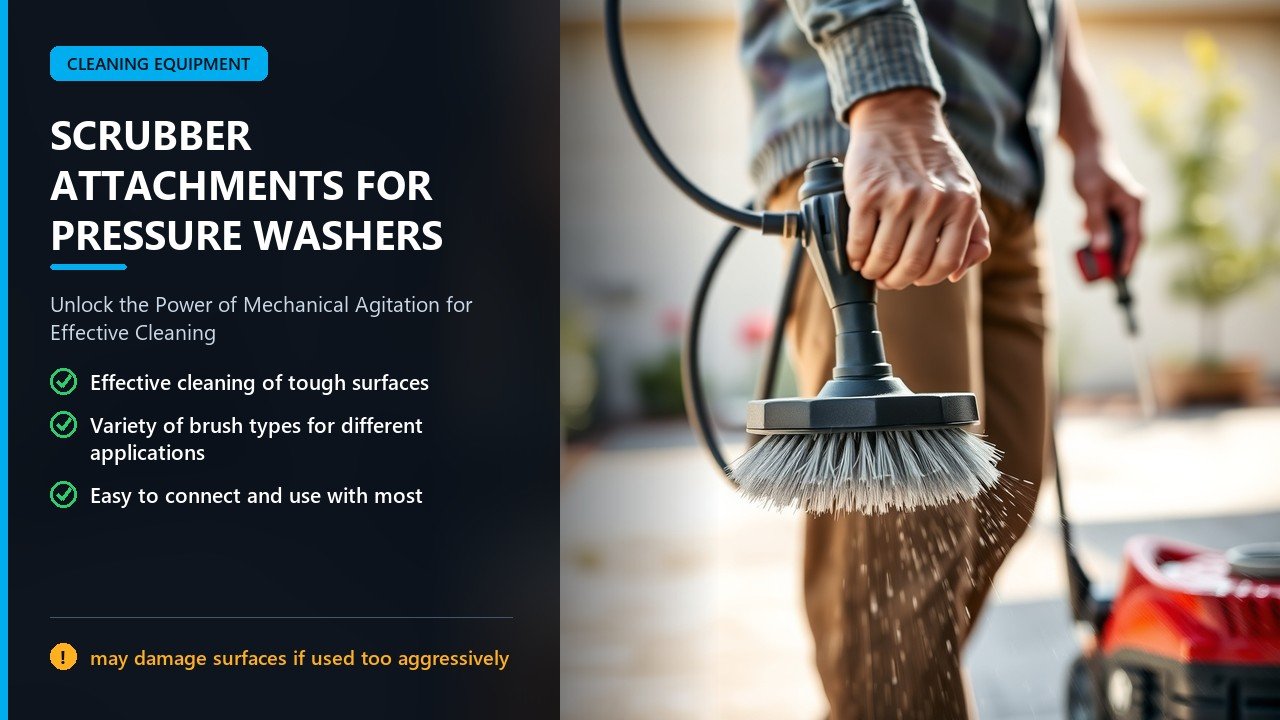
What Are Scrubber Attachments?
A scrubber attachment is an accessory that adds a rotating or fixed brush to your pressure washer. Water flows through or around the brush while the bristles physically scrub the surface. The combination of mechanical agitation and pressurized water cleans far more effectively than either alone.
Scrubber attachments typically fall into a few broad categories:
- Rotary brush attachments — spinning brushes driven by the water flow or a motor.
- Fixed brush wands — a static brush mounted around or beside the nozzle.
- Surface cleaner brushes — brush skirts or brush rings on flatwork cleaners.
- Specialty brushes — designed for decks, siding, vehicles, or grills.
Quick Note: Scrubber attachments do not replace pressure — they combine mechanical agitation with it. The brush loosens the dirt; the water flushes it away.
Why Use a Scrubber Attachment?
Pressure alone struggles with certain kinds of soil. A brush adds a mechanical advantage that improves results and can even let you clean at lower pressure — protecting delicate surfaces.
| Challenge | How a Brush Helps |
|---|---|
| Clinging mildew and algae | Physically scrubs growth off the surface |
| Textured or porous surfaces | Reaches into crevices spray misses |
| Grease and caked grime | Agitation breaks the bond |
| Delicate surfaces | Cleans at lower pressure with less risk |
| Stubborn stains | Combined action speeds removal |
For many professionals, a brush attachment is the difference between a surface that looks clean and one that is clean.
Short Note: Brushing lets you reduce pressure on sensitive surfaces — fencing, painted wood, and vehicle finishes — while still getting a deep clean.
Types of Scrubber Attachments
| Type | How It Works | Best For |
|---|---|---|
| Rotary brush head | Water-driven spinning brush | Flatwork, decks, large surfaces |
| Fixed brush wand | Static brush around the nozzle | Siding, fences, general cleaning |
| Water-broom / scrubber | Bristles plus multiple jets | Driveways, patios, walkways |
| Vehicle brush | Soft bristles for paint | Cars, trucks, RVs |
| Grill / detail brush | Small, aggressive bristles | Grills, equipment, tight areas |
Rotary and water-broom designs suit broad flat surfaces, where spinning action and multiple jets combine to clean quickly. Fixed brush wands are more versatile for vertical and irregular surfaces. Specialty brushes handle vehicles and detail work.
How They Connect to Your Pressure Washer
Most scrubber attachments connect through the same quick-connect fittings used by spray nozzles and wands. That means compatibility is usually straightforward — but a few details matter.
| Consideration | What to Check |
|---|---|
| Fitting type | 1/4-inch quick-connect is standard on most machines |
| Pressure rating | Must handle your machine’s PSI |
| Flow requirement | Rotary brushes need enough flow to spin |
| Temperature tolerance | Important for hot-water machines |
| Bristle material | Nylon, nylon-abrasive, or natural |
Short Note: Rotary brush attachments rely on water flow to spin the head. If your machine has low flow, a water-driven rotary brush may spin poorly — a fixed brush wand is often the better choice for low-flow electric units.
Choosing the Right Attachment
| Task | Recommended Attachment |
|---|---|
| Concrete driveway / patio | Rotary brush or water broom |
| Wood deck | Soft-bristle scrubber at lower pressure |
| Vinyl / wood siding | Fixed brush wand |
| Vehicles and RVs | Soft vehicle brush |
| Grills and equipment | Aggressive detail brush |
| Tight corners and edges | Small fixed brush |
Match the bristle stiffness to the surface: soft for paint and delicate finishes, stiffer for concrete and masonry. The wrong stiffness either leaves dirt behind or damages the surface.
Applications and Benefits
- Flatwork. Rotary brushes and water brooms clean driveways, patios, and walkways quickly and evenly.
- Decks and fences. Brushes remove mildew and grey weathering from wood before staining.
- Siding. Fixed brush wands scrub dirt and organic growth from vinyl and painted siding.
- Vehicles and fleets. Soft brushes lift road film while a gentle spray rinses.
- Grills and equipment. Aggressive detail brushes cut through grease and caked residue.
- Pre-treatment work. Brushing spreads and works in cleaning solutions for better results.
In each case, the brush provides the agitation that pressure alone cannot, improving both the speed and quality of the clean.
Technique for Best Results
- Pre-soak and dwell. Apply detergent and let it work before scrubbing.
- Work in sections. Scrub a manageable area, then rinse before moving on.
- Let the brush do the work. Use steady pressure and motion rather than pressing hard.
- Overlap passes to avoid missed strips.
- Keep the brush moving to prevent swirl marks and uneven cleaning.
- Rinse from top down so dirty water does not recontaminate cleaned areas.
- Test in a hidden spot before using an aggressive brush on a visible surface.
Short Note: Aggressive brushing on painted or delicate surfaces can dull or scratch the finish. Always test first and choose a soft bristle where the surface is vulnerable.
Maintenance and Storage
| Task | Interval | Purpose |
|---|---|---|
| Rinse bristles and jets | After each use | Remove dirt and detergent |
| Inspect bristles for wear | Regularly | Replace when worn flat |
| Check the rotary bearing | Seasonally | Ensure smooth spinning |
| Inspect jets and fittings | Before use | Maintain spray and safety |
| Store dry | Off-season | Prevent mildew and corrosion |
Bristles wear down over time and lose their ability to agitate. When a brush no longer scrubs effectively, replace it — a worn brush just smears dirt around.
Common Mistakes to Avoid
- Using a stiff brush on delicate surfaces. It scratches paint and finishes.
- Too much pressure with a brush. Let the bristles work; pressing hard causes damage and wear.
- Skipping the pre-soak. Detergent loosens dirt and makes scrubbing far easier.
- Mismatched attachment. A low-flow machine with a water-driven rotary brush spins poorly.
- Ignoring the pressure rating. Attachments not rated for your PSI can fail.
- Brushing dry. Always keep water flowing to flush loosened dirt.
- Not rinsing after scrubbing. Loosened dirt must be washed away, not left behind.
Scrubber Attachments vs Surface Cleaners
Surface cleaners and scrubber attachments are sometimes confused because both clean broad flat areas. They work differently and complement each other.
| Tool | How It Works | Strength |
|---|---|---|
| Surface cleaner | Spinning high-pressure bar under a dome | Fast, even, streak-free rinsing |
| Scrubber attachment | Brush agitation plus water | Loosening clinging dirt and growth |
Surface cleaners are ideal for rinsing large, lightly soiled flatwork. Scrubber attachments shine when dirt clings, surfaces are textured, or you want to clean at lower pressure. Many professionals use both: scrub first, then rinse.
Bristle Materials and Abrasiveness
| Material | Abrasiveness | Best For |
|---|---|---|
| Soft nylon | Low | Paint, vehicles, delicate finishes |
| Standard nylon | Medium | General cleaning, siding, decks |
| Nylon-abrasive | High | Concrete, masonry, heavy grime |
| Stainless wire | Very high | Metal, industrial cleaning only |
Short Note: Abrasive bristles can permanently scratch painted, polished, or delicate surfaces. When in doubt, start with the softest bristle that still cleans, and test in a hidden area first.
Combining Brushes With Detergents
Scrubber attachments reach their full potential when paired with the right cleaning solution. The detergent softens the soil; the brush agitates it; the water rinses it away.
- Apply detergent first and allow dwell time so it begins breaking down dirt.
- Choose the right chemistry. Use degreasers for grease and oils, mildewcides for organic growth, and general cleaners for everyday dirt.
- Never mix chemicals unless the labels say it is safe — some combinations produce dangerous fumes.
- Match temperature. Some brushes and hoses are not rated for hot water.
- Rinse thoroughly so no detergent residue remains on the surface.
A detergent-and-brush combination often cleans faster and more completely than either alone, and it lets you reduce pressure on sensitive surfaces.
Fitting and Compatibility Details
- Quick-connect standard. Most attachments use 1/4-inch quick-connect; adapters cover other systems.
- Pressure and flow ratings. Confirm the attachment matches your machine’s output.
- Wand length. Some brush heads sit closer to the user than a long lance; choose a comfortable reach.
- Weight and balance. Rotary heads add front weight that affects handling over long jobs.
- Hot-water compatibility. Check seals and bristles if using heated water.
Getting the connection details right prevents leaks, poor performance, and safety problems. Measure your existing fittings or check your machine’s manual before ordering.
Buying Checklist
- Match the attachment to your surface type and bristle stiffness.
- Confirm fitting compatibility (usually 1/4-inch quick-connect).
- Check pressure and flow ratings against your machine.
- Prefer replaceable brush heads for longer service life.
- Choose hot-water-rated parts if you use heated water.
- Budget for the right detergent to pair with the brush.
- Start with versatile attachments if you are new to brushing.
With the right attachment and technique, scrubbing transforms what your pressure washer can achieve — removing the stubborn dirt that spraying alone leaves behind.
Safety With Brush Attachments
- Wear eye protection. Spinning brushes throw water, dirt, and detergent.
- Keep hands and loose clothing clear of rotating brush heads.
- Never touch a rotating brush head while the machine is running.
- Watch for kickback and torque from rotary brushes, especially at high pressure.
- Use both hands and firm footing on ladders and uneven ground.
- Check bristles and fittings before use for damage or loose parts.
- Match the attachment to your machine’s pressure and flow.
- Follow chemical safety guidance when using cleaners with a brush.
Guidance from the Occupational Safety and Health Administration (OSHA) on powered equipment and rotating tools applies directly, particularly for employees using brush attachments professionally.
Cost and Value
| Attachment | Typical Price |
|---|---|
| Fixed brush wand | $15–$40 |
| Rotary brush head | $30–$80 |
| Water broom | $30–$70 |
| Vehicle brush | $20–$60 |
| Detail / grill brush | $10–$30 |
Scrubber attachments are among the most affordable pressure-washer upgrades, and they can improve results dramatically on dirty surfaces. For a modest cost, they turn a pressure washer into a more versatile cleaning system.
Real-World Scenarios
Scenario 1: A property owner restoring a deck. After applying deck cleaner, they use a soft-bristle scrubber to lift grey weathering and mildew, then rinse — preparing the wood perfectly for a fresh stain.
Scenario 2: A cleaning contractor on a concrete driveway. A rotary brush head scours embedded dirt and tire marks before a final rinse, delivering an even, streak-free finish faster than pressure alone.
Scenario 3: A small business washing its fleet. A soft vehicle brush lifts road film from trucks before a low-pressure rinse, cleaning thoroughly without risking the finish.
Frequently Asked Questions
Do scrubber attachments fit any pressure washer? Most use standard 1/4-inch quick-connect fittings, so they fit the majority of machines. Check the pressure and flow compatibility for water-driven rotary heads.
Are scrubber attachments better than pressure alone? For clinging dirt, textured surfaces, and grease, yes — the added agitation cleans more thoroughly and often at lower, safer pressure.
Can I use a brush on a car? Yes, with a soft-bristle brush designed for vehicles. Hard bristles can scratch paint.
What bristle stiffness should I choose? Soft for paint and delicate surfaces; stiffer for concrete and masonry.
Do rotary brushes work on low-flow machines? Not well. Water-driven rotary heads need adequate flow to spin; use a fixed brush wand on low-flow units.
Final Thoughts
Scrubber attachments for pressure washers add mechanical agitation that pressure alone cannot provide, making them one of the most practical upgrades for anyone cleaning textured, weathered, or heavily soiled surfaces. They loosen what water cannot, let you clean delicate surfaces at lower pressure, and cost relatively little.
Choose the attachment to match your surface and machine, keep water flowing, and let the brush do the work. For related reading, see our guides on the attachment for power washer and pressure cleaner accessories.