Every pressure washer owner eventually learns the same lesson: when a hose fails, the job stops. A cut, a bulge, or a blown fitting can end a cleaning session in seconds, and if that session is a paid job or the only free afternoon you have, a spare hose turns a disaster into a brief delay. Keeping a spare high-pressure hose is one of the simplest forms of insurance for anyone who relies on their machine.
This guide explains why a spare hose is worth having, what to look for in one, and how to keep a backup ready to use.
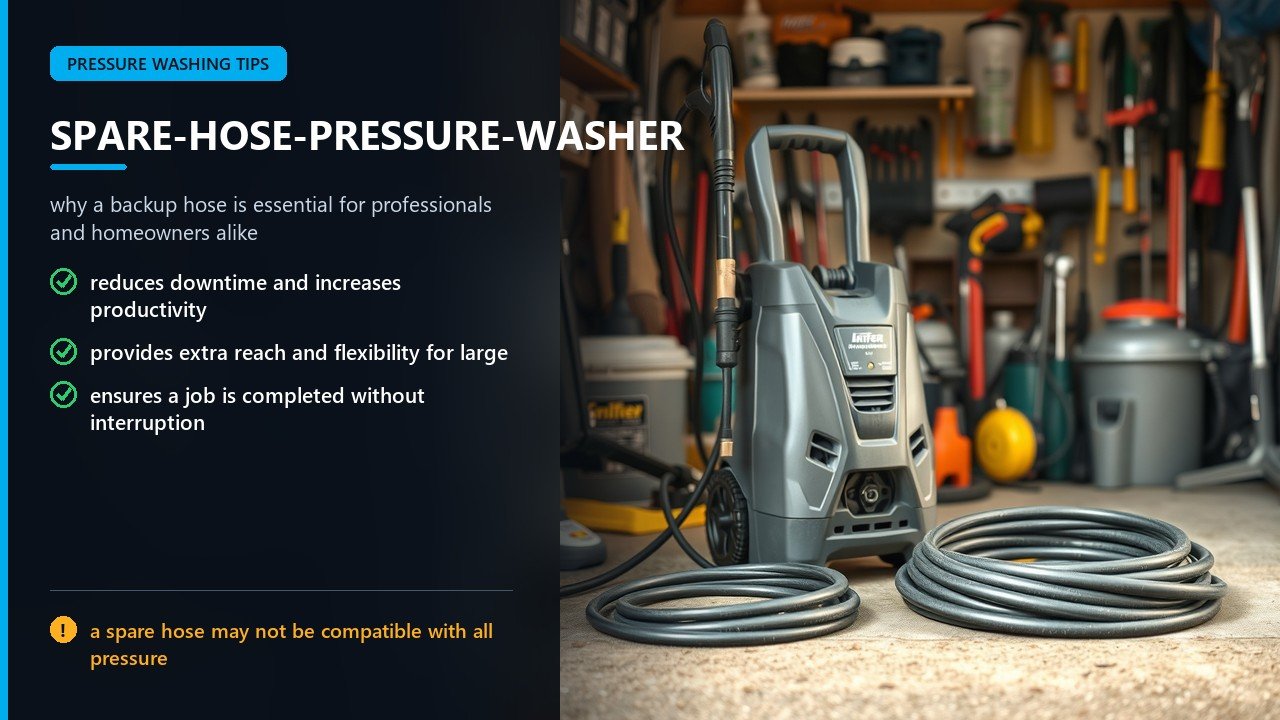
Why Carry a Spare Hose
Hoses are the most likely part of a pressure washer to fail because they take the most abuse. They are dragged over rough ground, run over, kinked, exposed to sun and heat, and constantly flexed at their fittings. Any of these can damage a hose, and once it fails under pressure it cannot be repaired — it must be replaced. A spare turns that replacement from a problem into a routine swap.
For professionals, a spare hose is not optional. A working cleaner who loses a hose mid-job loses time, money, and credibility, and driving to buy a replacement can cost more than the hose itself. Carrying a spare means the work continues and the failed hose is replaced later, which keeps the customer happy and the schedule intact.
For homeowners, the case is softer but still real. A spare hose lets a weekend project finish if the original hose fails, and it also gives extra reach when a job needs more length. Even a machine used a few times a year benefits from not being stopped by a single worn part.
What Makes a Good Spare
A spare hose should match the machine’s specifications, or its replacement becomes the next failure. The pressure rating must meet or exceed the machine’s output, the diameter must suit its flow, and the fittings must match the pump and gun or come with the right adapters. A spare that does not fit or does not seal is no spare at all.
The table below outlines what to check when choosing a spare.
| Consideration | What to look for |
|---|---|
| Pressure rating | At or above the machine’s output |
| Diameter | 1/4 inch for low flow, 3/8 inch for high flow |
| Length | Enough to reach the work; a spare can also add reach |
| Fittings | Correct ends, or adapters to match the machine |
| Material | Rubber for flexibility and heat; thermoplastic for light duty |
The simplest approach is to buy a second hose identical to the first. It fits without adapters, performs the same way, and can be swapped in without thought. If the spare is a different length, it is worth noting whether the extra length helps reach or adds unwanted pressure loss.
A Spare as Extra Reach
A spare hose serves two purposes. The first is obvious: it replaces a failed hose. The second is less obvious but just as useful — joined with a coupler, a spare hose extends the machine’s reach. Two hoses joined end to end make one longer run, which is handy for large driveways, tall siding, or any job where the machine cannot be moved close enough to the work.
Extending with a spare requires a hose coupler rated for the machine’s pressure, and it comes with a trade-off. The longer run adds resistance, so pressure at the nozzle drops slightly, and the extra length means the hose is more likely to kink if it is not handled carefully. For occasional extra reach the trade-off is well worth it; for constant long runs, a single longer hose is the better answer.
This dual role makes a spare more useful than a simple backup. The same hose that saves the job when the original fails can extend the job when more length is needed, so it earns its place in the kit even if the original hose never fails.
Spare Hose for Professionals
For anyone cleaning for money, spares are part of doing the job properly. A professional kit typically includes a spare hose, spare O-rings and fittings, spare nozzles, and often a spare gun or wand. These are the parts that fail, and having them on hand means a fault costs minutes rather than a lost day. The cost of the spares is trivial against the cost of downtime.
Professionals also rotate their hoses. Rather than wearing one hose to failure, they may keep two identical hoses and swap between them, so each wears evenly and each is inspected regularly. This rotation spreads the wear, keeps a known-good hose available, and makes it obvious when one is due for retirement.
Keeping the spare in good condition matters as much as having it. A spare that has been stored coiled tightly in the sun for two years may fail the moment it is used. Store the spare the same way you store the primary hose — loosely coiled, out of sun, away from heat and sharp edges — so it is genuinely ready when called on.
Choosing and Using a Spare
When choosing a spare, favour quality over price. A cheap spare hose that fails when used is worse than none, because it gives false confidence. Buy a hose rated for the machine, with proper crimped fittings and a material suited to the conditions, and treat it as a real part of the system rather than an afterthought.
Match the fittings to the machine or buy adapters. If the spare uses different connections, the adapters must be rated and on hand at the moment of need, or the spare cannot be fitted in an emergency. The cleanest solution is to standardise the whole setup on one quick-connect size so any hose fits any time.
Then use it wisely. A spare is there to keep work going, but a failed hose should still be replaced properly rather than patched, and the spare should itself be inspected and replaced when it shows wear. Treating the spare as the new primary and bringing in another backup keeps the system covered at all times.
Building a Spares Kit
A spare hose is most useful as part of a small spares kit. Alongside the hose, keep spare O-rings in the sizes and materials the machine uses, a spare nozzle or two, and any adapters needed to fit the spare to the machine. With those parts on hand, the common failures — a blown hose, a leaking connection, a clogged or worn nozzle — can all be dealt with on the spot.
Store the kit with the machine so it travels with the work. A spare hose locked in a garage is no help on a job. Keep it in a bag or box with the other spares, and know where it is. On a professional setup, the spares kit lives in the vehicle as standard equipment.
Keep the kit stocked and current. Replace used spares promptly so the kit is never depleted, and remove any part that has been sitting unused for years and may have degraded. A spares kit is only as good as its contents, and an out-of-date or empty kit provides false confidence.
Storing the Spare Correctly
How a spare hose is stored determines whether it works when needed. Coil it in large, loose loops rather than tight coils, because tight coiling creates permanent kinks and stresses the inner braid. Some reels and hooks are designed to hold hoses in wide loops, and these are ideal for storing a spare without damage.
Keep the spare out of direct sunlight and away from heat. UV breaks down the rubber and the outer cover, and heat accelerates the aging of the material, so a hose stored in a hot, sunny spot may fail early despite never being used. A shaded, dry location extends its life considerably.
Protect the fittings during storage. The crimped ends are vulnerable to corrosion and knocks, so store the hose so the ends are not crushed or left in damp conditions. Check the fittings before putting the spare into service, since a damaged end will leak at the worst moment.
Spare Hose Safety
The safety rules for a spare are the same as for any hose. Never repair a failed hose — replace it. Never use a spare with a bulge, cut, or damaged fitting. Never fit a spare rated below the machine’s pressure or temperature. A spare stored for years should be inspected carefully before use, because age alone can make a hose unsafe.
Match the spare’s rating to the machine exactly as you would the primary hose. A spare kept “just in case” that turns out to be under-rated is a hazard, not a help. The pressure and temperature ratings matter every bit as much on the backup as on the hose in daily use.
Finally, treat the spare as a working part of the system, not an emergency-only item. Inspect it, store it well, and rotate it into use so both hoses stay proven and ready.
Frequently Asked Questions
Do I need a spare pressure washer hose? It is a worthwhile backup. Hoses are the most likely part to fail, and a spare keeps a job going instead of stopping it. For professionals it is essential.
How do I choose a spare hose? Match the machine’s pressure and temperature ratings, the diameter to the flow, the length to your reach, and the fittings to the pump and gun. The simplest choice is a duplicate of the original.
Can a spare hose add reach? Yes. With a suitable coupling, two hoses join to extend reach, though the extra length adds some pressure loss. For frequent long runs, a single longer hose is better.
What else should be in a spares kit? Spare O-rings, a spare nozzle or two, and any adapters needed to fit the spare hose. These cover the most common failures.
How should I store a spare hose? Coil it in large loose loops, keep it out of direct sun and away from heat and sharp edges, and protect the fittings. Poor storage is why stored hoses fail early.
Should I rotate my hoses? Yes, especially professionals. Rotating two identical hoses spreads the wear, keeps a known-good hose available, and makes it clear when one needs replacing.
Can I use an old stored hose as a spare? Only after a careful inspection. Hoses degrade with age, so check for bulges, cuts, and damaged fittings. If in doubt, replace it.
Can a spare hose be repaired? No. A high-pressure hose cannot be safely repaired. Replace any failed hose with one rated at or above the machine’s pressure and temperature.
Final Thoughts
A spare hose is cheap, simple insurance against the most common pressure washer failure. For professionals, it is part of the job; for homeowners, it keeps a planned afternoon from being ruined. The same hose doubles as extra reach when a job needs more length, so it earns its place in the kit even if the original never fails.
Choose a spare that matches the machine, store it as carefully as the primary hose, and keep it ready with a few O-rings, nozzles, and adapters. Inspect any stored hose before use, never repair a failed one, and rotate your hoses so both stay proven. For related reading, see our guides on a pressure washer high pressure hose and a pressure washer reel and hose.