The first time I used a steam cleaner pressure washer on a commercial kitchen hood, I understood why old-school cleaners swear by steam. The heavy, baked-on grease that had resisted hot water and degreaser softened and slid away under a plume of vapor that seemed almost magical, and the surface was left nearly dry. There was no puddle to push, no chemical residue to rinse, and no film left behind. That is the promise of steam cleaning, and it comes from going beyond hot water into the realm of superheated vapor. This guide explains what a steam cleaner pressure washer is, how steam differs from hot water, what it cleans best, how the machines work, and what to consider before buying or using one.
What Steam Cleaning Actually Is
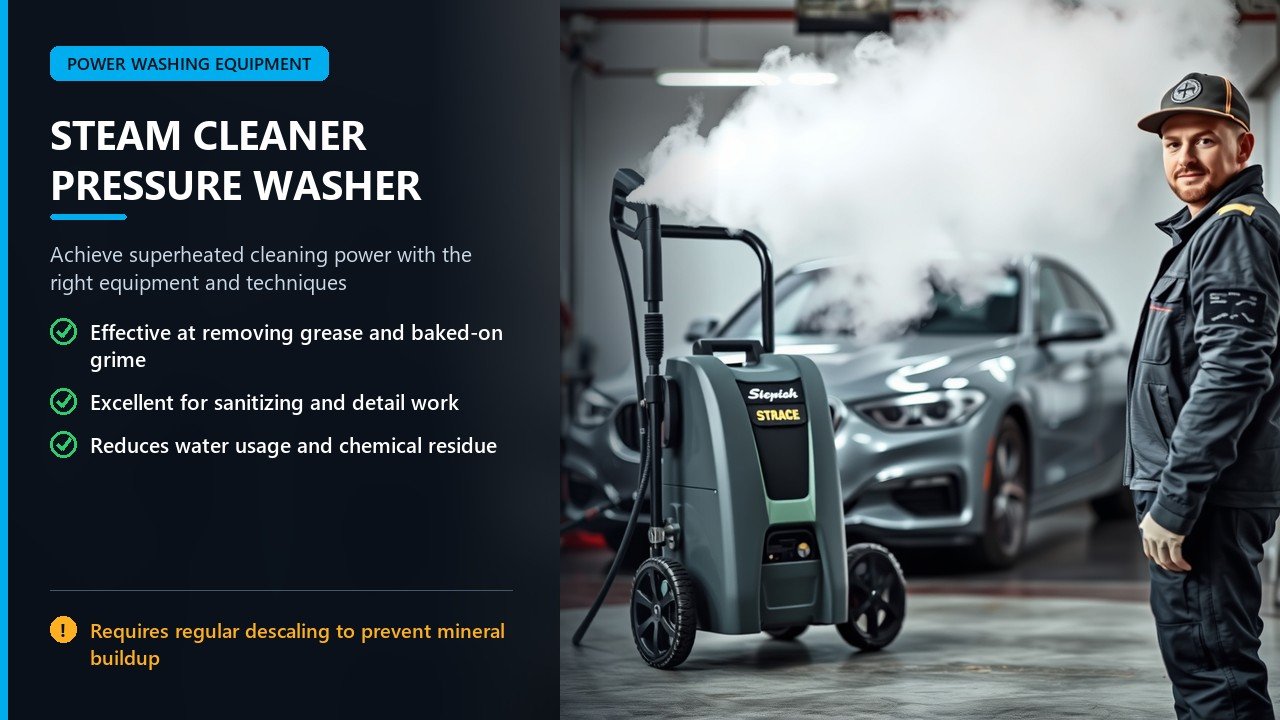
Steam cleaning uses water heated past its boiling point to create vapor, which transfers a great deal of heat to the surface with relatively little moisture. When that vapor contacts a cooler surface, it condenses and releases its heat, softening and lifting soil while leaving far less water behind than a hot water rinse.
The two defining qualities of steam are temperature and dryness. Steam is much hotter than hot water, and it carries less liquid water, so it penetrates and breaks down soil without flooding the surface. This combination makes steam uniquely suited to certain tasks, grease and sanitizing chief among them, and it explains why steam cleaning feels almost dry compared to conventional washing.
In a pressure washer context, steam is produced by heating water to high temperature, sometimes under pressure, so that it exits the nozzle as hot vapor or a high-temperature mist. Not every hot water pressure washer reaches true steam temperatures, so the term can mean different things. At the high end, dedicated steam machines produce genuine vapor for the most demanding cleaning and sanitizing. Understanding where a given machine falls on this spectrum is important when shopping.
Steam vs Hot Water
Steam and hot water are related but distinct, and knowing the difference clarifies what each does well.
Hot water cleans by softening grease and oils and helping chemicals work, at temperatures high enough to make a real difference but still liquid. It is excellent for general cleaning of greasy surfaces, and it is the standard for commercial cleaning. It is also safer and easier to manage than steam.
Steam goes hotter and drier. It melts grease quickly, penetrates crevices, sanitizes with heat, and leaves minimal moisture. This makes it superior for baked-on grease, sanitation, and situations where adding moisture is undesirable, such as cleaning electrical enclosures, machinery, or surfaces that should dry fast.
| Quality | Hot Water | Steam |
|---|---|---|
| Temperature | Hot but liquid | Superheated vapor |
| Moisture left behind | Substantial | Minimal |
| Grease removal | Strong with chemicals | Very strong from heat alone |
| Sanitizing | Limited by temperature | Heat-based sanitizing |
| Operator safety | Burns are a risk | Severe burn risk, more dangerous |
Steam is not universally better; it is specialized. For large flat surfaces, hot or cold water with a surface cleaner is often more efficient. For baked-on grease, crevices, and sanitation, steam excels. The best operators match the method to the job.
How a Steam Cleaner Pressure Washer Works
A steam-capable pressure washer heats water to high temperature in a heat exchanger or boiler, then delivers it through a hose and nozzle. The heat source is typically a fuel burner, diesel or propane, and the machine may pressurize the water as well, producing a high-temperature spray or vapor.
The key components include the pump, which moves the water, the heat source and coil or boiler, which raises the temperature, and the control system, which manages temperature and pressure. Some machines produce steam at low pressure, relying on heat for cleaning, while others combine high pressure with high temperature. The design affects both the cleaning action and the safety considerations.
Producing true steam requires more heat and careful temperature control than producing hot water, and it places more stress on the coil and components. This is why steam-capable machines tend to be heavier-duty and more expensive, and why they demand more careful maintenance, especially descaling, since scale inside a hot coil reduces performance and leads to overheating and failure. The machine’s ability to produce sustained steam, rather than just hot water, depends on its design and burner capacity.
What Steam Cleans Best
Steam’s heat and low moisture make it ideal for specific jobs.
Baked-on grease. Commercial kitchen hoods, ovens, grills, fryers, and exhaust systems are prime steam applications. Steam melts and lifts grease that resists hot water, often without heavy chemicals, which is a major advantage in food service.
Sanitizing. Heat is an effective sanitizer, and steam can sanitize surfaces without chemicals, which is valuable in food processing, healthcare, and any environment where chemical residues are unwelcome. This makes steam a tool for sanitation as well as cleaning.
Crevices and detail work. Vapor penetrates cracks, hinges, grout lines, and tight spaces where water and brushes struggle, making steam excellent for detailed cleaning.
Machinery and equipment. Steam cleans engines, machinery, and equipment with minimal moisture, reducing the risk of water damage to sensitive components and speeding drying.
Gum, adhesive, and residue. Steam softens sticky residues like gum, adhesives, and hardened spills, which lift away more easily under heat.
Delicate surfaces where chemical residue matters. Where a chemical-free result is important, steam cleans with heat and water alone.
The unifying strength is grease, sanitation, and low moisture. Where a job involves baked-on oil, the need for sanitizing, or a surface that must not be soaked, steam is often the best tool available.
The Low-Moisture Advantage
One of steam’s most underrated benefits is how little water it leaves behind.
Conventional pressure washing uses a lot of water, which must be managed, drained, and sometimes recovered because of runoff regulations. Steam uses far less liquid water because much of it flashes to vapor, so surfaces dry quickly and runoff is minimal. This matters in several ways. It reduces the risk of water damage to sensitive equipment and electrical areas. It speeds drying, so areas can be used sooner. It limits the volume of dirty runoff, which helps with environmental compliance and reduces cleanup. And it allows cleaning in places where a flood of water would be impractical or damaging.
The low moisture also means steam can clean in situations where adding water is problematic, such as around electrical panels, electronics, and indoor spaces sensitive to moisture. That said, operators must still manage what moisture there is, and steam is not a substitute for water in every situation. But for grease, sanitation, and sensitive surfaces, the low-moisture advantage of steam is a genuine benefit that distinguishes it from conventional washing.
Pressure and Flow Considerations
Steam cleaning reshapes the usual pressure and flow equation.
For steam, temperature often does much of the cleaning, so high pressure is less essential than for cold water blasting. A steam cleaner can clean baked-on grease with moderate pressure and high temperature, relying on heat to break the soil’s bond rather than on sheer impact. This can also be gentler on surfaces, since less force is needed.
At the same time, the machine still needs adequate water supply to produce steam continuously, and the burner must be sized to heat the water to steam temperatures at the flow rate used. As with any heated pressure washer, higher flow requires more burner capacity to reach a given temperature. The balance between temperature, pressure, and flow determines the machine’s cleaning action and its suitability for different jobs. When evaluating a steam-capable machine, look at its achievable temperature at working flow, not just a headline maximum, because that is what determines whether you get real steam performance on the job.
Water Supply for Steam Machines
Steam-capable machines, like other heated pressure washers, require a reliable water supply and usually benefit from a buffer tank.
A starved pump suffers cavitation damage, and a machine that must produce steam continuously needs steady water flow. On commercial work, a buffer tank with a float valve ensures the machine is never starved, and a filter protects the pump and the heat exchanger from debris. Because a hot coil is especially vulnerable to scale, clean water and filtration are even more important for steam machines than for cold-water units.
Planning the water supply also means planning for the low runoff that steam produces. While steam leaves less water behind, the water it does produce is dirty and may be regulated, so containment or recovery may still be needed. As with any commercial cleaning, matching the water supply and runoff plan to the machine and the job keeps the operation productive and compliant.
Safety: The Serious Side of Steam
Steam is one of the most dangerous forms of cleaning energy because of its heat.
Severe burns. Steam and superheated water cause serious burns almost instantly. The operator must treat the nozzle and the vapor stream with extreme care, keep the spray away from skin, and never point it at anyone. Even brief contact with steam or superheated water can cause deep burns.
Pressure hazards. Steam under pressure carries stored energy, and a failed hose, fitting, or connection can release scalding vapor violently. Use only components rated for steam temperature and pressure, and inspect hoses and fittings regularly.
Carbon monoxide. Fuel-fired steam machines produce exhaust and carbon monoxide, so they must be operated outdoors or with engineered ventilation, never in enclosed spaces without proper exhaust management. The CDC carbon monoxide guidance explains the danger.
Electrical hazards. Using steam or water near electrical equipment requires great care, even though steam leaves less moisture. Isolate power where possible and keep the spray away from live components.
Scalding surfaces. Steam heats surfaces rapidly, and the surface itself can become hot enough to burn. Be aware that the object being cleaned may be dangerous to touch immediately afterward.
Cost and Buying Considerations
Steam-capable machines cost more than cold or hot water units, reflecting the higher temperatures, heavier components, and more demanding engineering. Beyond the machine, consider the burner fuel, the water supply system, and the maintenance the machine requires, particularly coil descaling, which is critical for steam performance.
When buying, determine what you actually need. Some machines produce hot water and can reach steam-like temperatures, while others produce true high-temperature steam. Read the specifications carefully, focusing on achievable temperature at working flow and the machine’s intended applications. A machine marketed as a steam cleaner may or may not produce genuine steam, so verify the details.
The return on investment depends on the work. For businesses cleaning baked-on grease, sanitizing, or working in low-moisture-sensitive environments, steam capability can be essential and well worth the cost. For general cleaning, a hot water machine or even a cold-water machine may suffice at lower cost. As always, match the machine to the jobs you actually do, and account for the maintenance and safety demands that steam brings.
Maintenance, Especially Descaling
Steam machines require disciplined maintenance, and descaling is the most critical item.
Hard water leaves mineral scale inside the heat exchanger coil, and at steam temperatures scale forms faster and does more damage than in hot water machines. Scale insulates the coil from the flame, reducing heat output and eventually causing overheating and coil failure. Descaling on a schedule based on your water hardness is essential, and using filtered or softened water dramatically reduces how often it is needed. For a steam machine, water quality is not a minor concern; it is central to reliability.
Beyond descaling, service the burner regularly, including its nozzle, electrodes, and air settings, because clean combustion is what produces the heat. Replace fuel filters on schedule, keep the water supply filtered, change the pump oil correctly, and inspect hoses and fittings for heat damage, since steam temperatures stress them more than cold water. Test safety and control systems regularly. Finally, winterize the machine thoroughly, because freezing water cracks coils and pumps, and a cracked coil on a steam machine is an expensive failure. With disciplined maintenance, a steam machine delivers years of powerful, specialized cleaning; without it, scale and heat damage shorten its life dramatically.
Wet Steam vs Dry Vapor
The term steam covers a range of moisture levels, and understanding the difference helps you know what a machine actually delivers.
Wet steam is water vapor carrying a significant amount of suspended liquid water. It transfers a lot of heat and volume but leaves more moisture behind. Many hot water pressure washers produce something in this range at their highest temperatures, a very hot, misty spray rather than truly dry vapor.
Dry vapor contains little suspended liquid, so it delivers heat with minimal moisture. This is what people mean by true steam cleaning: intense heat, fast drying, and excellent penetration into crevices, with almost no water left behind. Producing dry vapor requires higher temperatures and more careful control, which is why dedicated steam machines cost more than hot water units.
The practical difference shows up in the work. Dry vapor is better for situations where moisture is a problem, such as electrical areas, machinery, and surfaces that must dry quickly. Wet steam, being hotter and more voluminous than plain hot water, still cleans grease well and may be sufficient for many jobs at lower cost. When shopping, ask specifically what the machine produces at its highest setting, because “steam” alone does not tell you whether you are getting wet steam or dry vapor. Matching the moisture level to your application prevents disappointment and ensures the machine performs as you expect. For most commercial grease cleaning, a hot water or wet steam machine suffices, while true dry vapor is reserved for the applications that genuinely require it.
Steam Cleaning Applications in Depth
Looking at specific applications shows where steam earns its place.
Commercial kitchen exhaust systems. Hoods, filters, and ductwork accumulate heavy grease that is both a fire hazard and a cleaning challenge. Steam melts the grease, often without heavy chemicals, and the low moisture keeps the kitchen functional sooner. This is one of steam’s strongest use cases.
Cooking equipment. Grills, griddles, ovens, fryers, and ranges are cleaned with steam, which reaches baked-on carbonized grease and lifts it, restoring equipment without abrasive scrubbing.
Food processing and sanitation. Where sanitation is required and chemical residues are unwelcome, steam provides heat-based cleaning and sanitizing, valuable for production equipment and surfaces.
Vehicle interiors and detailing. Steam cleans upholstery, carpets, vents, and crevices with minimal moisture, drying quickly and reaching places liquid water would saturate, which is why detailers use steam for interiors.
Machinery and engines. Greasy machinery and engine bays are cleaned with steam, which cuts grease while limiting water that could damage electrical components and bearings.
Graffiti and residue removal. Steam helps soften paint, gum, adhesives, and stubborn residues, sometimes in combination with other methods.
In each case, the theme is grease, sanitation, or low moisture. Steam is not the fastest way to clean a large flat driveway, but it is often the best way to clean a greasy hood, sanitize equipment, or detail a surface that must not be soaked. Knowing these applications lets an operator deploy steam where it delivers the most value.
Choosing Between Steam, Hot Water, and Cold Water
Steam is one option among several, and choosing well means matching the method to the job.
Cold water is the most economical and simplest. It handles dirt-based cleaning, such as driveways, siding, and general exterior surfaces, well when paired with adequate pressure and the right technique. For most residential and light commercial cleaning, cold water suffices, and it is the lowest-cost and lowest-maintenance choice.
Hot water adds heat to soften grease and improve chemical performance, making it the standard for commercial cleaning of greasy surfaces. It is a strong balance of capability, cost, and safety, and it handles the majority of professional cleaning, from kitchens to fleets.
Steam adds the most heat and the least moisture, excelling at baked-on grease, sanitizing, and detail work where moisture is a problem. It costs the most, requires the most maintenance, and carries the greatest safety risk, so it is reserved for the applications that genuinely need it.
A sensible approach for a cleaning business is to own equipment that covers the range, using cold water for general cleaning, hot water for greasy commercial work, and steam for the specialized jobs that demand it. If you must choose one, hot water covers the widest range of professional needs, with steam added when the work justifies it. The goal is not to own the most powerful option but to match your equipment to the work you actually do, so that each machine earns its place.
Common Mistakes With Steam Cleaning
A few errors reduce steam’s effectiveness and increase its risks.
Neglecting descaling. The most costly mistake. Scale wrecks a steam machine’s coil and heat output. Descaling on schedule and using clean water is essential.
Using a machine that is not rated for steam. Some machines marketed as steam cleaners produce only hot water. Verify the machine’s actual temperature and moisture output for your application.
Ignoring safety. Serious burns and pressure injuries result from treating steam casually. Protective equipment, rated components, and careful handling are mandatory, not optional.
Running fuel-fired machines indoors. Carbon monoxide from the burner is lethal. Operate outdoors or with engineered ventilation, always.
Using steam where water is better. For large flat surfaces and dirt-based cleaning, hot or cold water is faster and cheaper. Steam is specialized, not universal.
Starving the water supply. Even a steam machine needs steady water, and a starved pump cavitates and fails. Provide adequate supply and filtration.
Tip: Keep a descaling schedule tied to your water hardness and track it, because descaling is easy to forget and expensive to neglect. Log the date of each descaling and the water source, and use filtered or softened water wherever possible. Your coil will last far longer, and your heat output will stay strong.
Steam Cleaner Pressure Washer: Frequently Asked Questions
What is a steam cleaner pressure washer? A pressure washer that heats water to steam temperatures, producing superheated vapor for cleaning grease, sanitizing, and detail work with minimal moisture.
Is steam better than hot water? Not universally. Steam excels at baked-on grease, sanitizing, and low-moisture cleaning. Hot water is often better for large-area general cleaning. Match the method to the job.
Do I need chemicals with steam? Often not. The heat of steam does much of the work, which is a major advantage in food service and anywhere chemical residues are unwelcome.
Is a steam cleaner pressure washer safe? It can be safe with care, but steam causes severe burns almost instantly and carries pressure hazards. Proper protective equipment, rated components, and strict safety practices are essential.
Why is descaling important for a steam machine? Hard water scale forms rapidly at steam temperatures, reducing heat and eventually causing overheating and coil failure. Regular descaling and filtered water are critical.
What is the best use for a steam cleaner pressure washer? Commercial kitchen hoods, grills, and ovens, sanitizing surfaces, cleaning machinery with minimal moisture, and detailing crevices and tough residues.
Final Verdict on Steam Cleaner Pressure Washers
A steam cleaner pressure washer is a specialized, powerful tool that goes beyond hot water into superheated vapor. It melts baked-on grease, sanitizes with heat, penetrates crevices, and leaves minimal moisture behind, making it uniquely suited to food service, sanitation, machinery, and detail work. For businesses facing those jobs, steam is often the best tool available, and it can reduce chemical use and runoff in the bargain.
Its power comes with demands. Steam machines cost more, require more maintenance, especially descaling, and are far more dangerous to operate than cold-water units, so protective equipment and disciplined safety are non-negotiable. Choose a machine that produces the temperature you actually need at working flow, feed it clean water, descale it on schedule, and respect its heat. Do that, and a steam cleaner pressure washer becomes an indispensable part of a professional cleaning operation, handling the jobs that ordinary pressure washing cannot. For the right work, there is nothing else quite like it.