I watched a maintenance crew clean a commercial kitchen hood that day, and the transformation was startling. The thick, baked-on grease that had resisted scrubbing for years dissolved under a jet of superheated vapor that left no puddle, no chemical residue, and no wiping, just a clean surface. The machine doing the work was a steam pressure washer, and it demonstrated what makes these tools special: heat so intense it melts grease and sanitizes surfaces, often with very little water and no chemicals. Steam pressure washers occupy a powerful niche in cleaning, and this guide explains what they are, how they work, where they excel, and how to choose one.
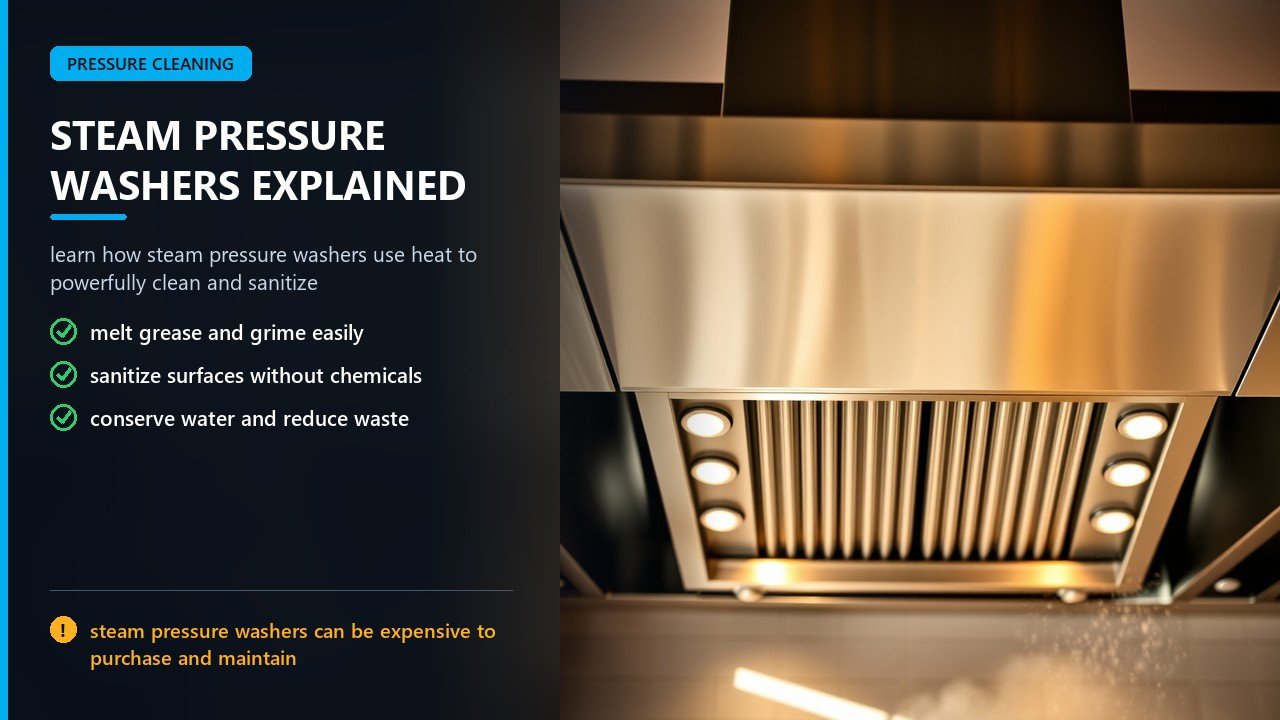
What Is a Steam Pressure Washer
A steam pressure washer is a cleaning machine that heats water to a high temperature and delivers it, often as a mixture of steam and hot water, to a surface under pressure. The defining characteristic is heat: these machines produce very hot water or saturated steam, far hotter than a standard hot water pressure washer, and use that heat as a primary cleaning tool alongside pressure.
The terminology can be confusing, because “steam pressure washer” describes a spectrum. Some machines produce true steam, often called “dry steam,” which is vapor with very little water content. Others produce “wet steam,” a mixture of steam and hot water droplets. Still others are hot water pressure washers operating at high temperatures that approach steam conditions. What they share is intense heat delivered under pressure, and the cleaning power that heat provides.
The heat does much of the work. Grease, oil, and baked-on residue soften and dissolve at high temperatures far more readily than under cold water, so steam machines clean stubborn soils that cold water cannot, often without chemicals. Because the heat is so effective, steam cleaning frequently uses less water, since the temperature, not volume, does the cleaning. This combination of heat and modest water use gives steam pressure washers their distinct advantages and their specific niche.
How Steam Pressure Washers Work
Understanding the mechanism helps explain their capabilities and limits.
Water is heated in a coil or heat exchanger, typically by a fuel burner but sometimes electrically, raising it to a high temperature. Some machines pressurize the heated water further to produce superheated water or steam. The result is delivered through a hose and nozzle to the surface. Because heating water to steam expands it enormously in volume, steam machines can produce a large volume of cleaning vapor from a modest amount of water, which is why they can clean effectively with low water consumption.
The temperature and the state of the output, wet or dry steam or hot water, depend on the machine’s design. Dry steam is vapor with minimal moisture, effective for sanitizing and cleaning where water must be limited. Wet steam carries more water and provides more rinsing action, suited to heavy greasy soil. Hot water machines provide the highest water volume and pressure, best for thorough washing where water is not a concern. Each has its place, and the choice depends on the cleaning task.
Pressure plays a role too, but in steam cleaning, heat often dominates. Machines may deliver steam at relatively low pressure compared to conventional pressure washing, using temperature rather than force to clean, which also reduces the risk of damaging delicate surfaces and the amount of water used. Understanding this balance of heat, pressure, and water content is key to selecting and using a steam pressure washer effectively.
| Output Type | Characteristics | Best For |
|---|---|---|
| Dry steam | Vapor, minimal water | Sanitizing, low-water cleaning, delicate areas |
| Wet steam | Steam plus hot water droplets | Heavy grease, general degreasing |
| Hot water (high temp) | High-volume hot water | Thorough washing, heavy soil with water |
Heat, Temperature, and Sanitizing
The high temperature is central to what steam pressure washers do.
Heat at steam temperatures softens and dissolves grease, oil, and many residues almost instantly, which is why steam cleaning excels on baked-on and greasy soils. It also provides a sanitizing effect, since high temperature kills many microorganisms on contact, which is valuable in food service, healthcare, and other settings where hygiene matters. This sanitizing power often reduces or eliminates the need for chemical disinfectants, making steam an appealing option where chemical residues are undesirable. The CDC emphasizes effective cleaning as a foundation of hygiene.
The exact temperature required and the time needed for sanitizing depend on the application and the organisms involved, and steam machines reach temperatures well above what hot water units produce. For many food-contact and grease-cleaning tasks, steam’s heat is both an effective cleaner and a sanitizing agent in one step, which is a significant advantage. This is why steam pressure washers are common in food processing, commercial kitchens, and healthcare, where both cleaning and hygiene are crucial and chemical-free or low-residue cleaning is valued. The heat does double duty, cleaning and sanitizing, which streamlines the work and improves results.
The Benefits of Steam Pressure Washers
The advantages of steam cleaning are substantial in the right applications.
Superior degreasing. Heat melts grease and oil that cold and even hot water struggle with, cleaning stubborn soils quickly and thoroughly, often without chemicals.
Sanitizing. High temperature kills many microorganisms, meeting hygiene needs in one step alongside cleaning, valuable in food and healthcare settings.
Low water use. Because heat does the cleaning, steam machines often use far less water, which matters where water is scarce, costly, or unwanted, and reduces runoff.
Chemical-free or low-chemical cleaning. Steam can clean and sanitize without chemicals, avoiding residues and the handling and cost of cleaning agents, desirable in food processing, healthcare, and environmentally sensitive settings.
Reach and detail. Steam penetrates crevices, grilles, and complex surfaces, cleaning areas that are hard to reach and residue that is hard to dislodge.
Reduced drying time. With less water used, especially dry steam, surfaces dry faster, which is valuable in some processes and settings.
These benefits come with tradeoffs: steam machines cost more, use fuel or significant electricity, require more maintenance for their burners and coils, and may be less suited to high-volume washing where large amounts of water are needed. But in the applications that value heat, sanitizing, and low water use, steam is unmatched, and the value it delivers justifies its complexity and cost.
Where Steam Pressure Washers Excel
Certain applications are natural fits for steam cleaning.
Commercial kitchens. Hoods, vents, grills, fryers, and ovens accumulate baked-on grease that steam dissolves. Steam cleaning restores these surfaces quickly and sanitizes them, often without chemicals, which is ideal around food.
Food processing and manufacturing. Where hygiene and grease removal are critical and chemical residues are undesirable, steam cleans and sanitizes conveyors, equipment, and surfaces effectively.
Healthcare and institutions. Steam sanitizes surfaces, restrooms, and equipment, supporting hygiene with reduced chemical use.
Automotive and heavy equipment. Engine bays, undercarriages, and greasy parts benefit from steam’s degreasing power, and steam can clean delicate areas with less water and lower pressure.
Industrial settings. Machinery, floors, and equipment with grease and grime clean well with steam, especially where water use must be limited.
Facilities and janitorial. Restrooms, grout, tile, and fixtures clean and sanitize with steam, and dry steam suits upholstery and surfaces where excess water is a problem.
In these settings, steam’s combination of heat, sanitizing, and low water use delivers results that other methods cannot match. Where grease, hygiene, and water constraints converge, steam pressure washers become the tool of choice, which is why they are standard equipment in commercial kitchens and food production. Our guide to a hot water pressure washer trailer covers mobile hot water rigs for commercial work.
Steam vs Hot Water vs Cold Water
Comparing the three clarifies which suits a task.
Cold water pressure washers rely on pressure and water volume, plus chemicals, for cleaning. They are simple, affordable, and effective for many tasks but struggle with grease and offer no sanitizing.
Hot water pressure washers heat water significantly, improving grease removal and cleaning speed, and are the standard for heavy-duty commercial cleaning where water volume is not a concern. They clean better than cold water but do not reach steam temperatures and use more water than steam.
Steam pressure washers reach the highest temperatures, providing superior degreasing and sanitizing with the least water, but are more complex, costly, and maintenance-intensive, and may be less productive for high-volume washing.
Choosing among them depends on the task. Where grease, hygiene, and water use are the priorities, steam wins. Where large-scale washing with plenty of water is needed, hot water is often more productive. Where the work is routine and grease is minimal, cold water suffices. Many operations use more than one, matching the machine to the job, and understanding the differences ensures the right tool is applied to each task rather than forcing one machine to do everything.
Choosing a Steam Pressure Washer
Selecting one requires attention to several factors.
Output type and temperature. Decide whether you need dry steam, wet steam, or high-temperature hot water, based on your cleaning tasks and whether water use is constrained. Confirm the machine reaches the temperature your work requires.
Heat source. Fuel-fired burners provide the most heat and suit heavy-duty use, while electric heating suits smaller or indoor applications where emissions are a concern.
Capacity. Match the machine’s output to your workload, considering that steam cleaning is often slower per unit area than high-volume washing but more effective on grease.
Build quality. Steam machines work hard and need durable pumps, coils, and burners, so quality matters for reliability and service life. Reputable brands with parts and service support are worth the investment.
Maintenance needs. Steam machines require burner service and coil descaling, so consider the maintenance burden and your ability to meet it.
Portability and setup. Decide whether you need a stationary unit, a portable machine, or a mobile trailer rig, and plan for fuel, water, and ventilation.
Support and parts. Ensure service and replacement parts are available, because steam machines are complex and will need maintenance.
Considering these factors ensures the machine suits your applications and your operation’s ability to maintain it. A steam pressure washer is a significant investment, and matching it to the work, rather than choosing on heat alone, determines whether it delivers value or becomes an expensive, underused machine.
Safety and Maintenance
Steam pressure washers demand respect for their heat and require diligent maintenance.
Safety. Steam and superheated water cause severe burns, so use proper protective gear, including gloves, eye protection, and clothing, and never direct steam at skin or at people. The combination of high temperature and pressure is dangerous, and the heat hazard is greater than with cold machines. Vent fuel-fired units safely, since burners produce carbon monoxide. Allow machines to cool before servicing, and relieve pressure before opening anything.
Maintenance. Descale the heating coil regularly, because mineral scale insulates the coil, reduces efficiency, and can cause damage or failure. Service the burner, keep fuel clean, and maintain the pump and seals. Change oils and filters on schedule, and winterize to prevent freeze damage. Because steam machines run hot and work hard, maintenance is more intensive than for cold machines, and skipping it leads to costly failures and poor performance.
Proactive maintenance keeps a steam machine efficient and reliable, and respecting the heat and pressure keeps the operator safe. A well-maintained steam pressure washer delivers years of powerful, sanitizing cleaning, while a neglected one loses efficiency, fails, and becomes dangerous. Treat the maintenance schedule as essential, not optional, and the machine will justify its place in your operation. Our guide to pressure washer repair kits covers fixing the failures that maintenance prevents.
Steam Cleaning in Food Processing and Kitchens
No setting values steam pressure washers more than food service and food processing, where grease, hygiene, and chemical avoidance align perfectly.
Commercial kitchens are defined by grease. Hoods, ductwork, filters, grills, griddles, fryers, ovens, and ventilation surfaces accumulate layers of baked-on grease that cold and hot water struggle to remove. Steam dissolves this grease rapidly, restoring surfaces without the laborious scrubbing and harsh chemicals that traditional hood cleaning requires. The heat also sanitizes, addressing the bacterial concerns of food environments, and because steam can clean without chemical residue, it is ideal around food-contact surfaces.
Food processing and manufacturing present similar demands at larger scale. Conveyors, mixers, vats, tables, and equipment must be cleaned and sanitized regularly to prevent contamination, and residues must not linger. Steam cleans and sanitizes in one step, reaching crevices and complex surfaces that manual cleaning misses, and it does so with less water and fewer chemicals, which reduces contamination risk and costs. Regulatory and hygiene demands make effective, residue-free cleaning essential, and steam meets them well.
Beyond the kitchen, food retail, catering, and any operation handling food benefit from steam’s cleaning and sanitizing power. The combination of grease removal and hygiene, with minimal water and chemical use, makes steam pressure washers standard equipment in these settings, and it explains why they command a premium, because the value they deliver in food safety and labor savings is substantial. For these operations, steam is not a luxury but a practical, cost-effective necessity.
Combining Steam with Other Methods
Steam is powerful, but it is often best used alongside other cleaning methods rather than as a sole solution.
For large surfaces with light soil, a conventional pressure washer may be faster, while steam handles the greasy, detailed, and hygiene-critical areas. Some operations use steam for degreasing and sanitizing and a pressure washer for rinsing and broad washing, matching each tool to its strength. Chemicals can complement steam for certain soils, though the value of steam often includes avoiding them, so many users minimize chemical use for the hygiene and residue benefits.
Steam also complements manual cleaning, loosening soil so it can be wiped or brushed away, and it works well for detail areas, crevices, and equipment that cannot be submerged or heavily wetted. In automotive cleaning, steam handles engine bays and greasy parts while pressure washing handles the body and wheels. In facilities, steam cleans and sanitizes restrooms and fixtures while conventional methods handle floors and larger areas.
The practical approach is to see steam as one tool in a cleaning arsenal, applied where its heat, sanitizing, and low-water properties add the most value. A well-equipped operation may have steam, pressure washing, and manual methods available, using each where it excels. This matching of method to task produces the best results at the lowest cost and effort, and it is how professional cleaning operations achieve efficiency. Steam’s unique capabilities make it indispensable for certain tasks, and integrated with other methods, it elevates the overall cleaning capability.
Cost and Return on Investment
Steam pressure washers cost more than cold or hot water machines, so the investment deserves consideration.
The purchase price is higher because of the robust heating systems, high-temperature components, and the engineering required to produce and handle steam or superheated water safely. Operating costs include fuel or electricity for heating, water, and the maintenance that steam machines require, particularly burner service and coil descaling, which are more intensive than for simpler machines.
The return comes from what steam enables. In commercial kitchens, steam cleaning reduces labor dramatically by dissolving grease that would otherwise require extensive scrubbing, and it reduces chemical costs and the labor of chemical handling. The hygiene benefit supports food safety and compliance, which has real business value. In food processing and healthcare, steam’s sanitizing and residue-free cleaning meet requirements that other methods struggle to meet, enabling compliance and quality. The low water use can reduce water and disposal costs and support sustainability goals.
For operations where grease, hygiene, and water constraints are central, the return on a steam machine can be substantial, paid back through labor savings, chemical reduction, compliance, and quality. For operations with light cleaning needs, the cost is harder to justify, and a conventional machine may be more appropriate. As always, the machine should follow the work that pays for it, and where the work calls for steam’s capabilities, the investment makes strong economic sense. The operators who rely on steam do so because it pays for itself in results and savings, not because it is fashionable.
Steam Pressure Washers: Frequently Asked Questions
What is the difference between a steam pressure washer and a hot water pressure washer? Steam machines reach much higher temperatures, often producing wet or dry steam, while hot water machines heat water significantly but do not approach steam. Steam cleans and sanitizes with less water.
Do steam pressure washers kill bacteria? The high temperature kills many microorganisms on contact, providing a sanitizing effect. The exact requirements depend on the application and organisms, but steam supports hygiene in food and healthcare settings.
Are steam pressure washers better than hot water? For grease, sanitizing, and low water use, yes. For high-volume washing where water is plentiful, hot water can be more productive. The best choice depends on the task.
Do steam pressure washers use less water? Often yes, because heat does much of the cleaning, so less water volume is needed. This is a major advantage where water is scarce, costly, or unwanted.
What are the main applications? Commercial kitchens, food processing, healthcare, automotive, industrial cleaning, and facilities, wherever grease, hygiene, and reduced water use matter.
Are steam pressure washers hard to maintain? They require more maintenance than cold machines, especially burner service and coil descaling, because they run hot and work hard. Diligent maintenance is essential.
Final Verdict on Steam Pressure Washers
Steam pressure washers bring intense heat to cleaning, dissolving grease, sanitizing surfaces, and doing so with little water and often no chemicals. In commercial kitchens, food processing, healthcare, and heavy degreasing, they deliver results that cold and hot water machines cannot, and their sanitizing power makes them valuable wherever hygiene matters.
They are not for every task. They cost more, need more maintenance, and may be less productive than high-volume washing where water is plentiful. But where grease, hygiene, and water constraints converge, steam is unmatched, which is why it is standard in the settings that need it most. Choose carefully, match the machine to the work, maintain it diligently, and respect its heat, and a steam pressure washer becomes a powerful, versatile tool. The kitchen crew cleaning that hood watched years of grease vanish under superheated vapor, and they knew exactly why steam is worth its complexity. In the right hands and the right application, it is a remarkable cleaning force.