A surface cleaner for a pressure washer is one of the most valuable attachments you can add. Also called a rotary cleaner or whirlaway, it turns a single high-pressure jet into a wide, spinning cleaning path under a hood, letting you clean driveways, patios, and paths far faster and far more evenly than a wand. For anyone with a lot of flatwork, it is close to essential.
This guide explains what a surface cleaner does, how to choose the right one for your machine, and how to use and look after it.
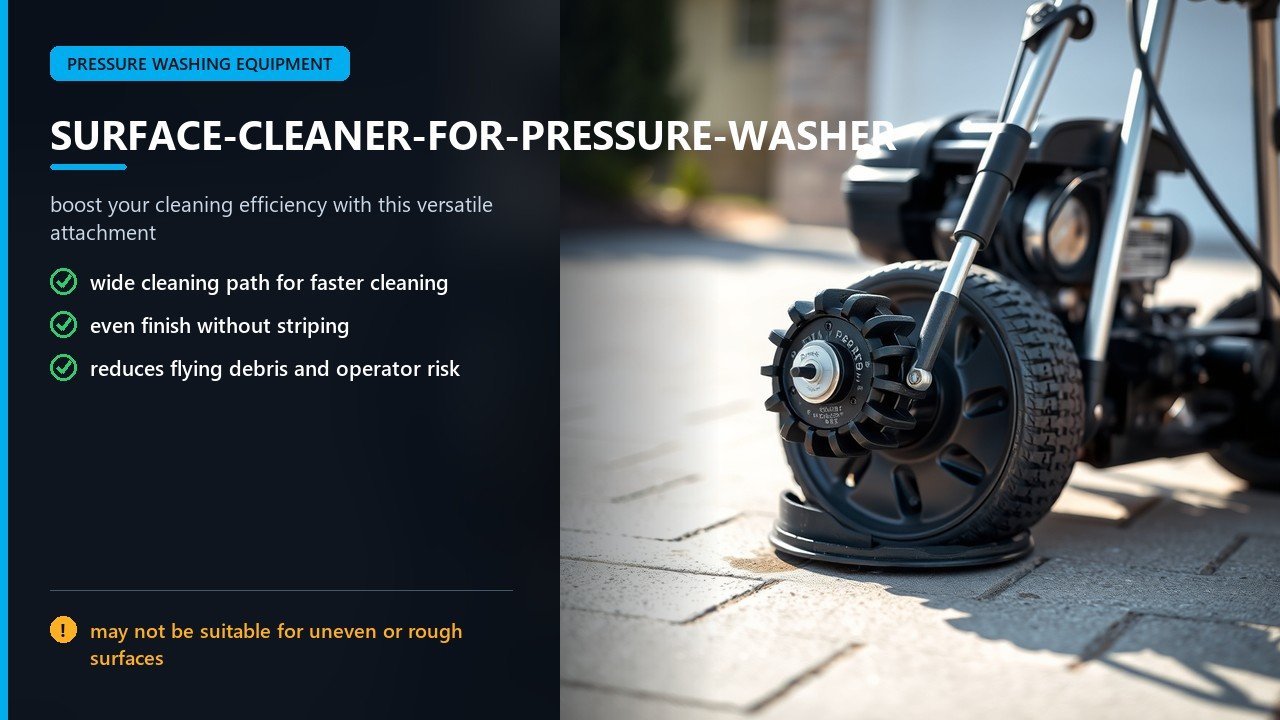
What a Surface Cleaner Does
A surface cleaner is a hooded attachment on wheels or a hover skirt that houses one or more rotating spray bars. The high-pressure water spins these bars, and the nozzles spray down onto the surface as the hood moves over it. Because the jet passes quickly and repeatedly over each point, the surface is cleaned evenly without the concentrated line a single wand jet leaves.
The benefits are speed and consistency. The wide cleaning path covers ground much faster than a wand, and the rotating spray eliminates the striping that wand work produces, giving an even finish. The hood also contains much of the spray and the flying debris, making the job cleaner and safer for the operator.
Surface cleaners come in different sizes and configurations, from small units for a home driveway to large professional models that cover a wide swath. They are designed for flat, hard surfaces such as concrete, block paving, and some stone, and they attach to the machine’s hose or gun, usually through a quick-connect fitting.
How It Works With Your Machine
A surface cleaner does not create pressure or flow; it uses the pressure and flow your machine provides. Its rotating nozzles are sized to a particular flow and pressure, so the cleaner must be matched to the washer. A cleaner rated for a larger flow than the machine delivers will spin slowly or not at all and clean poorly, while a cleaner matched to the machine spins fast and cleans well.
Because the jet is spread across a wider area, a surface cleaner uses the machine’s output efficiently, and it is generally gentler on the surface than a wand held in one spot. It also cleans more uniformly, since the rotating bars pass over each point several times. The trade-off is that a cleaner is less able to reach edges and tight spots, so a wand is still needed for the perimeter.
Most surface cleaners connect by quick-connect to the high-pressure hose or gun, and some have a trigger gun mount or a separate handle. Matching the connection type to your machine, and using properly rated fittings, keeps the cleaner working safely and lets you switch between cleaner and wand quickly.
Types of Surface Cleaner
Surface cleaners come in a few broad types. The common domestic type is a wheeled or hover unit with a rotating bar and a single cleaning head, sized for the pressure and flow of home machines. On the smallest machines, a hover design uses the water spray to float the head just above the surface, while larger units run on wheels for easier pushing.
Professional cleaners can be larger, sometimes with a front and rear spray bar or multiple rotating arms, covering a wider path and built for heavy, sustained use. These need substantial flow and pressure to drive, so they suit commercial machines rather than domestic ones. There are also smaller, handheld rotary nozzles and turbo attachments, but these are different tools, best suited to spot work rather than whole-surface cleaning.
The core principle is the same across types: one or more rotating jets under a hood, matched to the machine’s output. The differences are in size, build quality, and how the head moves. A cleaner matched to the machine and sized to the work is far more useful than either an oversized unit the machine cannot drive or an undersized one that takes forever.
Choosing the Right Cleaner
The first thing to match is flow and pressure. Manufacturers rate surface cleaners for a range of GPM and PSI, and the cleaner’s nozzles determine how much flow it needs. Choose a cleaner whose rating covers your machine, with the nozzles sized to your flow. This is the single most important compatibility check, since a mismatched cleaner will not perform.
Size matters next. A larger cleaner covers more ground per pass but needs more flow to spin properly and is heavier to handle. A smaller cleaner suits lighter machines and tighter spaces. For a typical home machine, a cleaner in the 12- to 16-inch range is usually a good balance, while larger machines can drive bigger, faster cleaner heads.
Consider the build and the wheels or skirt. Sturdy construction, quality bearings in the rotating assembly, and good nozzles make a cleaner last, and smooth-rolling wheels or a durable skirt make it easy to handle. Cheaper cleaners can be hard to push, spin unevenly, or fail at the swivel, so it is worth buying one matched to the machine and built to last. Check the connection type so it fits your machine without awkward adapters.
Using a Surface Cleaner
Using a surface cleaner is simple once it is set up. With the machine running, hold the handle and push or pull the cleaner slowly and steadily across the surface, overlapping each pass slightly. Let the spinning nozzles do the work; do not press down or rush, since a steady pace gives an even finish. Work in sections and overlap the edges so no strip is missed.
Start with the right pressure and the correct nozzles for the surface. On concrete, a surface cleaner can be used at full machine pressure; on softer paving, take care with the pace and pressure to avoid disturbing joint sand. Because the cleaner covers the surface evenly, it is gentler than a wand, but it can still damage soft or poorly laid surfaces if used carelessly.
After cleaning the main area, switch to a wand for edges, corners, and transitions, since the cleaner cannot reach right into them. Then rinse, and finish as you would any flatwork job. Following the water so it drains away from cleaned areas keeps the finish even, and re-sanding paving joints afterward restores the paving.
Care and Maintenance
A surface cleaner is simple to look after. After use, flush clean water through it to clear detergent and debris, and check the nozzles for blockages, since a clogged nozzle makes the bars spin unevenly or stops the rotation. Clean blocked nozzles from the back with water or a soft tool, and replace worn nozzles, which affect both performance and the rotation.
Look after the swivel and bearings, the rotating parts that let the bars spin. Wear here causes uneven or slow rotation, and on many cleaners the swivel can be serviced with new seals or a rebuild kit. Keep the wheels or skirt in good order so the cleaner glides evenly, and store the unit clean and dry, with the nozzles protected.
Match the cleaner’s nozzles to your machine’s flow, and replace them as a set if they wear, so the bars stay balanced and spin correctly. If the cleaner stops spinning, check for blocked or worn nozzles and for a worn swivel first, since these are the usual causes. A well-kept cleaner spins freely and cleans evenly for years.
When a Surface Cleaner Helps Most
A surface cleaner earns its place on large, flat, hard surfaces. Driveways, patios, paths, garage floors, and forecourts are where it shines, covering ground fast and leaving an even finish without the striping of a wand. For anyone who cleans flatwork regularly, it is the single biggest upgrade to efficiency and quality.
It is less useful for small areas, narrow strips, walls, vehicles, and other non-flat surfaces, where a wand or a different attachment is better. That is why a surface cleaner and a wand work as a pair: the cleaner does the bulk of the flatwork, and the wand handles edges and everything the cleaner cannot reach.
The table below sums up the key points of matching and using a surface cleaner.
| Point | Detail |
|---|---|
| Match flow and pressure | Cleaner rated for your machine’s GPM and PSI |
| Size | Bigger covers more but needs more flow |
| Connection | Match your machine’s fitting to avoid adapters |
| Best surfaces | Large, flat, hard areas |
| Maintenance | Clean nozzles, service the swivel, check rotation |
Get these right and the cleaner transforms flatwork cleaning, turning a job that would take hours with a wand into a quick, even, and far more satisfying task.
Frequently Asked Questions
What is a surface cleaner for a pressure washer? A hooded attachment with rotating spray bars that cleans flat surfaces in a wide, even path, far faster and more uniformly than a wand.
How do I choose one? Match its rated flow and pressure to your machine, choose a size to suit your work, and make sure the connection fits. Nozzles sized to your flow are essential.
Will it work with my machine? Only if the cleaner is rated for your machine’s flow and pressure. A cleaner needing more flow than you have will spin poorly and clean badly.
What surfaces can I clean? Flat, hard surfaces such as concrete, block paving, and many types of stone. It is not suited to walls, vehicles, or non-flat areas.
Why has my cleaner stopped spinning? Usually blocked or worn nozzles or a worn swivel. Check and clean or replace the nozzles, and service the swivel if needed.
Is it better than a wand? For large flatwork, yes: it is faster and more even and avoids the striping a wand can leave. A wand is still better for edges and tight spots.
Can it damage the surface? It is gentler than a wand held in one spot, but soft or poorly laid surfaces still need care. Use a sensible pace and pressure.
Do I need special nozzles? The cleaner comes with nozzles sized to a flow and pressure range. Keep them clean, replace them as a set when worn, and match them to your machine.
Final Thoughts
A surface cleaner for a pressure washer is the attachment that changes flatwork cleaning from a slow, stripe-prone chore into a fast, even job. Its rotating spray covers a wide path, cleans consistently, and contains the mess, while a wand handles the edges the cleaner cannot reach.
Choose one matched to your machine’s flow and pressure and built to last, keep its nozzles clean and its swivel in good order, and use it with a steady pace and sensible pressure. Paired with a capable pressure washer, it is money well spent for anyone with driveways, patios, or paths to clean. For related reading, see our guides on a pressure washer flat surface and on GPM and pressure washers.