A homeowner pulled his gas pressure washer out of the shed for the first spring cleaning and could not get it to start. He had filled it with fuel the previous fall and left it. The fuel smelled wrong, looked dark, and would not ignite properly. A mechanic drained the tank, cleaned the carburetor, refilled it with fresh gas, and the machine roared to life on the next pull. The entire problem came down to one question the owner had never considered: what is the right type of gas for a power washer, and how should it be stored? The answer is simple, but the mistakes around it are among the most common and most avoidable in small engine ownership.
Gas pressure washers are four-stroke engines, and they have specific fuel requirements that differ from two-stroke tools like chainsaws and trimmers. Getting the fuel right means the machine starts easily, runs smoothly, and lasts for years. Getting it wrong means hard starting, rough running, clogged carburetors, and expensive repairs. This guide covers exactly what to put in the tank, what to avoid, how ethanol fits into the picture, how to store fuel so it stays usable, and how fuel differs for hot water burners.
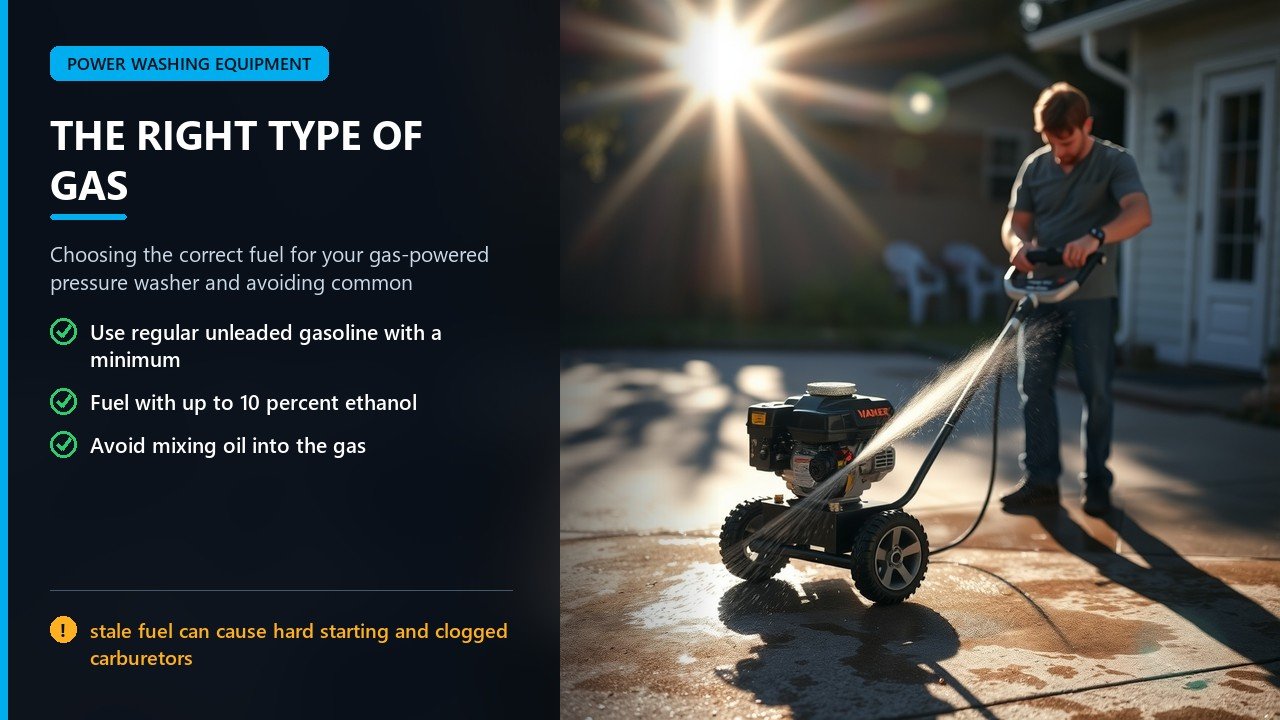
The Short Answer: Regular Unleaded, 87 Octane
Every major small engine manufacturer gives the same basic guidance.
Regular unleaded gasoline. A gas pressure washer engine is designed to run on ordinary regular unleaded fuel from the pump. As Honda’s fuel recommendations state, Honda engines are certified and designed to run on regular unleaded gasoline containing from zero to ten percent ethanol. There is no benefit to premium fuel in a machine that specifies regular.
Minimum 87 octane. Octane measures a fuel’s resistance to knocking. Most engines specify a minimum of 87 octane on the anti-knock index, which corresponds to 91 on the research octane number scale. Regular pump gas almost always meets this. Higher octane does not add power or efficiency to an engine tuned for 87, so premium is simply wasted money unless the manual explicitly calls for it.
Clean and fresh. The word “fresh” is doing more work than most owners realize. As Briggs & Stratton notes, gasoline can begin to deteriorate in as little as 30 days. Stale fuel is the single most common cause of small engine starting problems, and it affects a pressure washer just as badly as a lawn mower.
Never mix oil. Unlike a two-stroke engine, a four-stroke pressure washer has a separate oil reservoir and does not need oil mixed into the fuel. Putting two-stroke mix or oil into the gas of a four-stroke engine fouls the spark plug, clogs the combustion chamber, and causes smoke and poor running.
Octane Ratings Explained
The numbers on the pump confuse many owners, so a quick explanation helps.
| Rating | What It Means | For a Pressure Washer |
|---|---|---|
| 87 octane (regular) | Meets most small engine specs | Correct, use this |
| 89 to 91 octane (midgrade) | Higher knock resistance | Unnecessary but harmless |
| 91 to 93 octane (premium) | Highest knock resistance | No benefit, waste of money |
| AKI vs RON | Two scales measuring the same thing | 87 AKI equals about 91 RON |
Why premium does not help. Octane prevents knock in high-compression or high-performance engines. A standard pressure washer engine has modest compression and is tuned for regular fuel. Filling it with premium changes nothing about power, fuel economy, or longevity; the engine simply cannot use the extra knock resistance. Save the money.
The exception. A rare few high-performance or modified engines may specify higher octane, so always check the manual. If the manual says 87, use 87. If it specifies more, honor it, but that is uncommon on pressure washers.
Ethanol: What You Need to Know
Ethanol is the most common and most consequential footnote in small engine fuel.
Up to 10 percent is acceptable. Most modern small engines are designed to tolerate gasoline with up to ten percent ethanol, commonly labeled E10. This is the standard pump gas in much of the United States, and manufacturers explicitly list it as acceptable.
E15 and E85 are not. Fuel with 15 percent ethanol, labeled E15, and 85 percent ethanol, labeled E85, are not approved for small engines like those in pressure washers. Manuals warn that engine damage may occur from these fuels and that the damage is not covered under warranty. Always check the pump label, because “look before you pump” is literal advice.
Why ethanol causes trouble. Ethanol attracts water from the air, a property called hygroscopicity, which leads to phase separation, where water and fuel separate inside the tank. Ethanol also degrades some fuel system components over time, especially in older equipment. In a pressure washer used seasonally and stored for months, these effects compound, which is why many owners prefer ethanol-free fuel for their small engines.
Ethanol-free options. Many areas sell ethanol-free gasoline, often labeled “recreational” or “marine” fuel, and canned fuel products combine ethanol-free gas with a stabilizer. These cost more but eliminate the ethanol problems entirely, making them an excellent choice for a machine that sits idle for long stretches. For a seasonal pressure washer, an ethanol-free fill before storage is money well spent.
Fuel Storage and Stale Gas
How you store fuel matters as much as what fuel you buy.
The 30-day problem. Fresh gasoline is a volatile blend of compounds that evaporate and oxidize over time. Within about a month, the fuel begins to degrade, and stale fuel causes hard starting, rough running, and varnish and gum deposits in the carburetor. The most important storage habit is to avoid keeping large quantities of fuel around for long periods.
Fuel stabilizer. A fuel stabilizer slows the degradation of stored gasoline, extending its usable life. Add it when you fill the can or the tank, not after the fuel has already aged. Some manufacturers recommend a stabilizer for any fuel that will sit longer than a month, and it is cheap insurance for a machine that gets used only a few times a season.
Store fuel properly. Keep gasoline in an approved, sealed container in a cool, dry place away from ignition sources and out of the sun. Heat and temperature swings accelerate degradation, so a shaded shed beats a hot metal toolbox. Never store fuel in the machine’s tank over a long break without stabilizing it.
When to discard fuel. If fuel is more than a few months old, smells sour, or looks dark, do not run it in your engine. Dispose of it properly, at a hazardous waste facility or a fuel recycling location, and start fresh. A small amount of bad fuel can clog a carburetor and cost far more than the fuel was worth.
What Never Goes in a Pressure Washer Tank
A few fuels and additives will damage or destroy the engine.
Diesel. A gasoline pressure washer engine will not run on diesel, and putting it in the tank is a serious mistake that requires draining and flushing the entire fuel system. Diesel belongs only in the burner of a hot water machine, which uses a completely separate tank and fuel system.
Two-stroke mix. Oil-mixed fuel is for two-stroke engines without a crankcase oil supply. A four-stroke pressure washer does not want it, and running it produces smoke, plug fouling, and combustion chamber deposits.
E15 and E85. As noted, these are explicitly not approved and can damage small engines, voiding the warranty.
Old or contaminated fuel. Fuel that has been sitting for a year, fuel with water in it, or fuel stored in a dirty container all cause problems. Keep a clean, single-purpose fuel can for your equipment and use it fresh.
Fuel additives you do not understand. Stick to stabilizers and the fuel the manual specifies. Random octane boosters, injector cleaners, and mystery additives are unnecessary at best and harmful at worst in a simple small engine.
Regular Versus Ethanol-Free: Which Should You Buy?
For a seasonal machine, the choice between standard pump gas and ethanol-free fuel is worth thinking through.
When E10 pump gas is fine. If you use your pressure washer regularly during the season and do not store fuel for long, standard E10 regular is perfectly acceptable and the most economical choice. Freshness matters more than the ethanol content in this scenario.
When ethanol-free is worth it. For a machine that sits for months between uses, ethanol-free fuel reduces the risk of water absorption, phase separation, and component degradation. It costs more per gallon, but for a small tank that runs a few times a year, the difference is trivial compared with the cost of a carburetor repair.
Canned fuel as an easy option. Pre-mixed, stabilized, ethanol-free canned fuels are convenient for occasional use, especially for the final fill before storage. They are expensive per ounce, but they eliminate guesswork and give a machine the best possible chance of starting after a long rest.
The practical recommendation. Run regular E10 during the working season, then switch to stabilized ethanol-free fuel for the last tank before storage, running it through the carburetor. This combines economy with protection where it matters most.
Two-Stroke Versus Four-Stroke: Do Not Confuse Them
The most damaging fuel mistake owners make is treating a pressure washer like a two-stroke tool.
What a pressure washer is. A gas pressure washer uses a four-stroke engine, the same basic design as a car. It has a crankcase full of oil that lubricates the moving parts, and it burns straight gasoline in the combustion chamber. The engine oil and the fuel are completely separate systems, each with its own fill point and its own maintenance schedule.
What a two-stroke is. Tools like chainsaws, string trimmers, and some blowers use two-stroke engines that have no separate oil reservoir. They need lubricant mixed into the fuel, typically at a 50:1 ratio, because the oil travels through the engine with the gas.
Why the confusion is costly. An owner used to mixing fuel for a trimmer may absentmindedly pour two-stroke mix into a pressure washer tank. The result is heavy smoke, fouled plugs, carbon deposits, and degraded performance. If it happens, drain the tank and carburetor, refill with straight gas, and replace the spark plug.
Check the oil separately. Because the pressure washer’s oil is separate from its fuel, remember to check and change the engine oil on schedule, just as you would with a car. Fuel and oil maintenance are two different tasks, and both matter. Our guide to the electric power washer motor covers what changes when the machine is electric instead of gas.
Fuel System Maintenance
A little fuel system care prevents most starting problems.
Change the fuel filter. Many gas pressure washers have an inline fuel filter that traps debris before it reaches the carburetor. Replace it on the schedule in the manual, or sooner if fuel flow is weak. A clogged filter starves the engine just as a dirty air filter does.
Keep the tank clean. Over time, dirt, rust, and water accumulate in a fuel tank. Flush the tank occasionally, keep the cap sealed, and avoid pouring fuel from a dirty container. A clean tank means clean fuel downstream.
Treat the carburetor gently. The carburetor is the part most vulnerable to stale fuel and varnish. Running the carburetor dry before storage, or using stabilizer, prevents the deposits that clog its tiny passages. If it does clog, a cleaning or a rebuild is far cheaper than replacing it.
Inspect fuel lines and seals. Old fuel lines harden, crack, and leak, and ethanol accelerates this. Check the lines and the cap gasket periodically and replace worn parts before a leak causes a fire hazard or a fuel starvation problem.
Cold Weather and Winter Fuel Storage
Pressure washers are often stored through the cold months, and that is when fuel problems take root.
Winter fuel goes stale. Cold temperatures slow but do not stop fuel degradation, and temperature swings draw moisture into the tank, especially with ethanol-blended fuel. A machine stored all winter with untreated fuel is a prime candidate for a clogged carburetor come spring.
Stabilize or drain. Before winter storage, either add fuel stabilizer, run the engine to circulate it, and store the tank full to limit condensation, or drain the fuel completely and run the carburetor dry. Both approaches work; what fails is doing nothing.
Protect the whole machine, not just the fuel. Fuel is only part of winterizing. Water left in the pump or lines freezes and cracks components, so drain and protect the entire machine. Fuel and water issues together account for most spring start-up failures.
Start fresh in spring. When the season begins, check the fuel, top off with fresh gas if you stored stabilized fuel, check the oil, and inspect filters and lines before the first job. A few minutes of spring preparation pays off in reliable starts all summer.
Fuel for Hot Water and Diesel Burners
Hot water pressure washers have two fuel systems, and keeping them straight is essential.
The engine still uses gasoline. The engine that drives the pump on a hot water pressure washer is typically a gasoline engine, so it uses the same regular unleaded 87 octane fuel described above. The engine’s fuel has nothing to do with the burner.
The burner uses a separate fuel. The heater that warms the water on a hot water unit typically runs on diesel, kerosene, or heating oil, drawn from its own dedicated tank. This fuel never goes in the engine, and the engine fuel never goes in the burner. Mixing them up damages components on both sides.
Check the manual for both. Because a hot water machine has two fuel systems, read the manual for both the engine’s fuel recommendation and the burner’s fuel type. On some units, the burner fuel type is selectable or has specific requirements, which matters for performance and emissions.
Fuel Problems and How to Diagnose Them
Recognizing a fuel problem early saves a costly repair.
| Symptom | Likely Fuel Cause | Fix |
|---|---|---|
| Won’t start | Stale or old fuel | Drain, refill fresh |
| Runs rough, surges | Water or debris in fuel | Clean tank, fresh fuel |
| Smokes heavily | Oil mixed in the gas | Drain and refill correctly |
| Knocks or pings | Octane too low or engine issue | Use 87+ octane |
| Starts then dies | Clogged carburetor from varnish | Clean the carburetor |
| Ethanol fuel separation | Old E10 left too long | Drain, switch to ethanol-free |
Start with the fuel. When a gas pressure washer misbehaves, the fuel is the first thing to check, because it is the most common cause and the easiest to fix. Drain the tank and the carburetor float bowl, add fresh fuel, and try again before assuming a mechanical fault.
Look at the spark plug. A fouled, black plug points to oil contamination or an overly rich mixture, while a clean plug that will not fire points more toward fuel delivery. Both are quick, cheap checks.
Fueling Safely
Gasoline is dangerous, and pressure washers add heat and moving parts to the equation.
Engine off, engine cool. Always shut the engine off and let it cool before removing the fuel cap. Fuel spilled on a hot engine or exhaust is a fire hazard, and pressure washers run hot.
Fill outdoors, on level ground. Refuel outside, never in a closed garage, and on a level surface so you do not overfill. Leave room in the tank for expansion, and wipe up spills immediately.
No smoking, no open flame. Keep sparks, flames, and smoking materials far away from fueling and from stored fuel. Gasoline vapor is heavier than air and can travel to an ignition source.
Store fuel safely. Use approved containers with tight caps, store them in a cool, well-ventilated place, and keep them out of reach of children. Never store fuel inside a vehicle or near a water heater or furnace pilot light.
Replace the cap. Never run the engine without the fuel cap securely installed, which prevents spills and keeps debris out of the tank.
Frequently Asked Questions
What type of gas does a pressure washer use? Clean, fresh, regular unleaded gasoline with a minimum of 87 octane. Fuel with up to 10 percent ethanol is acceptable, but E15 and E85 are not approved for small engines.
Can I use premium gas in a pressure washer? You can, but there is no benefit. An engine specifying 87 octane cannot use the extra knock resistance, so premium is simply wasted money unless the manual calls for higher octane.
Can I use ethanol gas in a pressure washer? Yes, up to 10 percent ethanol is acceptable for most engines. Avoid E15 and E85, and consider ethanol-free fuel if the machine is stored for long periods, because ethanol attracts water and can cause problems over time.
Do I mix oil with the gas in a pressure washer? No. A pressure washer is a four-stroke engine with its own oil reservoir, so it uses straight gasoline. Mixing oil in the fuel fouls the plug and causes deposits and smoke.
How long can gas sit in a pressure washer? Fresh fuel is best within about 30 days, after which it starts to degrade. For longer storage, add a fuel stabilizer, run it through the system, or drain the fuel and run the carburetor dry.
Can I use diesel in a gas pressure washer? No. Diesel will not run a gasoline engine and requires a full fuel system flush if used by mistake. Diesel belongs only in the burner of a hot water machine, which has its own separate tank.
What octane is best for a small engine? A minimum of 87 octane on the anti-knock index, which is what regular pump gas provides. Higher octane is unnecessary for standard pressure washer engines.
Will bad gas damage my pressure washer? Yes. Stale or contaminated fuel causes hard starting and rough running and leaves varnish and gum deposits that clog the carburetor, leading to repairs. Use fresh fuel and stabilize what you store.
Is ethanol-free gas better for a pressure washer? It is often better for machines that sit unused for long periods, because it does not absorb water or separate the way ethanol blends can. For regular seasonal use, standard E10 is fine as long as it is fresh.
What happens if I put the wrong fuel in my pressure washer? The damage depends on the mistake. Diesel requires a full fuel system flush and will not run. Two-stroke mix causes smoke and deposits. E15 or E85 can damage components and void the warranty. In every case, stop, drain the fuel, and refill with the correct gasoline.
How do I know if gas has gone bad? Old fuel smells sour or varnished, may look darker or cloudy, and often separates with water at the bottom. If the fuel is more than a few months old or looks or smells off, discard it properly and start fresh.
Should I fill the tank before winter storage? Either fill it with stabilized fuel to limit condensation, or drain it completely and run the carburetor dry. Both prevent problems. What you should never do is leave untreated fuel sitting in the tank all winter.
Final Thoughts on the Right Gas for a Power Washer
The type of gas for a power washer is refreshingly simple: fresh, regular unleaded with a minimum of 87 octane, up to 10 percent ethanol, and never any oil. The complexity lies entirely in the habits around it, meaning buying fresh fuel, stabilizing or draining what you store, avoiding E15 and E85, and never putting diesel or two-stroke mix in a four-stroke tank. Master those habits and the machine starts when you need it and runs for years.
That homeowner learned his lesson cheaply: drain the old fuel, refill fresh, and store smarter next time. He now buys ethanol-free fuel for the tank before winter, adds stabilizer, and runs the carburetor dry, and his pressure washer starts on the first pull every spring. Fuel is the lifeblood of a gas engine, and treating it with the same care you give your machine’s oil and pump is what separates a pressure washer that works when called on from one that becomes a seasonal frustration. Fill it right, store it right, and the engine will reward you with reliable service season after season.