Marcus ran a mobile detailing and pressure washing business out of the back of his pickup truck for two years. Every job meant lifting the machine out of the bed, dragging a hose across a driveway, and hoping the customer had a working outdoor faucet he was allowed to use. The turning point came when a commercial property manager asked him to clean a parking garage, and Marcus had to admit he could not guarantee a water source. A trailer mount pressure washer solved every problem at once: the machine, the water, the hoses, and the fuel all traveled together, and suddenly his business could go anywhere. Understanding what a trailer-mounted rig is, how it is configured, and who benefits from one is the key to deciding whether the jump is worth it for you.
A trailer-mounted pressure washer is exactly what it sounds like: a pressure washer permanently mounted to a trailer, usually with its own water supply, hose reel, chemical tank, and sometimes a hot water system. It is the professional-grade step up from a cart-mounted machine, designed for people who wash for a living or maintain properties that demand serious, self-contained cleaning power. This guide covers the components, the configurations, the costs, the use cases, and the practical decisions involved in buying or building one.
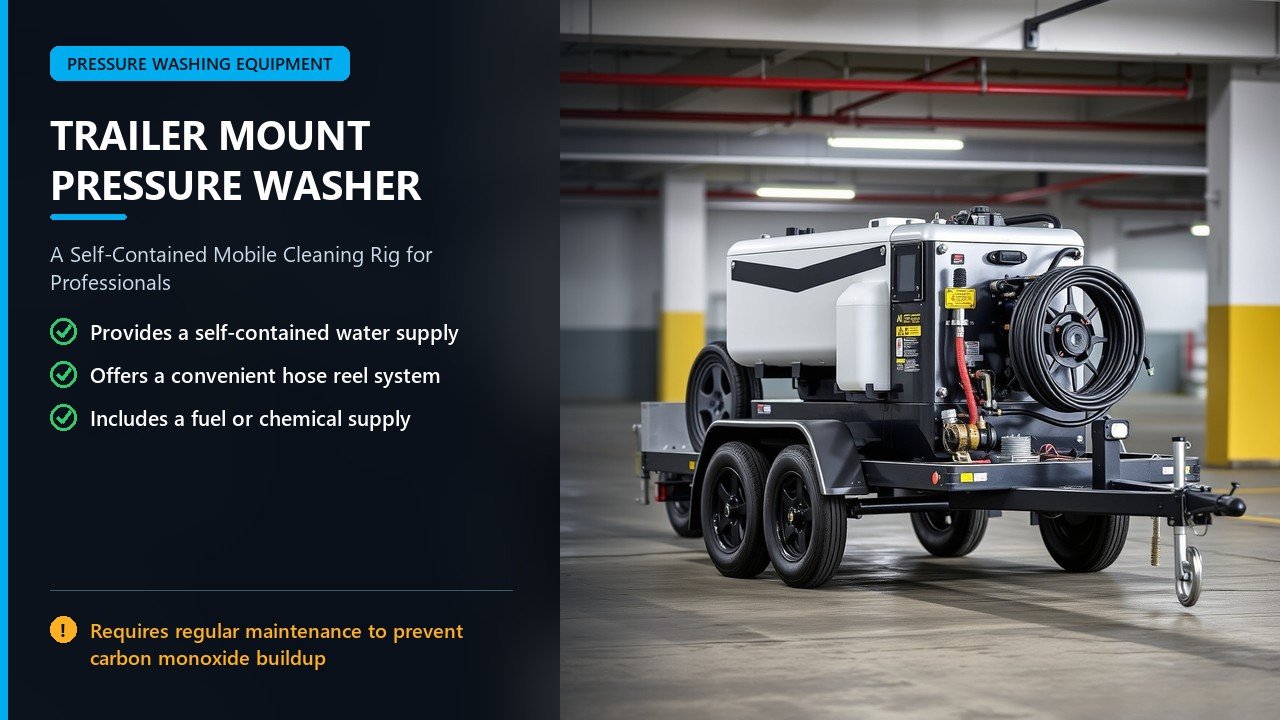
What a Trailer Mount Pressure Washer Is
The concept is simple, but the details are what make a rig effective.
The core machine. At the center sits a pressure washer, often a gas-powered unit in the 4,000 PSI range or a commercial hot-water machine. On a trailer, it is permanently mounted rather than carried, which protects it from the wear and tear of loading and unloading and keeps it ready to work at a moment’s notice.
The water supply. Most trailer rigs carry their own water tank, typically 50 to 200 gallons or more, so the machine never depends on a customer’s faucet. A pump moves water from the tank to the pressure washer, which means the rig can operate in parking garages, on construction sites, or anywhere a tap is unavailable.
The hose reel. A reel holding 100 to 200 feet of high-pressure hose keeps the rig organized and lets the operator reach far from the trailer. Reeling and unreeling is fast, and the hose stays protected from kinks and damage compared to a loose coil.
Chemistry and fuel. Trailer rigs often include a chemical tank, a downstream injector or proportioner, and dedicated space for gasoline. Some carry a hot water burner with its own fuel tank. Everything the job requires travels together.
The trailer itself. The platform matters as much as the equipment: a sturdy deck, good tires, a proper hitch, brakes for heavier loads, and tie-downs and lighting for road safety. A rig is a vehicle as much as it is a tool.
The Components of a Pro Trailer Rig
Seeing the pieces together clarifies why these setups cost what they do.
| Component | Purpose | Typical Spec |
|---|---|---|
| Pressure washer | Creates pressure and flow | 4,000 PSI, 4 GPM gas; or hot water |
| Water tank | Self-contained supply | 50 to 200-plus gallons |
| Transfer pump | Feeds the washer from the tank | Matched to washer demand |
| Hose reel | Stores and deploys hose | 100 to 200 feet |
| Chemical tank | Holds detergent or cleaner | 5 to 30 gallons |
| Surface cleaner | Flat-surface cleaning | Rotary or water broom |
| Fuel storage | Powers engine or burner | Gas and/or diesel |
| Trailer and brakes | Mobility and safety | Sized to total weight |
The transfer pump is the unsung hero. Without a reliable pump feeding the pressure washer from the tank, the machine starves for water and suffers the same damage as dry running. The pump must keep up with the washer’s flow demand, so matching these two components is critical to a working rig.
Everything is matched. A trailer rig is a system, and its performance depends on each part fitting the others. A big machine on a small water tank runs out of water. A small machine on a large hose reel wastes capacity. Successful rigs are designed as a whole, not assembled from mismatched parts.
Why Businesses Choose a Trailer Mount
The advantages over a cart machine are exactly what a working business needs.
True self-sufficiency. With its own water and fuel, a trailer rig works almost anywhere. No hunting for a spigot, no asking permission, no failed jobs because the customer’s water was off. This alone justifies the setup for many mobile businesses.
Speed and professionalism. Everything is staged and ready. The operator backs in, unrolls the hose, and works, rather than lugging equipment and setting up from scratch. Customers notice the difference, and a professional presentation wins repeat business.
Equipment protection. A permanently mounted machine is spared the jarring of load-and-unload and the weather exposure of riding in an open truck bed. It lasts longer, starts more reliably, and stays cleaner.
Capacity for big jobs. Trailer rigs carry larger machines, bigger tanks, and longer hose, which opens up commercial work like parking lots, garages, fleet yards, and multi-unit properties that a cart machine cannot touch.
Brand and storage. A well-built rig, lettered with the company name, is a rolling advertisement and a secure place to store the equipment between jobs. It turns a pile of tools into a business asset.
Gas Versus Hot Water on a Trailer
The type of machine on the trailer shapes what the rig can clean.
| Type | Cleaning Strength | Best Work | Complexity |
|---|---|---|---|
| Cold water gas | Pressure and flow | Concrete, fleet, exteriors | Lower, simpler |
| Hot water gas | Pressure, flow, and heat | Grease, kitchens, industrial | Higher, needs fuel and burner |
| Electric cold | Pressure and flow, quiet | Indoor, noise-sensitive sites | Needs generator or power |
Cold water covers most mobile work. Concrete cleaning, fleet washing, and building exteriors all clean well with a cold-water rig plus detergent. Simpler and cheaper to build and maintain, cold water is the default for most start-up rigs.
Hot water unlocks grease. Adding a burner turns the rig into a grease-fighting machine for restaurant pads, dumpster areas, machine shops, and industrial soil. The trade-off is a fuel supply, a burner to maintain, and a significantly higher price. Businesses that chase grease and oil work tend to graduate to hot water.
Electric trailers are a niche. Some rigs mount an electric machine for quiet indoor work, paired with a generator. Electric pressures are typically lower, so this suits delicate or noise-restricted jobs rather than heavy concrete work.
Costs and What to Expect
Trailer rigs span a wide price range, from modest DIY builds to factory systems well into five figures.
Entry-level cold-water rigs. A basic trailer-mounted gas pressure washer with a small tank and hose reel can be assembled for a few thousand dollars, especially by buying a used trailer and mounting a cart machine. This is the lowest-cost path into mobile work.
Mid-range professional rigs. A purpose-built system with a 4,000 PSI machine, a larger tank, a transfer pump, a hose reel, and a chemical system typically runs into the many thousands of dollars. This is the workhorse of a full-time mobile business.
Hot-water and high-end rigs. Adding a burner, a large tank, and premium components pushes the price far higher, into the cost of a used vehicle. These rigs target commercial and industrial customers who pay accordingly.
The true cost includes the tow vehicle. A loaded trailer needs a capable truck, a proper hitch, and, for heavier rigs, trailer brakes. Budgeting for the tow vehicle is part of the decision, and it is the piece first-time buyers most often forget.
Safety: Towing, Carbon Monoxide, and Runoff
A trailer rig adds vehicle and environmental responsibilities that a cart machine never carries.
Tow within limits. Know the gross weight of the loaded rig and the towing and payload limits of your vehicle. Water makes a trailer heavy fast, and overloading is a leading cause of trailer accidents. Distribute weight properly, secure everything, and use trailer brakes when the load calls for them.
Never run the engine in an enclosed space. A gas pressure washer produces carbon monoxide, so a trailer rig must run outdoors, never inside a garage, warehouse, or enclosed structure, even with the doors open. The Consumer Product Safety Commission rates engine carbon monoxide as a top cause of poisoning deaths, and a trailer that parks itself near a building can put exhaust into windows and intakes.
Manage runoff. Pressure washing sends water and chemicals into storm drains and onto landscaping. Many municipalities regulate wastewater, and cleaning jobs that carry grease, oil, or heavy chemicals often require containment and recovery. Check local rules before washing commercial sites, because fines for illegal discharge can dwarf the job’s profit.
Fuel handling. Carry and dispense gasoline safely, never refuel a hot engine, and store fuel in approved containers. On a rig, a burner or engine plus fuel storage means fire safety deserves constant attention.
Soft Wash Trailers and Chemical Handling
Many trailer rigs are built for soft washing, a growing share of professional work.
The soft-wash rig. A soft-wash trailer carries a large chemical tank, a pump or proportioner to mix bleach or cleaner, and a hose reel for gentle application. Rather than high pressure, it uses chemistry at low pressure, which suits roofs, siding, and delicate surfaces that a pressure blast would damage.
The proportioner matters. A proportioner mixes cleaning solution with water at a controlled dilution, so the operator applies the right strength consistently. Getting dilution wrong weakens the clean or risks the surface, which is why a good proportioner is central to a soft-wash rig.
Chemical safety. Bleach-based soft-wash solutions demand eye and skin protection, careful mixing, and plant protection. Never mix bleach with ammonia or acids, and never let chemicals sit in a tank or pump over the off-season, where they corrode seals and components.
Pairing the two methods. The best trailers combine a pressure washer for hard surfaces with a soft-wash system for delicate ones, giving the operator a full range of tools on one platform. It is the same chemical-first philosophy described in our guide to the hand spray pump, scaled up to commercial work.
Common Trailer Rig Mistakes
Most first-time rig builders make the same handful of errors.
Undersizing the water tank. A small tank seems sufficient until the surface cleaner drains it in twenty minutes and the job stalls while you refill. Estimate consumption honestly and size up rather than down.
Mismatching the transfer pump and machine. A pump that cannot keep up with the washer’s flow starves the machine, which cavitates and overheats exactly as if it were dry running. Match the pump to the washer’s demand.
Ignoring weight and balance. An overloaded or poorly balanced trailer is dangerous to tow and hard on tires, bearings, and the tow vehicle. Keep the load within limits and centered over the axles.
Skipping the hose reel. Loose coils of high-pressure hose kink, wear, and turn setup into a tangle. A reel is not a luxury; it is what makes the rig usable.
Forgetting winterization. Water left in the machine, pump, or lines cracks components at the first freeze. Winterizing is cheap; replacing a cracked pump is not.
Neglecting the trailer itself. Tires, bearings, lights, and the hitch need the same attention as the pressure washer. A trailer breakdown strands the whole business.
Starting a Mobile Pressure Washing Business With a Trailer
For someone building a business, the trailer rig is both tool and foundation.
Start with the work, not the rig. Before investing in a full trailer, confirm you can sell and complete jobs. Many operators begin with a cart machine and a portable tank, then graduate to a trailer when the workload demands it and the revenue supports it.
Price jobs to cover the rig. A trailer rig has real fixed costs, including fuel, maintenance, insurance, and the tow vehicle. Job pricing must account for those, or the business runs hard and profits little.
Get insurance and, where required, licensing. Mobile cleaning businesses need liability coverage, and some areas require permits, business licenses, or handling certifications for wastewater. The rig represents a real exposure, so insurance is not optional.
Build a repeatable process. The rig’s biggest advantage is that it standardizes how a job gets done: same machine, same chemistry, same setup every time. A consistent process produces consistent results and makes the business scalable as it grows.
Building a Rig Versus Buying a Complete System
There are two roads to a trailer mount, and each suits a different personality and budget.
Building your own. Many operators start by mounting a cart pressure washer and a tank on a used trailer. The advantages are lower cost and total control over the layout, allowing you to add a reel, a chemical tank, or a bigger water tank over time. The disadvantages are the time, the trial and error, and the risk of a poorly balanced or under-built rig that fights you on the road.
Buying a complete system. Factory-built trailers come engineered and matched, with the right pump, tank, reel, and mounting already done. You pay more, but you get reliability, a warranty, and a rig that is ready to work on day one. For a business that cannot afford downtime, the ready-made system is often the better value despite the higher sticker.
The hybrid approach. Some operators buy a quality used trailer and a quality new machine and assemble the rest themselves. This balances cost and reliability, provided the components are matched and the trailer is sound.
Safety is non-negotiable either way. Whatever the path, the finished rig must have secure mounting, balanced weight distribution, working lights, safe tires, and, for heavier loads, brakes. A rig that is unsafe on the road is not worth the savings.
Maintaining a Trailer Rig
A rig is an investment, and maintenance protects it.
Service the machine and pump. The pressure washer and its pump need the same care as any commercial unit: engine oil changes, pump oil checks, belt inspection on belt-drive models, and pump packing and valve service as pressure drops. Our guide to the Honda 4000 PSI machine covers the maintenance that applies to most rigs.
Care for the water system. Flush the tank regularly, keep the transfer pump clean, and protect the system from freezing. Algae and sediment in a neglected tank clog screens and starve the machine.
Inspect the trailer. Check tires, bearings, lights, hitch, and tie-downs before every trip. A trailer failure on the highway is dangerous and expensive, and a few minutes of inspection prevents both.
Winterize everything. Water left in the machine, pump, or lines over a freeze cracks components. Drain and winterize the entire rig, and store fuel properly. Protecting the system in cold weather is a routine that saves thousands.
Frequently Asked Questions
What is a trailer mount pressure washer? A pressure washer permanently mounted on a trailer, usually with its own water tank, hose reel, and chemical supply, creating a self-contained mobile cleaning rig that does not depend on a customer’s water source.
How much water does a trailer rig carry? Tanks commonly range from 50 to 200-plus gallons, with larger tanks on commercial rigs. Size the tank to your jobs, remembering that a surface cleaner can consume several gallons per minute.
Do I need a trailer-mounted pressure washer for a pressure washing business? Not to start, but it is the standard for full-time mobile work. A rig lets you take the job anywhere without a customer water supply, and it opens up commercial contracts that a cart machine cannot serve.
Can I put a pressure washer on any trailer? You can, but the trailer must be rated for the total weight of the machine, water, fuel, and equipment, with safe tires and, for heavier loads, brakes. Water alone can add over a thousand pounds.
How much does a trailer mount pressure washer cost? A basic DIY cold-water setup can be assembled for a few thousand dollars, while factory-built professional and hot-water rigs run well into the tens of thousands, not counting the tow vehicle.
Is hot water worth it on a trailer rig? If your work involves grease, oil, or industrial soil, yes. Hot water cleans those jobs far more effectively. For concrete and fleet washing, cold water with detergent is usually sufficient and far simpler.
How do I feed the pressure washer from a tank? A transfer pump moves water from the tank to the pressure washer at the flow rate the machine demands. The pump must be matched to the washer, or the machine will starve and overheat.
Can I use a trailer rig without a water tank? Yes, if the jobs have a reliable water source and permission to use it. The tank is what makes the rig self-contained, however, and most professional operators consider it essential for scheduling flexibility and commercial work.
How long does a tank of water last? It depends entirely on the machine and attachments. A surface cleaner can draw several gallons per minute, so a 100-gallon tank may last only twenty to thirty minutes of continuous cleaning. Size the tank to your typical job length.
Do trailer pressure washers need a license? The trailer itself may need to be registered and titled depending on your state and its weight, and a mobile cleaning business may need a license or permit. Check local requirements, and carry liability insurance regardless.
Can one person operate a trailer rig? Yes. A well-designed rig lets a single operator back in, unroll the hose, and clean without assistance. The self-contained water and fuel supply is what makes one-person operation practical on remote jobs.
What size trailer do I need? Match the trailer to the total weight and footprint of the machine, tank, and equipment, then add margin. A single-axle trailer suits small rigs, while larger tanks, hot water, and multiple reels generally call for a tandem-axle trailer with brakes.
Can I mount a pressure washer on a truck bed instead of a trailer? Yes, bed-mounted rigs exist and have advantages, such as easier maneuvering and no separate trailer to tow. The trade-off is limited space, weight on the truck, and losing the ability to drop the rig and use the truck for other work.
How do I keep the rig from tipping or shifting in transit? Secure the machine, tanks, and equipment with proper tie-downs, keep the heaviest components low and centered over the axle, and check the straps before every trip. A shifting load is both a road hazard and a way to damage the equipment.
Final Thoughts on the Trailer Mount Pressure Washer
The trailer mount pressure washer is the tool that turns pressure washing from a side job into a business. By bundling the machine, water, chemistry, and hose onto one mobile platform, it removes the single biggest barrier to mobile work, which is the need for a water source and a place to set up. It is more expensive and more complex than a cart machine, but for anyone doing this work seriously, it pays for itself in capability and credibility.
Marcus bought a used trailer, mounted his existing machine, and added a 100-gallon tank and a hose reel. His first garage job paid for the tank, and the second paid for the reel. By the end of the season, he was taking commercial contracts he could not have imagined the year before, all because his water and equipment now traveled with him. That is the promise of the trailer rig: it does not just carry your equipment, it carries your business to places it could never have gone otherwise.
If your work is growing beyond what a cart can serve, the trailer is the answer, but only when the revenue justifies the investment and you are ready to take on the towing, the maintenance, the insurance, and the responsibility that come with a mobile operation. Build it well, size it honestly, maintain it faithfully, and the rig will quietly do exactly what it promises: put a complete professional cleaning system wherever the customer needs it, without ever asking for a garden hose again.