Sam had a box of pressure washer tips rattling around in his garage. Some had a quick-connect collar that snapped on instantly, others were just small metal pieces with threads. When he tried to match them to a new lance, nothing fit. One quick-connect tip leaked, another just wouldn’t stay on. The problem wasn’t the washer — it was not knowing the difference between threaded pressure washer nozzles and quick-connect tips. Once he understood the thread types and how they matched his gun, every tip sealed properly and did exactly what it was supposed to do.
Threaded pressure washer nozzles are the older, more universal style that screw directly onto the end of a lance or gun with pipe threads. Unlike quick-connect nozzles that snap in and out, threaded nozzles create a solid metal-to-metal seal when tightened properly. They are common on many industrial machines, older pressure washers, and specialized setups where you want a secure, leak-free connection that won’t pop off under pressure. This guide explains what threaded pressure washer nozzles are, how they compare to quick-connect, sizing, materials, and how to pick the right ones for your machine.
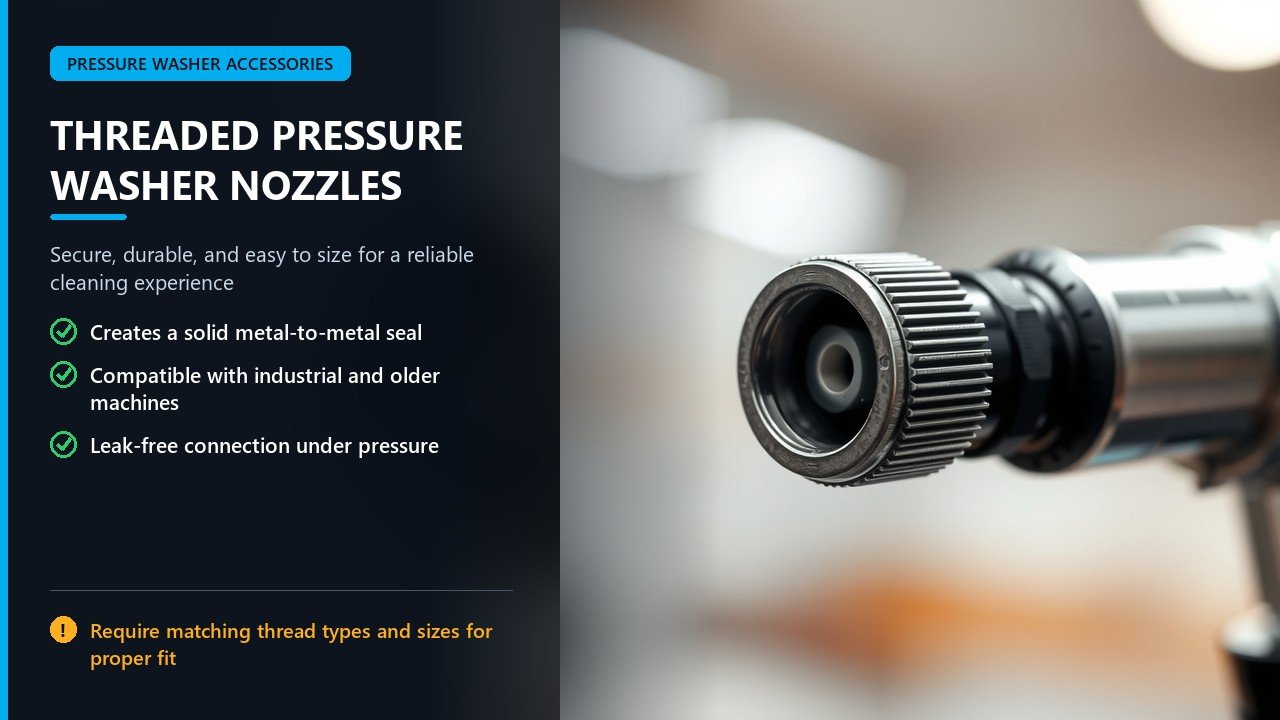
What Are Threaded Pressure Washer Nozzles?
Threaded pressure washer nozzles screw onto the end of a wand or directly into a gun using National Pipe Thread (NPT). The most common size for consumer and light commercial machines is 1/4″ NPT. When tightened, the threads create a tight seal, so there is no coupler that can wear out or accidentally release under pressure. The spray angle and orifice size are usually stamped or laser-etched into the metal body, since there is no color band on a quick-connect collar to identify them.
The tradeoff is speed. Swapping tips takes longer than popping a quick-connect in and out. But for setups where you rarely change tips, or where you want maximum durability and leak resistance, threaded pressure washer nozzles are a solid choice. Many industrial and fixed-installation washers use threaded tips for exactly that reason.
Threaded vs Quick-Connect Nozzles
The biggest difference is convenience versus security. Quick-connect nozzles let you switch between soap, rinse, and cleaning tips in seconds with a spring-loaded coupler. Threaded nozzles screw on and off, taking a few extra seconds but forming a very secure connection with no moving coupler parts to wear out or fail.
Quick-connect tips are almost always color-coded by spray angle for easy ID. Threaded pressure washer nozzles usually have the degree (0°, 15°, 25°, 40°, 65°) and orifice number (like 3.0, 4.0, 5.0) engraved directly on the steel or brass body. Both types come in the same spray angles and orifice sizes, so cleaning performance is identical when properly matched to your PSI and GPM.
| Feature | Threaded Nozzles | Quick-Connect Nozzles |
|---|---|---|
| Connection | Screw-on (NPT) | Snap-in coupler |
| Speed to change | Slower | Fast |
| Leak resistance | Very secure | Good (coupler wears over time) |
| ID Method | Engraved numbers | Color-coded |
| Best For | Industrial/fixed, secure setups | Frequent tip changes |
Understanding Spray Angles
Threaded pressure washer nozzles come in the same color-coded spray angles as quick-connect tips. Red (0°) is a pinpoint jet for very tough, localized cleaning — use with extreme caution as it can damage surfaces. Yellow (15°) cuts heavy grime and paint prep. Green (25°) is the all-purpose workhorse for concrete, decks, and siding. White (40°) is the gentlest for vehicles, windows, and wood. Black (65°) is low-pressure for applying soap and detergents.
Choose the widest angle that still cleans effectively. Starting wide and moving narrower only when needed protects surfaces and prevents damage.
Sizing Threaded Nozzles by PSI and GPM
The orifice size is critical. An orifice that is too small for your machine builds backpressure, stresses the pump, and can trigger the unloader. An orifice that is too large drops your working pressure and kills cleaning power. You must match the nozzle orifice to your pressure washer’s PSI and GPM.
To size threaded pressure washer nozzles correctly, find your machine’s rated PSI and GPM, then use a nozzle chart to get the correct orifice number. For example, a 3000 PSI machine at 3.0 GPM typically needs a #3.0 orifice. The number stamped on the nozzle (like 3.0, 4.0, 5.0) often corresponds to the GPM it flows at a reference pressure. Always verify against your specific machine specs using a proper nozzle sizing chart.
Materials: Stainless Steel vs Brass
Threaded pressure washer nozzles are usually made from hardened stainless steel or brass. Stainless steel is very durable, resists wear from high-pressure water, and holds up well for general use. Brass is excellent for chemical applications, especially when using corrosive or acidic detergents that can attack steel over time. For most homeowners, stainless steel is fine. For industrial chemical washing, brass is often preferred for its corrosion resistance.
When to Use Threaded Nozzles
Use threaded pressure washer nozzles when you want a rock-solid, leak-resistant connection, when your gun/lance is designed for NPT threads (not quick-connect), or when you have an older or industrial machine. They are also great for fixed wash setups, wall-mounted systems, or any application where you do not swap tips constantly. If you change tips dozens of times per job, quick-connect is more convenient. If reliability and durability matter most, threaded tips win.
Installation and Maintenance Tips
When installing threaded pressure washer nozzles, hand-tighten firmly, then give a small quarter-turn with a wrench if needed. Do not overtighten — you can damage the threads or crack the nozzle holder. Use thread sealant tape (PTFE) sparingly on male NPT threads only if your setup calls for it; many nozzles seal fine without it when threads are clean.
Keep them clean. Clogged or worn nozzles create uneven spray patterns (streaks or pinwheels) and reduce pressure. Inspect regularly for wear — if the spray pattern becomes fuzzy or distorted instead of a crisp fan, the orifice is worn and the nozzle needs replacing. Replace nozzles as a set when doing maintenance to keep spray patterns even.
Pros and Cons of Threaded Pressure Washer Nozzles
Pros: Secure, leak-resistant connection, no coupler to wear out or fail, extremely durable, universal thread size (1/4″ NPT) fits many lances and guns, easy to find replacements, work well in industrial/fixed setups.
Cons: Slower to change tips than quick-connect, no built-in color-coding (must read engraved markings), easier to cross-thread if not careful, not as convenient for jobs requiring frequent tip changes.
Choosing the Right Set
Start by confirming your connection: does your gun/lance take 1/4″ NPT threaded tips? If yes, buy a matched set based on your PSI and GPM. A basic set covering 0°, 15°, 25°, 40°, and 65° (soap) in the correct orifice size will cover almost everything. Stick with hardened stainless steel for general use, or brass for heavy chemical work. Buy from reputable brands so orifice sizes are accurate and threads are cut cleanly.
Final Thoughts
Threaded pressure washer nozzles are simple, tough, and reliable. They may not be as fast to swap as quick-connect, but they give you a secure seal and fewer wear points to worry about. The key is getting the orifice size right for your machine and choosing the right spray angle for each job. For anyone running an older washer, industrial setup, or just wanting maximum leak resistance, threaded pressure washer nozzles are the right call.