Search for a turbo nozzle and you will find listing after listing describing it as perfect for “wood decks, painted surfaces, vinyl siding, vehicle exteriors, and outdoor furniture.” That advice is not just wrong — it is the fastest way to etch a deck, strip paint, and gouge siding. A turbo nozzle is one of the most aggressive tools you can put on a pressure washer, and the marketing around it routinely gives dangerous guidance.
This guide sets the record straight on turbo pressure washer nozzles: what they really do, the surfaces they will ruin, and how to use one correctly and safely.
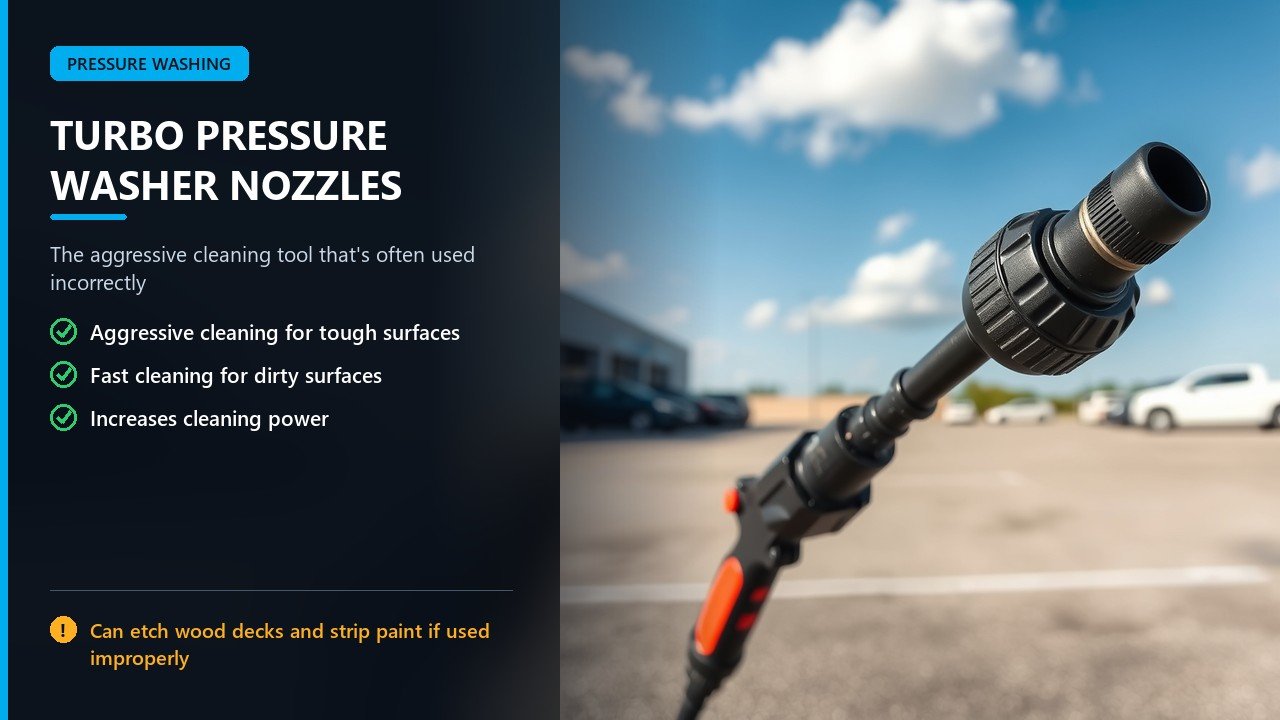
What a Turbo Nozzle Actually Is
A turbo nozzle — also called a rotary or rotating nozzle — is a nozzle with a spinning internal element. A ceramic or hardened tip is made to rotate rapidly, driven by the water flow itself, so the jet sweeps in a circular cone rather than spraying in a fixed pattern. That rotation is the whole trick.
The result is a nozzle that behaves like a zero-degree (pencil-jet) nozzle in terms of impact, but covers an area closer to a 25-degree nozzle. You get the cutting force of the narrowest spray with the coverage of a wider one, which is exactly why a turbo nozzle can clean hard, dirty surfaces noticeably faster than a standard tip.
The rotation speed depends on your machine’s pressure and flow. More pressure and flow spin the rotor faster and clean more aggressively. This matters because a turbo nozzle’s behavior changes with the machine behind it — the same nozzle behaves very differently on a 2,000 PSI electric unit versus a 4,000 PSI gas machine.
Where Turbo Nozzles Shine
Turbo nozzles are built for hard, durable, ground-level surfaces where a normal nozzle is simply too slow. Concrete driveways, sidewalks, patios, garage floors, and foundations are the classic targets. Brick, block, stone, and masonry also handle a turbo nozzle well.
They also excel on heavy equipment and farm machinery — caked mud, caked grease, dried manure, and baked-on grime that a fan nozzle slides over. In agricultural and industrial settings, a turbo nozzle saves serious time where the surface is metal or very hard masonry.
The common thread is durability. If a surface can shrug off a 0-degree pencil jet, a turbo nozzle cleans it faster. If it cannot, the turbo nozzle is the wrong tool entirely.
The Surfaces a Turbo Nozzle Will Destroy
Here is where the listings fail you. A turbo nozzle should never touch soft or finish-critical surfaces. It will etch, gouge, or scar them almost instantly, and the damage is usually permanent.
Keep it away from wood and composite decks, where it furs the grain and leaves gouges. Keep it off vinyl and aluminum siding, where a moment’s pause can cut a groove. Never use it on painted surfaces, on car or truck paint, on fiberglass, on glass, or on asphalt shingles, which it can strip apart.
The golden rule is simple: a turbo nozzle belongs on the ground and on hard masonry and metal, and nowhere else. If you are unsure whether a surface can take it, test a small hidden spot first, from a good distance, for a second or two. Trust the test, not the product description.
The Hidden Danger: It Adds Effective Pressure
A turbo nozzle concentrates the machine’s output into a fast-moving point, so the effective cleaning force at the surface is far higher than a fan nozzle at the same distance. That is the point — but it also means the margin for error is thin.
Hold a turbo nozzle still on concrete and it will eventually leave a permanent circular etch mark, because even the most durable surface has a limit. The trick is constant motion. Never let the jet dwell in one spot; keep the wand sweeping so no single point absorbs the full force for long.
The same concentration makes a turbo nozzle genuinely dangerous. A spinning 0-degree jet at close range can pierce skin, and the recoil of a turbo nozzle is stronger than a fan nozzle, which can throw you off a ladder or scaffold. Treat it with more respect than any other nozzle in the kit.
How to Use One Correctly
Technique matters more with a turbo nozzle than with any other accessory. Start by keeping a safe working distance — roughly a foot or more from the surface — and only move closer if the surface clearly tolerates it. Most damage comes from working too close.
Use short, controlled bursts rather than holding the trigger down. Sweep in overlapping passes, covering about half of the previous pass each time, so the cleaning is even and no spot sits under the jet too long. Work systematically rather than jumping around, and pause the trigger as you move to the next area.
Keep both hands on the wand and your stance stable. The added recoil takes some getting used to, so learn on a hard, sacrificial surface before graduating to anything expensive. Avoid working from ladders or unstable platforms with a turbo nozzle, and never point it at a person or animal, ever.
Sizing a Turbo Nozzle to Your Machine
The single most common reason a turbo nozzle disappoints is a mismatch with the machine. Nozzles are sold in orifice sizes meant for specific combinations of pressure and flow, and using the wrong one wastes the tool or strains the pump.
A nozzle with too small an orifice on a high-flow machine over-pressurizes the pump, while too large an orifice on a low-flow machine gives weak, wobbly rotation and little cleaning power. Match the orifice to your machine’s GPM and PSI using the nozzle manufacturer’s chart, and check the pressure and temperature ratings before buying.
Temperature rating matters if you run hot water; not every turbo nozzle is built for it. Inlet connection matters too — most consumer and mid-range wands use a standard 1/4-inch quick connect, while some professional wands use different fittings. Confirm both before you buy to avoid a nozzle that does not fit or cannot take the heat.
Turbo Nozzle vs. Standard Nozzle vs. Surface Cleaner
A turbo nozzle is not the right answer for every job, and knowing when to reach for something else saves time and damage. The table below maps common jobs to the right tool.
| Job | Best tool | Why |
|---|---|---|
| Stubborn stains on concrete | Turbo nozzle | 0-degree force with wider coverage; fast on hard ground |
| Large, flat concrete areas | Surface cleaner | Even, streak-free coverage and much faster on flatwork |
| Siding, cars, painted surfaces | Fan nozzle (white/green) at distance | Gentle, controllable, will not etch |
| General rinsing and light dirt | Standard fan nozzle | A turbo nozzle is overkill and risky here |
In short: reach for the turbo nozzle only when the surface is hard and the grime is stubborn. For everything else, a standard fan nozzle or a surface cleaner is the safer, smarter choice.
Maintenance and Troubleshooting
A turbo nozzle has a moving part, and moving parts need care. Sand, grit, and mineral deposits work into the rotor and can make it stick, chatter, or stop spinning. A turbo nozzle that will not rotate is almost always clogged, not broken.
Flush the nozzle after every use, especially if you run it in dirty or mineral-heavy water or draw from a tank. If the rotation stops, remove the nozzle and clear the obstruction using only the method the manufacturer recommends — typically a soft probe or back-flushing — never a metal pick that can scar the ceramic tip or damage the rotor.
Inspect the tip for wear and the rotor for free spin. A worn ceramic tip loses its sharp jet; a sticking rotor gives a lopsided spray. On hot-water systems, scale builds faster, so maintenance should be more frequent. Keep the nozzle clean and it will keep spinning.
Do You Actually Need One?
A turbo nozzle is worth owning if you regularly clean concrete, masonry, or metal, and you are tired of how slowly a fan nozzle works on baked-on grime. For a homeowner with a long driveway and a stained sidewalk, it is a genuine time-saver.
It is not essential if your cleaning is mostly cars, siding, and decks — exactly the surfaces a turbo nozzle must avoid. In that case a set of fan nozzles and, for flat concrete, a surface cleaner will serve you better and safer.
Many people buy a turbo nozzle expecting a magic upgrade, then damage the first soft surface they point it at. Go in with clear expectations — an aggressive tool for hard surfaces only — and it earns its place in the kit. Treat it as a toy, and it costs you a deck.
Common Mistakes to Avoid
The biggest mistake is using it on the wrong surface, which we have covered at length. The second is working too close; distance is your only real control over the turbo nozzle’s aggression, and holding it within a few inches is how etching happens.
Buying the wrong orifice size is the third. A mismatched nozzle either underperforms or stresses the pump, so always match it to your machine’s flow and pressure. The fourth is ignoring the temperature rating on hot-water machines, which can ruin a nozzle rated only for cold water.
The final mistake is complacency. Because a turbo nozzle looks like any other nozzle, people point it where they would point a fan nozzle — at siding, at a car, at a wooden fence. It is not the same tool. Respect the difference and it is safe and effective; ignore it and the damage happens before you can react.
A Quick Safety Checklist
Before squeezing the trigger on a turbo nozzle, run through the essentials. Confirm the surface is hard and durable. Confirm the nozzle is rated for your machine’s pressure, flow, and temperature, and that the orifice matches. Set your distance before you start, keep both hands on the wand, and commit to short bursts with overlapping passes. If anything is uncertain, drop back to a fan nozzle or a surface cleaner instead.
That checklist takes seconds and prevents nearly every turbo nozzle disaster. The tool rewards discipline and punishes carelessness in equal measure. Used with that discipline rather than as a catch-all attachment, a turbo nozzle is one of the most effective accessories in a pressure washing kit.
Frequently Asked Questions
What does a turbo nozzle do? It spins a narrow high-pressure jet in a circular pattern, giving the impact of a 0-degree nozzle with the coverage of a wider spray, so it cleans hard surfaces faster.
Is a turbo nozzle the same as 0 degrees? Not exactly. It has a 0-degree-class jet, but the jet rotates, so its effective coverage resembles a 25-degree nozzle while keeping the sharp impact.
Can I use a turbo nozzle on wood or a car? No. It will etch wood, strip paint, and damage vehicle finishes. Use it only on hard surfaces like concrete, brick, and metal.
What PSI do I need for a turbo nozzle? Turbo nozzles work best with gas machines; match the nozzle’s pressure rating to your washer. Many are rated to 3,600–4,500 PSI, with smaller ones for lower-pressure units.
Why is my turbo nozzle not spinning? Usually debris or mineral deposits in the rotor. Flush it and clear the obstruction using the manufacturer’s recommended method — never a metal pick.
How close should I hold it? About a foot or more as a starting point, and only closer if the surface tolerates it. Working too close is the main cause of etching.
Does orifice size matter? Yes. The orifice must match your machine’s flow and pressure, or the nozzle either underperforms or stresses the pump.
Can I use a turbo nozzle with hot water? Only if it is rated for it. Check the temperature rating, since not every turbo nozzle is built for hot water.
Final Thoughts
Turbo pressure washer nozzles are among the most useful accessories you can add to a gas pressure washer — provided you use them for what they are. They excel at stripping stubborn grime from concrete, masonry, and metal, and they fail badly the moment they touch wood, siding, paint, or a car.
Ignore the product descriptions that blur that line. Match the nozzle to your machine, keep your distance, keep it moving, and reserve it for surfaces that can take the heat. Do that, and the turbo nozzle becomes a fast, reliable workhorse. For related reading, see our guides on pressure washer spray wands and pressure washer handles.