Walk into any pressure washing supply store and you will hear customers ask for the same thing in two different ways. One says, "I need a new washing gun." The other says, "I need a spray gun." The counter staff knows they usually mean the same device – the handheld trigger and wand assembly that controls water from the pressure washer. But the term washing gun is broad, and it covers everything from a compact stubby trigger for detailing to a low-pressure garden hose nozzle for light rinsing. Knowing exactly which type you need, and which specs must match your machine, prevents both wasted money and dangerous mismatches.
A washing gun is more than a handle. It is the control point where pressure, flow, reach, and safety all converge. The right one makes cleaning comfortable and precise; the wrong one leaks, fatigues your hand, or fails under pressure. This guide covers the types available, how to match one to your machine, and how to maintain it so it lasts.
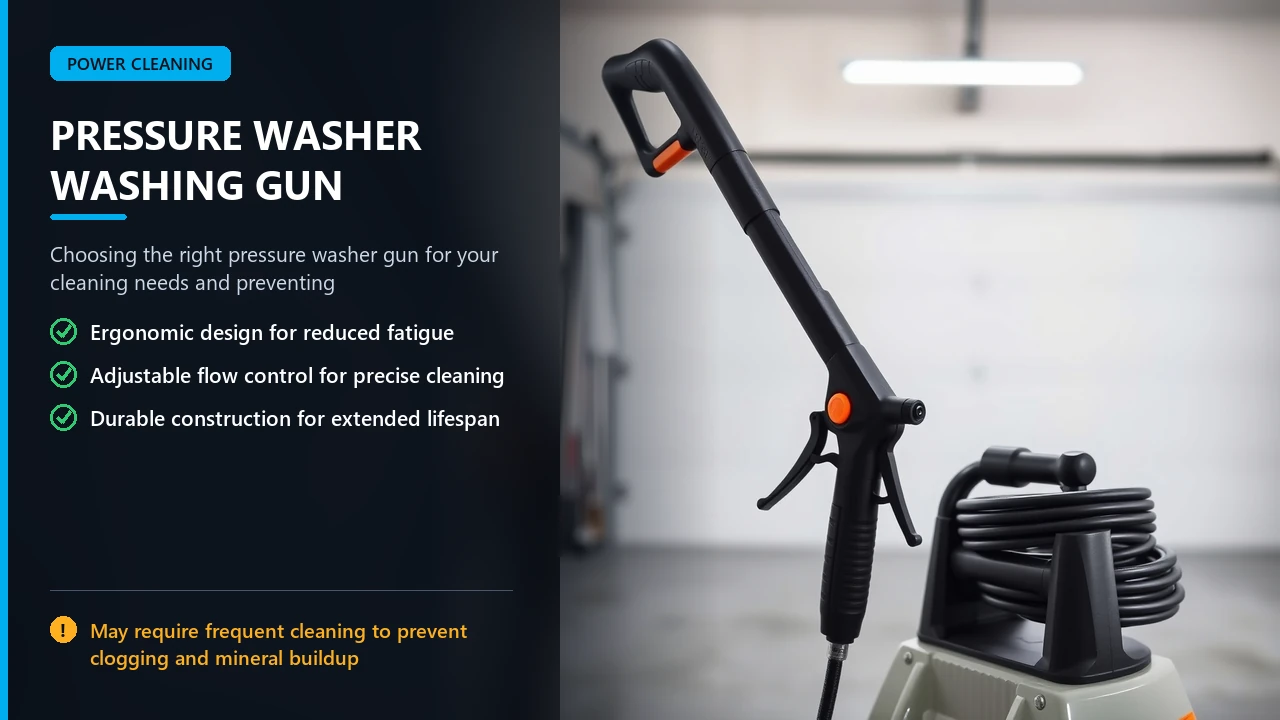
What a Washing Gun Is and Does
A pressure washer washing gun – also called a spray gun, trigger gun, or wash gun – is the handheld device at the end of the high-pressure hose. It performs four jobs:
- Controls flow. The trigger starts and stops water without shutting down the machine, using an internal valve.
- Provides leverage and reach. The body and wand let you aim the spray while keeping your hand away from the high-pressure stream.
- Accepts nozzles. The front of the gun or wand holds the interchangeable tips that set spray pattern.
- Enables safety features. A lockout prevents accidental spraying, and the trigger design keeps pressure contained until you deliberately release it.
Washing guns connect to the hose at the inlet – typically 3/8-inch quick connect, M22 threaded, or a proprietary fitting – and to nozzles or wands at the outlet, usually 1/4-inch quick connect. Matching those two ends to your existing equipment is the single most important buying decision.
Types of Washing Guns
| Type | Best For | Key Trait |
|---|---|---|
| Standard trigger gun with wand | General cleaning – floors, siding, patios | Balanced reach and control |
| Short (stubby) gun | Detail work, wheel wells, tight spaces | Compact body for precise aiming |
| Swivel gun | Mobile work, around vehicles | Swivel inlet prevents hose kinks and fatigue |
| Foam cannon gun | Car washing and detergent application | Mixes air with soap for thick foam |
| Low-pressure garden gun | Light rinsing, garden watering | Not for pressure washers – garden hose only |
The most common confusion is between pressure washer guns and garden hose guns. A garden gun is built for household water pressure – typically 40 to 80 psi. A pressure washer gun handles 1,500 to 5,000 psi. Confusing the two leads to leaks, failures, or a gun that simply cannot connect to a high-pressure hose.
Matching a Washing Gun to Your Machine
Three specs decide compatibility, and getting any of them wrong means leaks or a non-functioning setup.
| Spec | What to Match | Consequence of Mismatch |
|---|---|---|
| Pressure rating (psi) | Gun at or above machine’s max psi | Under-rated gun can fail violently |
| Flow rating (gpm) | Gun passes your machine’s flow without restriction | Restriction causes pressure spikes and poor cleaning |
| Inlet fitting | 3/8″ QC, M22 (14mm or 15mm), or adapter | Wrong thread will not seal – leaks constantly |
| Outlet fitting | 1/4″ QC for most nozzles and wands | Nozzles won’t attach if outlet differs |
The M22 thread confusion deserves special attention. M22 is a common European-style threaded fitting, but it comes in 14mm and 15mm variants with different seat depths. A 14mm gun on a 15mm outlet leaks no matter how tight you make it. Always confirm which your machine uses – check the manual, the machine’s inlet, or measure – before ordering.
Ergonomics: The Overlooked Spec
Specs get you connected, but ergonomics determine whether you can work comfortably for hours. These details matter more than they appear on a spec sheet.
- Trigger effort. A stiff trigger becomes painful quickly. Some guns have adjustable or lighter-pull triggers.
- Grip design. Textured grips resist slipping when wet or gloved. Smooth plastic gets slick fast.
- Weight and balance. A front-heavy gun with a long wand is tiring. Compact guns keep weight close to the hand.
- Trigger guard size. Must accommodate gloved fingers for cold-weather or chemical work.
- Safety lock location. It should be easy to engage and disengage one-handed but not easy to bump off accidentally.
Swivel Guns and Hose Management
A swivel at the gun inlet lets the hose rotate freely instead of twisting as you move. The benefit is understated but significant: without a swivel, a stiff high-pressure hose constantly pulls against your grip, and you spend the whole job making small corrections. With a swivel, the hose follows the gun instead of fighting it.
For anyone doing repeated passes around a vehicle, a building, or equipment – the standard motions of commercial cleaning – a swivel gun reduces fatigue and reduces kinking. Kinking damages hoses internally and drops pressure at the worst moment. A swivel is one of the most recommended upgrades among professionals, and it often costs only slightly more than a fixed-inlet gun.
Safety Features to Insist On
- Positive safety lock. Must stay engaged in a bag or hand and require deliberate action to release.
- Pressure rating labeling. A quality gun states its psi rating clearly. An unlabeled gun is a gamble.
- Internal valve rated for pressure. The shutoff valve carries the full system pressure when the trigger is released; a weak valve leaks or fails.
- Nozzle retention. Quick-connect collars must lock securely so tips cannot eject under pressure.
- Thread-safe inlet. Correct threading with a clean sealing surface at the inlet prevents a spray of high-pressure water at the connection.
Maintenance That Extends Gun Life
A washing gun lives in a harsh environment: high pressure, water, and often chemicals. Basic care keeps it reliable.
- Replace o-rings proactively. The inlet and nozzle-seat seals are wear items. A small kit of the correct sizes prevents drips from becoming leaks.
- Lubricate the trigger pivot. A drop of silicone lubricant keeps the trigger smooth and prevents sticking.
- Rinse after chemical use. Detergent and degreaser residue attacks seals. Flush with clean water after every chemical job.
- Store dry, trigger unlocked. A locked trigger stored for months can take a set, and trapped moisture corrodes internals.
- Inspect before use. Check the safety lock, the inlet seal, and the nozzle collar for wear.
The spray gun residue problem is real. Leftover soap or degreaser in the valve body dries, gums, and interferes with the trigger over time. A thirty-second clean-water flush at the end of each chemical job prevents it entirely.
Common Mistakes to Avoid
- Buying a garden gun for a pressure washer. It will not connect or hold pressure and may burst.
- Ignoring the M22 thread variant. The 14mm versus 15mm mix-up causes endless leaks and returns.
- Under-rating the psi. A cheap gun on a high-pressure machine is a projectile risk, not a bargain.
- Choosing a stiff trigger. You will feel it by hour two and stop using the machine as much.
- Skipping the swivel. For mobile work, the swivel pays for itself in reduced fatigue and hose protection.
- Never replacing seals. Every gun eventually drips; replacing a few o-rings restores it to like-new.
Frequently Asked Questions
What is a washing gun?
In pressure washing, a washing gun is the handheld trigger device that controls water flow from a pressure washer, connecting the high-pressure hose to the wand and nozzles. The term is also used loosely for garden hose spray guns and foam sprayers, which are different tools with much lower pressure ratings.
How do I know which washing gun fits my pressure washer?
Match the inlet fitting to your hose (3/8″ quick connect or M22, confirming 14mm vs 15mm), confirm the gun’s psi rating meets or exceeds your machine’s maximum, and ensure the outlet accepts your nozzles (usually 1/4″ quick connect). Check the manual when unsure.
Can I use any nozzle with my washing gun?
If the gun has a 1/4-inch quick-connect outlet – which most do – it accepts any standard 1/4-inch quick-connect nozzle. Confirm the nozzle is rated for your pressure and flow, and never use a 0-degree tip on delicate surfaces.
Is a swivel washing gun worth it?
For regular or mobile work, yes. The swivel lets the hose rotate instead of fighting your grip, which reduces fatigue and hose kinking. For occasional light use, a fixed-inlet gun is fine.
Why is my washing gun leaking at the inlet?
The most common cause is a worn or missing o-ring, or a wrong M22 thread depth (14mm versus 15mm). Check the seal first, then confirm the thread matches. Replace the o-ring and confirm the connection seats fully.
How do I maintain a pressure washer gun?
Replace o-rings as they wear, lubricate the trigger pivot occasionally, rinse with clean water after chemical use, store dry with the trigger unlocked, and inspect the safety lock and seals before each session.
The Bottom Line
A washing gun is the control point of the entire pressure washing setup. Match its pressure rating, flow capacity, and inlet/outlet fittings to your machine, and choose the body style that fits your work – a compact gun for detail tasks, a standard gun for floors and walls, or a swivel gun for mobile cleaning around vehicles. Insist on a positive safety lock and a psi rating at or above your machine’s maximum.
Maintain it with fresh o-rings, occasional lubrication, and a clean-water flush after every chemical job. Do that, and the gun becomes the comfortable, reliable interface between you and the water – the part you never think about because it simply works, every time.