Every spring, my inbox fills with the same question from people who just bought a cold-water pressure washer and then ran into grease for the first time. Can I hook up a water heater to this thing? Can I use the spare electric water heater in my basement? Is there a cheap way to make hot water for my pressure washer? I understand the instinct completely, because hot water is the difference between struggling with grease and watching it melt away. But the answers here matter, because some of the shortcuts people imagine are ineffective and others are genuinely dangerous. This guide explains what a water heater for a pressure washer really is, how heat is added correctly, what actually works, and what you should never attempt.
If you are trying to understand your options before spending money, this is the article to read. We will cover the physics of heating water at pressure washer flow, the real equipment choices, how to size heat correctly, and clear guidance on who needs it and who does not.
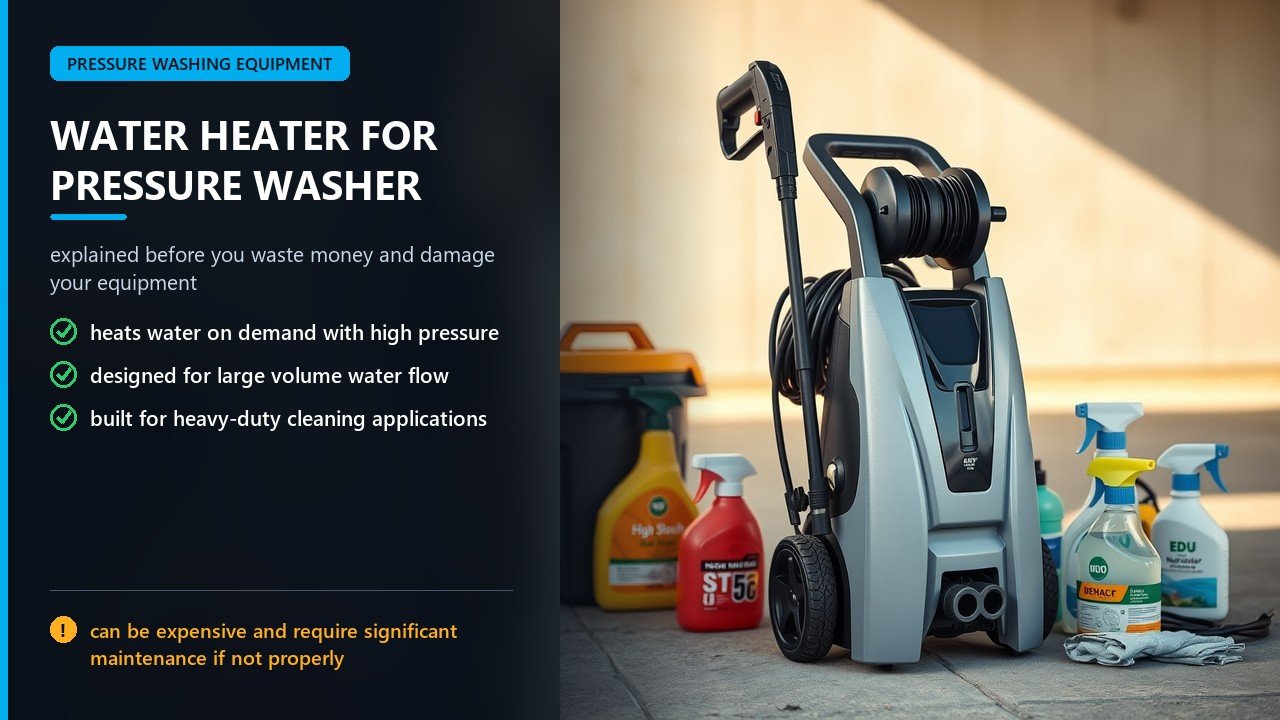
The Core Question: Can You Heat Pressure Washer Water
Yes, absolutely, but only with equipment designed for the purpose. A pressure washer moves a large volume of water at high pressure, and heating that water on demand requires a unit built to handle both the flow and the pressure. Purpose-built pressure washer heaters, often called burners or hot boxes, do exactly that. They sit in the water path, heat the water as it passes through, and deliver hot water to the gun.
What does not work is repurposing a domestic water heater. A residential tank heater is a low-pressure device. It is not built to withstand pressure washer pressure, and it cannot heat water fast enough to keep up with even a modest pressure washer’s flow. Attempting to combine the two creates a safety hazard, not a solution. The correct path is always purpose-built equipment.
The reason heat is worth chasing is simple. Cold water removes loose dirt but struggles with oil and grease, tending to smear it rather than lift it. Heat softens fats and oils, breaks their bond with the surface, and lets the water carry them away. For kitchens, shops, and fleets, that difference is the entire job.
The Math of Heating Water: Why Flow Matters
Here is the concept that explains why some heaters disappoint their owners. Heating water takes energy, and the amount of energy needed depends on how much water you are heating and how much you want to raise its temperature.
A pressure washer moves water at a flow rate measured in gallons per minute, or GPM. To heat that water, the heater must add enough energy to raise the temperature of that many gallons every minute. The faster the water flows, the more energy is required to heat it. A burner has a fixed heat output, measured in BTUs per hour. If the flow increases, the same burner has to spread its heat across more water, so the temperature rise falls.
In plain terms, a heater that produces very hot water at two gallons per minute may produce only warm water at four gallons per minute. This is why matching the burner’s output to your actual working flow is the most important decision in the whole process. The advertised maximum temperature is usually measured at the lowest flow, which is not how you will use the machine.
| Flow Rate | Effect on Temperature |
|---|---|
| Low flow | High temperature rise, very hot water |
| Moderate flow | Balanced heat, good for most work |
| High flow | Lower temperature rise, heater must be larger |
So the question “will this heater make hot water” depends entirely on the flow you run. Match the burner to your machine’s real output and you get hot water. Mismatch it and you get lukewarm disappointment.
Method One: A Dedicated Hot Water Pressure Washer
The most reliable way to get hot water is to buy a machine built for it. A dedicated hot water pressure washer integrates the pump, engine, and burner on one frame, engineered as a system. Everything is matched: the burner is sized to the pump, the plumbing is rated for heat, and the controls manage both.
This is the standard choice for professionals who run hot water regularly, because it eliminates the compatibility headaches of mixing components. The drawback is cost, since a complete hot water machine is significantly more expensive than a cold-water unit, and it requires fuel and burner maintenance.
If you are starting fresh and you know you need heat, a dedicated machine is often the simplest path. You buy once, and it works. For operations that clean grease daily, it is usually the right answer.
Method Two: An Add-On Inline Heater
If you already own a good cold-water pressure washer and want to add heat without replacing it, an add-on inline heater, sometimes called a hot box or burner unit, is the practical route. It installs in the water path between the pump and the gun and heats the water as it flows.
The advantage is cost and reuse: you keep your existing machine and add heat to it. The catch is sizing and integration. The heater must be rated for your flow and pressure, and it must be plumbed so water flows through it correctly. Every added connection is a potential leak point, and if the heater is undersized for your pump, the water will not get hot at working flow.
An add-on heater works very well when it is properly matched. It is a poor experience when it is bolted onto a machine whose flow it cannot keep up with. Do the sizing math first, and when in doubt, choose more heating capacity than you think you need.
Method Three: Understanding the Fuel Options
Heaters run on different fuels, and the choice affects cost, convenience, and where you can operate.
Diesel. The workhorse for professional hot water cleaning. Diesel is energy dense and widely available, and it delivers strong heat for the money. The tradeoffs are fuel storage and periodic burner maintenance, plus emissions rules in some areas.
Propane. Burns cleanly and heats quickly, with no diesel fuel handling. It is a good fit where diesel storage is inconvenient or where cleaner emissions matter. Propane usually costs more per unit of heat and requires managing tanks.
Electricity. Clean, quiet, and emission-free, which is attractive indoors. The problem is energy density. Heating water at pressure washer flow with electricity requires an enormous amount of power, typically a heavy-duty circuit at high voltage, which ties the machine to a fixed location with ample power. Electric heat suits fixed indoor stations, not mobile work.
| Fuel | Strengths | Limitations |
|---|---|---|
| Diesel | Efficient, widely available, strong heat | Storage, burner service, emissions rules |
| Propane | Clean, fast heat, no diesel handling | Higher cost, tank logistics |
| Electric | Clean, quiet, indoor-friendly | Very high power demand, fixed use |
For mobile work, fuel-fired heat is the practical standard. For fixed indoor work with abundant power, electric heat is a clean and simple option. Choose based on where you work and what fuel you can store.
What You Should Never Do
This section could save you from a dangerous mistake, so read it carefully.
Never connect a residential water heater to a pressure washer. Home water heaters are low-pressure devices that cannot withstand pressure washer pressure, and they cannot heat water fast enough to keep up with the flow. This is both ineffective and dangerous.
Never use a garden hose as a supply into a home water heater feeding a washer. The pressure and temperature relationships are wrong, and the risk of catastrophic failure is real.
Never run a fuel-fired heater indoors or in an enclosed space. Combustion produces carbon monoxide, an invisible, odorless gas that kills. Even brief operation in a closed garage is dangerous. The CDC carbon monoxide guidance explains how quickly CO can reach lethal levels.
Never improvise high-pressure plumbing. Fittings, hoses, and connections must be rated for both the pressure and the temperature. A burst high-pressure hot water line can cause severe burns and injury.
Who Actually Needs a Water Heater for a Pressure Washer
Not everyone does, and honesty here saves money.
Homeowners cleaning driveways, patios, siding, and cars generally do not need hot water. These surfaces are dirt-based rather than grease-based, and a cold-water machine with good pressure and flow handles them well. For occasional cleaning, the cost and complexity of heating equipment are hard to justify.
Professionals and serious users who face grease, oil, food residue, or sanitation needs do need heat. Restaurant pads, mechanic bays, fleet yards, food service, and industrial cleaning all depend on hot water for a quality result and, in some cases, for compliance. For these users, heat is not optional; it is what makes the work possible at a professional standard.
A useful test is to estimate the share of your jobs that involve grease or food. If that share is high, invest in heat. If it is low or occasional, put your budget into pressure, flow, a surface cleaner, and a good hose and nozzle setup instead, and revisit heat only when the work demands it.
Installation Essentials
Adding heat to a pressure washer is a system change, so plan the whole water and fuel path.
Water supply. Heating does not change the fact that the pump needs a steady, adequate water supply. Use a buffer tank with a float valve on commercial rigs so the pump never starves, and filter the inlet water to protect the pump and the heater coil.
Heat-rated plumbing. Every hose, fitting, and o-ring downstream of the heater must be rated for high temperature. Cold-water components fail quickly under heat.
Fuel storage. Store diesel or propane safely, with containment, ventilation, and compliance with local rules. Keep fuel away from ignition sources and never refuel a hot machine.
Venting. Fuel-fired heaters produce exhaust and carbon monoxide. Position and vent the unit so exhaust cannot enter a building or accumulate in a workspace. Outdoor operation or full ventilation is mandatory.
Controls and safety. Use machines and heaters with proper temperature and pressure safety controls, and never disable them.
Maintenance and Descaling
Heat adds maintenance, and the biggest item is the heating coil. Hard water leaves mineral scale inside the coil, and scale acts as insulation, reducing heat transfer and eventually causing overheating and failure. Descaling the coil on a schedule based on your water hardness is essential, and using filtered or softened water reduces how often you must do it.
Beyond the coil, service the burner regularly, including its nozzle, filter, and ignition components, because poor combustion means poor heat and more soot. Change pump oil on schedule with the correct spec, flush the system after detergent use, inspect hoses and fittings for heat damage, and winterize the entire system so trapped water does not freeze and crack the coil, pump, or lines. Test the safety controls regularly, because they are what stand between normal operation and a dangerous failure.
Cost and Return on Investment
Heat costs money up front and to operate, so the return depends on your work. For a professional cleaning business, hot water unlocks grease and food service work, cleans faster, and produces results that win and keep contracts. The return is measured in jobs completed and contracts won, and it is usually compelling.
For a homeowner, the return is weak. A hot-water system is expensive to buy and maintain, and occasional home cleaning rarely needs heat. If you want heat for specific tasks like cleaning a grill or engine, a smaller dedicated steam cleaner or a hot water machine borrowed for the job may serve better than owning a full system.
The honest summary is that heat is a business tool, not a hobby upgrade. Buy it when the work pays for it.
Choosing the Right Heater Size: A Practical Method
Sizing feels technical, but you can approach it sensibly without engineering calculations.
Start with your machine’s flow in GPM. This is the number that drives everything. Then decide how hot you need the water for your toughest job. Grease and food residue generally demand genuinely hot water, while light cleaning can get by with warm. Finally, understand that achieving hot water at higher flow requires a larger burner. If your machine runs a lot of water per minute, you need a burner with more heating capacity to keep up.
The practical approach is to choose a heater whose heating capacity is specified to deliver hot water at or above your machine’s flow rate. If a heater is rated to produce hot water at two gallons per minute and your machine runs four gallons per minute, you will get warm, not hot, water. This mismatch is the single most common reason a buyer is disappointed with an add-on heater.
When you are unsure, size up. Extra heating capacity is never wasted, and it gives you margin when conditions are cold or when you push the machine harder. Under-sizing, by contrast, leaves you with lukewarm water and wasted fuel, and there is no easy fix short of buying another heater.
Tip: Before buying, note your machine’s flow and pressure, then ask the seller to confirm the heater’s rated heat output and the flow at which it achieves its rated temperature. A seller who cannot answer that is a seller to avoid.
Real-World Scenarios for Hot Water
Different users get different value from heat, and specifics make it clear.
Restaurant and food service. This is the strongest case for heat. Hood cleaning, kitchen floors, dumpster pads, and grease traps are dominated by fats and oils that cold water cannot effectively remove. Hot water, often combined with steam and degreasers, is the professional standard. Without heat, the work is slow, incomplete, and likely to fail an inspection.
Automotive and fleet. Engine bays, undercarriages, and heavy grease on trucks and equipment respond far better to heat. A mobile operation with a hot water machine can serve clients a cold-water rig cannot handle, which widens the customer base and increases revenue per job.
Industrial and manufacturing. Machinery, floors, and equipment caked in oil and process grime are cleaned with hot water. When the environment also demands sanitation or minimal moisture, steam becomes valuable on top of heat.
Residential deep cleaning. A homeowner’s main use for heat is a barbecue grill, a range hood, or a greasy engine. These are occasional, which is why most homeowners do not buy heat equipment but instead use a small dedicated cleaner or a borrowed machine for these specific tasks.
Commercial exterior cleaning. Parking lots, sidewalks, and building exteriors are often dirt-based rather than grease-based, so heat provides less benefit. Here, a surface cleaner and good pressure and flow matter more than temperature. This is an important distinction, because it explains why some cleaning businesses thrive with cold water and others absolutely need heat.
Portable vs Fixed Heating Setups
Where and how you work determines whether you need a portable or fixed approach.
A portable setup travels with you. It means the heater is mounted on your machine, cart, or trailer, running on fuel you carry and independent of any building supply. This is the standard for mobile cleaning businesses, and it is why fuel-fired heaters dominate professional use: they deliver a lot of heat in a package you can take anywhere. A mobile pressure washing trailer can carry the machine, heater, fuel, and water tank together, making it a complete self-contained cleaning station.
A fixed setup stays in one place. This suits indoor facilities, wash bays, and shops, where power and water are plumbed and ventilation can be engineered. Fixed setups can use electric heat because abundant power is available, and they avoid fuel handling. The tradeoff is that you cannot take the capacity anywhere; the work must come to the station.
Choose based on your work pattern. If you travel to jobs, portable fuel-fired heat is the answer. If your cleaning happens in a fixed bay, a fixed electric or fuel-fired setup may be cleaner and simpler to operate.
Common Mistakes and Misconceptions
Several beliefs about heating pressure washer water lead people astray.
“Any hot water works.” False. Temperature matters, and a lukewarm stream does not melt grease the way genuinely hot water does. Size the heater so the water is actually hot at your working flow.
“I can use my home water heater.” False and dangerous. Residential water heaters are not built for pressure washer pressure and flow.
“I can add heat later cheaply.” Sometimes true, but an add-on heater must be matched to your machine, and mismatched equipment wastes money. Plan for heat from the start if you know you need it.
“Hot water is always better.” Not for everything. Hot water on a dirt-based concrete driveway offers modest benefit compared with the cost. Heat earns its keep on grease, oil, and sanitation.
“Maintenance does not matter much.” False. A scaled coil and a neglected burner rob you of heat and cause failures. Maintenance is what keeps a hot water setup productive.
Quick Note: If you are unsure whether to buy heat, rent or borrow a hot water machine for one greasy job first. The difference will make the decision obvious, and you will know your real needs before spending thousands.
Water Heater for Pressure Washer: Frequently Asked Questions
Can I use a home water heater for my pressure washer? No. Residential water heaters are not built for pressure washer pressure and flow and cannot heat water fast enough. Using one is unsafe and ineffective. Use purpose-built pressure washer heating equipment.
How do I add hot water to an existing pressure washer? Install an add-on inline heater or hot box rated for your machine’s flow and pressure, and upgrade all downstream hoses and fittings to heat-rated components.
Why is my heater not making the water hot? The most common reason is that the burner is undersized for your flow, so the temperature rise is small at working flow. Other causes include a scaled coil, contaminated fuel, or a burner needing service.
Is diesel or propane better for heating pressure washer water? Diesel is usually more economical per unit of heat and widely available; propane burns cleaner and avoids diesel handling. Choose based on cost, fuel availability, and emissions rules where you operate.
Do I need hot water for home pressure washing? Generally no. Cold water handles most home surfaces. Heat matters for grease, oil, food residue, and sanitation, which are more common in commercial work.
What temperature can a pressure washer heater reach? Fuel-fired units can raise water to roughly 180 to 200 degrees Fahrenheit or more, depending on the burner size and flow rate. Higher flow reduces the achievable temperature for a given burner.
Final Verdict on Heaters for Pressure Washers
Heating water for a pressure washer is entirely possible and, for the right user, transformative. The catch is doing it with the right equipment and the right sizing. A dedicated hot water machine or a properly matched add-on heater delivers the hot water that melts grease and speeds cleaning, while a residential water heater or an improvised setup delivers danger and disappointment.
Start by deciding whether your work actually needs heat. If it involves grease, oil, or food, it probably does, and the investment will pay for itself through faster jobs and better results. If it involves dirt on driveways and siding, it probably does not, and your money is better spent on pressure, flow, and a surface cleaner. Get that decision right first, size the heat correctly second, and respect the safety rules always. Do that, and a water heater for your pressure washer becomes a genuine advantage rather than an expensive mistake.