The shop owner had a big air compressor, the kind that runs impact wrenches and paint sprayers all day, and he wondered why he should buy a separate pressure washer when he already had air on tap. He rigged a siphon gun to a bucket of water, pulled the trigger, and watched a fine mist drift onto the concrete. The heavy greasy film on the floor barely moved. The air pressure gauge read a healthy 100 PSI, which felt powerful, yet the water barely made an impression. The mystery is one of physics, and it is the key to understanding the compressed air power washer. Air and water behave in completely different ways, and a machine that uses one to move the other has very specific strengths and limits. Knowing which is which saves money, time, and a lot of frustration.
This guide explains what an air-powered or compressed-air pressure washer really is, how it works, when it makes sense, why a simple air compressor cannot replace a real pressure washer, what a compressor must supply to run a proper pneumatic system, and the safety rules that keep air-powered cleaning safe.
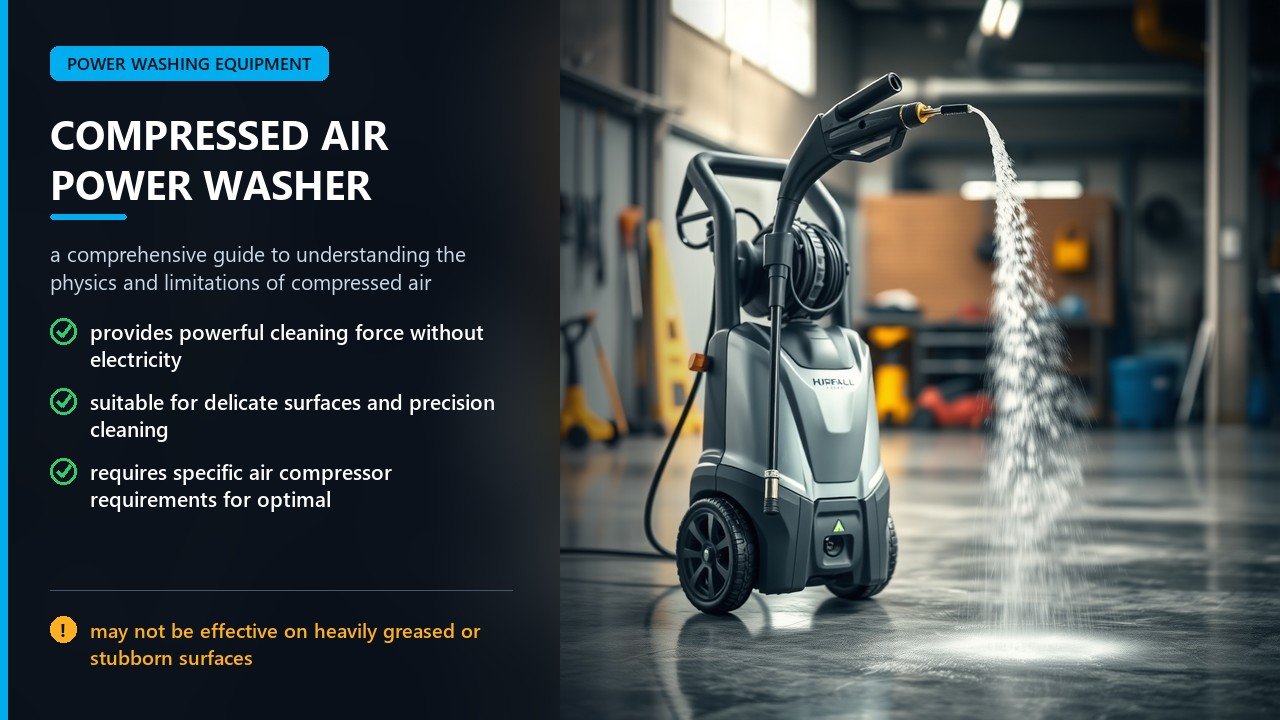
What Is a Compressed Air Power Washer?
The phrase covers a few different tools, and mixing them up causes most of the confusion. There are three distinct categories, and only one of them is a true pressure washer.
Air-driven (pneumatic) pressure washers. These are genuine pressure washer systems powered by compressed air instead of electricity or gasoline. An air-driven motor turns a pump, and the pump pressurizes water to commit serious cleaning force. No electricity or fuel powers the pump; the compressed air does.
Air-assist spray guns and siphon guns. These are light-duty attachments that combine compressed air with water at the nozzle. They use air to draw water up a tube and spray a mist or low-pressure stream. They are useful for rinsing and applying cleaners, but they are not true pressure washers.
Dry compressed air cleaning. This is simply using a blow gun and compressed air to remove dust, debris, and dry contaminants from surfaces, tools, and equipment without any water at all.
When people search for a “compressed air power washer,” they usually mean one of the first two. Understanding the difference between a real air-driven pressure washer and a simple siphon attachment is the key to setting realistic expectations.
How an Air-Driven Pressure Washer Works
A true air-powered pressure washer is not the compressor alone. It is a system built around a specialized pump, sometimes called an intensifier pump or air motor pump, that turns air pressure into water pressure.
The process runs in a clear sequence. Compressed air flows from the compressor into the air motor of the pump. The air motor drives a piston or plunger inside the pump. As the plunger moves, it pressurizes water drawn from a standard supply line or garden hose. The pressurized water then exits through a high-pressure hose and spray wand, just like a conventional machine.
The critical concept is the pressure ratio. The pump multiplies the air pressure it receives into water pressure through mechanical advantage. For example, a 30-to-1 intensifier pump fed with 90 PSI of air can produce roughly 2,700 PSI of water pressure (90 multiplied by 30). A 12-to-1 pump fed the same air would produce far less. The pump design, not the compressor alone, decides how much water pressure you get.
This is why a compressor running at 90 PSI does not deliver 90 PSI at the water outlet. The air simply drives the pump; the pump’s internal ratio sets the water pressure. Systems built on this principle are used in industrial, automotive, and remote settings where electricity or fuel is impractical, and they can deliver professional-grade performance when sized correctly.
Why an Air Compressor Alone Cannot Replace a Pressure Washer
Many people assume that because an air compressor reaches the same PSI as a pressure washer, it can do the same job. This is the most common and costly misunderstanding. The two machines move fundamentally different fluids.
Air is a gas. Its molecules are widely spaced and highly compressible, so stored air acts like a cushion. Water is a liquid and is essentially incompressible, which means every bit of energy a pump applies travels through the water column to the nozzle as a solid slug of mass. When you try to use air to push water, the air compresses against the water and absorbs much of the energy you intended for cleaning.
Water is roughly 800 times denser than air. Because kinetic energy depends heavily on mass, an air stream simply cannot generate the same hammer effect as a dense water jet. The result is that an air-and-water siphon gun produces a turbulent mist rather than a cohesive high-pressure stream, and it loses momentum quickly over distance.
The other half of the story is volume. Cleaning power comes from both pressure and flow, measured as PSI and GPM. A standard pressure washer delivers 2,000 to 3,000 PSI at 2 to 4 gallons per minute. An air siphon gun, even with strong air pressure, moves only a fraction of a gallon per minute. Multiply the two numbers and the gap becomes enormous, which is why an air compressor works for light rinsing but never for stripping grime.
| Metric | Air Siphon Gun | Standard Pressure Washer |
|---|---|---|
| Pressure | 90–125 PSI | 2,000–3,000 PSI |
| Water flow | 0.1–0.3 GPM | 2.0–4.0 GPM |
| Cleaning units (PSI × GPM) | Tens | Thousands |
| Best use | Light rinsing, applying cleaner | Real cleaning and stripping |
Types of Air-Based Cleaning Tools
With the physics clear, the tools make sense. Each solves a different problem.
True pneumatic pressure washer. An air motor drives a high-pressure pump. It delivers genuine pressure washer output, no electricity needed. It is heavier, more expensive, and demands a serious air supply, but it is the only air-based option that truly cleans like a pressure washer.
Air-assist spray gun. A toolkit attachment that mixes air and water at the nozzle for a higher-impact spray than a hose alone. It typically stays under 1,000 PSI and suits light-duty tasks such as rinsing a vehicle or cleaning patio furniture.
Siphon gun (Venturi). A gun that uses a high-speed air stream to create a vacuum and draw water from a bucket. Cheap and portable, but it produces a mist with very low water volume and inconsistent flow as tank pressure drops.
Air blow gun. A tool that uses dry compressed air alone to blow away dust and debris. Excellent for engines, filters, electronics, and dry shop cleanup, and it needs no water at all.
| Tool | Air Needed | Water Needed | Real Cleaning Force |
|---|---|---|---|
| Pneumatic pressure washer | High CFM at 90+ PSI | Yes, supply line | Yes, full pressure washer output |
| Air-assist spray gun | Moderate CFM | Yes | Limited, light duty |
| Siphon gun | High CFM | Yes, from a bucket | Minimal, mist only |
| Air blow gun | Moderate CFM | No | Dry debris removal only |
Air Compressor Requirements
If you want a true air-driven pressure washer, your compressor must be up to the job. This is where many projects stall, because a home compressor that runs a nail gun is often nowhere near powerful enough to drive a real pressure washer pump.
The essential specification is CFM — cubic feet per minute — measured at the operating pressure, usually 90 PSI. CFM describes air volume, and a pressure washer pump moves a lot of air. A small pneumatic pressure washer might need 4 to 6 CFM at 90 PSI, within reach of a decent shop compressor. Larger, professional units can demand 20 to 30 CFM or more, which means only a serious compressor with a large tank and a high duty cycle can keep up.
Several other factors matter. The compressor should sustain at least 90 PSI continuously, not just a peak rating at lower pressure. It should have a large tank, often 60 gallons or more, to maintain consistent flow during extended cleaning. A 100 percent duty cycle is important for long sessions, because a compressor that must rest cannot sustain a pressure washer. Use 3/8-inch or larger air hoses to minimize pressure drop over distance. And supply clean, dry air, because moisture in the lines accelerates corrosion inside the pump and its fittings.
As a rough check, if your compressor requires at least 25 CFM at 100 PSI for the pump you want, the compressor must produce at least that much at the same pressure — not merely at a lower, easier pressure where many compressors advertise their best numbers.
| Pump Ratio | Air Pressure Needed | Approx. Water Pressure |
|---|---|---|
| 12:1 | 90 PSI | About 1,080 PSI |
| 20:1 | 90 PSI | About 1,800 PSI |
| 30:1 | 90 PSI | About 2,700 PSI |
Where Air-Powered Washers Make Sense
An air-driven pressure washer is not for everyone, but in specific environments it is the best tool available.
Hazardous and flammable areas. Because the pump is driven by air, there is no electric motor to create sparks, short circuits, or heat. That makes air-powered systems ideal in paint booths, chemical plants, fuel storage areas, and other environments where an electric motor would be dangerous.
Remote and mobile locations. Where reliable electricity is unavailable, a compressor powered by a generator or a truck-mounted system can still run a pneumatic pressure washer. Construction trailers, roadside repair, and marine maintenance are natural fits.
Industrial and heavy-duty cleaning. Large industrial machinery, fleet vehicles, and factory equipment often need serious cleaning in facilities where compressed air is already the dominant utility. If air is already piped throughout the building, adding a pneumatic washer may be simpler than running new electrical service.
Shops already invested in air. For a facility that lives on compressed air and has the CFM to spare, an air-driven washer can clean tough deposits without adding another electric motor to the service panel.
Outside these cases, a dedicated electric or gas pressure washer usually wins. It is typically cheaper, delivers higher and more consistent water pressure with less setup, and does not depend on a high-CFM air supply. For a typical homeowner, an electric pressure washer is the practical choice.
Safety With Compressed Air and Water
Compressed air and water are both dangerous when mishandled, and combining them demands care.
Never point compressed air at your skin. Air injected into the body — even at modest pressure through a small nozzle — can force air into tissues and bloodstream, causing severe injury or death. This is the single most important air-tool safety rule.
Protect against tank corrosion. Air compressor tanks are steel and designed to stay dry. Introducing water, or operating in heavy moisture, can pool in the tank and initiate rust, weakening the pressure vessel. Use an air dryer or filter, drain the tank regularly, and never let water migrate into the compressor.
Prevent backflow. Do not connect a garden hose to an air line in a way that lets water or air contaminate a potable water supply. Use proper backflow prevention.
Match ratings and connections. Use hoses, fittings, and a regulator rated for the pressures involved, and always depressurize before changing parts.
Wear eye and ear protection. Airborne water and debris travel fast, and air tools are loud. Protect yourself.
Cleaning Units: The Real Measure of Power
The pressure washing industry has a simple way to compare machines that cuts through marketing: cleaning units. You calculate them by multiplying pressure (PSI) by water flow (GPM). The result approximates the tool’s actual cleaning ability far better than either number alone.
A modest pressure washer rated at 2,000 PSI and 2.0 GPM produces 4,000 cleaning units. A stronger machine at 3,000 PSI and 3.0 GPM produces 9,000. Now consider an air siphon gun running near 100 PSI but moving only 0.1 to 0.2 GPM of water. Its cleaning units land around 10 to 20 — barely more effective than a garden hose with a thumb over the end. That single calculation explains why an air compressor cannot substitute for a pressure washer no matter how impressive its PSI rating looks.
The lesson extends beyond air tools. When comparing any two pressure washers, do not be fooled by a high PSI number paired with weak flow. High pressure with low volume loosens grime but cannot carry it away, while strong flow rinses a surface clean and speeds up coverage. The machines that clean best balance both, and the ones that disappoint usually sacrifice flow to advertise pressure.
Sizing a Pneumatic Setup: A Practical Walkthrough
If you decide a pneumatic pressure washer is right for your environment, plan the system methodically. Mistakes here are expensive, so work through the steps in order.
Step 1 — Define the job. Decide what you will clean and how often. Light rinsing may suit an air-assist gun, while stripping heavy grime on industrial machinery calls for a true pneumatic pressure washer with real output.
Step 2 — Pick the pump and its ratio. Choose a pump based on the water pressure you need. A 12:1 pump at 90 PSI of air gives roughly 1,080 PSI, a 20:1 gives about 1,800 PSI, and a 30:1 gives about 2,700 PSI. Match the ratio to the work, not to the biggest number available.
Step 3 — Confirm the air demand. Read the pump’s CFM requirement at its operating pressure. This is the number your compressor must satisfy.
Step 4 — Verify your compressor. Check that your compressor delivers that CFM at 90 PSI or higher, sustained, not just at peak. Confirm tank size for consistent flow and a duty cycle that supports your longest sessions.
Step 5 — Prepare clean, dry air. Install a filter and dryer or at least a moisture trap, and drain the tank regularly. Wet air corrodes the pump and the tank interior.
Step 6 — Build safe connections. Use air hoses of 3/8 inch or larger, rated fittings and regulators, and a proper water supply with backflow protection.
Step 7 — Test at low pressure. Before a real job, run the system briefly, check for leaks, and confirm the water pressure at the wand.
Working through these steps prevents the most common failure: buying a capable pump and discovering the compressor cannot feed it, leaving a stalled, sputtering system.
Maintaining Air-Powered Systems
An air-driven pressure washer rewards basic maintenance. Drain the compressor tank after every use to remove condensed moisture, because water sitting in a steel tank is the leading cause of internal rust. Replace or clean the air filter and moisture trap regularly so the pump only receives clean, dry air. Inspect the air hoses for cracks and worn fittings, since a leak wastes both air and money.
On the water side, treat the pump as you would any pressure washer pump: check the oil if it is a lubricated design, inspect seals and o-rings for wear, and keep the water supply clean to avoid debris damaging the plunger. Flush the unit after chemical use. Store the system with the tank drained and the hoses coiled without sharp bends. Given how much mechanical stress a pneumatic pump endures, these small habits are what separate a system that lasts for years from one that fails within seasons.
Common Mistakes to Avoid
Thinking air PSI equals water PSI. A 90 PSI air supply does not produce 90 PSI of water. The pump’s ratio determines water pressure, and without a proper pump, there is no useful cleaning force.
Expecting a siphon gun to strip grime. Siphon guns mist water; they do not clean like a pressure washer. Use them for rinsing and applying cleaner, not for heavy grime.
Undersizing the compressor. A pump that needs 25 CFM will not run on a compressor that delivers 8. Match CFM at operating pressure, and check the duty cycle.
Ignoring moisture. Wet air corrodes the pump and the tank. Use clean, dry air and drain the tank often.
Cutting corners on safety. Never aim air at skin, never exceed ratings, and always depressurize before servicing.
Buying pneumatic for a home when electric fits. For most homeowners, an electric pressure washer is cheaper and simpler. Choose pneumatic only when the environment or the existing air supply justifies it, and always confirm the CFM and duty cycle before you commit.
Frequently Asked Questions
Can I turn my air compressor into a pressure washer? Not by connecting air to water directly. A true setup needs a purpose-built air-driven pump with a high pressure ratio. Without that pump, you only get a low-volume siphon mist.
Does 90 PSI of air equal 90 PSI of water? No. Air drives a pump that multiplies the pressure by its ratio. A 30:1 pump at 90 PSI of air produces about 2,700 PSI of water.
How much CFM does a pneumatic pressure washer need? It varies by pump. Small units may need 4 to 6 CFM at 90 PSI, while large professional systems can require 20 to 30 CFM or more at operating pressure.
Is an air compressor good for cleaning? It is excellent for dry debris with a blow gun and useful for light rinsing with an air-assist gun. For deep cleaning and stripping, a dedicated pressure washer is far more effective.
Why does a siphon gun only mist? Because air is compressible and low in mass, it acts as a cushion rather than a piston, atomizing the water instead of forming a cohesive high-pressure stream.
Can a small home compressor run an air-powered pressure washer? Usually not a full pneumatic washer, which demands high CFM at 90 PSI and often a large tank with a high duty cycle. A small compressor can run an air-assist gun or a blow gun, but not a true pressure washer pump.
Can I use an air compressor to clean my car? Yes for drying and blowing away dust, and an air-assist gun can help rinse and apply cleaner. For removing road film and grime, a dedicated pressure washer or a careful hand wash remains far more effective.
Are pneumatic pressure washers safe around flammable materials? Yes. With no electric motor, there are no sparks or short circuits, which makes air-driven systems a good fit for paint booths, chemical plants, and fuel areas.
What is the main drawback of air-powered washers? Most need a large, high-CFM compressor, and a comparable electric or gas pressure washer usually delivers more consistent water pressure for less cost and complexity.
Final Thoughts
A compressed air power washer can mean several very different tools, and the difference decides your results. A true air-driven pump multiplies air pressure into genuine water pressure and cleans like a real pressure washer, while a siphon gun merely mists water and should never be expected to strip grime. The physics is simple: cleaning power is pressure times flow, and air-propelled water simply cannot match the mass and volume of a real pressure washer stream.
Choose air-powered cleaning when the environment demands it — hazardous areas, remote sites, or facilities built around compressed air — and make sure your compressor can deliver the CFM, tank size, and duty cycle the pump requires. Verify those numbers carefully, because a pump starved of air will sputter and stall no matter how well it is built. For everything else, a dedicated electric or gas machine is simpler and stronger, and it will clean more surfaces in less time with far less planning. Pair either approach with dependable pressure washer pumps, hoses, and cleaning accessories, and you will get genuine cleaning power instead of a hopeful mist.