A homeowner named Dan stood in a hardware store, staring at two labels that seemed to describe the same machine. One box said “pressure washer.” Another said “jet washer.” A third accessory in the aisle was called a “jet nozzle.” He pulled out his phone and searched, only to find articles arguing about which term was correct and videos showing spinning turbo tips. By the time he left, he was more confused than when he walked in. Here is the truth he was looking for: a jet pressure washer is not a mysterious third category of machine — it is a pressure washer by another name, and the real decisions are about nozzles, pressure, and technique. Once you understand the vocabulary, choosing the right tool becomes easy.
The words “jet,” “power,” “pressure,” and “jet wash” get thrown around so loosely that buyers end up comparing apples to oranges. Some of it is regional, some of it is marketing, and some of it describes genuinely different accessories. This guide untangles all of it. You will learn what a jet pressure washer actually is, how it differs from a jet nozzle and a water jet cleaner, what turbo and rotary nozzles really do, and how to pick the right tool for the surface in front of you.
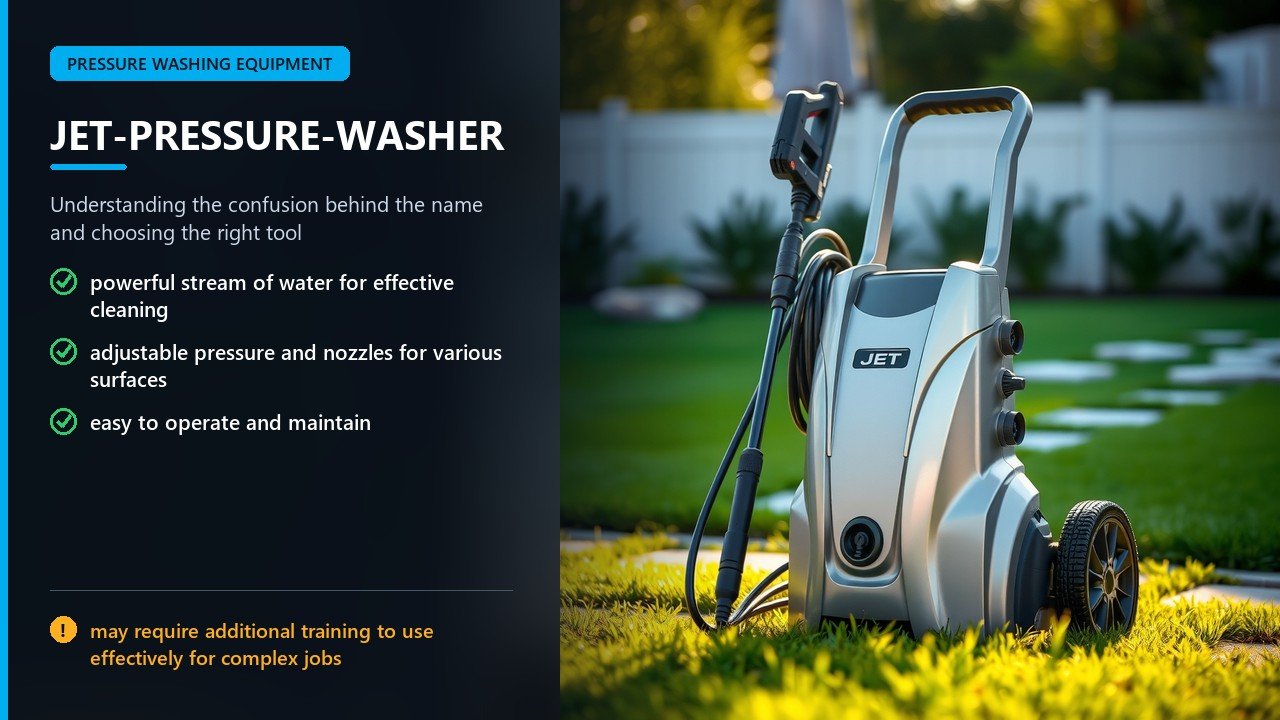
What “Jet Pressure Washer” Actually Means
In plain terms, a jet pressure washer is simply a pressure washer — a motorized machine that uses a pump to raise water pressure well above what a garden hose can produce, then fires that water through a nozzle to blast away dirt. The word “jet” refers to the powerful stream of water leaving the lance, not to a distinct type of machine.
The confusion is largely regional. In the United Kingdom, “jet washing” and “jet washer” are the everyday terms for what North Americans call “pressure washing” and a “pressure washer.” The name stuck because several manufacturers branded their machines as jet washers. So a jet pressure washer and a pressure washer are, functionally, the same tool.
The Family of “Jet” Tools You Need to Separate
The real confusion comes from a handful of products that all use the word “jet” but work very differently. Getting these straight is the key to buying the right thing.
The pressure washer (jet washer). A complete machine with a motor and pump that delivers high pressure. This is the main tool. Consumer models run roughly 1,400 to 2,200 PSI, while professional machines reach 2,000 to 4,000+ PSI.
The jet nozzle. A simple attachment you screw onto a garden hose. It concentrates the hose’s normal 40 to 70 PSI into a narrow, more forceful stream, reaching perhaps 500 to 1,500 PSI. It amplifies garden hose pressure; it does not come close to a pressure washer’s power.
The turbo (rotary) nozzle. A pressure washer accessory that fires a concentrated near-zero-degree jet and spins it in a rapid circle. It combines the cutting power of a pinpoint stream with the coverage of a slightly wider pattern. It does not increase your machine’s pressure — it rearranges the energy your pump already produces.
The water jet cleaner. An industrial tool that reaches pressures of 20,000 to 30,000 PSI or more, used for cutting, stripping, and heavy industrial cleaning. This is in a completely different league and price bracket from any residential pressure washer.
| Tool | Typical Pressure | Power Source | Best For |
|---|---|---|---|
| Jet nozzle (hose attachment) | 500–1,500 PSI | Garden hose | Light, precise spot cleaning |
| Jet/pressure washer (home) | 1,400–2,200 PSI | Electric | Cars, patios, siding, furniture |
| Jet/pressure washer (pro) | 2,000–4,000+ PSI | Electric or gas | Driveways, commercial, stripping |
| Turbo/rotary nozzle | Same as host machine | Accessory | Concrete, masonry, tough grime |
| Water jet cleaner (industrial) | 20,000–30,000+ PSI | Specialized pumps | Industrial cutting and stripping |
Pressure Washing, Power Washing, and Jet Washing: Clearing the Air
Beyond “jet,” two more terms create needless confusion: pressure washing and power washing. In North America, these two are related but not identical. Pressure washing uses cold water under high pressure. Power washing uses heated water under high pressure. The heat is the differentiator, and it matters enormously on grease, oil, and organic growth, which cold water struggles to remove. In the UK, the lines blur and people use “power washing” and “jet washing” interchangeably, often with cold water.
So where does that leave a “jet pressure washer”? Right in the middle of the terminology soup. In practice, a jet washer is a pressure washer, and a pressure washer can be cold or hot depending on the machine. If your goal is degreasing a driveway stained with motor oil, what you actually want is a hot water (power washing) machine. If your goal is rinsing mud off a patio, a cold water pressure washer is perfect.
Here is the practical takeaway. Terms vary by region and by brand, so ignore the label and ask three questions instead: How much pressure does it deliver? How much flow? Does it heat the water? Those three answers describe the tool far better than any marketing word, and they are the only things that affect the result on your surface.
Inside a Turbo Nozzle: Why Rotation Changes Everything
It helps to understand what is physically happening inside a turbo nozzle, because that knowledge tells you exactly when to use one and when to leave it in the toolbox. At the core is a small orifice that creates a high-pressure jet, much like a zero-degree tip. That jet then strikes a rotating element — often a ceramic or hardened insert — housed in a bearing assembly. The element spins, sweeping the jet in a tight circle many times per second.
The effect is that any single point on the surface receives repeated, concentrated impacts rather than one continuous blast, and the impacts arrive from rapidly changing angles. That is why the turbo nozzle cleans hard surfaces so efficiently: it combines the bite of a pinpoint stream with a moving pattern that covers ground far faster than a stationary jet could.
But rotation is also the turbo nozzle’s weakness. The spinning parts are moving components that can clog with debris, wear out, or seize up. A turbo nozzle needs enough flow to spin properly; on a weak machine it may stall and spray unevenly. And because the impact is so concentrated, it leaves visible swirl marks if you move at an inconsistent pace, especially on softer or lighter-colored concrete. Knowing this, you use the turbo to break the bond on tough, hard surfaces, then switch to a fan tip to even the finish.
Jet Nozzle vs Pressure Washer
This is the comparison that trips up the most shoppers. A jet nozzle and a pressure washer both clean with pressurized water, but they occupy different ends of the power and price spectrum.
A jet nozzle is a small, inexpensive attachment you connect to your garden hose. It amplifies household water pressure into a stronger stream and lets you spray with precision. It is gentle enough for delicate surfaces, light enough to carry anywhere, and cheap enough to keep in a drawer. For washing a car’s wheels, a patio chair, or a mailbox, it is often all you need.
A pressure washer, by contrast, is a powered machine with its own pump that can push water up to eight times harder than a hose. It strips layered grime, cleans large surfaces fast, and handles jobs a nozzle never could — but it costs more, requires setup, and demands more care to avoid damaging surfaces.
| Factor | Jet Nozzle | Pressure Washer |
|---|---|---|
| Approx. cost | $10–$25 | $100 and up |
| Pressure | 500–1,500 PSI | Up to 4,000+ PSI |
| Portability | Extremely light | Heavy, needs setup |
| Speed on big jobs | Slow | Fast |
| Delicate surfaces | Safe | Can damage if misused |
| Best for | Precision spot cleaning | Large and heavy-duty cleaning |
Turbo and Rotary Nozzles: The Real “Jet” Feature
If there is one accessory that earns the word “jet,” it is the turbo nozzle, also called a rotary nozzle. It works by forcing water through a small orifice to create a high-pressure pinpoint jet, then passing that jet through a rotating component that spins it in a circle. The result is a concentrated stream that moves rapidly, hitting the surface from multiple angles in quick succession.
This design solves a real problem. A fixed zero-degree tip has enormous punch but only cuts a narrow line, so covering a large area takes forever. A wide fan tip covers area but loses impact. The turbo nozzle sits in between, delivering concentrated impact across a small circular path. That makes it excellent for concrete, brick, curbs, steps, and mud-caked equipment.
What the turbo nozzle cannot do is create power that is not there. A common myth claims a turbo nozzle multiplies your machine’s pressure. It does not. It rearranges the energy from your pump into a moving point of impact. A 3,000 PSI machine stays a 3,000 PSI machine. The rotating impact simply attacks stubborn grime more efficiently than a stationary stream.
| Feature | Turbo / Rotary Nozzle | Fixed Tip |
|---|---|---|
| Spray action | Concentrated jet spinning in a cone | Stationary spray in a set pattern |
| Coverage | Small circular cleaning path | 0°, 15°, 25°, or 40° fan |
| Best use | Tough grime on hard surfaces | Rinsing, delicate work, detergent, finish |
| Finish consistency | Can leave circles or stripes with poor pace | Easy to overlap in uniform rows |
| Maintenance | Rotor can clog, wear, or seize | Simple orifice, few failure points |
| Damage risk | High if held close or still | Varies by angle; wide fans are gentle |
Understanding the Numbers: PSI, Flow, and Orifice
Whatever the label on the box, three specifications determine performance. Understanding them keeps you from buying the wrong tool or nozzle.
PSI (pounds per square inch) measures the force of the water at the tip. Higher PSI bites harder into stubborn grime. Consumer pressure washers deliver roughly 1,400 to 2,200 PSI; professional units reach 2,000 to 4,000+ PSI.
GPM (gallons per minute) measures water volume. Higher flow rinses debris away and cleans large areas faster. Pressure and flow work together: pressure breaks the bond, flow carries the dirt off.
Orifice size is the diameter of the nozzle opening. A smaller orifice raises pressure but reduces flow; a larger orifice lowers pressure but increases flow. When you buy replacement nozzles, match the orifice to your machine’s PSI and GPM so you neither lose performance nor overload the pump.
For a turbo nozzle specifically, the rotor needs enough flow to spin properly. On a weak machine, a turbo nozzle may simply stall and spray unevenly. Match the accessory to the machine, always.
What Each Tool Cleans Best
Matching the tool to the job prevents both frustration and damage.
Jet nozzle (hose attachment) is ideal for: car wheels and trim, patio furniture, grills, mailbox and fence pickets, window frames, and any light, precise or delicate task. It is safe near plants and gentle on soft surfaces.
A home pressure washer is ideal for: cars and trucks, patios and decks, siding and fences, driveways, and general outdoor cleaning. It is the workhorse for most homeowners.
A pro or high-PSI pressure washer is ideal for: concrete driveways and sidewalks, commercial buildings, heavy equipment, fleet vehicles, and paint stripping or surface prep.
A turbo nozzle on a suitable machine is ideal for: concrete, brick, paving, curbs, steps, and mud-caked hard surfaces. It is the go-to for fast, aggressive cleaning.
Soft washing (under 500 PSI plus cleaning solutions) is ideal for: roofs, render, painted brick, and delicate stone. Here the chemistry does the work and low pressure keeps the surface safe.
Three Real Jobs, Three Right Tools
Abstract advice becomes clear with concrete examples. Here are three common scenarios and the tool each one actually needs.
Scenario one — washing a family car. The goal is to remove road film and grime without harming paint or trim. A jet nozzle on a garden hose handles the wheels and a quick rinse, but for a thorough wash a home pressure washer at lower pressure with a 40-degree tip or a foam cannon is ideal. A turbo nozzle is exactly wrong here: the concentrated impact can mar clear coat and blast water past seals. The right tools are gentle wide tips, a soap stage, and a controlled rinse — not maximum pressure.
Scenario two — renewing a concrete driveway. Years of dirt, algae, and tire marks have darkened the surface. A jet nozzle would take all day and barely make a dent. This is a pressure washer job, ideally with a turbo nozzle or a surface cleaner attachment. The turbo tip breaks the bond fast on the sound concrete, and a surface cleaner delivers an even finish across large areas. Higher pressure and flow pay off here in both speed and result.
Scenario three — cleaning a painted wood fence. The goal is to remove grime and mildew without splintering the wood or stripping paint. Maximum pressure is the enemy. A pressure washer at reduced pressure with a wide fan tip, held at a safe distance and working with the grain, does the job. Alternatively, a jet nozzle on the hose removes loose dirt gently. This is a job where restraint beats power, and where soft washing (low pressure plus cleaning solution) often produces the best and safest result.
The pattern across all three: the surface dictates the tool and the setting. Pressure, flow, nozzle angle, and distance are the variables you actually control. Master those and the labels stop mattering.
The Role of Temperature: The Variable Everyone Forgets
Most people fixate on pressure and ignore temperature, yet heat transforms what a pressure washer can do. Cold water removes loose dirt, mud, and surface grime through force. Hot water adds thermal energy that dissolves grease and oil, emulsifies fats, and helps kill bacteria and organic growth. On a greasy engine, a food-service floor, or an oil-stained driveway, hot water cleans in a fraction of the time and with far less detergent.
That is why professional machines often run hot water burners, and why “power washing” specifically refers to heated cleaning. When you shop, decide whether your jobs involve grease, oil, or sanitation. If they do, a hot water machine — whether electric, gas, propane, or diesel — will outperform a cold water unit no matter how high the cold unit’s PSI climbs. If your work is mostly mud, dust, and light grime, cold water is simpler, cheaper, and entirely adequate.
How to Choose a Jet Pressure Washer
Since a jet pressure washer is a pressure washer, choose it the way you would choose any machine.
Match PSI and GPM to your jobs. Lighter work needs less; heavy concrete and stripping need more. Balance pressure with flow rather than chasing the biggest PSI number.
Choose the power source. Electric is quieter, lighter, and fume-free — perfect for cars and home use. Gas delivers more power and portability for big or remote jobs. Our guide to gas and electric pressure washers compares them in depth.
Look at the pump. A triplex plunger pump outlasts cheap axial pumps. Pump quality decides lifespan more than any other single part.
Check the accessories. A machine that includes multiple nozzles, a turbo tip, and a foam cannon gives you more capability out of the box.
Consider the surface you clean most. Car detailing favors lower pressure with good flow and gentle tips. Concrete favors higher pressure and a turbo nozzle. Let your most common job drive the purchase.
Safety Rules for Anything Called a Jet
Whether you are using a jet nozzle, a pressure washer, or a turbo tip, high-pressure water deserves respect.
Never aim at people or animals. High-pressure water can cause serious injury. Treat every nozzle like a loaded tool.
Wear eye protection. Backsplash and debris fly back at you, especially when cleaning at height or around hard objects.
Mind electrical hazards. Keep water away from outlets, fixtures, and overhead lines. Never spray near a live electrical source.
Respect the surface. Hold a safe distance, keep the nozzle moving, and start with a wider, gentler tip. Test in a hidden area first.
Relieve pressure before changes. Before swapping nozzles or disconnecting hoses, shut off the machine and squeeze the trigger. A nozzle that pops off under pressure becomes a projectile.
Watch your footing. Wet, slippery surfaces and kickback can throw you off balance. Stand securely and grip with both hands.
Common Mistakes to Avoid
Thinking “jet” means a different machine. It is a naming variation. Compare real specs, not labels.
Believing a turbo nozzle adds pressure. It does not. It concentrates existing pressure and flow.
Using a turbo nozzle on soft surfaces. Wood, vinyl, and paint can be damaged quickly. Save the turbo for hard materials.
Holding the tip too close. Distance matters as much as pressure. Even a gentle tip etches at point-blank range.
Mismatching the orifice. The wrong orifice either kills performance or overloads the pump. Read the markings.
Expecting a hose nozzle to do a machine’s job. A jet nozzle is a convenience tool, not a substitute for a pressure washer on big jobs.
Ignoring the finish. Turbo nozzles can leave visible stripes if your pace varies. Switch to a fan for the final pass.
Frequently Asked Questions
Is a jet pressure washer different from a pressure washer? No. “Jet washer” is a common British term for a pressure washer. The machines are the same.
Is jet washing the same as pressure washing? In the UK, yes — the terms are interchangeable. The only meaningful technical distinction is between high-pressure cleaning and low-pressure soft washing.
What is a jet nozzle used for? A jet nozzle attaches to a garden hose to create a stronger, more concentrated stream for light, precise cleaning tasks on delicate surfaces.
Does a turbo nozzle increase pressure? No. It spins a concentrated jet to improve impact and coverage, but the pressure comes from your pump, not the nozzle.
Can I use a turbo nozzle on my car? Generally no. The concentrated spinning jet can damage paint and trim. Use a wide fan or soap tip on vehicles.
What is the best PSI for a home user? Around 1,400 to 2,200 PSI handles most home tasks. Go higher only for heavy concrete or professional work.
What is a water jet cleaner? An industrial machine reaching 20,000 to 30,000+ PSI for cutting and heavy stripping. It is far beyond any residential pressure washer.
Final Thoughts
A jet pressure washer is not a rare third kind of machine — it is a pressure washer under a different name, which means the real decisions are about power, flow, and nozzles. Separate the vocabulary and everything becomes clear: the jet nozzle amplifies a garden hose gently, the pressure washer delivers serious power, the turbo nozzle concentrates that power into fast hard-surface cleaning, and the water jet cleaner lives in an industrial world of its own.
Choose your tool by matching pressure and flow to the surface, add the right nozzle for the job, and use a turbo tip only where it belongs — hard, sound materials that can take the impact. Respect the pressure, protect your eyes and your surfaces, and relieve pressure before every change. Do that, and whatever label is printed on the box, you will get exactly the cleaning result you intended. Explore trusted pressure washers, nozzles, and accessories to put the right tool in your hands.