A quick connect pressure washer wand is one of the simplest upgrades you can make to a pressure washer, and one of the most useful. Instead of fiddling with threaded fittings every time you want to change a nozzle or swap an attachment, a quick connect system lets you snap parts together and pull them apart in seconds. It saves time on every job, reduces wear on threads, and makes the whole machine far more pleasant to use. This guide explains how quick connect wands work, how to choose one that matches your machine and your work, how to use and maintain it, and the mistakes to avoid, so that a small fitting turns into a genuine improvement in the way you clean.
What a Quick Connect Pressure Washer Wand Actually Is
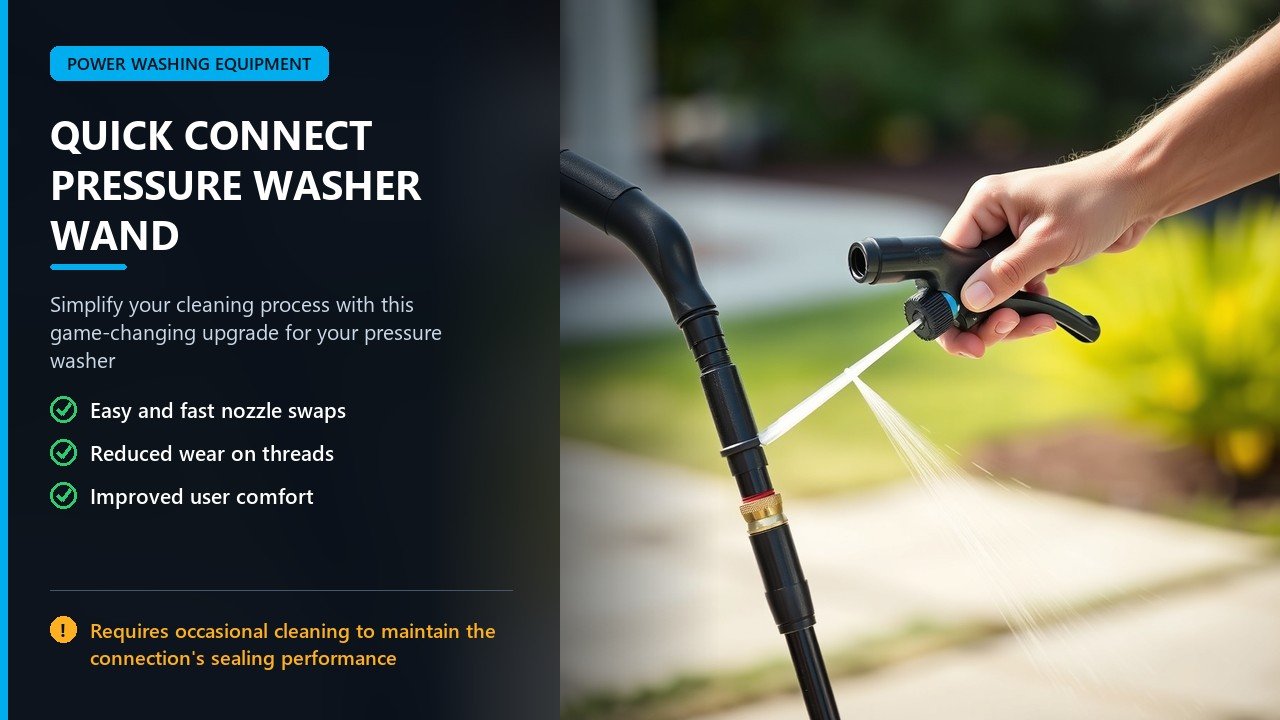
Before buying one, it helps to understand exactly what a quick connect wand is and how it fits into the pressure washer setup. Understanding the parts and how they join is the key to buying the right one.
The wand and the connection. A pressure washer wand, sometimes called a lance, is the rigid tube you hold, fitted with a handle, a trigger, and a nozzle at the tip. A quick connect wand takes that idea and adds a fast fitting system at one or both ends, so the wand can be joined to the gun, the hose, or an attachment without threading. The quick connect itself is usually a collar that slides or rotates to lock two matching halves together, sealing with an O ring so no water escapes under pressure. There are a few standards in common use, including the popular plug and socket design found on many machines, and some manufacturers use their own fitting. Understanding which system your machine uses is the first step, because the wand must match the gun and the accessories it will work with if the whole setup is to share one convenient connection.
How the system fits together. In a typical setup, the gun has a quick connect socket, the wand has a matching plug, and nozzles snap into the tip of the wand with their own smaller quick connect. Some wands also accept attachments such as surface cleaners, foam cannons, or turbo nozzles through the same connection, so one gun can drive a whole family of tools. The beauty of the system is that every change is fast and tool free, which encourages you to use the right attachment for each surface rather than making do with whatever is already fitted. It also means a broken or worn part can be replaced on its own, since the pieces are modular. A quick connect wand is therefore not just a single accessory but a hub that ties your cleaning setup together, and choosing the right standard makes every future addition easy. A little thought at the start saves a great deal of confusion later.
Why Quick Connect Beats Screw Fittings
The advantages of quick connect over traditional threaded fittings are easy to feel the first time you use one on a real job.
Speed and convenience. The most obvious benefit is speed. With screw fittings, every nozzle change means unscrewing one part and threading on another, often with wet hands and in awkward positions. Over a full day of cleaning, those small delays add up, and they can tempt you to keep using the wrong nozzle rather than swapping to the right one. A quick connect wand removes that friction entirely, letting you change from a fan tip for rinsing to a focused tip for a stubborn patch in the time it takes to pull one collar and push another. On multi surface jobs, where you might switch several times in an hour, the saving is significant. For professionals, that time is money, and for home users it makes cleaning less of a chore, so the job gets done more often and to a better standard. That alone makes the fitting worth having.
Less wear and less frustration. Threads wear out. Every time a threaded fitting is tightened and loosened, its threads and its seals suffer a little, and over time they cross thread, leak, or seize, especially if grit gets in. Quick connect fittings avoid most of that wear because there is little turning involved, and the seal is protected inside the fitting rather than exposed to the elements. A worn O ring is cheap and easy to replace, whereas a stripped thread can mean replacing a whole gun or wand. The system is also far more forgiving for anyone with cold, wet, or tired hands, and it removes the small daily frustrations that make a machine unpleasant to use. For all these reasons, quick connect has become the standard on quality equipment, and it is one of the few upgrades that pays off on the very first job. Few accessories deliver so much for so little.
Matching the Connection Type
The single most common mistake with quick connect wands is buying one that does not fit the machine, so the connection standard deserves careful attention. Get this wrong and nothing else works, so check before you spend.
The common standards. Several quick connect standards appear on pressure washers, and they are not all compatible. The most widespread for nozzles is the small plug and socket design found on countless machines, where the nozzle simply pushes into the wand tip and locks. At the gun and hose end, larger fittings such as the common brass plug and socket and the bayonet style are used, and some manufacturers, particularly in the consumer market, use proprietary fittings unique to their brand. Mixing standards requires adapters, and while adapters are available and useful, too many of them add leak points and complexity. The sensible approach is to identify exactly what your machine uses before buying, whether by checking the manual, measuring the fittings, or asking the seller, and then buy a wand that matches or a well made adapter that bridges the gap cleanly. When in doubt, standardise and keep a spare adapter on hand.
Adapters and compatibility. Where your machine uses a non standard fitting, adapters let you bring it into line with a common standard so that wands and accessories become easy to source and share. A short adapter from a proprietary thread to a standard quick connect is usually all it takes to open up a wide choice of wands, nozzles, and attachments. The key is to use good quality adapters, because a cheap one can leak, restrict flow, or fail under pressure, and each extra joint is a potential weak point. Where possible, standardise your whole setup on one common connection so every part works with every other, and keep a spare adapter or two in the toolbox. A little thought about compatibility at the start saves a great deal of frustration later, and it means the parts you buy will actually work together when you need them. Compatibility is the quiet key to a smooth setup.
Choosing the Right Length and Reach
The length and shape of the wand affect comfort, reach, and safety, so it is worth choosing with your work in mind. A wand that suits your work feels natural in the hand and saves strain.
Standard length versus long reach. Most machines come with a short wand of around a foot or so, which is fine for close work such as washing a car or a patio at close range. For larger areas, high walls, roofs, or driveways, a longer wand reduces the need to stoop and lets you reach further without moving the machine. A telescoping extension wand for pressure washer use goes further still, extending to reach gutters, second storey walls, or the roof of a van without a ladder, which is both safer and faster. The trade off is that longer wands flex more and need a little more control, and very long wands can reduce the felt pressure at the tip. For most owners, a mid length wand for general work plus a telescoping extension for high or distant jobs covers almost every situation comfortably. With those two, few jobs will leave you reaching for a ladder.
Reach, control, and comfort. Choosing a wand is also about comfort and control, not just length. A wand that is too short forces you to stoop and reach, which tires the back and arms, while one that is too long can feel unwieldy and hard to aim precisely. The grip should suit your hand and the trigger should be easy to hold for long periods, and the balance of the wand in the gun matters more than many people expect. For detailed work around vehicles or delicate surfaces, a shorter wand gives better control, while for large flat areas a longer one lets you stand comfortably upright. If you do a lot of overhead or distant cleaning, a telescoping wand made from lightweight materials is worth the investment. The best wand is the one that lets you work accurately without strain, so try to match the tool to the way you actually clean.
Nozzles and Tips for Your Wand
The nozzle at the end of a quick connect wand does much of the real work, so choosing wisely is important. The right tip protects the surface and the pump together.
Understanding nozzle types and colours. Pressure washer nozzles come in a range of spray angles, and the colour coding used by most manufacturers makes them easy to tell apart. A wide angle tip produces a gentle, fan shaped spray for rinsing and delicate surfaces, while a narrow tip concentrates the jet for stubborn dirt, and the very narrowest tips deliver the strongest, most focused stream for the toughest spots. Most machines include a set of nozzles in a holder, and because a quick connect wand accepts them without threading, swapping between them is a matter of seconds. Matching the nozzle to the job protects both the surface and the machine: a tip that is too small over stresses the pump, and one that is too large wastes flow. Knowing your coloured tips and reaching for the right one turns a good machine into a precise cleaning tool. It is a small habit that separates a tidy job from a messy one.
Turbo, soap, and specialist tips. Beyond the standard fan tips, several specialist nozzles add capability to a wand. A turbo or rotating nozzle spins a zero degree jet to scrub stubborn dirt far faster than a fan tip, which is useful on concrete and heavy staining, though it must be used with care on delicate surfaces. A soap or detergent nozzle draws cleaning chemical into the spray at low pressure, ideal for applying detergent before rinsing. There are also fixed low pressure tips, and specialist nozzles for particular tasks. Because a quick connect wand accepts them quickly, you can move between heavy cleaning, detergent application, and gentle rinsing without ever touching a thread. Building a small collection of the tips you actually use, kept tidily on the machine, means the right nozzle is always to hand and you never have to make do with the wrong one. Having the right tip close by keeps the work quick and accurate.
Materials and Build Quality
The quality of the materials in a wand decides how long it lasts and how well it performs, so it is worth knowing what to look for.
What good wands are made from. The best pressure washer wands use brass or stainless steel for the quick connect fittings, since both resist corrosion and hold their shape under pressure and repeated use. The tube itself may be brass, stainless steel, or a strong composite, and the collar and spring that lock the connection should be sturdy enough to take thousands of cycles without losing their grip. The O rings that provide the seal are usually rubber or a similar elastomer, and quality rings last far longer than cheap ones and are easy and cheap to replace. Insulated grips are a bonus on hot water machines, protecting the operator from heat. Cheap wands often use thin metal and soft plastics that wear quickly, leak, and fail at the worst moment, so build quality is worth a little extra spend and a little time to check. Good fittings repay that small effort many times over.
| Component | Good Sign | Why It Matters |
|---|---|---|
| Fittings | Brass or stainless steel | Resists wear and corrosion |
| Collar and lock | Firm, positive lock | Safe, secure connection |
| O rings | Quality, replaceable seals | Leak free and serviceable |
| Grip and trigger | Comfortable, well balanced | Less fatigue on long jobs |
| Body | Light but rigid materials | Control without weight |
| Nozzle set | Full colour coded set | Right tip for every surface |
Spotting quality before you buy. A little inspection tells you a lot about a wand’s quality. Check that the collar moves smoothly and locks with a positive click rather than a vague slide, and look for brass or stainless fittings rather than plated or plastic ones. Feel the grip and trigger, and consider whether they would still be comfortable after an hour of work. Look at the seals, if visible, and check that replacement O rings are easy to find and inexpensive, because this is the part that wears out first. Read reviews with an eye for comments about leaks and connections working loose, since these are the failures that matter most in daily use. A well made quick connect wand from a reputable seller will cost a little more, but it will keep its connection tight and its seals sound for far longer than a cheap imitation. In this part of the kit, quality speaks for itself.
Using a Wand Safely and Effectively
A quick connect wand is safe and easy to use, but good technique and a few habits make it better still. Good habits protect both the operator and the surface being cleaned.
Safe handling and pressure control. The first rule is to respect the pressure. Keep the nozzle away from your body and never point it at yourself or anyone else, since a high pressure jet can cause serious injury. Before changing a nozzle or attachment, release the trigger and, if possible, switch off the machine or lock the trigger off, so that no pressure remains to surprise you. Use the right nozzle for the surface, start at a distance, and increase pressure only as needed, keeping the lance moving rather than holding it still on one spot. Watch out for kickback, especially with narrow tips and turbo nozzles, and keep a steady stance. These simple habits protect you and the surfaces you clean, and they make the work more accurate too, because a controlled operator cleans better than an anxious one. Safety and good results go hand in hand. Keep them both in mind every time you pick up the wand.
Technique for clean, even results. Good technique with a wand follows a few consistent rules. Work from the top down and from one side to the other so that dirty water runs onto uncleaned areas rather than freshly rinsed ones, and overlap your passes slightly so no stripes are left behind. Keep the nozzle at a consistent distance and angle, and let the water do the work rather than moving the wand too quickly or too slowly. For flat areas, a surface cleaner attachment on the quick connect saves enormous time, with the wand reserved for edges and detail. Rinse thoroughly when the cleaning is done, and use detergent where plain water struggles. Together, these methods turn a quick connect wand from a convenient tool into a genuinely effective one, and they deliver a finish that looks intentional rather than hurried. Consistent method is what makes cleaning look professional. It is worth the small extra care it takes.
Extension Wands and Telescoping Options
For high or distant cleaning, extension and telescoping wands extend your reach dramatically. They are among the most useful additions you can make to a wand setup. A good extension wand changes what jobs you can take on.
Why extension wands matter. Much of the cleaning that people find hardest involves height or distance, such as fascia boards, upper walls, gutters, roofs, and the tops of vehicles. Reaching these with a standard wand usually means ladders, which are slow, tiring, and genuinely dangerous. A telescoping extension wand for pressure washer work extends your reach dramatically, letting you clean high and awkward areas safely from the ground. This is one of the most practical accessories a quick connect system enables, because the wand simply plugs into the gun and accepts a nozzle at the far end. Beyond safety, an extension wand also saves the time spent repositioning a ladder, which turns a difficult job into a manageable one and lets you clean areas you might otherwise put off or leave to someone else. Reaching them yourself saves both time and money. An extension wand often pays for itself on the first overgrown job.
Choosing and using an extension wand. Extension wands come in varying lengths, often from a couple of metres up to several, and some are fixed while others telescope for adjustability. Choose a length that reaches your typical overhead work without being unwieldy, and prefer a lightweight material such as aluminium so the wand is manageable when fully extended. Check that the connection matches your quick connect standard, and that the wand is rated for your machine’s pressure and flow. When using one, be aware that the extended length makes the tip harder to control, so keep a firm stance, use both hands, and avoid over reaching. A telescoping extension wand for pressure washer tasks is a real labour saver, but it works best when it is matched to your machine and used with a little care. Used sensibly, it is one of the most useful tools you can own. Keep it clean and it will serve you well.
Keeping the Connection Clean and Working
Quick connect fittings are robust, but they last longer and seal better with a little routine care. Clean fittings seal better and last longer, and the effort is tiny.
Cleaning and lubricating the fittings. Grit and dried dirt are the enemies of a good quick connect seal, because a single grain of sand caught in an O ring can cause a leak that seems mysterious. Rinse and wipe the fittings after each use, especially the nozzle and wand tips, and keep the protective caps on when parts are stored. A tiny amount of suitable lubricant on the O rings, using a product designed for the purpose rather than ordinary oil, keeps them supple and helps the connection slide and lock smoothly. Avoid forcing a fitting that feels tight, and never use tools to persuade one to close, since that damages the collar and the seal. Clean, lightly lubricated fittings click together easily and come apart just as readily, which is exactly how they should behave, and this small habit prevents most of the leaks that owners complain about. It is far easier to prevent a leak than to chase one down.
Replacing worn O rings and parts. Even with care, O rings eventually wear and begin to leak, and this is the most common quick connect problem. The good news is that O rings are cheap and easy to replace, and doing so restores a good seal immediately. Keep a small supply of spares in the correct size for your fittings, and change one at the first sign of a drip rather than waiting for it to get worse or for the leak to soak you. If a collar becomes loose or fails to lock, replace the fitting or the wand rather than trying to repair it, because a connection that lets go under pressure is dangerous. Because quick connect systems are modular, worn parts can usually be replaced individually, which keeps the rest of the setup in use. A little spares kit and a habit of prompt replacement keep a quick connect wand working like new.
Common Mistakes and Troubleshooting
Most problems with quick connect wands fall into a few familiar patterns that are easy to fix once understood. Knowing them in advance is the easiest way to avoid them entirely. A little awareness before you start saves a great deal of trouble.
Fitting and compatibility mistakes. The single most common mistake is buying a wand or nozzle that does not match the machine’s connection, which leaves the owner hunting for adapters or unable to use the new part at all. Another frequent error is stacking several cheap adapters to bridge incompatible fittings, which introduces extra leak points and restricts flow. Forcing a stiff connection, ignoring a leaking O ring, or continuing to use a collar that no longer locks are further mistakes that turn a minor annoyance into a failure. Mixing standards across a setup also causes confusion, since parts that look similar may not fit. Avoid all of these by identifying your connection type before buying, standardising on one system where possible, and dealing with leaks and loose fittings promptly rather than hoping they will improve on their own. Left alone, a minor drip tends to become a major one. Deal with it early and it never becomes a problem.
Performance and use problems. Sometimes the issue is not the fitting but the way it is used. A leaking connection usually means a worn or dirty O ring, not a faulty wand, and cleaning or replacing the ring solves it. Loss of pressure at the nozzle often points to a nozzle that is too large, a partially blocked tip, or an inlet supply that cannot keep up, rather than a problem with the wand itself. A connection that pops apart under pressure is a sign that it is not fully locked or that the collar is worn, and should be fixed before it causes an injury. Difficulty reaching overhead or distant surfaces usually means the wrong wand length, which an extension or telescoping wand easily corrects. Working through these possibilities from the simplest first is the quickest route to a problem solved. Most troubles have a straightforward cause and an easy fix.
Upgrading Your Wand Setup
Once you have a quick connect wand, a few sensible additions turn it into a complete and flexible cleaning system. A few well chosen additions go a long way toward making every job easier. Build the set patiently and let each piece earn its place.
Building a practical accessory set. The first upgrade is a good set of nozzles, since these deliver the biggest change in capability for the smallest cost. Add a surface cleaner for flat areas and a foam cannon or soap nozzle for detergent work, and you can handle most jobs to a high standard. A telescoping extension wand covers overhead and distant cleaning, and quality spare O rings keep everything sealing properly. A wall mounted hose reel and good pressure washer couplers keep the setup tidy and the hose protected, and a storage bag or rack keeps the nozzles and adapters together. Building the set gradually, choosing each item to match the quick connect standard you have adopted, means every addition works with the last, and the whole system becomes more useful with each sensible purchase rather than less coherent. A tidy, matched kit is a pleasure to work with. Build it gradually and enjoy the result.
Choosing upgrades that earn their place. It is easy to buy accessories that promise a great deal and deliver little, so it pays to be selective. Prioritise the items you will use often, such as the nozzles and a surface cleaner, and only add specialist attachments if the work genuinely calls for them. Check compatibility with your connection standard every time, and prefer quality over quantity, since a cheap attachment that fails under pressure is worse than no attachment at all. Consider whether an upgrade reduces effort, saves time, or improves the finish, and if it does not do any of these, it probably does not belong in the kit. A thoughtful, well matched set of accessories built around a quick connect wand will genuinely improve your cleaning, whereas an overflowing box of unused gadgets only clutters the garage and the job. Choose less, choose well, and use what you buy.
Buying Guide and Value
With the theory understood, buying a quick connect pressure washer wand becomes a simple, practical decision. A little care here repays itself on every job you do. It is a small purchase with a long and useful life.
What to look for when buying. Start by confirming the connection type your machine uses, since nothing else matters if the wand will not fit. Then consider the materials, preferring brass or stainless fittings and a sturdy collar, and check the length that suits your work, whether a standard wand, a longer one, or a telescoping option. Look at the reviews for comments about leaks and loose connections, and check that spare O rings are easy to find. Decide whether you need a simple wand, a kit with nozzles, or a wand that accepts a range of attachments, and budget accordingly. Buy from a seller who stocks compatible parts, so that a worn ring or a broken tip can be replaced without replacing the whole wand. Matching the purchase to your machine and your cleaning tasks is the surest way to get real value from a modest spend. A little research before buying always pays off here.
Getting value over time. A quick connect wand is a small purchase, but its value shows up in the hours it saves and the frustration it removes over its life. Because the parts are modular and the seals replaceable, a good wand can be kept in service for years with minimal cost, while a cheap one that leaks or jams will be replaced again and again. Think of it as the interface between you and the machine, the part you touch and adjust most often, and it becomes clear why quality here is worth a little extra. Combine it with a good set of nozzles and a couple of useful attachments, and you have a cleaning system that is quick, precise, and pleasant to use. For a modest outlay, that is a genuine improvement in every job you take on. It is money well spent on the part you use most.
Frequently Asked Questions
What is a quick connect pressure washer wand? It is a pressure washer lance fitted with a fast connect system at one or both ends, allowing the wand to be attached to the gun and changed for attachments in seconds without threading. It usually also accepts nozzles through a small quick connect at the tip. The result is a modular setup that saves time on every changeover and makes the machine far more convenient to use, whether for occasional home cleaning or regular professional work. Whether you clean for a living or tend a few jobs at home, the convenience is the same, and it costs very little compared with the time it saves over a season. It is a simple, practical upgrade that almost every owner appreciates once they try it. If you are unsure which wand to choose, start with a standard length in good materials, add a set of nozzles, and expand from there as your needs become clear.
Are all quick connect fittings the same? No, several standards exist, and they are not interchangeable. There is a common small plug and socket design for nozzles, larger fittings for guns and hoses, and proprietary fittings used by some brands. Mixing them needs adapters, and stacking many adapters adds leaks and restricts flow. Identify your machine’s connection before buying, and standardise your setup on one system wherever possible to keep everything compatible. Take a moment to check the fittings on your pressure washer gun, wand, and nozzles before you buy anything new, since a mismatch is the most common source of frustration. Once you know your standard, every future purchase becomes easy, and your whole kit works together the way it should. Adapters can bridge a gap, but a unified system is always simpler and more reliable. Once set up, it never needs thinking about again. That simplicity is the whole point of the system.
Do quick connect wands reduce pressure? A good quality quick connect wand has a negligible effect on pressure, because the fitting is designed to flow freely. Problems only arise when cheap adapters or undersized fittings restrict the flow, or when too many joints are stacked together. Choosing quality parts, keeping the connection clean, and replacing worn O rings promptly means the wand delivers the pressure and flow your machine produces without noticeable loss. If you do notice a drop in performance, check the O rings, clear any blocked tip, and make sure your inlet supply is keeping up before blaming the wand. In normal use, a good quick connect fitting is invisible, letting the machine deliver the pressure it was built to produce with no fuss at all. Regular cleaning and a glance at the seals will keep the connection tight through thousands of changeovers. A well maintained quick connect simply keeps working.
How do I stop my quick connect leaking? A leak almost always comes from the O ring. Clean the fitting, check the ring for grit or wear, and replace it if necessary, since O rings are cheap and easy to change. Never force a tight connection or use tools on it, as this damages the collar and seal. Keeping fittings clean and lightly lubricated, and storing parts with their caps on, prevents most leaks before they start. Spare rings cost almost nothing, so keep a small packet in the toolbox and change one at the first sign of trouble. A clean, well kept connection clicks together smoothly and holds pressure without complaint, which is exactly what it should do, and it will keep doing it for years with only the slightest attention. Store the wand safely, keep the caps on, and it will reward you with years of trouble free service.
Can I use a quick connect wand on any pressure washer? Usually yes, provided the connection matches, which may require a suitable adapter for a proprietary fitting. Once adapted to a common standard, most wands, nozzles, and attachments will work with the machine. Check the wand’s pressure and flow rating against your machine’s output, and confirm the connection type before buying, so the wand works safely and delivers the performance you expect. Check the pressure and flow rating of any wand before you buy, and fit a suitable adapter if the connection differs. Provided the parts match and are in good condition, the wand will work safely with your machine, and it will make the whole setup quicker and more pleasant to use every time you clean. A spare adapter in the toolbox also means a surprise fitting mismatch will never stop a job. Preparation of this kind separates a smooth operation from a difficult one.
Final Thoughts
A quick connect pressure washer wand is a small, inexpensive part that quietly improves almost everything about using a pressure washer. It turns slow, fiddly threaded changes into instant, tool free swaps, protects the pump and the surfaces you clean by making it easy to use the right nozzle, and opens the door to a whole family of attachments, from surface cleaners to foam cannons. Choosing one that matches your machine, in a sensible length and good materials, is a straightforward decision once you know what to look for, and it repays the effort on every job. A quick connect pressure washer wand is a small and inexpensive part, yet it improves almost every aspect of using a pressure washer. It saves time, protects the machine, and opens the door to a wide range of attachments. Choose one that matches your machine, keep it clean, and it will quietly make your cleaning faster, safer, and more enjoyable for years. In the end, it is the small, practical upgrades that make the biggest difference to how a machine feels to use.
Buy the right one and look after it. Confirm your connection type, choose quality materials, and match the wand to the work you actually do. Keep the fittings clean, replace worn O rings promptly, and build a small, well chosen set of nozzles and attachments around it. Done this way, a quick connect wand becomes the reliable hub of your cleaning setup, and the small convenience it delivers each time you work adds up to a very large improvement over the life of the machine. A quick connect wand is a modest purchase, but it is one you will use on every job, and the small conveniences it adds up to a habit of working that is quicker, safer, and far more enjoyable. Choose a good one, look after it, and let it quietly make every cleaning task easier. With so little cost and so much convenience, it is one upgrade almost every owner is glad they made.
To explore machines and accessories that pair well with quality connections, see our guide to pressure washer trailers and equipment.