They are the smallest parts of a pressure washer and the ones most likely to spoil a working day. Pressure washer couplers are the connectors that join the hose to the gun, the gun to the wand, and often the machine to everything downstream, and when one fails the whole setup stops. A leaking joint wastes pressure, a sticking collar wastes patience, and a wrong thread simply will not fit at all. This guide explains what couplers do, how the common types differ, how to match them to your machine, and how to keep them working so a simple connector never becomes the reason the job stalls.
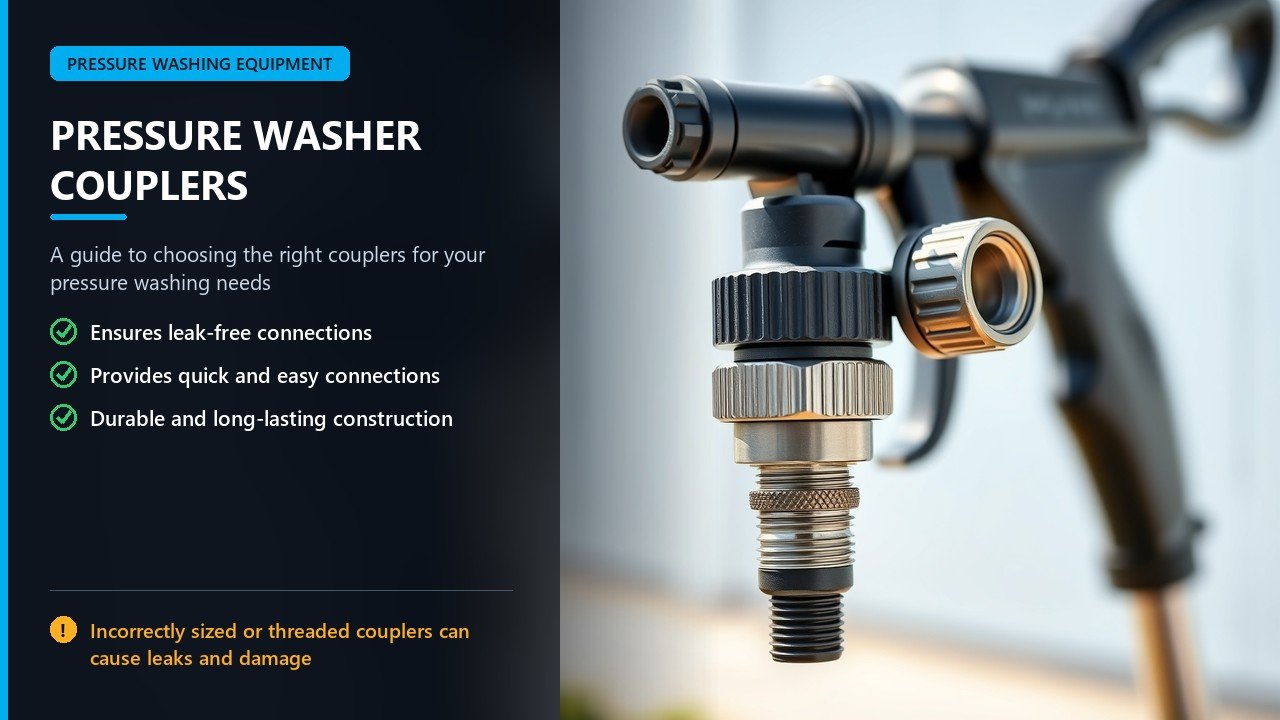
What Pressure Washer Couplers Are and Why They Matter
Before choosing a connector, it helps to understand exactly what they do and why they deserve more attention than most owners give them.
They join the working parts of the system. A pressure washer is really a chain of connected components, and couplers are the links. The water leaves the pump, travels down the high pressure hose, passes through a coupler into the gun, another joins the gun to the wand, and further connections may join quick change nozzles to the tip of the wand. Every one of those joints must hold the full working pressure without weeping a single drop, which at three or four thousand psi is no small demand. A coupler is therefore far more than a convenience fitting, it is a pressure rated component that must be strong, well sealed, and correctly threaded. Owners who treat couplers as an afterthought discover their importance the moment a cheap one leaks mid job, drops the pressure to the nozzle, and forces them to stop and hunt for a replacement. A cheap fitting is never worth the downtime it causes.
Good couplers protect pressure and patience. When couplers work properly, they are invisible, and that is exactly the point. A dry, secure joint means every drop of water reaches the nozzle at full force, so the machine performs as it was designed and the job goes quickly. Good couplers also make the tool pleasant to use, because swapping between a wand, a surface cleaner, and a foam cannon takes seconds rather than minutes. Poor couplers do the opposite: they dribble, they stick, they cross thread, and they turn a simple changeover into a wrestle. Because they are cheap and easy to replace, there is no reason to tolerate bad ones. Upgrading to quality pressure washer couplers is one of the least expensive improvements a person can make to a pressure washer, and the difference in daily working life is felt immediately. Treat them as working parts, not afterthoughts, and the whole machine benefits.
How Quick Connect Couplers Work
Most modern pressure washers use quick connect fittings, and understanding the mechanism makes them far easier to use and to fault find.
The collar, the balls, and the seal. A quick connect coupler works with a ring of small steel balls inside a sleeve. When you push the mating plug into the socket, the balls drop into a groove on the plug, and a spring loaded sleeve locks them in place, holding the parts together against the pressure. A rubber or plastic O ring inside the socket forms the watertight seal, while the metal parts carry the load. To disconnect, you pull the collar back, which releases the balls and lets the plug slide out. This simple design gives a fast, tool free connection that can be made and broken hundreds of times, which is why quick connect couplers dominate on wands, guns, and nozzles. Understanding that the seal is a soft O ring and the strength is in the steel balls explains most of the problems owners encounter with these fittings.
Why they sometimes stick or leak. Because the seal is a soft ring, it is the first part to wear. Grit, scale, or a dry O ring will cause a drip, and a worn or swollen ring will leak more with use. Sticking usually comes from dirt in the sleeve, a bent plug, or pressure still trapped in the line, so always release the trigger and let pressure bleed before pulling the collar. A cross threaded or mismatched plug will never seat properly, no matter how hard it is pushed. When a quick connect pressure washer wand refuses to lock, the cause is often a cheap coupler with loose tolerances rather than any fault in the wand. Cleaning the fitting, checking the O ring, and replacing worn parts solves the great majority of problems, and a little care when connecting keeps the mechanism working smoothly for years. Look after the seal and the sleeve, and the rest takes care of itself. A minute of attention here prevents most of the trouble owners blame on the machine.
Common Coupler Types and Thread Standards
Not every pressure washer speaks the same language, and buying the wrong thread is the most common reason a new fitting will not fit.
M22, quick connect, and the rest. Many machines and hoses use M22 threaded fittings, which come in male and female versions and in metric and imperial variants that look similar but are not interchangeable. Others rely on quick connect plugs and sockets, often described by their size and the type of plug, such as the common 1/4 inch quick connect, which is widely used for wands, nozzles, and guns because it is compact and fast to use. Some guns and hoses use specialty threads that vary between brands, which is why an adapter is often required to marry two parts that were never designed to meet. The safest approach is to identify exactly what your machine uses at each connection point before buying anything, and to keep a small set of adapters on hand, since they turn a frustrating mismatch into a two minute fix. Keep a small adapter set in your kit and a mismatch becomes a minor delay rather than a lost afternoon.
Male, female, and adapters explained. Confusing terminology trips up many buyers, so it pays to be precise. A male fitting has exposed threads or an exposed plug, while a female fitting has internal threads or a socket. To connect two male ends you need a female to female adapter, and to connect two female ends you need a male to male adapter. Quick connect plugs and sockets work differently again, because one slides into the other rather than screwing on. Reading the description carefully, or simply taking the old coupler to the shop, prevents the common mistake of ordering a fitting with the wrong gender or thread. A well chosen adapter not only solves a mismatch, it can also convert an older machine to modern quick connect fittings, making every future accessory easier to attach. Getting the gender right is half the battle, so slow down and check the description before you order.
Choosing the Right Size and Type for Your Machine
Getting the size and type right the first time saves a great deal of frustration and a drawer full of useless fittings.
Identify what each connection needs. Walk the whole machine and note the fitting at each joint: the pump outlet, the hose ends, the gun inlet, the gun outlet, and the wand base. Write down whether each is threaded or quick connect, the size, and the gender, and photograph the fittings with your phone for reference. This simple audit takes a few minutes and prevents ordering errors, because a coupler that fits the hose may not fit the gun. If you are unsure, take the component to a supplier who can match it in person, or buy a mixed kit that covers the common sizes so you are never stuck without a spare. Knowing your machine’s fittings turns a guessing game into a precise purchase and makes upgrades such as a new gun or wand far simpler. A short audit now saves a string of failed purchases and returns later on, whatever you decide to upgrade.
Match the pressure rating and flow. A coupler must be rated for at least the pressure your machine produces, and ideally a good margin above it, because fittings that are too lightly built will deform, leak, or fail at the worst moment. Check the rated pressure and flow of any coupler before fitting it, and prefer those designed for the pressure class of your machine rather than for a garden hose. The internal bore also matters, because a fitting that narrows the flow creates a restriction that costs performance, especially on high flow machines. A coupler chosen for the correct pressure and a generous flow keeps the machine breathing freely, so the jet at the nozzle stays as strong as the pump intends. Size and rating are the two specifications that matter most, and both deserve a moment of attention before you buy. Pressure and flow are the two numbers that decide whether a coupler helps the machine or quietly holds it back.
Materials and Build Quality That Last
The material a coupler is made from decides how long it survives the pressure, the water, and the abuse of daily use.
Brass, stainless, and the plastic trap. Brass is the traditional choice for pressure washer couplers and adapters, because it resists corrosion well, machines cleanly, and holds a thread reliably. Stainless steel is even tougher and resists corrosion superbly, which suits marine, food, and chemical environments, though it costs more. Plastic fittings have their place on cheap consumer machines, but at high pressure plastic is the wrong material for a load bearing joint, and plastic threads strip and crack with repeated use. The best couplers combine a metal body with a quality O ring, often nitrile or a similar compound chosen for water and temperature resistance. Choosing brass or stainless steel over plastic is one of the clearest quality signals, and it is a decision that pays back over many years of use. The material you choose is the clearest sign of how long the fitting will last under daily pressure in the field.
Seals, springs, and the hidden quality. The parts you cannot see often decide how well a coupler performs. A quality O ring seals reliably and resists the chemicals and temperatures a pressure washer meets, while a cheap ring hardens, swells, or tears and begins to drip. A well made spring and correctly sized steel balls give a crisp, positive lock, while a cheap mechanism feels vague and eventually refuses to hold. Chrome plating or a smooth finish on the plug reduces wear and keeps the connection sliding freely. When comparing two couplers, look beyond the price and consider the seal material, the spring, and the finish, because these inexpensive details separate a fitting that lasts for years from one that fails in a season. Good pressure washer couplers are an investment in the reliability of the whole system. Overlooked parts like these decide whether the machine feels solid or constantly troublesome. Pay attention to the details you cannot see, and the reliability follows. Cheap hidden parts are the quiet cause of most repeat failures.
Where Couplers Fit in the System
Seeing where couplers sit in the chain helps explain why one bad joint affects everything downstream.
Pump, hose, gun, wand, and nozzle. The first coupler usually sits where the high pressure hose meets the pump outlet, the second where the hose meets the gun, and often a third where the gun meets the wand. Quick change nozzles add further joints at the tip, and a surface cleaner or foam cannon introduces its own connections. Each joint is a potential leak point, and pressure lost at any one of them reduces the force at the nozzle, because the whole system shares a single source of pressure. This is why troubleshooting always begins at the connections, checking each joint in turn for drips and looseness before suspecting anything more expensive. A pressure washer couplers set that is clean, correctly sized, and in good condition keeps the entire chain sealed, so the machine delivers its full rated performance right where it matters. Every joint is a potential weak point, so treat the chain as only as strong as its cheapest link.
Accessories that depend on good couplers. The convenience of modern pressure washers rests on quick connect fittings, because they let a single machine accept a wide range of tools. A quick connect pressure washer wand, a spray wand, a surface cleaner, and a foam cannon all rely on couplers to attach and detach quickly, and the quality of those fittings decides how pleasant the machine is to use. A pressure washer gun replacement usually involves matching the coupler at the inlet and outlet, and pressure washer wands for sale are usually chosen to suit the connector already on the machine. When the couplers are good, the whole accessory ecosystem works smoothly and the machine feels versatile. When they are cheap, every changeover is a chore, and owners quietly stop using the tools that should have made the work easier. Good fittings quietly multiply the usefulness of every accessory you own and every tool you add later. Weak fittings, on the other hand, quietly shrink the value of every accessory you buy.
Troubleshooting Leaks, Sticking, and Failures
Most coupler problems have simple causes, and a logical check finds them quickly.
Drips, sprays, and sudden loss. A minor drip at a threaded joint usually means the connection is not tight enough or the sealing surface is dirty, so clean the threads and reseat it carefully. A drip at a quick connect usually points to a worn or dry O ring, which is cheap to replace, or to grit in the socket, which a rinse will clear. A sudden spray or a fitting that blows apart under pressure is more serious and often means a coupler rated below the machine’s pressure, a cross threaded joint, or a cracked component, all of which require replacement rather than repair. Never simply tighten a leaking joint harder, because over tightening damages threads and can cause a dangerous failure. Working through the joints in order, from pump to nozzle, isolates the culprit and keeps the diagnosis calm and methodical. Never force a leaking joint, because force damages the very parts that need to seal.
Sticking collars and stubborn connections. A quick connect that will not release is usually held by trapped pressure, so release the trigger and bleed the line before trying again. If it still refuses, the sleeve may be full of dirt, in which case a rinse and a little lubrication free cleaning frees it, or the plug may be bent, in which case it needs replacing. A connection that will not lock is often a cheap coupler with loose tolerances or a plug that is slightly the wrong size, and no amount of force will fix a mismatch. Forcing a stubborn fitting risks injury and damage, so stop and diagnose instead. Most coupler faults are resolved by cleaning, replacing a worn O ring, or swapping a cheap fitting for a quality one, and none of these takes more than a few minutes once the cause is clear. Patience here saves a fitting and often the whole working day.
Maintenance and Storage Habits
A little routine care keeps couplers sealing and sliding for years, and it takes only seconds.
Simple habits that prevent most problems. Rinse couplers after use to clear grit, and dry them before storage so the seals do not sit in water. Check O rings periodically and replace any that look hardened, flattened, or torn, since a fresh ring restores a leaky joint instantly. Keep spare O rings and a spare coupler in your kit so a failure never ends the day. When connecting, push squarely rather than at an angle, and never force a fitting that will not seat, because force is what cross threads and damages seals. Store hoses and wands with the couplers clean and protected, avoiding dirt and grit. These small habits cost almost nothing and keep the whole system working smoothly, which is exactly why experienced operators treat their fittings with the same care as the machine itself. Good habits around fittings cost seconds and repay them many times over in the field.
When to replace rather than repair. Some problems are worth fixing and some are not. A worn O ring, a dry seal, or a bit of grit is a quick, cheap fix that restores full performance. A cracked body, a bent plug, collapsed threads, or a mechanism that will not lock reliably are signs to replace the coupler, because a fitting that is compromised under pressure is a safety risk as well as a performance one. A coupler is inexpensive enough that there is no good reason to nurse a failing one. Keeping a couple of spares means replacement takes seconds,and you are back to work rather than ordering parts and waiting. Judging when to repair and when to replace keeps the machine reliable and the operator safe without wasting time on fittings that have already done their service. A cheap coupler is never worth nursing once it has failed, so replace it and move on. A machine kept free of tired fittings is a machine that rarely surprises you. Regular checking costs almost nothing and prevents most sudden stops.
Safety Around High Pressure Connections
Fittings carry the full force of the machine, so a few safety habits matter more than they might seem to.
Respect the pressure at every joint. A connection that fails under pressure can throw water or metal with real force, so never inspect a joint with your hand while the machine is running, and never point a fitting at yourself or anyone else. Release the trigger and let the pressure bleed before disconnecting anything. Check that every coupler is rated for the machine’s pressure and correctly seated before starting work, and listen for changes in sound that might signal a leak. Keep the working area clear of people who might stand in the path of a failed joint, and inspect hoses and fittings for damage before each use. These habits take seconds and prevent the rare but serious accidents that high pressure water can cause when a fitting gives way unexpectedly. Treat every connection as a live pressure joint, and the safe habits soon become automatic, protecting you and everyone around the machine.
Avoid the habits that damage fittings. Most coupler failures are self inflicted, and avoiding a few habits extends their life greatly. Do not drag the machine by the hose, because it strains every joint in the chain. Do not overtighten threaded fittings, since this crushes seals and strips threads. Do not leave fittings to sit in dirt or let hoses kink against the connectors, and do not force a quick connect that will not seat. Use the right adapter rather than improvising with tape or brute force, and replace damaged parts promptly rather than hoping they will hold. Treated with this ordinary care, pressure washer couplers last a long time and keep the whole system safe and efficient, which is exactly what a small, cheap component should do. Look after the fittings with these simple habits and they look after the performance of the whole machine, quietly and reliably for years without any complaint at all. Safety and reliability share the same simple habits, which is why they are worth forming early.
Buying Tips and What to Avoid
Couplers are inexpensive, which makes it tempting to grab the cheapest, but a little judgement pays off.
What to look for. Buy couplers rated comfortably above your machine’s pressure, in the correct size and thread for each connection. Prefer brass or stainless steel bodies with good seals, and choose reputable brands that publish clear specifications. Kits that include several common sizes and a set of spare O rings offer excellent value and cover most situations. If you are converting an older machine or adding a quick connect pressure washer wand, buy an adapter kit designed for that purpose rather than a random fitting, and confirm the thread you need. Reading the description carefully, and checking the gender and size, prevents the most common ordering mistakes. A modest spend on quality fittings is one of the best value upgrades available for a pressure washer. Buy the right thing once, fit it carefully, and you can forget about fittings for a very long time indeed, even under hard daily use. Whether you are fitting a new gun, a set of spray wands for pressure washers, or a rack of pressure washer hose reels, choose fittings that match the thread and pressure rating of your machine.
What to avoid. Avoid unbranded fittings with no pressure rating, since these are the ones that fail early and dangerously. Avoid lightweight plastic couplers for high pressure work, and avoid mixing sizes by guesswork, because a fitting that almost fits will leak or jam. Do not buy a single odd fitting when a small kit would cover the machine, and do not ignore the flow restriction that a narrow coupler can create on a high flow setup. Most of all, do not treat couplers as disposable clutter. They are the joints that hold the whole system together, and a few pounds spent on good ones saves repeated frustration and occasional danger. Choose the right pressure washer couplers once, care for them, and the machine rewards you with steady, leak free performance. Fit them right and maintain them simply, and they repay you with years of trouble free work and a machine that always feels ready. Judging fittings on quality rather than on price is the whole secret to a reliable setup.
A Practical Coupler Checklist
Run through these points and you will choose the right fittings and keep them working without fuss.
Before you buy. Identify every connection on the machine and note whether each is threaded or quick connect, along with the size and gender. Check the pressure rating of the machine so you can match or exceed it, and consider the flow so a coupler does not restrict a high flow setup. Decide whether you need a full kit or a single replacement, and check whether an adapter is required to marry parts that were never meant to meet. Confirm the seal material suits your use, and buy a set of spare O rings at the same time. With these details in hand, the purchase is quick and correct, and you avoid the drawer full of fittings that do not fit anything. A few minutes spent checking sizes and ratings is the cheapest habit in pressure washing, and it prevents the wasted purchases most owners collect over time without ever using them.
After you buy. Fit each coupler squarely, seal threaded joints with the correct method, and test for leaks before starting serious work. Rinse and dry the fittings after use, check the O rings regularly, and replace worn seals promptly. Keep a spare coupler and spare rings on the machine, and store hoses with the connectors clean and protected. Match the right fitting to each job rather than forcing one to serve where it does not belong, and let adapters do the work of joining different systems. Maintained this way, your pressure washer couplers keep sealing and sliding for years, quietly holding the whole system together so the machine can do what it was built to do. Good fittings are almost invisible when they work, and that is the whole point, because they should never be the reason a job stops. Keep them clean, keep spares handy, and the machine keeps running, day after day. Bought well and cared for simply, the couplers fade into the background, leaving only the cleaning to think about. That is the quiet mark of a well set up machine, where nothing between the pump and the nozzle ever draws attention to itself. Get the fittings right and the machine stops being a collection of parts and becomes a single, reliable tool. That is the reward for a little care with the small parts of a big machine.
| Coupler Type | Where It Is Used | Best Feature | Watch Out For |
|---|---|---|---|
| Quick connect | Wands, guns, nozzles | Fast, tool free changes | Worn O rings and grit |
| M22 threaded | Hose to pump and gun | Strong, common, widely used | Metric and imperial look alike |
| Adapters | Joining mismatched parts | Solves thread differences | Wrong gender or size |
| Brass couplers | General high pressure use | Durable and corrosion resistant | Counterfeits with weak seals |
| Stainless couplers | Chemical or heavy duty use | Very durable and clean | Higher cost |
Frequently Asked Questions
Are all pressure washer couplers the same? No, and this is the single most common source of frustration. Couplers differ by type, size, thread, and pressure rating, and a fitting that looks similar may be metric or imperial, male or female, or rated for far less pressure than your machine produces. Always match the specification precisely, and keep a set of adapters on hand to bridge parts that were never designed to connect. The pressure rating matters just as much as the size, because a fitting built for a garden hose will fail under the force of a pressure washer. Check the description carefully, or take the old coupler to a supplier, and the purchase becomes quick and certain. A few pounds spent on a quality fitting and a spare ring is cheap insurance against a day lost to a leak. It is one of the cheapest forms of insurance in pressure washing.
Why does my quick connect coupler leak? In most cases a leaking quick connect comes down to the O ring. The soft seal inside the socket wears, dries, or swells over time, and once it stops sealing the joint drips under pressure. Grit lodged in the socket has the same effect. Replace the O ring with a good quality spare, rinse out any debris, and the leak usually stops immediately without any need for a new coupler. Clean the socket, reseat the plug squarely, and if a fresh ring still drips, check for grit or a damaged plug before replacing the fitting entirely. Nine times out of ten, a new seal and a clean socket solve the problem in seconds. In practice, the O ring is the part that fails in almost every case, so keeping a small bag of spares on the machine solves the problem before it costs you any working time.
Should I use brass or stainless steel couplers? Brass is the practical default for most high pressure applications, offering durability and good corrosion resistance at a sensible price. Stainless steel lasts longer and resists chemicals and corrosion even better, which suits harsh environments and frequent use, but it costs more. For ordinary home and light commercial work, quality brass couplers are an excellent choice. Stainless steel makes sense where chemicals, salt, or constant use are part of the job, but for most owners a good brass fitting gives years of dependable service at a fraction of the cost. Whatever you choose, buy quality brass or stainless, and the fitting will outlast several of its cheap rivals. In short, brass for general work and stainless for the harshest jobs. Whichever you choose, insist on a published pressure rating and a good quality seal, because those two details matter far more than the name of the metal on the outside of the fitting.
Can I use couplers to convert my machine to quick connect? Yes, and it is one of the best upgrades you can make. Adapter kits turn threaded connections into quick connect fittings, so wands, guns, surface cleaners, and foam cannons swap in seconds rather than minutes. Choose a kit designed for your machine’s thread, fit the adapters to each connection, and the whole accessory range becomes far easier to use. Fit the adapters carefully, check the thread of each before you buy, and keep spare plugs and rings together so a changeover never catches you without the part you need. A conversion kit is a small outlay that changes how the whole machine feels to use. It is a small change with a large effect on daily convenience, and it suits both home and commercial owners alike. Once converted, every future accessory attaches in seconds, and the machine becomes far more pleasant to use on jobs where you change tools often.
How often should couplers and O rings be replaced? Replace O rings at the first sign of hardening, flattening, or leaking, which may be every season of regular use. Replace a coupler when its body cracks, its mechanism stops locking reliably, or its threads are damaged. Because both are inexpensive, many owners simply keep spares and swap them out as needed rather than waiting for a failure mid job. A simple rule is to replace any seal that looks tired and any fitting that no longer locks with a crisp, positive click. Keeping a small stock of rings and plugs on the machine means these small jobs never interrupt a cleaning session. Treat O rings as consumables and couplers as parts with a long but finite life, and replace each when it shows wear. A well stocked spares kit is the simplest way to keep a pressure washer working without a single unexpected stop.
A coupler is cheap enough that there is no reason to gamble on one that is already showing signs of wear, so swap it out and keep working.
Final Thoughts
Pressure washer couplers are easy to overlook because they are small, cheap, and hidden in the middle of the machine, yet they carry the full pressure of everything the washer does. A good set holds that pressure without complaint, makes every changeover quick, and quietly protects the performance of the pump, the hose, the gun, and the wand. A poor set does the opposite, leaking pressure, jamming when you least want it to, and turning simple tasks into a struggle. The difference between the two is measured in a few pounds and a little care. Give them that care, and they stop being a source of frustration and become exactly what they should be, a quiet, reliable part of a machine that simply works. That is the reward for treating small parts with the same respect as the pump and the engine. Look after them, keep a few spares, and the machine will reward you with years of steady, leak free work on every job you take on.
Choose well, fit carefully, and keep spares. Match the type, size, thread, and pressure rating to each connection, prefer brass or stainless over cheap plastic, and buy a small kit so you always have the right fitting to hand. Fit each coupler squarely, deal with leaks by checking the seal rather than by forcing it tighter, and keep the fittings clean and dry between jobs. Keep spare rings and a spare coupler on the machine, because a tiny part should never be able to stop a day’s work. Looked after this way, pressure washer couplers quietly do their job for years, and the machine keeps delivering the steady, leak free performance you paid for. Choose well, fit carefully, and keep spares, and these small parts will never be the reason a job stops, then you will have a machine that simply works, season after season. Few parts repay such a small cost with such a large gain in reliable, effortless cleaning.
To explore machines and accessories that pair well with quality connections, see our guide to pressure washer trailers and equipment.