Finding the best pressure washer spray gun for your machine is one of the most worthwhile upgrades an owner can make. The gun, or trigger, is the part you hold for hours, the part that controls the jet, and the part that endures the constant cycling of pressure every time you squeeze and release the trigger. A poor gun leaks, sticks, tires your hand, and spoils an otherwise capable pressure washer, while a good one feels effortless and lasts for years. This guide explains what separates a great spray gun from a mediocre one, how to match a gun to your machine, what features are worth paying for, and how to look after the gun you choose, so you can pick one that improves every job you do.
What Makes a Pressure Washer Spray Gun Good
Before comparing individual models, it helps to understand the qualities that separate a good spray gun from a bad one, because these apply to every type and price.
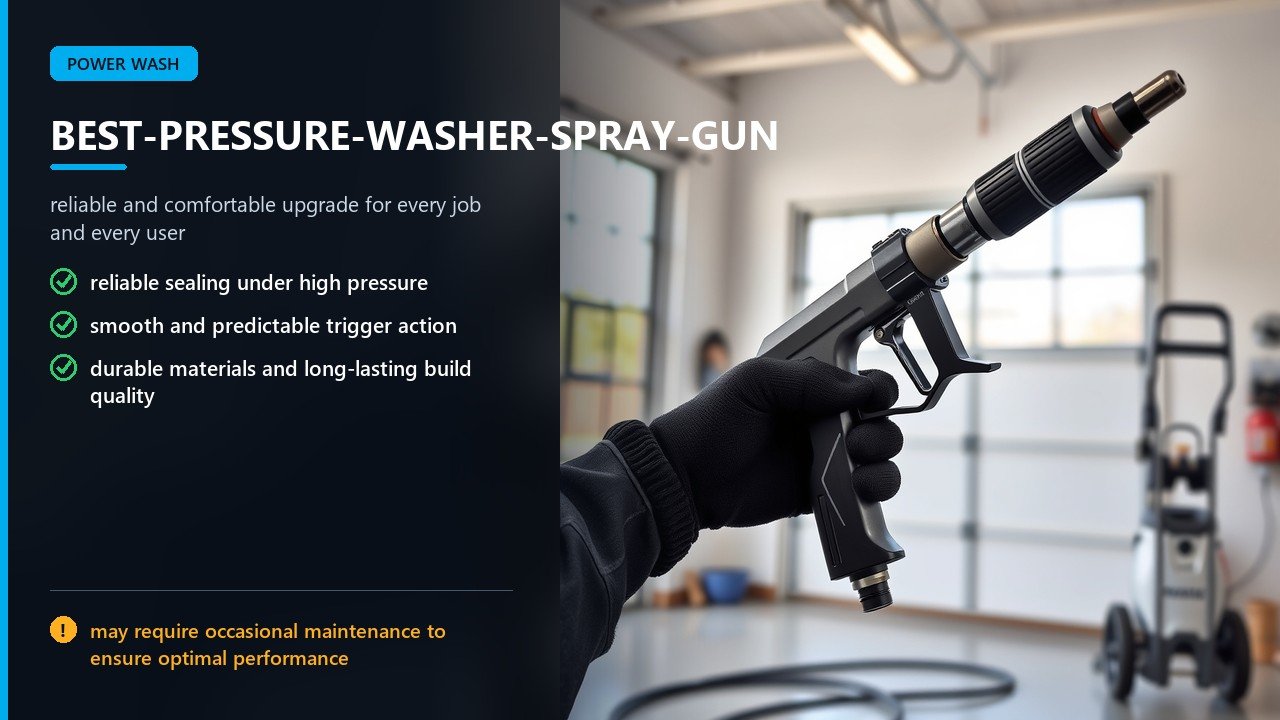
Reliability, sealing, and control. The single most important quality in any spray gun is reliability. A gun must seal perfectly under pressure, opening to release a full flow and closing to stop it completely without dripping. Cheap guns often develop leaks around the valve, washers, or the inlet fitting, which wastes pressure, damages the pump over time, and creates a constant nuisance of dribbling water. Good control is equally essential: the trigger should have a smooth, predictable action, so the operator can feather the spray for delicate surfaces and shut it off crisply to save water and avoid overspray. Together, reliable sealing and precise control define a gun that is a pleasure to use and a headache to be without, and they are the qualities that experienced operators notice first when they pick up a new gun. It is the difference between a machine that feels smooth and one that feels tired.
Durability, comfort, and fit. Beyond sealing and control, a good spray gun is built to last and comfortable to hold. Durability comes from the materials used, especially in the valve, the seals, and the threads, and from the quality of the internal mechanism that survives thousands of trigger cycles. Comfort comes from a well shaped grip, a smooth trigger, and sensible weight, since the gun is held for long periods and an awkward or heavy one tires the hand quickly. Fit matters too, because the gun must connect properly to the machine’s hose and accept the wands and nozzles you use, with the correct thread or quick connect standard. A gun that is durable, comfortable, and properly matched to the rest of the setup transforms the working experience, and it is these three qualities working together that make one gun the best choice for a given machine and operator. There is no universal winner, only the gun that suits your setup and your hands.
Types of Spray Guns
Spray guns come in several broad types, and understanding the differences helps you choose the right one for your work.
Standard trigger guns. The most common type is the standard trigger gun, a simple handheld unit with a pistol grip, a trigger, and a connection for the lance and the hose. It is used on the majority of pressure washers, from small electric machines to large professional units, and it is reliable, inexpensive, and easy to replace. Standard guns are available with a wide range of connection types, so almost any machine can be fitted with a quality replacement. The main variations lie in the materials, the sealing design, and the comfort of the grip and trigger. For most owners, a well made standard trigger gun is the right answer, and upgrading from a cheap original to a quality replacement is often the single most satisfying improvement they can make to their setup, and it is usually an inexpensive one. Upgrading the gun is also one of the few improvements that pays off regardless of the machine’s size or brand, so it is worth doing even on a modest pressure washer.
Rotary, foamer, and specialist guns. Some guns serve more specific purposes. Rotary or rotary nozzle guns combine the trigger with a rotating nozzle to give a more aggressive, concentrated jet for hard surfaces. Foam guns or cannon guns are designed to deliver detergent as a thick foam rather than a spray, which is invaluable for vehicle cleaning. Some guns are designed for hot water, with materials and seals that tolerate higher temperatures, and some are built for high pressure systems that demand stronger components. There are also guns with swivel inlets, which reduce hose tangling, and guns with insulated grips for comfort when working in the cold. Specialist guns are worth considering when a particular task demands them, but for general work a good standard trigger gun remains the most versatile and practical choice, and it can be paired with additional nozzles and accessories as needed, which keeps the whole setup flexible.
Connection Standards and Fit
A spray gun is useless if it does not connect to your machine, so connection standards are a critical part of choosing one.
Threads, quick connects, and adaptors. Pressure washer connections come in a range of thread standards, and guns are made to match them. Some connections use threaded fittings, which screw together and are reliable but slower to change, while others use quick connect fittings that snap together for fast changes. Inlet connections at the gun may be a threaded fitting to suit a hose, a quick connect, or a proprietary fitting from a particular brand. The outlet, where the lance attaches, is often a standard quick connect fitting that accepts a wide range of wands and nozzles. If the gun does not match your machine directly, adapters are widely available to convert between standards, so a good gun can usually be made to fit any machine. The important thing is to identify the connection types on your machine before buying, a gun that fits with minimal fuss, so you can get straight down to work.
Matching threads and quick connect standards. Getting the connection right comes down to knowing two things: the thread or fitting at the gun’s inlet, where it meets the high pressure hose or the machine, and the fitting at its outlet, where the lance or wand attaches. Common standards include various metric and imperial threads, and several quick connect profiles, and mixing them up is a frequent cause of frustration. Measure or identify the threads on your existing gun, or check the machine’s manual, and choose a replacement with the same fittings, or buy adapters to bridge the difference. Where quick connect fittings are used, they should seat firmly and release cleanly, and a worn or cheap fitting that leaks should be replaced. Getting these details right ensures the gun seals properly and delivers full pressure, which is exactly what you are paying for in the first place. A gun that seals properly protects the pump from the strain of leaks and keeps the jet consistent from the first squeeze of the trigger to the last.
Trigger, Grip, and Ergonomics
Because you hold the gun for the entire job, ergonomics have a direct effect on comfort and control.
Trigger action and safety lock. The trigger action is the heart of the gun’s feel. A good trigger is smooth and light enough to hold comfortably for long periods, yet firm enough to give precise control, and it should return crisply when released so the flow stops immediately. Some triggers include a locking catch or a safety latch that holds the gun closed when not in use, which is a valuable safety feature and also a convenience. A trigger that is stiff, gritty, or slow to return is a sign of a poor quality gun and will tire the hand and waste water. When possible, handle a gun before buying, or choose a reputable model whose trigger action is known to be good, because this single detail determines how pleasant the gun is to use minute after minute and hour after hour. A trigger that returns slowly dribbles water, wastes flow, and makes precise work difficult, while a crisp one gives the operator complete control over every burst of pressure, which is exactly what careful cleaning demands.
Grip shape, weight, and balance. The grip should suit the hand comfortably, with a shape that reduces strain and a surface that stays secure even when wet. Weight matters because the gun is held out in front of the body, where even a modest weight becomes tiring over time, so lighter guns are generally more comfortable, provided they are not so light that they feel flimsy. Balance, meaning how the gun sits in the hand with the hose attached, also affects comfort, and a well balanced gun is easier to aim accurately. Some guns offer cushioned or insulated grips that reduce vibration and cold transfer, which is welcome in cooler weather. A grip that fits your hand, a sensible weight, and good balance together make a gun that you can use for long sessions without discomfort or hand fatigue. Over a long session, small differences in weight and shape become very noticeable, and choosing a gun that fits your hand is the simplest way to avoid the tiredness that spoils the end of a job.
Materials and Build Quality
The materials used in a spray gun decide how long it lasts and how well it handles pressure and heat.
Body materials and coatings. Spray gun bodies are commonly made from brass, aluminium, stainless steel, or reinforced plastic, and each has strengths. Brass bodies are durable, corrosion resistant, and common in quality guns, though heavier. Aluminium is lighter and can be strong, but may need a protective coating to resist corrosion. Stainless steel offers excellent corrosion resistance and strength for demanding or hot water use. Reinforced plastic or composite bodies are light and comfortable, and good quality versions last well, though the very cheapest feel and perform poorly. Whichever material is used, the quality of the casting or moulding and the finish matter, since rough threads or poorly fitted parts lead to leaks and early failure. A gun made from good materials with careful finish will outlast and outperform a cheaper one by a wide margin over its working life. The upfront extra cost of a quality body is small compared with the cost of replacing a cheap gun every season, so it is worth choosing good materials from the outset rather than buying twice.
Seals, valves, and internal parts. Inside the gun, the seals and the valve determine how well it holds pressure and how long it lasts. Quality seals made from materials suited to water, detergent, and temperature resist wear and stay supple, while cheap seals harden, crack, and leak. The valve mechanism should be robust and precisely made, because it endures constant cycling and must seal perfectly every time. Stainless steel springs and well machined components resist corrosion and wear. Replaceable seal kits are a valuable feature, since a quality gun can be refreshed rather than replaced when its seals eventually wear. When assessing a gun, look beyond the body to the internal parts, because the finest exterior is worthless if the seals fail within a season, and the small cost the cost of quality internals is repaid many times over in lasting reliability. Good seals that can be replaced extend a gun’s life almost indefinitely, which is why a replaceable seal kit is such a desirable feature on any quality spray gun.
Flow, Pressure, and Nozzle Matching
A spray gun must be matched to the pressure and flow of the machine, and to the nozzles used with it.
Flow capacity and pressure rating. Every spray gun has a maximum flow and pressure rating, and it must comfortably exceed what your machine produces. Using a gun rated below the machine’s output risks leaks, premature wear, and even failure under pressure, and it may restrict flow and reduce performance. A gun rated well above your machine’s output gives a margin of safety and often lasts longer, since it is not working at its limit. The internal bore of the gun also affects flow, and a gun with a restrictive passage will reduce the flow reaching the nozzle, weakening the jet. Matching the gun’s rated flow and pressure to, or slightly above, the machine’s output ensures full performance and safe operation, and it is one of the simplest and most valuable checks to make before buying any gun. Matching the gun’s rating to the machine protects both components, because a gun overwhelmed by the pressure or flow it faces will leak, wear quickly, and eventually fail at the worst possible moment.
Choosing nozzles that suit the gun. The nozzle at the end of the wand shapes the jet, and it must suit both the work and the gun delivering it. A range of nozzles, from a focused jet to a wide fan, lets the operator match the spray to each task, and quality quick connect nozzles make changing them quick and secure. Using a nozzle that is too large for the machine wastes flow and weakens the jet, while one that is too small raises pressure and strains the pump. The gun simply needs to accept the standard nozzle fittings for your setup, usually a quick connect, so that nozzles can be swapped freely. Matching the gun, the machine, and the nozzles as one system is what delivers a strong, controllable jet and lets the operator get the best from every part of the equipment as one matched system. When the gun, the machine, and the nozzles are chosen to work together, the result is a strong, even jet that is easy to control, and that is the combination which makes light work of any cleaning task.
Swivels, Extensions, and Attachments
Attachments fitted to or alongside the gun extend its usefulness and improve comfort on the job.
| Feature | Benefit |
|---|---|
| Swivel inlet | Reduces hose twist and strain on the wrist |
| Quick connect outlet | Fast swaps between wands and nozzles |
| Extension wand | Extends reach for high or awkward areas |
| Foam cannon | Applies detergent as thick foam for vehicles |
| Rotary nozzle | Concentrated jet for hard surfaces |
| Safety lock | Holds the gun closed when not in use |
Swivels and extensions. A swivel inlet is one of the simplest and most welcome upgrades for a spray gun, because it allows the hose to rotate freely as you move, preventing the kinks, twists, and wrist strain that a fixed inlet causes. Extensions add reach, letting you clean high walls, gutters, and the roofs of vehicles without a ladder, and they simply fit between the gun and the nozzle. Both attachments make the gun more versatile and more comfortable, and they are inexpensive compared with the improvement they bring. Where the gun has a quick connect outlet, these attachments can be added and removed in seconds, and the operator can tailor the setup to each job rather than struggling with a fixed a fixed configuration that suits only some of the tasks you do. A swivel inlet and a quick connect outlet, by contrast, let the operator adapt the setup in seconds, so the same gun serves for gentle vehicle washing, hard surface cleaning, and everything in between.
Foam and rotary attachments. Foam and rotary attachments change what the gun can do and are valuable for specific tasks. A foam cannon turns detergent into a thick foam that clings to a vehicle, loosening dirt before the rinse and making the wash both easier and gentler on paintwork. A rotary nozzle fits to the gun to deliver a rotating, concentrated jet that cleans hard surfaces such as patios and driveways more aggressively than a fan nozzle, though it must be used with care on delicate materials. These attachments fit most guns with the right quick connect fitting, so choosing a gun with a standard outlet keeps all of them within reach. The right attachments, matched to the work, turn a basic spray gun into a genuinely versatile cleaning tool. Attachments are inexpensive compared with the gun itself, and building a small collection quietly turns one spray gun into a tool that can handle almost any job around a home or a business.
Safety and Control
A spray gun delivers a powerful, high pressure jet, so safe handling deserves serious attention.
Safe handling and the safety lock. The first rule of safe pressure washing is never to point the gun at a person, an animal, or any part of the body, because the jet can cause serious injury even at moderate pressure. Always assume the gun is live when it is connected, and use the safety lock or latch, where fitted, to keep it closed when you set it down or pause. Keep fingers and hands clear of the nozzle and never try to clear a blockage by looking into or touching the outlet. When moving between surfaces, release the trigger and keep the nozzle pointed somewhere safe. These habits, formed from the first time the gun is used, prevent the accidents that too often result from treating a pressure washer as harmless when it is anything but, so respect the jet at all times. Even a modest pressure washer can cause a serious injury, and most accidents happen when a gun is treated casually, so forming safe habits from the very first use is essential for anyone who values their fingers and their eyes.
Control for delicate surfaces. Alongside safety to a person, the gun also needs to be controlled to protect delicate surfaces. The ability to feather the trigger and choose a wider nozzle lets the operator reduce the force of the jet for paintwork, timber, render, or anything fragile, and a good trigger action makes this far easier. Keeping the nozzle at a sensible distance and moving steadily rather than dwelling on one spot prevents the stripes and gouges that occur when a jet is held too long in one place. Understanding how pressure, distance, and nozzle angle combine gives the operator real control, and a gun with a responsive trigger is the tool that makes such control possible. Safety and surface protection both flow from careful, deliberate handling of a gun that behaves predictably and above all safely. A responsive trigger is not only more comfortable but safer, because it lets the operator stop the flow instantly when a child, a pet, or a person steps into the path of the jet.
Maintenance and Care
A spray gun has moving parts and seals, so a little routine care keeps it working reliably for years.
Routine cleaning and inspection. After use, flush clean water through the gun to remove detergent and debris, then disconnect and drain it. Check the inlet and outlet fittings, the trigger, and the seals for wear or leaks, and wipe the body clean. Inspect the nozzle and the connection points, and clear any blockage carefully from behind, never by poking into the nozzle from the front. Store the gun somewhere dry, ideally with the trigger released and the fittings protected, and avoid leaving it connected under pressure for long periods. A few minutes of care after each session prevents the build up of grit and chemical residue that eventually causes leaks and stiff triggers, and it keeps the gun ready for the next job without any fuss or drama at all. Storing the gun with the trigger released and the fittings covered keeps grit out of the mechanism, which is the most common cause of a trigger that becomes stiff or a valve that begins to drip.
Replacing seals and worn parts. Even a quality gun will eventually need attention, and replacing seals is both simple and worthwhile. Seal kits are inexpensive and widely available, and a gun whose seals can be replaced will outlast one that must be thrown away when it leaks. When the trigger becomes stiff, the gun drips, or pressure drops, the seals or the valve are the usual culprits, and a new kit restores full performance. Check the threads and fittings for wear and replace them if they no longer seal properly. Looking after a good gun this way turns it into a long term investment rather than a disposable item, and it avoids the repeated cost of replacing cheap guns that fail again and again within a single season. Keeping a small stock of seals and O rings means minor problems can be fixed on the spot, which keeps the gun in service and avoids the frustration of being unable to finish a job because of a cheap, easily replaced part.
Matching the Gun to Your Machine
The best spray gun is the one that suits your machine, your work, and your hands, so matching is the key.
Considering pressure, flow, and use. Match the gun to the pressure and flow your machine produces, choosing one rated comfortably above both so it never works at its limit. Consider how you use the machine: a light electric washer for occasional car washing needs a simple, comfortable gun, while a heavy professional unit needs a robust gun that can handle constant cycling at high pressure and, if relevant, hot water. Think about the tasks you do most, and about whether you want features such as a swivel inlet, a safety lock, or a quick connect outlet. A gun chosen for the machine and the work will feel right and last well, while a mismatched one will either be overkill or, worse, struggle under the demands placed on it every time you work. Choosing a gun comfortably rated for the task gives a margin of safety and a longer service life, while one that is barely adequate will always be the weak point in an otherwise capable setup.
Trying before you buy where possible. Where you can, handle a gun before buying or choose a model with a strong reputation for trigger feel and reliability. Weight and grip shape are personal, and a gun that suits one person may feel wrong for another, so if you have the chance to pick one up, take it. Reading reviews with attention to comments about leaks, trigger stiffness, and durability gives a good sense of a model’s real world behaviour, since these are the issues that matter most. Buying from a supplier that supports the product, with available seal kits and spares, adds further peace of mind. A little care in matching and choosing gives a gun that feels right from the first use and right from the very first use and keeps working for many years. Reputation counts for a great deal with spray guns, because trigger feel, sealing, and durability are exactly the things that reviews and experience reveal over time rather than any specification sheet.
Popular Features to Look For
Certain features appear again and again on the best guns, and knowing them helps you judge any model.
Features worth paying for. Among the features most worth having are a swivel inlet, which prevents hose twist, a quick connect outlet, which speeds up changes, a reliable safety lock, and quality seals that can be replaced. A comfortable, well shaped grip and a smooth trigger action are worth more than any cosmetic detail, and a solid body in brass, stainless steel, or good quality composite promises durability. A gun that accepts standard nozzles and attachments protects your investment in accessories, and one supported by readily available spares is easier to keep running. These features, rather than a long list of gimmicks, are what separate a genuinely good gun from one that only looks impressive in a photograph online. Genuinely useful features, by contrast, are the quiet ones that make the gun easier to live with day after day, such as a smooth trigger, a secure grip, and fittings that seal without effort.
Features to treat with caution. Some features sound appealing but matter far less, or even signal a gimmicky product. Elaborate styling, unnecessary gauges, and very low prices are often signs of a gun that has cut corners where it counts, in the seals and the mechanism. A gun that is unusually light may be flimsy, and one that is very cheap may leak within weeks. Adjustable features that add complexity can become failure points if poorly made. The sensible approach is to prioritise the fundamentals, namely quality materials, good sealing, comfortable handling, and correct fittings, and to view extra features as useful only when they genuinely help the work. Judged that way, a straightforward but well made gun usually beats a feature packed but cheap one every time. The lesson is to judge a gun by how well it performs its basic job, not by how long its list of features is, because a simple tool that works flawlessly is worth far more than a complicated one that fails.
Buying Guide and Value
Buying a spray gun is straightforward once you know what matters, and the value is easy to judge.
How to choose and what to spend. To choose, identify your machine’s connection types, note its pressure and flow, decide which features you want, and pick a gun from a reputable maker that matches those needs. Spending a little more on a quality gun is nearly always worthwhile, because the difference between a cheap gun and a good one is felt every time the machine is used, in comfort, control, and the absence of leaks. At the same time, there is no need to buy a heavy duty professional gun for a light home machine, since a sensible mid range model will serve perfectly. The aim is to buy the best gun your machine and budget justify, not simply the most expensive one on the shelf or the page. The right gun is the one that matches your machine’s fittings and output, feels comfortable in your hand, and comes from a maker who supports it with spares, and that combination rarely costs a great deal.
Why a good gun is worth it. A good spray gun is worth its cost because it improves every single job and protects the rest of the equipment. Reliable sealing preserves pressure and reduces wear on the pump, precise control protects delicate surfaces and saves water, and comfortable handling means the work is easier and can be done for longer. Because the gun is the point of contact between the operator and the machine, its quality is felt more directly than that of almost any other component. Buying a good gun once, and maintaining it, is far better value than repeatedly replacing cheap guns that leak, stick, and disappoint, and it is one of the most rewarding upgrades any pressure washer owner can make to their kit. Because the gun is used on every single job, the improvement it brings is felt constantly, which is why owners who upgrade to a quality gun rarely regret the modest expense, and many wonder why they waited so long to upgrade.
Frequently Asked Questions
What is the best pressure washer spray gun? There is no single best gun, because the right choice depends on your machine’s pressure, flow, and connection type, and on the work you do. The best gun is one that seals reliably, feels comfortable, matches your machine’s fittings, and is rated above its pressure and flow. A quality gun from a reputable maker with replaceable seals and standard fittings will serve almost anyone well. Focus on reliable sealing, comfortable handling, correct fittings, and replaceable seals, and you will have a gun that suits almost any home or semi professional machine. For most owners that combination is all that is needed to enjoy years of dependable, leak free performance. If in doubt, buy from a reputable maker, keep the receipt, and choose a model with replaceable seals, so that the gun can be maintained rather than thrown away when it eventually wears.
Are all pressure washer guns interchangeable? Not directly, because machines use different thread and quick connect standards for the inlet and outlet. However, most guns can be made to fit with the correct adapter, so a gun that does not match out of the box can often still be used. Identify your machine’s fittings before buying, or buy the right adapters, so the gun seals properly and delivers full pressure. Adapters solve most mismatches, but they add another joint that can leak or fail, so it is best to buy a gun whose fittings match your machine directly where possible. That keeps the setup simple and the pressure where it belongs, at the nozzle. A small leak at the inlet or a loose adapter can cost noticeable pressure at the nozzle, so it is worth checking every joint in the chain from the machine to the gun before looking for a fault elsewhere.
Why is my pressure washer gun leaking? Leaks usually come from worn seals, a loose fitting, or a damaged valve inside the gun. Check the inlet and outlet connections first and tighten or reseal them, then inspect the seals, which harden and fail over time. In most cases a new seal kit restores the gun to full working order, which is far cheaper than replacing the whole gun. Keep a spare seal kit on the shelf so that a drip or a stiff trigger can be fixed the same day, rather than forcing you to stop work or buy a new gun. A little forward planning keeps the machine running without interruption. Keeping one spare seal kit on the shelf turns a frustrating breakdown into a simple repair, rather than forcing you to stop work or buy a new gun in a hurry. That small preparation is what separates an owner who keeps working from one who is stuck waiting for a replacement part.
Can I use a foam cannon with any spray gun? Most foam cannons fit any gun with a standard quick connect outlet, so if your gun uses that fitting, a cannon will attach easily. If your gun has a different outlet, an adapter can usually bridge the difference. A foam cannon is a worthwhile addition for anyone who washes vehicles, since it applies detergent evenly and gently. Used with a quality gun, a foam cannon turns vehicle washing into a quick, satisfying job, and it is one of the most popular attachments among owners. Choosing a gun with a standard outlet keeps this and other useful attachments within easy reach. Used with a quality gun, a foam cannon turns vehicle washing into a quick, satisfying job, and it is one of the most popular attachments among owners because it works with almost any standard outlet. For many owners the foam cannon alone justifies choosing a gun with a good standard outlet, because it makes regular vehicle washing so much easier and more effective.
How do I maintain a pressure washer spray gun? Flush clean water through the gun after every use to remove detergent and debris, check the seals and fittings for wear, and store it dry with the trigger released. Replace the seals when the gun drips or the trigger stiffens, and keep the fittings clean and protected. This simple routine keeps a good gun working reliably for many years. Flush it with clean water, check the seals and fittings, store it dry, and replace worn parts promptly, and a good gun becomes a durable companion that improves every job you do. The best pressure washer spray gun is not a luxury but a sensible, affordable upgrade that protects the rest of your equipment and saves time on every job. Few changes to a pressure washer setup deliver such a constant, noticeable benefit as a gun that seals well, feels comfortable, and never lets you down.
Final Thoughts
Choosing the best pressure washer spray gun comes down to matching the gun to the machine and the work, then choosing one that seals reliably, feels comfortable, and is built to last. The gun is the operator’s constant companion on every job, so its quality is felt more than that of any other component, in the smoothness of the trigger, the security of the grip, and the absence of leaks and drips that spoil an otherwise good machine.
Buy a gun rated above your machine’s pressure and flow, with the correct fittings and the features that help your work, and look after it with clean water and occasional new seals. Do that and a good spray gun will quietly improve every job you do, protect the rest of the equipment, and last for years, making it one of the simplest and most rewarding upgrades in the whole pressure washing setup.
To explore machines and accessories that pair well with quality connections, see our guide to pressure washer trailers and equipment.
In the end, the best pressure washer spray gun is not simply the most expensive one, but the one that fits your machine properly, seals reliably, feels comfortable in your hand, and suits the work you do most. Because the gun is the part you hold on every job, its quality is felt more directly than almost any other component, in the smoothness of the trigger, the security of the grip, and the absence of the leaks and drips that spoil an otherwise good machine. Match it to your pressure and flow, choose good materials and replaceable seals, keep the fittings right, and look after it with clean water. Do those things and a good spray gun will quietly improve every job you do for years, protecting the rest of the equipment and making the whole machine a pleasure to use. Choosing well, maintaining carefully, and matching the gun to the machine is all it takes to enjoy the benefits for years, which is why this simple upgrade is one of the wisest a pressure washer owner can make.