What to Know Before Buying a Kraken Pressure Washer
A Kraken pressure washer promises serious cleaning power wrapped in a bold name, and buyers are naturally curious about whether a machine like this lives up to its branding. Rather than trusting a label, the smart approach is to understand what the Kraken name represents, which specifications decide real-world performance, and how to match a model to the jobs you actually do. This guide walks through the whole picture, from the electric and gas options in this class to pumps, accessories, safety, and maintenance, so you can buy with confidence and get years of reliable cleaning instead of a machine that only looks the part.
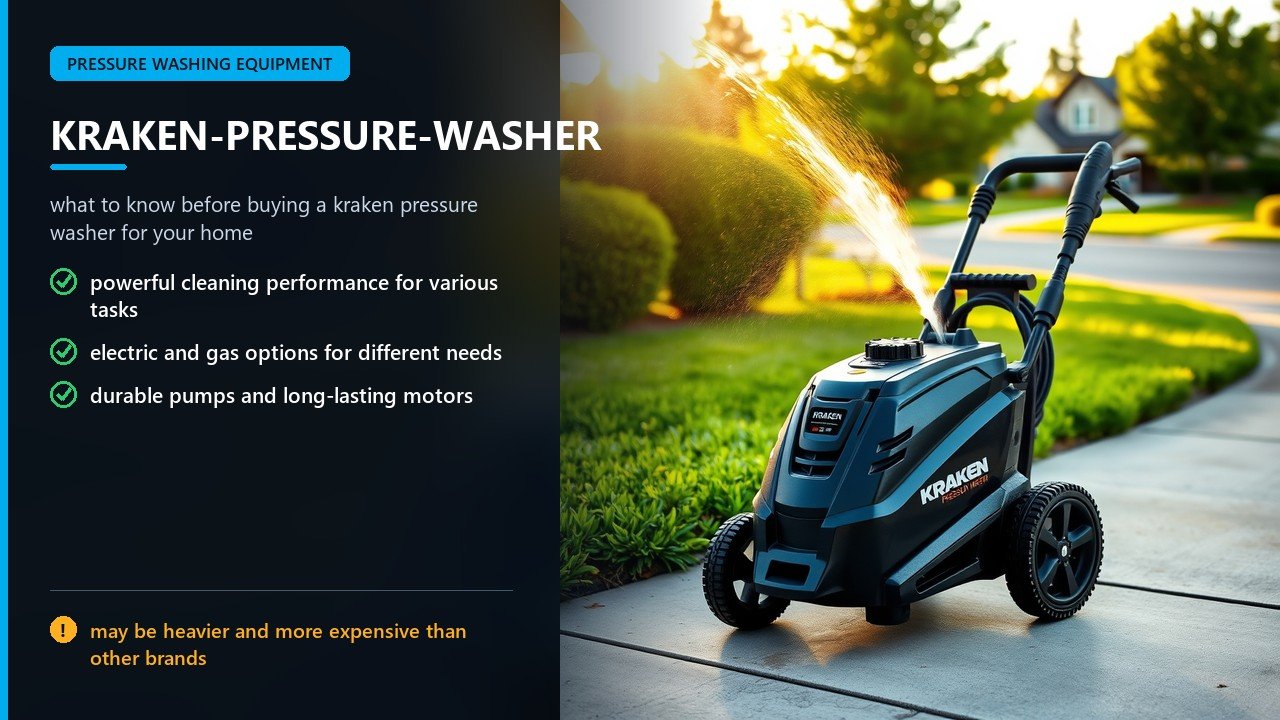
Understanding the Kraken Range
The Kraken name, like many pressure washer brands, is not a single machine but a family of machines that spans several classes and price points. Some models are electric units designed for homeowners who want convenience without the fuss of fuel and engine maintenance, while others are gas-powered machines built to deliver more power and flow for larger tasks. Within that family you will typically find a spread of pressure and flow ratings, along with accessory packages that can include nozzles, wands, surface cleaners, and foam cannons. Because the range is broad, the name itself tells you very little about any one unit, and two machines wearing the same badge can behave very differently depending on how they were specified and built.
The typical buyer for this class of machine is a homeowner or a light commercial user, someone who wants more than the cheapest bargain-bin pressure washer but does not need an industrial rig. That audience usually cleans cars, driveways, patios, decks, siding, and fences, and values a balance of power, durability, and affordability. Understanding where a particular Kraken model sits, whether it is a light electric helper or a heavier gas machine, is the first step in judging whether it fits your needs. A model aimed at cars and patios will frustrate you on a large lot, and a model built for heavy work may be more machine, and more cost, than a casual user ever needs.
The most important mindset to bring to a Kraken pressure washer is skepticism about the name and curiosity about the numbers. A brand can build excellent machines and budget machines under the same name, so the responsible way to shop is to look past the label and inspect the specifications that actually determine performance and lifespan. That means pressure, flow, cleaning units, pump type, motor type, build materials, warranty terms, and the availability of replacement parts. When you evaluate a Kraken pressure washer on those merits, you stop being swayed by marketing and start making a decision you can defend, which is exactly how you end up with the right tool for your property and your budget.
The Specifications That Actually Matter
The single most useful number to understand when comparing a Kraken pressure washer against any competitor is cleaning units, which is pressure multiplied by flow. Pressure, measured in PSI, describes how hard the water pushes, while flow, measured in gallons per minute, describes how much water moves each minute. Multiply the two and you get a figure that predicts how quickly a machine cleans far better than either number alone. A machine boasting very high pressure but modest flow cleans narrow strips slowly, while a machine with strong flow and moderate pressure can wash a large surface quickly and evenly. Whenever a spec sheet leans heavily on one number, check the other, because cleaning units are what your hands and your schedule will actually feel.
Once you have compared cleaning units, the next thing to examine is the pump, because the pump is the heart of the machine and the part most likely to determine how long it lasts. Triplex plunger pumps are the durable professional standard, built with serviceable valves and seals that can be replaced, while axial cam pumps are common on affordable electric units and are perfectly adequate for light, occasional use. Equally important is the material the pump and its fittings are made from: metal components resist heat, wear, and pressure surges far better than plastic, and brass or stainless connections hold up where cheap plastic threads strip and leak. On any Kraken pressure washer, confirm the pump type and the materials before you commit, because a strong pump with quality fittings is the surest sign of a machine built to last.
Beyond the pump, a handful of other specifications separate a machine you will be happy with from one you will regret. Build quality matters, so look for a sturdy frame, a decent-length hose, and metal quick-connect or threaded fittings rather than flimsy plastic. Warranty terms matter, because a generous warranty signals that the maker stands behind the product, while a vague or short one hints at low confidence. Parts availability matters even more over the long run, since a machine you cannot repair becomes scrap the moment a seal fails. Finally, real owner reviews matter, because they reveal how a Kraken pressure washer behaves after months of use, long after the impressive box copy has been forgotten.
Electric Versus Gas Machines
Choosing the power source is the decision that shapes almost everything else about owning a pressure washer, and the Kraken range, like most, offers both electric and gas options. Electric machines are quieter, lighter, and free of fuel and exhaust, which makes them ideal for home use where convenience and low maintenance matter most. They start with the press of a button, need no oil changes for an engine, and can be stored easily in a garage or shed. The trade-off is that electric units generally produce less power and flow, and they are tethered to a power outlet, so your reach is limited by the nearest socket and the quality of the household circuit feeding it.
Gas machines take the opposite set of trade-offs. They deliver more power and flow, run fully independently of any outlet, and are the right choice when you need to clean large areas, tackle heavy grime, or work somewhere without convenient power. In exchange, gas machines are heavier, louder, and more demanding to own, requiring fuel, engine oil, air filters, and the discipline of regular maintenance. They also produce exhaust, so they must run outdoors or in well-ventilated spaces. For a homeowner washing a car now and then, that complexity is hard to justify, but for someone cleaning long driveways, big decks, or multiple properties, the extra capability pays for itself quickly.
The practical way to decide is to match the power source to the work you do most often and to the conditions in which you work. If your jobs are modest, close to an outlet, and infrequent, an electric Kraken pressure washer will serve you quietly and cheaply for years. If your jobs are large, remote, or frequent, and you are comfortable with fuel and maintenance, a gas model will save you hours and spare you the frustration of an underpowered unit. Many buyers discover that the honest answer depends less on which type is objectively better and more on how they will actually use the machine, which is why honest self-assessment beats comparing spec sheets before you shop.
| Factor | Electric | Gas |
|---|---|---|
| Power and flow | Lower | Higher |
| Setup and start | Plug and go | Fuel and pull or push start |
| Portability | Tethered to outlet | Fully portable |
| Maintenance | Minimal | Regular engine and pump care |
| Noise and exhaust | Low | Higher |
Pumps, Motors, and Durability
Because the pump decides how well and how long a pressure washer performs, it deserves close attention on any Kraken model you consider. A triplex plunger pump moves water with three pistons and is the standard for machines that see regular or commercial use, precisely because it can be rebuilt rather than thrown away. An axial cam pump, by contrast, is simpler and cheaper and appears on many affordable electric machines, where it is perfectly adequate for light duty but wears faster under heavy or frequent work. Knowing which type a machine uses tells you a great deal about its intended workload and its realistic lifespan, so it is worth confirming before you buy rather than discovering later that the pump was never meant for the use you had in mind.
The materials inside and around the pump matter just as much as its design. Metal manifolds, brass or stainless fittings, and quality seals resist heat, corrosion, and pressure spikes that quickly destroy cheaper plastic parts. On electric machines, the motor is the other durability factor: induction motors run cooler and quieter and tend to outlast the universal motors found on some budget models, which are fine for occasional use but can wear out under steady demand. Thermal protection, which shuts an electric machine down before it overheats, is a useful safeguard that protects both the motor and the pump, and its presence is a small but telling sign that the maker thought about longevity rather than just the sale.
Serviceability is the quiet virtue that separates a machine you keep for a decade from one you replace in two years. Pumps with replaceable seals, valves, and o-rings can be maintained, and machines with accessible oil fills and filters are far easier to care for than sealed units that must be discarded when something fails. When you evaluate a Kraken pressure washer, picture where the oil goes, how the inlet filter is cleaned, and whether spare parts are easy to find, because those everyday details determine whether routine maintenance is a five-minute task or an impossible one. A durable machine is not simply built stronger; it is built to be kept running, and that difference pays off every season you own it.
Matching a Model to Your Jobs
The fastest way to be disappointed with any pressure washer is to buy the wrong size for the work, so matching a Kraken model to your actual jobs is worth more than any single specification. For light tasks such as washing a car, rinsing patio furniture, or spraying down a walkway, a modest electric machine is more than enough, and spending more buys you capability you will never use. These jobs reward convenience and light weight far more than raw power, and a smaller machine that you can set up quickly and move easily will serve you better than a heavy unit that feels like a chore to bring out.
For medium jobs such as driveways, decks, siding, and fences, you want a machine with enough flow to cover ground efficiently and enough pressure to lift stubborn grime. This is the range where a mid-level electric machine with a rotary surface cleaner can genuinely shine, or where a small gas unit starts to make sense if you have several large surfaces to handle. The key is a sensible balance of pressure and flow rather than a single flashy number, because even cleaning comes from steady flow as much as from force. A surface cleaner attachment is especially valuable here, turning a slow wand job into a fast, even wash across slabs and walkways.
For heavy grime or large properties, a gas machine with high flow earns its keep by finishing jobs in a fraction of the time a small unit would need. It also matters how often you clean: an occasional user is well served by a lighter, cheaper machine, while someone who cleans regularly should invest in durability to avoid early failure. Property owners who wash cars, patios, and the occasional driveway are best served by an electric unit, while those maintaining fences, outbuildings, and long driveways will appreciate the speed of gas. Choose for the work you do most often, and the machine will feel like money well spent rather than a compromise you regret. A useful rule of thumb is to buy one step above your smallest need but no more than one step above your largest, since that leaves a little headroom without paying for power you will never use.
Accessories That Add Real Value
The accessories included with a Kraken pressure washer can be worth as much as a small bump in pressure, so weigh the kit carefully when you compare packages. A complete nozzle set is the starting point, since it lets you move between a gentle rinse for delicate surfaces and a focused stream for tough spots, and being able to swap tips in seconds makes a single machine far more versatile. A turbo nozzle, which spins a concentrated jet of water, adds noticeable cleaning power without raising the machine’s pressure, making it one of the most cost-effective upgrades you can add to any pressure washer.
For flatwork, a rotary surface cleaner is the accessory that changes how the job feels, because it covers area quickly and leaves an even finish instead of the streaky pattern a hand wand tends to leave. A foam cannon is the other accessory that car owners quickly learn to love, applying a thick layer of detergent that clings to paint and lifts dirt before the rinse. Both attachments extend what you can do with a single machine, and both are far cheaper when bundled with the pressure washer than bought separately, so their presence in a package can tilt the value calculation in a model’s favor.
The less glamorous accessories deserve attention too, because they shape everyday usability. Hose length and quality decide how far you can reach and how often you fight kinks, and a longer, better hose is an upgrade many owners make far too late. Onboard storage, whether hooks, clips, or a small tray, keeps nozzles and wands from disappearing between jobs. Spare o-rings and a spare nozzle or two cost little and prevent a stalled job over a tiny worn part. When comparing Kraken pressure washers, weigh the whole kit, since a richer package with quality accessories often delivers more real cleaning improvement than a small bump in the headline pressure figure.
| Accessory | Why It Helps |
|---|---|
| Nozzle set | Versatility for different jobs |
| Turbo nozzle | More cleaning power without higher pressure |
| Surface cleaner | Fast, even flatwork |
| Foam cannon | Thicker detergent for car washing |
| Longer quality hose | More reach and fewer kinks |
Safety and Setup
Every pressure washer, the Kraken included, needs to be set up and used with care, because high-pressure water is genuinely dangerous when handled casually. On electric machines, always use a grounded outlet and a circuit that can carry the load without tripping, and avoid using an overloaded extension cord, which can overheat. On gas machines, fuel and exhaust introduce their own hazards, so refuel only when the engine is cool, run the machine outdoors or in well-ventilated spaces, and never operate it in an enclosed garage where carbon monoxide can build up unnoticed and fast.
The water supply is another common source of problems and damage. Ensure the machine receives adequate flow, because a starved pump cavitates and can be destroyed in minutes, and fit a filter on the inlet to keep grit and debris out of the delicate internals. Most importantly, never run the pump dry, since even a short period without water can wreck the seals and valves, turning an affordable machine into scrap. Before you start, double-check that the inlet is properly connected, the water is turned on, and the line is free of kinks that would restrict flow and place strain on the pump.
Safe operation also means respecting the spray itself and matching pressure to the surface in front of you. High-pressure water can cut skin, so never point the nozzle at people, pets, or yourself, and keep children well clear of the work area. Different surfaces tolerate different force, so test on a hidden patch before unleashing full pressure on paint, wood, or softer materials, and hold the nozzle at a safe distance rather than pressing it close to the surface. Finally, release pressure and switch the machine off before disconnecting any hose or fitting, since trapped pressure can cause a violent, unexpected spray. Safe habits cost nothing and prevent the kinds of accidents that end a cleaning job in the emergency room. Basic protective gear is also worth the small effort, so wear eye protection, gloves, and sturdy footwear, since flying debris and slippery wet surfaces are common around pressure washing and a moment of carelessness can turn a routine job into an injury.
Maintenance for Long Life
A pressure washer that is maintained properly will outlast one that is simply used hard, and the Kraken class is no exception, so a small routine goes a long way. On gas machines, check and change the engine and pump oil on schedule, because oil is what keeps the pump’s moving parts from grinding themselves apart. Replace the air filter when it clogs and keep the spark plug in good condition, since an engine that struggles to run puts extra strain on the whole system. On electric machines, the care is lighter but still matters: keep the motor and vents free of dust, and store the unit somewhere dry so moisture does not corrode the electronics.
The water side of maintenance is just as important as the engine side. Clean the inlet filter regularly, because a clogged filter restricts flow and forces the pump to work harder than it should. Flush the machine after using detergent, since chemical residue left inside the pump and lines can corrode seals and shorten the machine’s life. Inspect hoses and o-rings for wear and replace them before they fail, because a small leak wastes pressure and a burst hose ends the job entirely. These checks take only minutes, but they are the difference between a machine that runs smoothly for years and one that fails at the worst possible moment.
Finally, never forget seasonal care, especially where winters freeze. Water left inside a pump, hose, or wand can freeze, expand, and crack the very components that make the machine work, so drain the system thoroughly before cold weather arrives, or run a pump protector through it for storage. Store the machine in a dry, protected space rather than leaving it out in the elements, and give it a quick inspection before the first use each season. A disciplined maintenance routine does not demand mechanical skill, only consistency, and that consistency is the reason a well-kept pressure washer can outlast several neglected replacements. Store fuel safely and in approved containers, and give the whole machine a careful once-over before the season begins, because catching a worn hose or a loose fitting early is far cheaper than repairing the damage from a mid-job failure.
Common Mistakes to Avoid
Buying on PSI alone. One of the most common mistakes buyers make, with a Kraken pressure washer or any other brand, is choosing a machine purely on its pressure rating while ignoring flow. Two machines with identical PSI can clean at very different speeds if their flow rates differ, and a high-pressure, low-flow machine will feel weak the moment you try to cover a large surface. Always compare cleaning units, which combine pressure and flow, and weigh the type of work you do most. A balanced machine that delivers solid pressure and strong flow will outclean a boastful pressure figure every time, and it will leave you far less disappointed after the first real job. The lesson is simple: read the whole spec sheet, compare the cleaning units of two or three machines side by side, and think about the surfaces you clean most. A little arithmetic before you buy prevents the nagging feeling that you paid for a number that never translated into faster or cleaner work.
Another common mistake is overworking a light machine. A small electric unit is a wonderful tool for cars, patios, and light siding, but using it for heavy, frequent jobs pushes the motor and pump far beyond what they were designed to handle. The machine overheats, the pump wears, and what should have been a long-lived tool becomes a short-lived frustration that you blame on the brand rather than the mismatch. If your work is genuinely heavy, buy a machine rated for it from the start, because no amount of care can make an underpowered unit do a job it was never built for. Recognizing the mismatch early is important, since many buyers blame the brand when the real problem was asking a light machine to do heavy work. If you find yourself cleaning bigger or greasier surfaces than you expected, the honest fix is to upgrade to a machine that matches the workload rather than pushing the old one until it fails.
Neglecting basic maintenance is the third mistake that quietly kills pressure washers. Running the machine dry, skipping the inlet filter, ignoring oil changes, and leaving water in the pump over winter all cause damage that builds up until the machine simply stops working. None of these failures is dramatic at first, which is exactly why they go unnoticed until it is too late. Following the simple care routine above, checking the filter, flushing after chemicals, and winterizing the unit, costs almost nothing and prevents the majority of the breakdowns that send pressure washers to an early grave. The pattern is always the same: neglect is cheap in the moment and expensive later, while a few minutes of routine attention keeps a machine dependable for years. Treat maintenance as part of the job rather than an inconvenience, and a Kraken pressure washer, or any well-built machine, will reward you with steady, dependable service.
Frequently Asked Questions
Is a Kraken pressure washer good? Quality depends entirely on the specific model rather than the name, so judge any unit by its cleaning units, pump type and materials, build quality, warranty, and parts availability, then match it to the work you do.
What should I look for in a pressure washer? Focus on cleaning units, which combine pressure and flow, followed by pump type and materials, overall build quality, warranty terms, and the availability of replacement parts, and always match the machine to your typical jobs.
Should I choose electric or gas? Choose electric for home use, convenience, and low maintenance, and choose gas when you need more power, flow, and full portability for larger or more frequent jobs.
What PSI do I need? Around 1600 to 2000 PSI handles cars, furniture, and light cleaning, while 2500 to 3200 PSI suits driveways, decks, and tougher grime, always balanced against a healthy flow rate.
What is more important, PSI or GPM? Neither on its own. Cleaning units, which are pressure multiplied by flow, give the most honest prediction of how quickly and thoroughly a machine will clean.
Can I use a surface cleaner with it? Yes, provided the machine’s flow is enough to spin the cleaner’s bar, a rotary surface cleaner turns flatwork into a fast, even job and is one of the best accessories you can add.
How do I maintain a pressure washer? Check and change oil on gas machines, clean the inlet filter, flush after using detergent, inspect hoses and o-rings, and winterize the unit before storage, all of which takes only minutes.
Are pressure washer accessories worth buying? Yes. A turbo nozzle and a surface cleaner typically improve real cleaning results more than a small increase in pressure, so quality accessories are usually money well spent.
How long should a pressure washer last? A well-maintained machine can last many years, with the pump and motor usually deciding the lifespan. Regular oil changes, a clean inlet filter, and winterizing greatly extend how long a pressure washer remains reliable.
Can a pressure washer damage concrete or paint? Yes, if the pressure is too high or the nozzle is held too close. Always test on a hidden area, keep the tip moving, and match the pressure and nozzle to the surface before you commit to a full pass.
Final Thoughts
A Kraken pressure washer can be a capable tool when the model behind the name fits your work, but the name alone is never a reason to buy. Judge the machine by the specifications that matter, cleaning units first, then pump type and materials, build quality, warranty, and parts support. Match electric or gas to the jobs you actually do, choose a kit with accessories that add genuine value, and keep up with the simple maintenance that keeps any pressure washer alive. Do that, and whichever machine you bring home will deliver reliable, satisfying cleaning for years rather than the disappointment of a purchase made on branding alone.
It also helps to remember that pressure washers are not mysterious machines. Strip away the marketing and every unit is a pump, a motor or engine, a hose, and a wand, and the quality of each of those parts is what you are really paying for. When you understand that, the bold names and glossy claims lose their power over your decision, and you can compare a Kraken model against any competitor on equal terms. A machine with a strong pump, sensible cleaning units, and a solid warranty will serve you well regardless of the badge, while a weak machine with a famous name will still disappoint you on the first tough job.
It also helps to think about the machine as a long-term partner rather than a one-time purchase. The pressure washer you buy today will be with you for years, and how you treat it, along with how well it matches your work, decides whether those years are smooth or frustrating. Spending a little more on a machine that fits your jobs and is built to be maintained usually costs less over time than repeatedly replacing a cheap unit that was never right for the work. Buy for the long run, care for the machine, and use it within its limits, and a Kraken pressure washer, or any well-chosen model, will reward you with dependable cleaning season after season without drama or wasted money.