Under the shroud of almost every gas pressure washer sits a second engine, the pump that builds the pressure the machine is famous for, and it has a secret most owners never read: it needs its own oil. A machine owner who dutifully changes the engine oil but ignores the pump wakes one morning to a sad, spitting stream and a scorched pump housing. The most common pump failure in the entire hobby is running it dry, and the question that would have prevented it is the simple one this guide answers, what type of oil goes in a pressure washer pump.
The story repeats in every forum and shop. A veteran homeowner pulls the dipstick of the little pump casing and finds it bone dry on foam, because the “oil-sealed for life” sticker on a budget axial pump meant someone skipped the first check. The machine ran hot, the ceramic plunged, and the replacement pump cost more than the washer. Understanding the pump’s oil, the type, the level, and the rhythm of the change, is the cheapest insurance a pressure washer owner will ever buy, and it takes ten minutes a season.
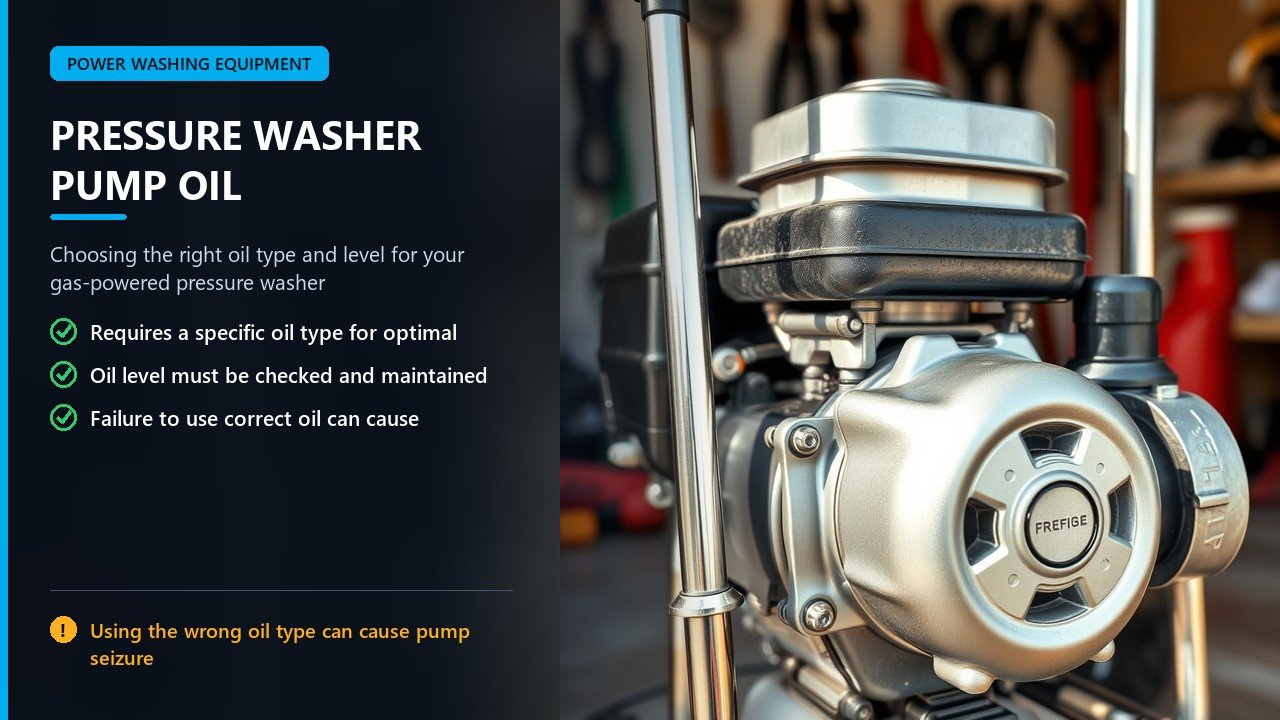
The Pump and Its Oil Well
Most residential pressure washer pumps are axial cam pumps, compact units bolted to the engine frame where a connecting rod and cam, not crankshaft bearings, drive the plungers. These pumps hold a small oil reservoir of roughly three to six ounces, and the oil lubricates the cam, the connecting rod, and the wrist pins as they hammer thousands of times a minute. Friction without oil turns that dance into a seizure, which is why the fill level and the oil type on these little units matter far more than housings suggest.
Commercial machines step up to triplex pumps, larger units with separate oil capacities of twenty ounces or more, and they carry the same story with bigger volume. Whether axial or triplex, the pump’s oil has one disciplinary rule: it is not the engine’s oil. The engine runs a thicker, detergent-rated product meant for combustion heat and crankcase blow-by; the pump runs a light, non-detergent oil meant to carry load and life without the additives that settle or foam in a sealed reservoir.
The tell to check is the sight glass or dipstick you actually have. Some pumps show the level through a translucent window; others carry a dipstick under the pump’s top plug. The manual’s chart, or the pump’s own label, states the capacity and the recommended oil, and the pump’s recommendation usually lands on a non-detergent 30-weight or a 10W-30 engine oil depending on the design. Knowing which part of the machine you are oiling is the first step toward choosing correctly.
The Recommended Oil Types
The short answer that fits most pumps is a non-detergent SAE 30 oil or a SAE 10W-30 engine oil, and the longer answer is that the pump’s own label wins over any general advice. Many pump makers specify a non-detergent ND30 for the sealed axial pumps, because detergent additives are unnecessary when there is no combustion and can hold moisture in suspension in a year-round reservoir. The light grade also stays fluid in the cold starts that a thicker 30-weight resists in winter.
Some modern pumps specify a synthetic oil in a 10W-30 or a 5W-30 weight, and synthetic blends resist the heat a pump builds on a long afternoon and hold their viscosity better over a season. Where the manual says “use 10W-30,” the synthetic version meets the same spec with a longer service life, and the cost is trivial against a pump replacement. The thread binds the answer: read the label, honor the grade, and treat a synthetic recommendation as a hard requirement rather than a suggestion.
A volatile warning closes the list. Never use automotive detergent oil with friction-reducing additives (the “energy conserving” oils sold for modern cars) in a pressure washer pump, because the friction modifiers can cause the pump’s centrifugal clutch or the cam drive to slip. Garden-grade non-detergent 30-weight, or a dedicated pressure washer pump oil in the specified weight, is the safe ring. The whole engine and pump oil story on this site digs into the full range of picks.
How to Check the Pump Oil Level
Checking the pump’s oil takes a steady routine and a clean rag. Run the engine for thirty seconds to warm the oil, shut it down, and set the machine level on its wheels, because a slope turns a half-full sight glass into a dishonest full one. Find the pump’s oil access, either the dipstick that doubles as the fill cap or the translucent sight window, and read the level against the marks, never overfilling, since a swollen reservoir on a sealed pump builds pressure and blows gaskets.
With a dipstick, wipe it clean, insert it fully, and read the wet line at the crosshatch; with a sight glass, look for the oil to sit at or slightly below the center line while the machine is parked on level ground. The oil should look clear to honey, not milky or gritty, because milky oil means water has worked in, usually from a leaky seal, and gritty oil means the internals are shedding. Both are warnings to address before the pump grinds itself further.
Make the check part of the engine check, before nearly every job, or at least every tank of gas. Oil burns off slowly and rarely disappears in a single season, so a pump that reads low on oil is a pump that has been running dry somewhere, and the fix is to find the leak the way a pilot checks the tail, because a steady low reading is a diagnosis, not a note to top up faster. The moment the pump sounds raw or scorched, pull the plug and check before the next trigger pull.
When and How to Change the Pump Oil
A new machine’s pump oil changes early and often deserves a first change after the first 20 to 50 hours of use, since a fresh pump breaks in and sheds metal shavings into the reservoir, then every season or roughly every 100 to 150 hours after that. Pumps that run hard in commercial services, hot water, or daily rental work get changed more frequently, and a pump that lives through a dusty summer can streak its oil sooner than the calendar suggests. When the oil darkens to the color of coffee before the interval, change it early.
Draining is a ten-minute job. Run the engine to warm the oil, shut it down, remove the pump’s drain plug or use the siphon fitting if the pump offers one, and let the old oil run into a catch pan. Replace the plug, fill with the recommended type to the correct level, and run the machine for a minute before rechecking, since the oil settles into the cavity. The step-by-step pump oil change on the site walks the full process with the wrench sizes.
Proper disposal closes the loop. Collect the old oil in a sealed container and take it to a recycling center or an auto-parts store that accepts used oil, never pouring it on the ground or down the drain, because a few ounces of pump oil in the wrong place can foul a whole waterway. Combine the change interval with the engine oil service and the spark plug check, and one afternoon of maintenance keeps both internals of the machine alive for a decade.
Straight 30-Weight Versus 10W-30 in the Pump
The two most common answers hide a nuance worth a paragraph. A straight non-detergent SAE 30 pours like a 30-weight at any temperature, simple and correct for pumps run in mild weather, and it is the classic recommendation from the axial pump era, because no additives are needed in a sealed reservoir and the steady grade protects the cam at operating temperature. Its weakness is the cold start, where a 30-weight thickens and drags on a freezing morning, and where a multi-weight pumps the warm-up wait.
10W-30 adds the winter branch: a 10W base that flows cold and thins to a 30-weight hot, so the pump cranks easily on a cool morning and still protects at full load. Where the pump’s label says 10W-30, that multi-grade is the answer, and a synthetic 10W-30 extends the interval without losing the flow. The decision therefore falls to the manual and the climate, cold nights favor the 10W-30, temperate garages accept the straight 30, and either works if it matches the pump’s printed recommendation.
The debate loses its heat when owners remember the reservoir is small and the change cheap. A premium bottle of either grade costs less than a pizza, so the mistake is not choosing the other valid grade, it is choosing the wrong category, detergent motor oil, car synth, or a mystery leftover. Buy the pump’s stated grade, keep the bottle labeled, and change on schedule, and the straight-versus-multi debate becomes a footnote rather than a field of internet warfare.
Reading the Pump Label and the Oil Jar
The pump almost always tells the owner what it wants. A stamped plate or sticker on the casing lists the model, the oil capacity, and often the word “non-detergent” or the grade, and the operator who writes it down only needs to find a bottle that matches. The machine’s manual repeats the same data on its lubrication page, and together the two labels settle most arguments before they start. The label is the first source, and the brand sticker on a jar is only trustworthy once it matches.
The jar tells its own story in fine print. A can labeled “SAE 30 non-detergent motor oil” is the classic pump grade; a jug labeled “10W-30 motor oil” may include the energy-conserving friction modifiers that slip a pump’s drive, so look for the plain spec or the pump-appropriate additive picture on the back. Garden-supply shelves carry a dedicated pressure washer pump oil, usually a 10W-30 or 30-weight blend marked for pumps, and it doubles as the safest single-bottle answer for most axial pumps.
One clean habit resolves the confusion for good. Beware the identical jug and the shared garage shelf, because the engine bottle and the pump bottle look alike on a dim shelf. Label the pump oil clearly and store it apart, and make the change a two-bottle routine, the engine gets its grade and the pump its own, each from the labeled container, and the machine never eats the wrong meal in a hurry.
Special Pump Cases Worth Knowing
The rules flex for the bigger machine. Commercial triplex pumps often carry larger reservoirs and a spec printed on the casing, usually a 10W-30 or a synthetic 30-weight, and their longer runs and hotter work call for more frequent changes on a real schedule rather than the weekend ritual. Belt-driven and gear-driven pumps transmit the drive mechanically, so they tolerate the friction-modifier oils less, and the non-detergent or synthetic requirement matters even more on these heavier units.
Hot water machines heat the pump’s neighborhood, and heat thins the oil faster, so hot water duty calls for the higher grade the manual names and a shorter change interval, often twice the household pace. Pumps that live in trailers and skids work through vibration and dust, and the fine particles and shaken reservoir push the oil toward the gritty failure a sight-glass check reveals early. Rental machines and detail shops cycle the hardest, and their pumps run the most frequent oil changes of all.
When a pump wears a special requirement, the casing sticker and the manual say so plainly, and the honest move is to obey them instead of following a forum anecdote. A pump that specifies a proprietary blend or a weight such as 5W-30 deserves exactly that oil, and the owner who keeps the manual’s page for that machine answers every future question from the machine itself. The special cases are not exceptions to a rule; they are more specific statements of the same rule, read the label, honor the grade, change on time.
What Happens When the Pump Runs Low or Dry
Running a pressure washer pump low on oil is a slow corrosion; running it dry is a fast death. The cam and connecting rod friction spikes the moment the oil film breaks, the aluminum housing shows it as a scorched, dark patch behind the pump casing, and the ceramic plungers score inside their sleeves, and the machine’s output drops to a weak, pulsing stream that never returns. By the time the owner hears the change in the pump’s tone, the damage is inside.
The cost of a replacement defines the stakes. A consumer axial pump runs the price of a few dinners, a triplex unit several times more, and either one plus the labor to bolt it on exceeds what most owners want to spend on a machine they can replace at retail. The cheap insurance is the fifteen-minute check every job, and every forum thread that starts with “pump dead, why?” turns out to be a pump that was never once looked at.
Low oil and milky oil predict different failures, and reading which is which saves the repair. Low oil with a raw pump sound points at a case seal or a slow leak around the fill plug; milky oil points at water drawn in through a downstream injector or a steam cleaning session that surged moisture past the seals. Both need a change and a fresh start, and both respond better to the habit of looking at the window before the machine is ever switched on.
Winterizing the Pump Oil Side
Freezing weather treats pump oil gently if the reservoir is healthy, and badly if it is not. The pump’s oil can handle a mild freeze, but water in the reservoir, the milky contamination, expands into ice and can split a sealed pump casing, so the winter routine for the pump mirrors the machine’s. A full oil change to a clean, correct type before storage removes moisture, and a pump drained dry and protected with the machine’s winterization guards the casing from the freeze.
Run a minute of clean water through the pump, then protect it with the machine’s winterizing ritual, which is covered in full by the winterizing guide. Some owners leave the pump full of the correct oil through the season, vented properly, because a sealed pump casing with fresh oil tolerates storage far better than air inside it, which can rust the exposed surfaces. The key is deciding on one approach and executing it cleanly rather than leaving the machine half-drained and forgotten.
A spring re-entry is the perfect time for the seasonal oil change. Before the first big job, pull the pump plug, look at the oil, and if it reads off the marks, cloudy, or metallic, change it early. A clean pump started on fresh oil each spring is the machine that still pulls a steady blast four seasons later, and the pattern of check, change, and winterize is the quiet discipline behind every “my old washer never quit” story.
Common Pump Oil Mistakes
The first mistake is treating the pump as sealed and never checking it, the sticker half-read as a promise. The second is pouring motor oil for the engine into the pump, since the heavier formulation and its additives belong in the crankcase, not in the pump’s small reservoir, and the mismatch shows up as a pump that runs hot and sluggish. The third is overfilling, which pressurizes the reservoir, froths the oil, and ultimately blows a gasket out of a pump that was otherwise fine.
The fourth is ignoring the label and buying whatever is on sale. A pump that calls for a non-detergent 30-weight runs differently on a detergent 10W-30, and a pump that calls for synthetic suffers the long-term drift of ordinary dino juice. Read the pump’s recommendation, keep the right bottle in the garage, and label it so nobody tops the pump with the engine’s oil by accident. The five-minute check, the right grade, and the honest level are the entire curriculum.
Finally, waiting for symptoms costs the pump. A pump rarely warns politely; the first sign is often the full failure, and by then a $40 oil change is history. The seasoned operator checks the pump’s oil the way a pilot checks the fuel, before the machine ever claims a task, and treats a cloudy window or a hot smell as a work stoppage. That small ritual is the difference between a pressure washer that washes for a decade and one that joins the scrap pile at the end of its first real summer.
Frequently Asked Questions
What type of oil goes in a pressure washer pump? Most pumps specify a non-detergent SAE 30 or a SAE 10W-30 engine oil; many recommend a synthetic 10W-30. Check the pump’s own label and follow its grade rather than guessing or borrowing the engine’s oil.
Can I use engine oil in the pump? Not the same oil you pour into the engine. The pump wants a lighter, non-detergent or synthetic grade stated on its label, and detergent additives and friction modifiers in car oils can cause slipping and foaming in the pump drive.
How often should I change the pump oil? Change after the first 20 to 50 hours on a new pump, then about every season or 100 to 150 hours. Commercial, hot water, and dusty duty shorten the interval, and dark or milky oil means change it now.
How do I check the pump oil level? Run the machine briefly to warm the oil, shut it down, and read the dipstick or sight glass with the machine level. The level sits at or just below the mark, and oil should look clear, not milky or gritty.
What happens if I overfill the pump? Overfilling presses the sealed reservoir, froths the oil at speed, and can blow a gasket or push oil past the seals. Fill to the mark and no more, and drain a little out if you misjudge.
Final Thoughts on the Pump Oil Question
What type of oil goes in a pressure washer pump is a question with a strict, learnable answer, read the pump’s label, use the stated non-detergent or synthetic grade, and keep the level at the mark. The pump is the machine’s second engine, and naming its oil correctly is the single best protection a pump will ever get. Ignoring it is how a perfectly good washer eats its own heart, and respecting it is how the same washer outlasts two cheaper replacements.
Make the pump check part of every job, change the oil on a real schedule, and winterize the reservoir with the machine. Keep the right grade bottled and labeled, watch the sight glass for color and level, and treat a cloudy window as a warning rather than a skip. The machine that proves itself season after season is not the most powerful one on the shelf; it is the one whose owner took ten minutes to learn what its pump needed, and supported it with the exact oil it asked for.