If you are searching for a “yellow pressure washer,” you are probably picturing a machine you saw — on a job site, in a shop, or on a shelf — and trying to work out what it was. The color is a clue, but not a specification. On a pressure washer, yellow usually points to one of two brands or to a spray-nozzle code, and confusing those two meanings is easy. Knowing which is which saves you from buying the wrong thing.
This guide explains what a yellow pressure washer actually is, the brands behind the color, and how yellow fits into the color-coded nozzle system.
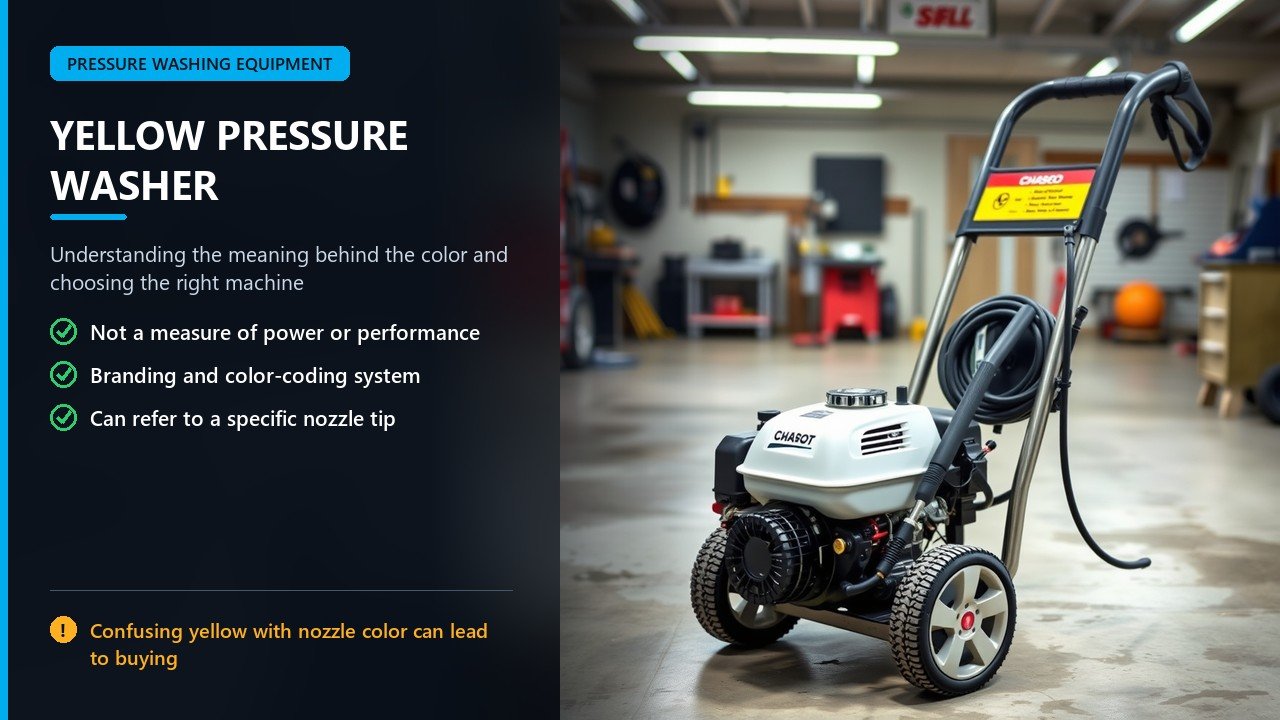
color Is Branding, Not Power
The first thing to understand is that the color of a pressure washer says nothing about how powerful it is. Manufacturers choose colors to make their machines recognizable, and two of the best-known choices happen to be yellow. A yellow machine is simply a machine from a brand that uses yellow — its pressure, flow, and engine are separate facts you have to check for yourself.
That matters because buyers sometimes assume a color signals a class of tool. It does not. A yellow electric washer and a yellow gas washer can sit at opposite ends of the performance range, and two machines of the same color can differ by hundreds of PSI and several GPM. The color identifies the maker; the specification plate identifies the machine.
There is one other meaning to keep in mind. Yellow is also the color of the 15-degree spray nozzle in the standard tip set, so a search for “yellow pressure washer” sometimes means someone is really looking for a yellow nozzle tip. That is a completely different product, and worth separating from the brand question.
The Brands Behind the Yellow
Two brands dominate the yellow pressure washer world, and they serve different buyers. The table below summarises how they compare in general terms.
| Brand | color scheme | Typical focus |
|---|---|---|
| DeWalt | Yellow and black | Job-site and pro-style; electric and gas; cordless options |
| Kärcher | Yellow (K-series) | Home and garden; light to medium cleaning |
DeWalt builds its pressure washers in its trademark yellow-and-black scheme, spanning compact electric units around 2,100-2,600 PSI, gas models in the 3,400-3,700 PSI range, and even cordless cleaners. The yellow-and-black color combination is part of the brand’s identity, which is why these machines are so recognizable. They tend to suit buyers who want job-site ruggedness and a familiar tool brand.
Kärcher, which markets itself as the world’s number one pressure washer brand, uses yellow across many of its K-series home and garden machines. These are generally lighter-duty units for cars, patios, garden furniture, and bikes, with modest pressure and flow. If the yellow machine you saw was compact, quiet, and aimed at home use, it was likely a Kärcher; if it was a heavier job-site machine with black accents, it was likely a DeWalt.
The Yellow Nozzle Explained
Pressure washer nozzles are color-coded by spray angle, and that color code is a language of its own. In the standard quick-connect set, red is a 0-degree pencil jet, yellow is 15 degrees, green is 25 degrees, white is 40 degrees, and black is the low-pressure soap setting. So a “yellow” tip is not a brand — it is the 15-degree spray pattern.
The 15-degree yellow tip sits between the aggressive 0-degree tip and the gentler 25- and 40-degree tips. It is a common choice for stripping heavier dirt, cleaning concrete and masonry, and tackling stains on hard surfaces, where a little more concentration than the 25-degree tip is wanted without the gouging risk of the 0-degree pencil jet. It is one of the most-used tips in a set, which is why yellow tips are bought and discussed so often.
The sizes of these tips are measured by orifice number, and the orifice must match the machine’s flow. A 15-degree yellow tip comes in sizes such as 3.0 for around 2.5-3.0 GPM and 3.5 for around 3.5 GPM. Choosing the wrong orifice either chokes the machine and over-pressures it or drops pressure and wastes its potential, so the color is only half the decision — the size must match too.
Choosing by Specification, Not Color
If you want a yellow machine, the useful next step is to forget the color and read the specifications. Pressure in PSI, flow in GPM, engine or motor type, and pump quality decide what the machine can do. A yellow washer that suits your jobs is a good buy; a yellow machine bought only because it matched a picture may not be.
Start with the work. Light home tasks like cars, furniture, and small patios need only modest pressure and flow, which is where a Kärcher-style home machine fits. Heavier jobs like driveways, siding, and paint prep need higher pressure and flow, which points to a DeWalt-style electric or gas machine — and gas if you need sustained power. The color narrows the brand; the specification picks the model.
Then check the details that determine whether the machine lasts: the pump type, the hose length and diameter, the nozzle set included, and the warranty. Whether a machine is yellow, red, or green, a triplex pump and a proper high-pressure hose are what make it durable. Treat the color as a starting point for brand recognition, not a reason to buy.
When “Yellow Washer” Means the Nozzle
If what you actually want is a yellow nozzle tip, buy it as a spray tip, not a machine. A 15-degree yellow nozzle is inexpensive and widely available in quick-connect sizes, and it is a useful addition to any tip set. Match the orifice number to your machine’s flow, and confirm the connection size — usually 1/4-inch quick connect for home machines.
Replacing a lost or worn yellow tip is far cheaper than replacing a machine, and keeping a full set — 0, 15, 25, 40, and soap — lets you handle every surface correctly. If your only yellow tip is worn or you never had one, adding one is one of the cheapest performance upgrades you can make, because the right tip does more for cleaning results than most accessories.
So the phrase “yellow pressure washer” splits cleanly in two: a yellow machine from a brand that uses that color, or a yellow 15-degree nozzle tip. Both are common searches, and knowing which one you mean is the first step to finding it.
Choosing Between the Yellow Brands
If you have narrowed your choice to a yellow machine, the decision is really between the two brands and their intended users. Kärcher’s yellow K-series machines suit home and garden cleaning: washing a car, hosing down a patio, cleaning garden tools and furniture. They are compact, easy to store, and designed for occasional use, with pressure and flow sized for light dirt rather than heavy stripping.
DeWalt’s yellow-and-black machines suit buyers who want more capability or a job-site tool. Its electric models in the 2,100-2,600 PSI range handle tougher home jobs, while its gas models around 3,400-3,700 PSI are built for larger areas, paint prep, and repeated use. DeWalt also offers cordless cleaners for light spot work, and its machines are often chosen by trades because they share the look and feel of the brand’s other tools.
The honest answer is that either brand makes good machines for the right buyer, and neither is better in the abstract. What matters is matching the machine to your work: light home cleaning points to a Kärcher-style unit; heavier or repeated work points to a DeWalt-style machine. Confirm the pressure and flow numbers, and check the pump and hose quality, rather than assuming a color or a name guarantees performance.
What to Check Before Buying Any Yellow Washer
Start with the specification plate, not the paint. Read the rated PSI and GPM, and understand that cleaning power is pressure multiplied by flow, so a higher GPM machine cleans faster than one with the same PSI but less flow. For light home work, a modest machine is enough; for large hard surfaces, more flow pays off.
Then check the build details. A triplex pump outlasts a cheaper axial pump, a longer high-pressure hose makes the machine easier to use, and a complete nozzle set — including a turbo or rotating nozzle for hard surfaces — adds real value. Confirm the connection type so you can add accessories and replacement tips later, and read the warranty.
Finally, think about fuel or power. An electric machine is quiet and simple but limited by the cord; a gas machine is powerful and portable but needs fuel and more maintenance. A cordless model is convenient for quick jobs but light on power. Matching the power source to where and how you clean is as important as the color on the casing.
Caring for a Yellow Pressure Washer
Whichever brand you own, the maintenance routine is much the same. Keep the machine clean and store it dry and out of freezing weather, because trapped water can crack a pump or fittings. On gas models, check the engine oil, change it on schedule, and keep the air filter and spark plug in good condition.
Never run the pump without water, avoid leaving the gun closed for long periods against a running pump, and always fit the correct-size nozzle for the flow. Flush the machine after use and winterize it before storage in cold weather. These habits protect the pump — the most expensive part to replace — and they apply to a yellow washer exactly as they do to any other color.
With basic care, a good yellow machine from either brand gives years of service. The color got your attention; the specification and the maintenance are what make it worth keeping.
Frequently Asked Questions
What is a yellow pressure washer? Usually a machine from a brand that uses yellow in its branding — most often DeWalt (yellow and black) or Kärcher (yellow K-series). The color is branding, not a performance rating.
Does the color tell me how powerful it is? No. color says nothing about pressure or flow. Check the specification plate for the rated PSI and GPM.
Which brand makes yellow pressure washers? DeWalt uses a yellow-and-black scheme for job-site and pro-style machines, and Kärcher uses yellow across many of its home-and-garden K-series models.
What does a yellow nozzle mean? In the standard tip set, yellow is the 15-degree spray nozzle. It is used for general cleaning of masonry, concrete, and heavy grime.
Is a yellow nozzle better than other colors? Not better — different. Red is 0 degrees, yellow 15, green 25, white 40, and black is soap. Choose the angle for the surface and the job.
What size yellow nozzle do I need? Match the orifice to your flow — about 3.0 for 2.5 GPM and 3.5 for around 3.5 GPM — and confirm the connection size, usually 1/4-inch quick connect.
Which yellow brand is better? Neither is better in general. Kärcher suits light home cleaning; DeWalt suits heavier or repeated work. Match the machine to your job.
How do I maintain a yellow pressure washer? The same way as any other: keep it clean and dry, protect the pump from freezing, never run it dry, use the correct nozzle, and service the engine on gas models.
Final Thoughts
A yellow pressure washer means one of two things, and the distinction is the whole answer: a machine from a brand that uses yellow, or a yellow 15-degree nozzle tip. The color itself is branding or a code — never a measure of power. To buy well, look past the paint to the rated pressure, flow, pump, and build, and match those to the work you actually do.
If it is a yellow machine you want, choose between the home-and-garden focus of a Kärcher-style unit and the job-site capability of a DeWalt-style one. If it is the yellow nozzle, buy the tip and match its orifice to your flow. Either way, the color is only the start of the story. For related reading, see our guides on turbo pressure washer nozzles and an electric cold water pressure washer.