Flow rates confuse more buyers than any other pressure washer spec. A machine advertised at 8 gallons per minute sounds impressive until you realize that number says nothing about pressure and everything about volume. It is like judging a fire hose by how fast the tank empties instead of how far the water travels. Yet for the right jobs, those 8 gallons per minute are the whole point. An 8 gal per minute pressure washer is a high-volume machine built to move water fast, and understanding what that flow actually does is the difference between a smart purchase and an expensive paperweight.
An 8 gal per minute pressure washer delivers eight gallons of water every minute through its pump and nozzle. That is roughly double to several times the flow of a typical homeowner machine, and it is squarely in professional territory. High flow is what makes surface cleaners glide, turbo nozzles spin, and soft washing rinse clean. This guide explains what 8 GPM really means in practice, what it cleans, what it demands for water and accessories, and whether you need one at all.
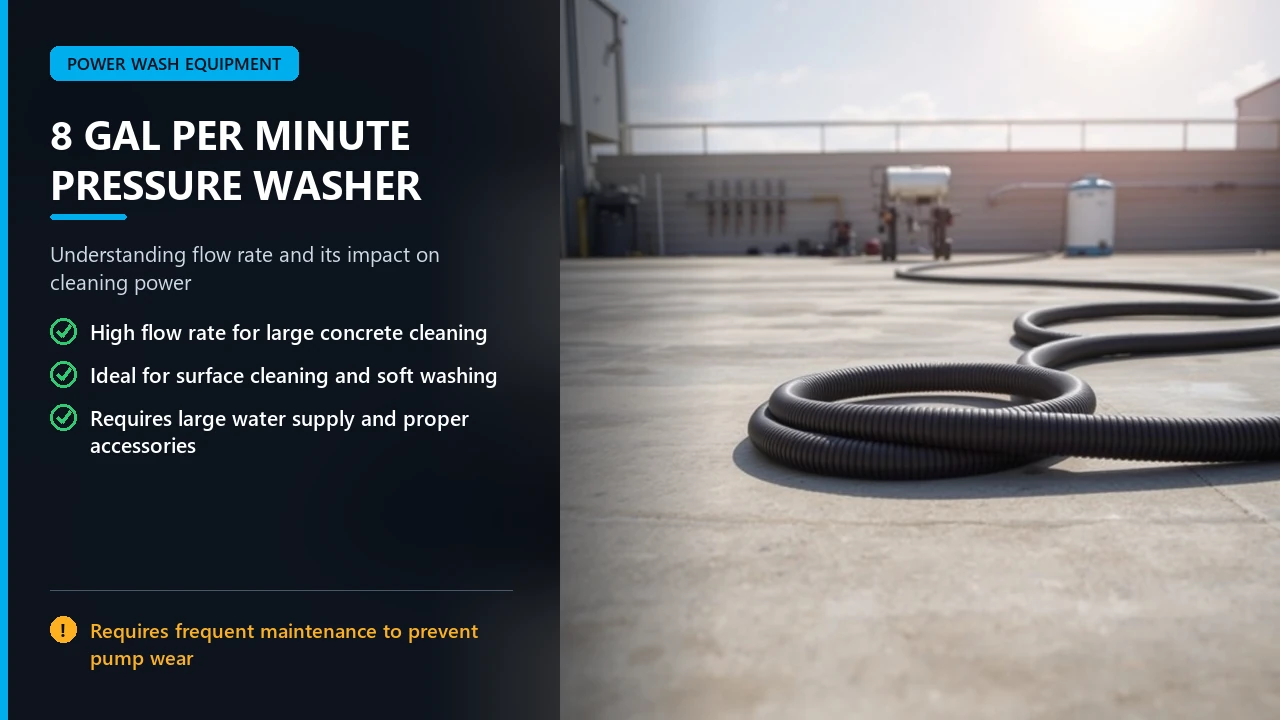
What 8 Gallons Per Minute Means
The flow rate, measured in gallons per minute, tells you how much water the machine pushes through the nozzle every minute. Flow is separate from pressure, which measures how hard the water hits. Together, pressure and flow define what a machine can do: pressure breaks the soil loose, and flow washes it away and rinses the surface.
Eight GPM is a lot of water. A typical electric homeowner washer produces around 1.2 to 1.5 GPM, and a decent gas residential machine reaches about 2.5 to 4 GPM. Commercial machines commonly run 4 to 6 GPM. At 8 GPM, you are using equipment built for professional crews who work large surfaces and cannot afford to go slow. Our foundational guide on what GPM means for pressure washer flow explains the concept, and the look at why flow often beats PSI alone makes the case for high flow.
| Category | Typical Flow | Who Uses It |
|---|---|---|
| Electric homeowner | 1.2–1.5 GPM | Light home cleaning |
| Gas residential | 2.5–4 GPM | Home and small jobs |
| Commercial mid-range | 4–6 GPM | Professional cleaning |
| High-flow machine | 8 GPM+ | Large areas, surface cleaning |
What an 8 GPM Machine Cleans
High flow shines wherever area and volume are the challenge, and there are several jobs where 8 GPM is a genuine advantage.
Large concrete surfaces clean dramatically faster when a high-flow machine drives a surface cleaner, the spinning attachment that covers a wide path in one pass. Soft washing for building exteriors and roofs relies on high flow and low pressure to rinse surfaces thoroughly after chemicals do the work. Fleet and commercial vehicle washing benefits from the rinsing power, especially on mud- and grime-covered trucks. Commercial property maintenance, including dumpster pads, sidewalks, and loading areas, is faster with high flow. And agricultural and equipment cleaning uses the volume to flush heavy soil from machinery.
| Job | Why 8 GPM Helps |
|---|---|
| Concrete and driveways | Runs surface cleaners at rated speed |
| Soft washing | Rinses exteriors gently and quickly |
| Fleet washing | Fast, thorough rinsing of large vehicles |
| Commercial pads and lots | Cleans big areas efficiently |
| Equipment and ag | Flushes heavy soil with volume |
The common thread is size. When the surface is large or the vehicles are many, flow saves time, and time is money for a professional. On a small car or a single patio, 8 GPM is more volume than the job needs, and a lighter machine is easier to handle and supply. Matching flow to work is the key decision.
It also helps to think in square feet. A lower-flow machine may clean a driveway in three slow passes, while an 8 GPM machine does it in one, which is a massive difference across a full day of work. On a large parking lot or a row of trucks, that gap compounds with every surface, and it is why professionals who work big areas treat flow as a production number, not just a specification. The same logic applies to rinsing: high flow removes detergent and loosened grime completely and quickly, so jobs finish cleaner with less rework.
The Water Supply Reality
The single biggest obstacle to using an 8 GPM machine is feeding it. Most residential water supplies cannot deliver eight gallons per minute, and a machine starved of water will not perform and may damage its pump.
A typical garden spigot might flow 4 to 6 GPM under real conditions, and shared plumbing can be worse. That is not enough for an 8 GPM machine running full out. The professional answer is a large onboard water tank, common on trailer rigs, usually a hundred gallons or more, so the machine always has the volume it needs. A buffer tank and feed pump can also keep a high-flow machine supplied by staging water in reserve even when drawing from a modest source.
If you plan to run 8 GPM from a fixed location, you need a high-capacity water source and a supply line sized to match, often three-quarter inch or larger. Plan the water side as carefully as the machine side, because a great machine on a weak supply is a constant frustration. Our guide on hose sizing for PSI and GPM helps you move that volume without choking the machine.
Machine Types and Configurations
An 8 GPM machine comes in several forms, and where it lives affects how well it works.
Most 8 GPM machines are gasoline-powered, since the flow requires a strong engine. They appear as trailer-mounted rigs with a tank and hose reels, as skid-mounted units that drop into a truck bed or trailer, and as loose machines to build a custom setup around. Cold water versions handle concrete and general cleaning, while hot water versions add a burner to cut grease for fleet and industrial work.
| Setup | Advantages | Best For |
|---|---|---|
| Trailer-mounted | Complete, mobile, carries water | Professional cleaning crews |
| Skid-mounted | Flexible, fits truck or trailer | Custom builds, contractors |
| Hot water | Grease removal plus high flow | Fleets, industrial, food sites |
| Cold water | Simpler, lighter, cheaper | Concrete, general big-area work |
For most professional use, a trailer-mounted machine makes the most sense because it solves the water supply problem at the same time. If you already have a truck and trailer, a skid-mounted unit gives you flexibility to build the rig you want. The engine and pump pairing matters as always: an 8 GPM pump needs an engine capable of driving it, and a quality triplex pump is essential for reliability at this flow. Trading resources such as the Cleaning Equipment Trade Association and manufacturer data from General Pump and Cat Pumps help you match pump to engine and understand ratings.
Nozzles, Hoses, and Attachments
High flow only delivers results if the whole water path is sized to carry it.
Nozzle size must match the machine’s pressure and flow. An undersized nozzle raises pressure dangerously and strains the engine, while an oversized nozzle weakens the spray. Correctly sized nozzles keep the machine running at its rated output. For high-flow machines, surface cleaners, turbo nozzles, and soft wash injectors must all be rated to handle at least eight gallons per minute, or they underperform and leave stripes or uneven results.
Hoses must be large enough to move the volume without restriction. Undersized hose chokes flow and wastes the machine’s capacity, so high-flow rigs use generous hose sizes and fittings that do not restrict the path. Every fitting, swivel, and quick-connect adds a potential bottleneck, so keep the water path clean and generously sized from tank to nozzle. Our guide on a power washer 8 GPM that saves hours explores how flow, nozzles, and attachments work together to speed up cleaning.
Sizing a Surface Cleaner to 8 GPM
Surface cleaners are the attachment most affected by flow, and choosing the right one is where 8 GPM pays off most.
A surface cleaner is rated for a flow range, and it performs best when the machine can feed it within that range. Put an 8 GPM machine behind a cleaner rated for that flow and it glides across concrete, cleaning a wide path in a single pass without striping. Feed the same cleaner with a low-flow machine and it hesitates, leaves swirl marks, and forces multiple slow passes. The cleaner and the machine must match.
For a high-flow machine, look for a surface cleaner rated to handle eight gallons per minute or more, with a good swivel, durable casters, and a deck sized for efficient coverage. Turbo nozzles similarly need to match the flow to spin properly and clean concrete faster. When the machine, the spray tip, and the cleaner are all correctly matched, high flow delivers its full benefit: fast, even, streak-free flat surface cleaning. That is the payoff that makes 8 GPM worth the water it consumes.
8 GPM vs Lower Flow: Choosing by Job Size
The decision between an 8 GPM machine and a lower-flow machine comes down almost entirely to the size of your jobs and your ability to supply water.
A 4 GPM machine runs happily from many residential supplies and a modest tank, and it handles a wide range of professional work. Doubling the flow to 8 GPM roughly doubles the water consumed and the speed on large surfaces, but it also roughly doubles the demand on your supply, tank, and hoses. The machine may not cost twice as much, but the complete rig around it grows, because everything touching water must be upsized to match.
For a cleaner who mostly washes driveways, small vehicles, and modest commercial locations, a 4 to 6 GPM machine is often the smarter buy, offering strong performance without the supply burden. For a cleaner who specializes in large concrete, fleets, and soft washing over big areas, 8 GPM turns hours of work into minutes and justifies the whole rig around it. The decision is less about which machine is better and more about which flow matches the jobs you book. Our comparison in the 8 GPM setup for soft washing and big jobs shows where the higher flow earns its place.
Engine and Pump Pairing at 8 GPM
High flow puts real demands on the engine and pump, and a mismatched machine will not deliver its rated performance.
The engine must produce enough power to drive a pump that moves 8 GPM at the machine’s rated pressure, and a quality commercial engine is essential. Common choices include commercial Honda and comparable engines built for continuous duty. A consumer engine may run the machine for a while but will not hold up to daily professional use at this output. The pump should be a triplex design with ceramic plungers, serviceable valves, and a proper unloader, since triplex pumps handle high flow and pressure far better than budget axial pumps and last much longer.
The drive system matters too. Belt drive isolates the pump from engine heat and vibration, runs cooler, and typically extends pump life, which is why serious high-flow machines favor it. Direct drive is simpler and cheaper but punishes the pump with heat and vibration. For a machine that runs all day, the belt-drive, triplex-pump combination is what turns an 8 GPM rating into years of reliable service. As always, judge the engine and pump as a pair, because the weakest link sets the machine’s real capability.
Setting Up and Running an 8 GPM Rig
Once you own an 8 GPM machine, how you set it up determines whether it delivers.
Start with water. Fill your tank or confirm your supply before every job, and connect with hose sized to move the volume without restriction. Confirm the pump is primed and receiving full flow before you pull the trigger, and watch the tank level on long jobs so you never run dry. Route hoses so nothing kinks or pinches, because a restriction starves the pump and robs performance. Check the surface cleaner, nozzles, and injectors are rated for the flow, then clean in steady passes for even results.
Work efficiently by planning the job around the machine’s strength: large areas in steady passes with a surface cleaner, soft washing with the right injector and gentle pressure, and rinsing with the flow the machine provides. Lock wheels, control the gun, and keep the spray on the surface. A high-flow machine rewards an organized operator with speed that lower-flow machines simply cannot match. Treat the rig as the production tool it is, and the flow will show up as finished jobs and satisfied customers.
Cost and Who Should Buy
An 8 GPM machine is a significant investment, so deciding whether it fits your work matters more than the price tag.
Costs include the machine, and usually a trailer and tank to feed and move it, plus hoses, reels, surface cleaners, and nozzles. A complete high-flow rig is a real capital outlay, which is why it is normally bought by businesses that bill for cleaning. For a professional, the payback comes from speed: if an 8 GPM machine and a surface cleaner cut a job from six hours to three, the machine pays for itself quickly in labor and in extra jobs per week.
An 8 GPM machine is worth it if you clean large surfaces or fleets professionally, work where high volume saves meaningful time, and can supply the water it needs. It is not worth it for light home use, small patios, or washing a single vehicle, where a lower-flow machine is cheaper, easier to feed, and simpler to handle. Buy for the work you actually sell, and the flow will earn its keep.
Maintaining a High-Flow Machine
High-flow machines work hard, and maintenance protects the investment.
Confirm a solid water supply before every job and never let the pump run dry. Clean the inlet filter regularly, since debris that starves a high-flow pump causes immediate damage. Change engine oil and service the pump on schedule, keep hoses and fittings in good condition, and replace any worn hose before it bursts. If the machine has a hot water heater, winterize it thoroughly and service the burner so it holds temperature. Store the rig properly and drain the system before freezing weather.
Because these machines see heavy use, maintenance is not optional, but it is straightforward. A well-kept 8 GPM machine runs for years and holds its value, while a neglected one fails at the worst moment. Treat oil changes, filters, and hose inspections as part of the job, and the machine will keep producing.
Frequently Asked Questions
What is an 8 gal per minute pressure washer used for? It is used for large concrete, surface cleaning, soft washing, fleets, commercial properties, and equipment, where high flow cleans and rinses much faster than typical machines.
Is 8 GPM the same as a high-flow pressure washer? Yes. Eight gallons per minute is a high flow rate, well above residential machines, and it is typical of professional equipment built for large-area cleaning.
What water supply does an 8 GPM machine need? It needs about eight gallons per minute, which most residential spigots cannot deliver. Professional setups usually use a large onboard tank or a reserve tank and feed pump.
Can I feed an 8 GPM washer from a garden hose? Only if the supply reliably delivers enough flow at pressure. Most spigots cannot, so a buffer tank or trailer tank is the reliable choice for professional use.
How much water does 8 GPM use per hour? At full flow it uses around 480 gallons per hour, which is why a large tank or high-capacity source is essential. Plan water for the full job plus a margin.
Is 8 GPM too much for home use? Usually yes. It is overkill for light home jobs and hard to supply. It makes sense for professional cleaners who work large areas and bill for their time.
Do I need a surface cleaner with an 8 GPM machine? A surface cleaner is one of the best uses of high flow and will transform concrete cleaning. Choose one rated for at least eight gallons per minute so it runs at its designed speed.
What pressure should pair with 8 GPM? Many high-flow machines run around 3,000 to 4,000 PSI, which balances pressure and volume well. The right combination depends on your jobs, but extreme pressure is not required to benefit from high flow.
Can an 8 GPM pressure washer soft wash? Yes, and high flow is ideal for soft washing, delivering plenty of water to rinse siding, roofs, and exteriors gently after chemicals do the work.
What engine powers an 8 GPM pressure washer? High-flow machines typically use commercial gasoline engines built for continuous duty, often Honda or comparable commercial models, paired with a triplex pump capable of moving eight gallons per minute.
Is 8 GPM good for commercial cleaning? Yes. High flow is a major advantage for commercial work like large concrete, parking lots, fleets, and property maintenance, where it cleans far faster than lower-flow machines.
Final Thoughts
An 8 gal per minute pressure washer is a high-flow tool built around volume. It cleans large surfaces dramatically faster than typical machines, feeds surface cleaners and soft wash systems the way they were designed to run, and rinses with speed that turns slow jobs into quick ones. For a professional, that speed translates directly into income.
The tradeoff is water. Feeding eight gallons per minute demands a tank or a serious water source, plus hoses, nozzles, and attachments sized to match. Plan the water side as carefully as the machine, respect the flow requirements, and maintain the rig, and an 8 GPM machine will pay for itself many times over. If your work is large and professional, the flow is worth every gallon it moves.