If you have ever shopped for a pressure washer, you have seen two numbers everywhere: PSI and GPM. PSI gets most of the attention, but GPM is just as important, and understanding the GPM meaning on a pressure washer is key to choosing the right machine and getting the performance you expect. GPM stands for gallons per minute, and it measures how much water a pressure washer delivers, which drives cleaning speed, rinsing, and the ability to run tools like surface cleaners. Many buyers overlook GPM and end up with a machine that cleans more slowly than they hoped. This guide explains what GPM means on a pressure washer, why it matters, how it works with PSI, and how to choose the right flow for your cleaning.
What GPM Stands For
The letters are simple, but the meaning matters.
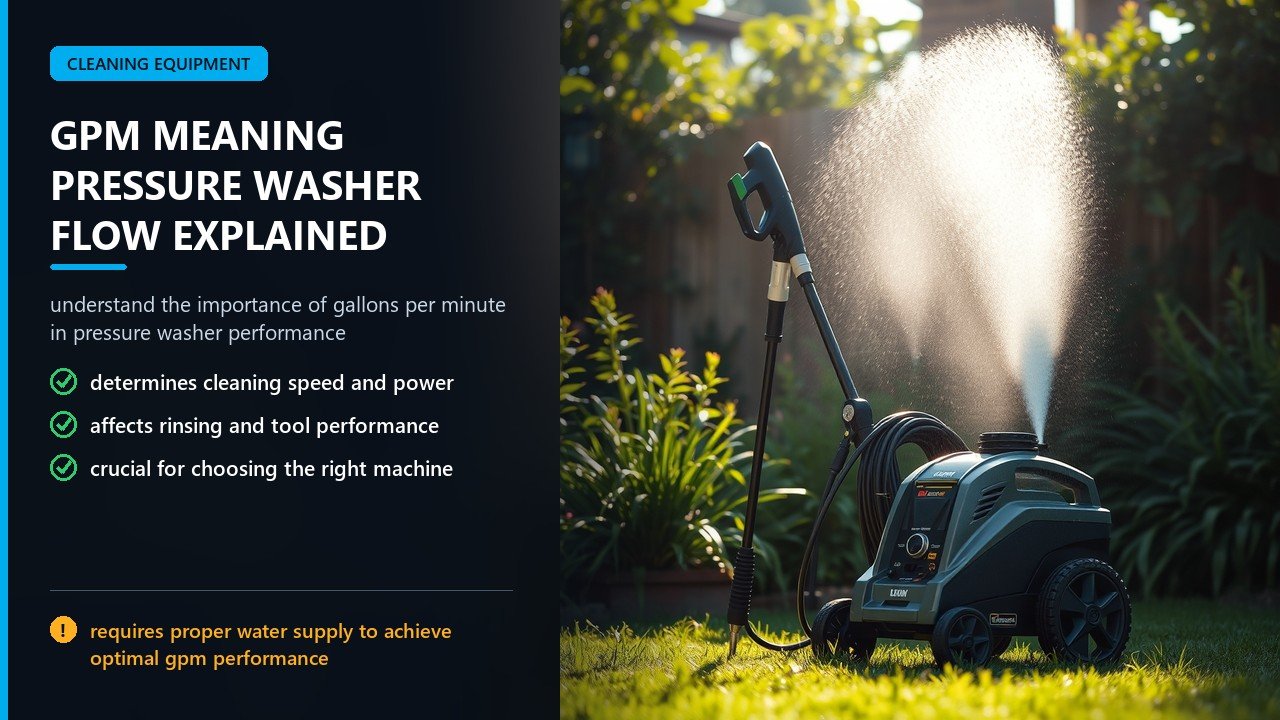
GPM stands for gallons per minute, and on a pressure washer it is the measure of how many gallons of water flow through the machine each minute. It describes the volume, or flow rate, of water, as opposed to PSI, which describes the pressure, or force, of the water. A machine rated at 2 GPM delivers two gallons of water each minute, while a 4 GPM machine delivers four. GPM tells you how much water you have to work with, which affects how quickly you can clean and rinse surfaces, and it is a fundamental specification alongside pressure.
GPM is sometimes listed as a maximum rating and sometimes as a rated or working figure, and the two can differ, so it is worth checking which number a manufacturer advertises. The engine or motor, the pump, and the nozzle all affect the actual flow, and a machine may deliver less than its maximum during normal use. Knowing this helps you compare machines fairly and understand what flow you will actually get. So GPM, while simply meaning gallons per minute, has nuances in how it is rated and delivered.
Understanding what GPM stands for and how it is rated sets the foundation. Because it measures the volume of water flow, and because its rating can vary, knowing the meaning helps you interpret specs and choose wisely. This simple definition, combined with the nuance of ratings, lets you read pressure washer specifications accurately and understand what the numbers tell you about performance. With this grounding, the question of why GPM matters and how it works with pressure becomes clearer, guiding your choice of machine. Our guide to pressure washer components explains the parts that create flow.
Why GPM Matters
Flow drives speed, rinsing, and tool performance.
GPM matters because flow determines how quickly a pressure washer cleans and rinses. More water per minute means the machine covers surfaces faster and carries away dirt and detergent more effectively, so a higher-GPM machine cleans large areas in less time. Flow is especially important for cleaning big flat surfaces like driveways, where the machine’s coverage rate depends on flow, and for rinsing, where more water removes grime and soap quickly. This is why professionals favor higher-flow machines even when pressure is similar, since the flow makes them more productive.
Flow also determines whether a machine can run tools like surface cleaners, which rely on a sufficient flow to spin their nozzles and clean evenly, and it affects how far a machine can effectively work. A machine with high pressure but low flow may have strong force but deliver little water, making it slow on large areas and weaker at rinsing, while a machine with good flow cleans faster and more thoroughly. So GPM is not a minor specification; it directly shapes how the machine performs in real use.
Recognizing why GPM matters changes how you evaluate machines. Because flow drives speed, rinsing, and tool performance, it is as important as pressure, and ignoring it can lead to a slow machine that disappoints on large jobs. Understanding its role helps you weigh GPM alongside PSI and choose a machine whose flow matches your work. This perspective prevents the common mistake of focusing only on pressure, and it sets up the comparison of the two specifications. Our guide to 5gpm pressure washer shows a high-flow example in practice.
GPM Versus PSI
The two specifications work together.
PSI measures pressure, the force of the water, which addresses how forcefully the stream hits a surface and how well it breaks up tough grime, while GPM measures flow, the volume of water, which addresses how much water is delivered and how quickly a surface is cleaned and rinsed. Together they define the machine’s cleaning power, and neither alone tells the full story. A high-PSI, low-GPM machine has force but little volume, suited to precision cleaning but slow on large areas, while a high-GPM, moderate-PSI machine has volume and cleans large areas quickly, though its lower pressure may struggle with the toughest grime.
Cleaners sometimes use a rough measure called cleaning units, the product of PSI and GPM, to compare overall cleaning power, though it is a simplification. A machine with 3,000 PSI and 4 GPM would have 12,000 cleaning units, while one with 2,000 PSI and 2 GPM would have 4,000, suggesting the former is more capable overall, which typically holds. This measure highlights that both numbers contribute, and it helps explain why a balanced machine can outperform one that maximizes only pressure. So GPM and PSI are partners, and the best machine balances them for the task.
The relationship between GPM and PSI is central to understanding pressure washers. Because pressure provides force and flow provides volume, and because cleaning power reflects both, the two specifications must be considered together, and the cleaning-units measure illustrates their combined effect. A machine with good flow and adequate pressure is versatile and productive, while one that maximizes pressure at the expense of flow may be slower. Understanding this helps you interpret specifications and choose a balanced machine. Our guide to what is the best psi for pressure washer covers the pressure side of the equation.
| Term | Meaning |
|---|---|
| PSI | Pounds per square inch, the pressure or force of the water |
| GPM | Gallons per minute, the flow or volume of water |
| Cleaning units | Roughly PSI x GPM, an overall cleaning power estimate |
This table summarizes the key terms, showing that PSI is pressure and GPM is flow, and that cleaning units combine them. Understanding these terms lets you read pressure washer specifications and compare machines meaningfully, rather than fixating on one number. The balance of pressure and flow is what determines whether a machine suits your tasks, and GPM, as the flow component, is essential to that balance.
How to Read GPM Specs
Reading the ratings correctly avoids surprises.
Pressure washer GPM is often advertised as a maximum, which the machine may achieve only under ideal conditions, while the working or rated GPM, delivered during normal use, is typically lower. This is similar to PSI, which is also often a maximum. So when comparing machines, look for the rated or working figures, or understand that the maximum is the peak. Some manufacturers list both, and reviews and specifications can clarify the real-world numbers. Knowing this helps you compare fairly and set expectations.
The nozzle also affects the delivered flow and pressure, since the orifice size determines how the machine’s output is used, and a nozzle mismatched to the flow can alter performance. Similarly, the water supply must be adequate to deliver the rated flow, since a restricted supply reduces the actual flow and starves the pump. So the advertised GPM depends on the machine and the setup, and the real flow requires a matching nozzle and an adequate water source. Understanding these factors lets you interpret GPM specs accurately.
Reading GPM specs correctly is important for choosing a machine and setting it up. Because the advertised figure is often a maximum and the actual flow depends on the nozzle and water supply, understanding the ratings prevents disappointment and helps you match the machine to your setup. This knowledge also helps you avoid starving the pump or misjudging performance. With accurate interpretation of GPM, you can compare machines and plan your water supply, ensuring the flow you need. Our guide to nozzle size for pressure washer covers how the nozzle affects flow and pressure.
Choosing the Right GPM
Match the flow to your cleaning tasks.
Choosing the right GPM depends on what you clean. For light home tasks like washing a car or cleaning patio furniture, a lower flow of around 1.5 to 2.5 GPM is sufficient, and it is easier on the water supply. For heavier home cleaning like driveways, decks, and siding, a flow of around 2.5 to 4 GPM cleans faster and handles larger areas better. For commercial and professional work, large surfaces, and running surface cleaners, higher flows of 4 to 5 GPM or more are favored, since they deliver the speed and volume that demanding jobs require.
Alongside flow, consider your water supply, since a high-GPM machine needs a correspondingly strong source, and a machine whose flow exceeds your supply will starve and underperform or be damaged. For home use, a standard faucet handles lower flows, while higher flows may need a tank or buffer system. So the right GPM balances your tasks with your water supply, and choosing a machine whose flow matches both ensures good performance. Weighing tasks and supply together leads to the right choice.
Choosing the right GPM is a matter of matching flow to work and supply. Because different tasks need different flows, and because the water supply must support the flow, selecting a GPM that fits your cleaning and your water source gives you a machine that performs well. For light tasks, lower flow suffices; for heavy or commercial work, higher flow pays off, provided the supply can deliver it. Understanding these factors lets you choose the right GPM and avoid both undersized and oversized machines. Our guide to 8gpm pressure washer covers a very high flow for demanding work.
GPM and Water Supply
Flow requires a supply that can keep up.
Because GPM measures how much water the machine draws each minute, the water supply must deliver at least that much continuously, or the machine will be starved of water and the pump will cavitate, which causes damage over time. A typical household faucet may supply around 4 to 8 GPM depending on the home and plumbing, but shared use, long hoses, and restrictions can reduce this, so a machine’s flow must be matched to the actual supply at the machine. For higher-GPM machines, especially those over 4 GPM, a standard faucet may be insufficient, requiring a tank or buffer system.
To support a machine’s flow, consider the supply’s capacity and the pressure available, since adequate pressure pushes the water to the machine, and use a short, large-diameter hose and remove restrictions like splitters or narrow fittings, which reduce flow. For a high-GPM machine, a water tank with a transfer pump or a buffer tank ensures the pump always has water even when the supply fluctuates. Managing the water supply is thus essential to realizing the machine’s rated GPM, and ignoring it is a common cause of poor performance and pump damage.
The connection between GPM and water supply is practical and important. Because the machine draws its rated flow continuously, the supply must keep up, and the setup, from hose diameter to the use of a buffer tank, affects whether the flow is delivered. Understanding this ensures the machine performs at its rated GPM and protects the pump, and it helps you plan the water system for higher-flow machines. With a matching supply, the machine delivers its flow and cleans as expected. Our guide to water tank and pressure washer covers supply systems for higher flow.
Real-World GPM Examples
Seeing flow in context clarifies its effect.
A light electric pressure washer rated at about 1.2 to 1.5 GPM, like many homeowner machines, cleans a car or patio furniture well but is slow on a large driveway, since its low flow covers less ground per minute. A mid-range machine at around 2 to 3 GPM handles most home tasks, cleaning decks, siding, and moderate driveways at a reasonable pace, and it works within a typical faucet’s supply. A high-flow machine at 4 to 5 GPM or more cleans large driveways, parking areas, and fleets quickly, running surface cleaners effectively, but it needs a strong water supply, often a tank.
These examples show how flow shapes practical performance. The difference between a 1.5 GPM machine and a 4 GPM machine on a large driveway is striking, with the higher-flow machine finishing in a fraction of the time, which is why professionals prioritize flow. At the same time, the higher-flow machine demands more water, illustrating the trade-off. Understanding these real-world differences helps you choose a GPM that matches the size and pace of your cleaning, whether you want a light machine for occasional car washing or a high-flow machine for large areas.
Real-world examples make the meaning of GPM concrete. Because the same task takes very different times depending on flow, and because higher flow demands more water, the examples clarify how GPM affects the cleaning experience. This helps you match the machine to your tasks and expectations, avoiding a machine that is too slow or that overreaches your water supply. With a realistic view of flow in practice, you can choose a GPM that delivers the speed and results you want. Our guide to 8 gpm power washer covers an extreme high-flow example.
Common GPM Misconceptions
Clearing up myths helps you choose better.
A common misconception is that PSI alone determines cleaning power, while GPM is secondary, but in reality flow is equally important, especially for speed and rinsing, and a low-flow machine can disappoint on large areas despite high pressure. Another is that a higher GPM is always better, when in fact a machine whose flow exceeds your water supply will underperform or be damaged, and higher flow also means more water consumption. So more GPM is better only when matched to the work and the supply.
Some buyers also assume the advertised GPM is what they will always get, when it is often a maximum and the actual flow depends on the nozzle and supply. Others believe they can simply use a larger nozzle to get more flow, when the machine’s pump and engine determine the flow and a mismatched nozzle only changes how the pressure and flow are applied. Understanding these misconceptions prevents the mistakes that lead to disappointing performance, and it encourages a balanced view of pressure and flow, matched to the task and the supply.
Correcting misconceptions improves choices. Because flow matters as much as pressure, because more GPM is only better when matched to work and supply, and because advertised figures are often maximums, a clear understanding of GPM prevents the errors that cause poor performance. This knowledge helps you evaluate machines realistically and plan your setup. With an accurate grasp of GPM, you avoid the pitfalls and select a machine whose flow truly fits your cleaning. Our guide to nozzle size for pressure washer clarifies how nozzles interact with flow and pressure.
Frequently Asked Questions About GPM Meaning on a Pressure Washer
What does GPM mean on a pressure washer? GPM stands for gallons per minute, the volume or flow rate of water the machine delivers. It measures how much water flows per minute, which drives cleaning speed and rinsing, alongside PSI, which measures pressure.
What is more important, PSI or GPM? Both matter. PSI provides the force to break up grime, while GPM provides the volume to clean and rinse quickly. For large areas, flow is very important, so consider both together rather than one alone.
What is a good GPM for a pressure washer? It depends on the task. Around 1.5 to 2.5 GPM suits light home cleaning, 2.5 to 4 GPM handles heavier home jobs, and 4 to 5 GPM or more suits commercial and large-area work. Match it to your tasks and water supply.
Does higher GPM clean better? Higher GPM cleans faster and rinses better, especially on large areas, but it needs a strong water supply and a capable pump. Combined with adequate pressure, higher flow improves productivity.
Why is my pressure washer GPM lower than advertised? The advertised figure is often a maximum, and the actual flow depends on the nozzle and water supply. An undersized supply or a mismatched nozzle can reduce the real flow below the rating.
How do GPM and PSI relate to cleaning power? Cleaning power roughly reflects the product of PSI and GPM, sometimes called cleaning units. A balance of good pressure and good flow generally cleans better than maximizing only one.
Final Verdict on GPM Meaning on a Pressure Washer
GPM on a pressure washer stands for gallons per minute, the flow or volume of water the machine delivers. It works with PSI, the pressure, to determine cleaning power, speed, and rinsing ability, and it is just as important as pressure when choosing a machine. Higher GPM cleans large areas faster and rinses better, while lower GPM suits light tasks and easier water supply.
Read the specs carefully, since GPM is often a maximum, and match the flow to your tasks and your water source, using the nozzle and setup to ensure the machine delivers its rated flow. By considering GPM alongside PSI and balancing the two for your cleaning, you choose a machine that performs as you expect. Understanding the meaning of GPM is the key to reading pressure washer specs and getting the flow your work needs.