Flow is the number that separates a residential pressure washer from a commercial one, and eight gallons per minute is where that separation becomes dramatic. An 8 GPM Honda pressure washer moves four to eight times the water volume of a typical homeowner machine, and that volume, not the pressure headline, is what makes it a professional’s tool. It rinses a sidewalk in a single pass, strips a fleet of trucks without endless dwelling, and keeps pace with a crew that cannot afford to wait. It is also a machine that demands a real water supply, a serious engine, and an operator who understands why flow matters. Buyers who look only at PSI often wonder why an 8 GPM machine costs so much more than a 4,000 PSI unit, and the answer is in the gallons. This is a machine built for volume and speed, and understanding what that means is essential before committing to one.
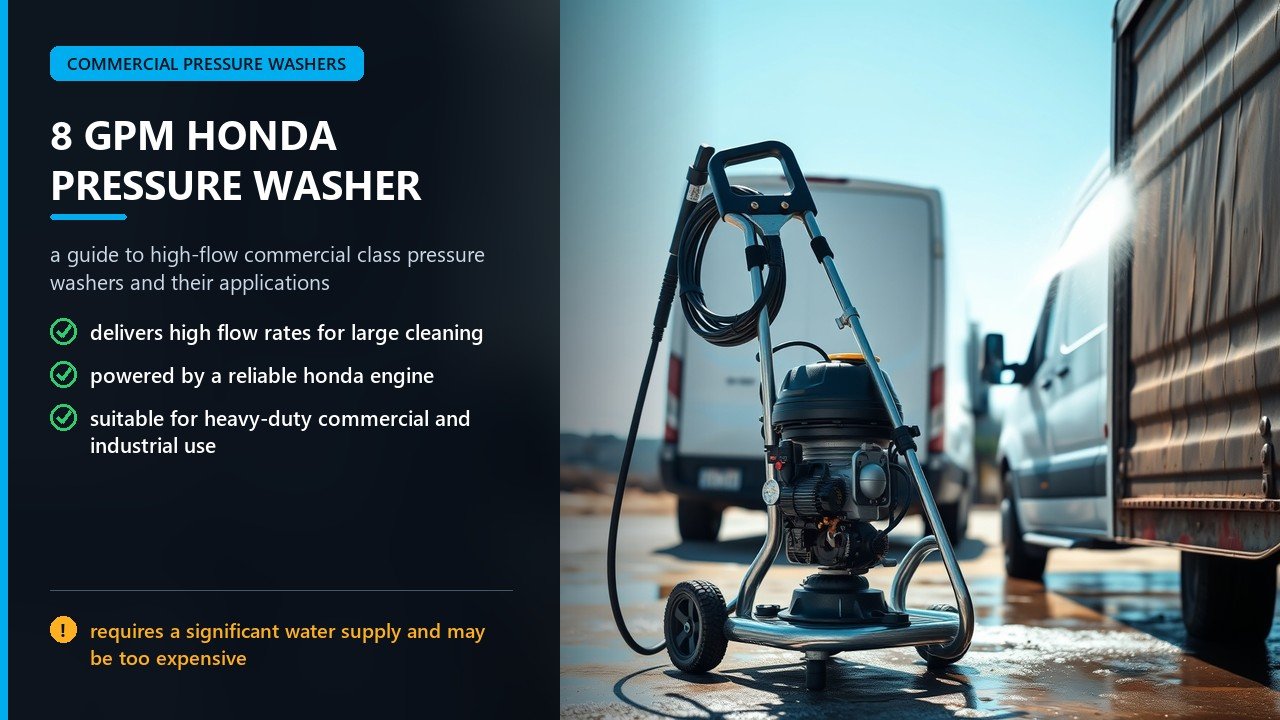
An 8 GPM Honda pressure washer is a high-flow gas pressure washer delivering roughly eight gallons per minute, typically at a pressure in the 3,000 to 4,000 PSI range, powered by a Honda engine, usually paired with a triplex pump and often belt-driven. It sits in the commercial to industrial class, above the residential machines and above many prosumer units. This guide explains what eight gallons per minute means in cleaning terms, why a Honda engine is favored for this duty, the pump and drive arrangements that support such flow, the water supply requirements such a machine imposes, the jobs it is built for, how it compares with lower-flow machines, what to consider before buying, and the maintenance a high-flow machine demands.
What 8 GPM Really Means
The gallons figure describes speed, and understanding it explains the machine’s price and purpose.
Flow is cleaning speed. Pressure strips dirt, but flow carries it away and determines how fast a surface is covered, so a machine with more flow cleans more area in less time. Eight gallons per minute is a commercial-grade volume that turns long jobs into short ones. Our guide to how flow works explains the relationship.
Cleaning units at 8 GPM. The product of pressure and flow, the cleaning-unit figure, is enormous at 8 GPM. An 8 GPM, 3,500 PSI machine produces around 28,000 cleaning units, roughly four times a 4 GPM, 3,500 PSI machine, which is why its speed advantage is so pronounced. Our guide to cleaning units covers the measure.
Why pros pay for flow. A commercial cleaner bills by the job, so time is money, and a machine that finishes a driveway in a third of the time directly increases profit. The higher price of an 8 GPM machine is an investment in speed, which is why professionals buy flow over pressure. Our commercial guide covers the economics.
Where pressure still matters. An 8 GPM machine does not necessarily have higher pressure than a smaller one; its advantage is volume. Pressure is still needed to strip stubborn dirt, so a high-flow machine pairs a strong pressure with its high flow for maximum effect. The two working together make the class so capable. Our pressure guide covers the pairing.
Why a Honda Engine for 8 GPM
Driving a high-flow pump takes real power, and the engine choice reflects that demand.
The power requirement. An 8 GPM pump at working pressure consumes substantial horsepower, far more than a residential machine’s engine provides, so the engine must be large enough to drive the pump without bogging under load. A Honda engine in the right displacement delivers that power reliably. Our guide to the Honda GX engine covers the commercial side.
Honda’s commercial reputation. Honda’s larger GX-series engines are the commercial standard for their durability, easy starting, fuel economy, and parts support, which matters for a machine that runs hard and often. A pro cannot afford an unreliable engine, and Honda’s record is why it dominates the class. Our guide covers the engine’s reputation.
The GX engine and high-flow pumps. Machines at 8 GPM commonly pair a Honda GX engine with a triplex pump, a combination built for continuous commercial duty. The engine and pump must be matched so the engine can drive the pump’s demand across its flow range. Our guide covers the pairing.
Electric start and convenience. High-flow machines often feature electric start given their engine size, and a reliable Honda engine starts readily on either system. For a commercial operator, quick, reliable starting is a working necessity. Our starting guide covers the routine.
Support and service. Honda’s widespread dealer and parts network means a commercial machine can be serviced quickly, minimizing downtime that costs a business money. The support network is part of the engine’s value. Our engine oil guide covers the maintenance.
The Pump and Drive Arrangement
An 8 GPM machine’s pump and drive are built for sustained high flow.
Triplex plunger pump. High-flow commercial machines use triplex plunger pumps, which are efficient, rebuildable, and built for continuous duty, unlike the axial cam pumps of residential units. A triplex pump can deliver 8 GPM reliably and be rebuilt when worn, extending the machine’s life. Our guide to pump types covers the difference.
Belt drive versus direct drive. High-flow pumps are often belt-driven, which isolates the pump from engine heat and vibration, allows the pump to run at its ideal speed, and makes the pump easier to service. Belt drive is common in commercial machines for these reasons. Our frame guide covers the arrangements.
Serviceable oil and rebuildability. A commercial triplex pump has a serviceable oil reservoir and rebuildable parts, so it is maintained rather than replaced, which lowers the cost of ownership over years of hard use. Our pump oil guide covers the service.
Unloader and pressure control. A high-flow machine has an unloader valve that manages pressure when the trigger is released, protecting the pump and the system. At 8 GPM the unloader handles significant flow, so it must be correctly set and maintained. Our pressure troubleshooting guide covers the component.
Matching engine, pump, and flow. The engine’s power, the pump’s displacement, and the machine’s rated flow are engineered together, so the pump delivers 8 GPM at the rated pressure with the engine driving it. This matched design is why the class performs as specified. Our buying guide covers the specifications.
The Water Supply Demands
An 8 GPM machine’s greatest practical constraint is feeding it, and the supply must be planned.
Eight gallons per minute is a lot of water. Most residential spigots deliver a fraction of that flow, so a garden hose alone often cannot feed an 8 GPM machine. The supply must be confirmed to deliver the flow, or the machine will starve and cavitate. Our guide to water supply covers the assessment.
Cavitation and starvation. If the supply cannot keep up, the pump pulls harder than the water arrives, causing cavitation, a damaging condition that sounds like gravel and wears the pump rapidly. A high-flow machine, more than any other, depends on an adequate supply to avoid this. Our pressure troubleshooting guide covers the symptom.
Buffer tanks. Many high-flow setups draw from a buffer tank rather than a spigot, using the tank to supply the machine’s demand while it refills from the source. A tank decouples the machine’s draw from the supply’s rate, which is how commercial rigs feed 8 GPM machines. Our guide to tank setup covers the buffer.
Large-diameter feed lines. The feed hose and fittings must be large enough to pass 8 GPM without restricting flow, so commercial rigs use generous feed lines and fittings. An undersized feed line chokes the machine regardless of the source’s capacity. Our suction hose guide covers the feed side.
Planning the job’s water. A high-flow machine consumes water quickly, so a commercial operator plans the supply, whether a large tank, a high-capacity source, or a refill strategy, before starting. Water planning is part of running this class. Our tank guide covers the capacity.
| Machine Class | Typical Flow | Supply |
|---|---|---|
| Residential electric | 1.2-1.5 GPM | Garden spigot |
| Residential gas | 2.5-3 GPM | Garden spigot |
| Commercial | 4-5 GPM | High-flow source or tank |
| High-flow commercial | 8 GPM | Tank or high-capacity source |
Jobs Built for 8 GPM
The class’s speed makes it worthwhile on specific commercial and heavy jobs.
Fleet washing. Washing trucks, vans, and heavy equipment in quantity is a natural fit, because the high flow rinses large surfaces quickly and keeps a fleet operation moving. Speed is the whole point. Our guide to vehicle washing covers the technique.
Large flatwork. Commercial lots, long driveways, and large plazas clean dramatically faster with an 8 GPM machine, especially paired with a surface cleaner, making the class ideal for concrete work at scale. Our surface cleaner guide covers the attachment.
Dumpster and container cleaning. Greasy, heavily soiled containers and dumpster pads yield to high volume and, with a hot water machine, heat, making this class suited to commercial sanitation. Our hot water guide covers the heated option.
Building washdown and hood cleaning support. Commercial washdown of buildings, loading docks, and similar surfaces benefits from the volume. The class handles large areas efficiently. Our siding guide covers the technique.
Municipal and industrial cleaning. Some municipal and industrial cleaning, including certain jetting support and washdown, uses high-flow machines for their volume, and the class scales to those demands. Our drain cleaning guide covers jetting.
Where it is overkill. For residential driveways, a single car, or a patio, an 8 GPM machine is more than needed, and its water demand and surface-damage potential make it a poor fit for casual use. The class is a professional tool. Our residential guide covers the smaller machines.
How It Compares With Lower Flow
The comparison clarifies when the high flow is worth its cost and demands.
Speed and productivity. Against a 4 GPM machine, an 8 GPM unit roughly doubles the cleaning speed at similar pressure, which for a professional translates directly into more jobs per day. The speed advantage is the class’s core value. Our commercial guide covers the productivity.
Cost. An 8 GPM machine costs substantially more than a residential or prosumer unit, reflecting the larger engine, triplex pump, and stronger frame. The price is an investment that a professional recovers through speed. Our buying guide covers the value.
Water and facility needs. The high flow demands a supply a residential machine does not, so the class requires tanks or high-capacity sources, which adds cost and complexity. A homeowner rarely has the supply. Our tank guide covers the requirement.
Weight and size. The larger engine, pump, and frame make an 8 GPM machine heavier and bulkier, usually a wheeled or trailer-mounted unit that is less portable than a residential machine. Portability gives way to capability. Our frame guide covers the construction.
Skill and surface risk. The high volume at pressure can damage surfaces more readily, so the class demands an experienced operator. The machine’s power is both its strength and its risk. Our beginner tips guide contrasts the residential machines.
Buying an 8 GPM Honda Machine
A few factors separate a sound commercial purchase from a costly mistake.
Confirm the real flow and pressure. Verify the machine’s rated GPM and PSI, and its cleaning-unit figure, rather than trusting a single headline number, because flow is the class’s defining spec. Our flow guide covers the comparison.
Check the pump’s quality and rebuildability. A high-flow machine lives or dies by its pump, so favor a reputable triplex pump with a serviceable oil reservoir and rebuildable parts. A rebuildable pump lowers long-term cost. Our pump oil guide covers the care.
Match the engine to the duty. Confirm the Honda engine is sized to drive the pump across its range and is the commercial GX series for hard use. The engine must hold up to continuous operation. Our GX guide covers the commercial engine.
Plan the water supply. Budget for the tank or high-capacity source the machine requires, because a high-flow machine without an adequate supply is a machine that starves. The supply is part of the purchase. Our tank guide covers the setup.
Consider the frame and mobility. A commercial machine’s frame and wheels must handle the weight and the jobsite, so favor a sturdy build, and consider a trailer or skid rig for heavy commercial use. The frame is part of the machine’s value. Our frame guide covers the build.
Support and parts. Buy where the engine, pump, and machine can be serviced locally, because commercial downtime is expensive and a supported machine returns to work faster. Our buying guide covers the support.
Maintaining a High-Flow Machine
An 8 GPM machine works hard, so maintenance is more demanding than on a residential unit.
Engine oil and service. Check the oil frequently and change it on the engine’s commercial schedule, using the Honda-specified grade, because a hard-working engine consumes and degrades oil faster. Our engine oil guide covers the choice.
Pump oil and rebuilds. Check and change the triplex pump’s oil on its schedule, because pump oil protects a valuable, rebuildable pump. A pump starved of oil fails early. Our pump oil guide covers the service.
Feed and cavitation checks. Confirm the water supply delivers the flow and the feed lines are unobstructed, since cavitation from a starved feed is the class’s most damaging condition. Our water supply guide covers the check.
Unloader and pressure settings. Maintain and correctly set the unloader, because at 8 GPM it manages significant flow and protects the pump from overpressure. Our pressure troubleshooting guide covers the component.
Belt drive service. On a belt-driven machine, inspect and tension the belts, which wear and slip with use, because a slipping belt robs the pump of drive. Our frame guide covers the drive.
Winterizing and storage. Drain the water before freezing weather, because a frozen high-flow pump is an expensive failure, and store the machine protected. Our winterizing guide covers the steps.
Building a Complete High-Flow Rig
An 8 GPM machine rarely stands alone; a professional rig wraps it in the support systems it needs.
A buffer tank. The rig’s foundation is a water tank that supplies the machine’s 8 GPM draw while refilling from the source, decoupling the machine’s demand from the supply’s rate. Sizing the tank to the job prevents mid-job starvation. Our guide to tank setup covers the sizing.
A feed line that passes the flow. From the tank to the pump, the suction line, strainer, and fittings must be large enough to pass 8 GPM without restriction, or the machine starves despite an ample tank. The feed path is as important as the source. Our suction hose guide covers the feed.
A reel and heavy-duty hose. A high-flow machine needs a hose and reel rated for its pressure and flow, with the diameter to carry 8 GPM without choking it, so the setup uses a generous hose on a reel built for commercial duty. Our 50-foot reel guide covers one option, with larger reels for longer runs.
A surface cleaner sized to the flow. Large flatwork pairs with a surface cleaner sized to the machine’s flow, so the attachment cleans at the machine’s speed rather than bottlenecking it. A properly sized surface cleaner multiplies the machine’s productivity. Our surface cleaner guide covers the match.
A refill and tank strategy. A commercial operator plans how the tank refills, whether from a spigot, a hydrant, or a water source, so the rig stays supplied through the job. Water logistics are part of running a high-flow machine. Our water supply guide covers the planning.
Trailer or skid mounting. For heavy commercial use, the machine and its tank are mounted on a trailer or skid so the rig is a self-contained cleaning unit. This is the form a high-flow machine takes when it works professionally. Our frame guide covers the construction.
Common Mistakes With This Class
Looking only at PSI. Flow defines this class. Judge a high-flow machine on its GPM and cleaning units.
Feeding it from a garden spigot. A spigot rarely supplies 8 GPM. Use a tank or high-capacity source or the machine starves.
Ignoring cavitation. Starvation damages the pump. Ensure the feed keeps up.
Cheaping out on the pump. A high-flow machine needs a quality, rebuildable triplex pump.
Using it on delicate surfaces carelessly. The high volume at pressure can damage surfaces. Respect the machine.
Neglecting engine and pump service. Hard commercial use demands frequent service. Keep oil fresh.
Storing it wet and freezing. Trapped water cracks the valuable, expensive pump. Winterize.
Frequently Asked Questions
What is an 8 GPM Honda pressure washer? A high-flow commercial gas pressure washer delivering about eight gallons per minute at commercial pressure, powered by a Honda engine, usually with a triplex pump and often belt-driven.
Why is 8 GPM special? Flow determines cleaning speed, and eight gallons per minute is a commercial volume that cleans large areas far faster than a residential machine, which is why professionals value it.
Can I run an 8 GPM machine from a garden hose? Rarely. Most spigots cannot supply 8 GPM, so the machine needs a buffer tank or a high-capacity source to avoid starvation and cavitation.
Is 8 GPM better than higher PSI? They measure different things. Flow cleans faster and pressure strips dirt harder, so a high-flow machine’s advantage is speed at a given pressure. Pros often prioritize flow.
What pump does an 8 GPM machine use? Typically a triplex plunger pump, which is efficient, rebuildable, and built for the continuous high-flow duty this class demands.
Is an 8 GPM machine good for home use? Usually not. Its high flow requires a supply most homes lack and can damage surfaces, so it is a professional tool, while a residential machine suits homeowner jobs.
Final Thoughts on the 8 GPM Honda Pressure Washer
The 8 GPM Honda pressure washer is defined by its flow, and that flow is what makes it a professional’s machine. Eight gallons per minute cleans large surfaces with a speed no residential unit approaches, and pairing that volume with a reliable Honda engine, a rebuildable triplex pump, and a sturdy frame produces a commercial tool built for fleets, flatwork at scale, and heavy washdown. The trade is a demand for a real water supply, a heavier and costlier machine, and an operator who respects the volume’s potential to damage surfaces.
Buy one for its flow and cleaning units rather than a pressure headline, favor a quality rebuildable pump and a commercial GX engine, and plan the tank or high-capacity source the machine requires before expecting it to perform. Keep the engine oil fresh and the pump serviced, guard against the starvation that causes cavitation, maintain the unloader and any belt drive, and winterize to protect the expensive pump. Choose the class for the work that justifies it, and an 8 GPM Honda machine delivers the speed and productivity that make high-flow cleaning pay, a professional tool earning its keep one large job at a time.