Marcus had run a mobile wash business for a year out of the back of an old truck, and he had one recurring headache. Every job needed water, and every job site did not have a spigot he was allowed to use. He spent mornings juggling whether a customer’s outdoor tap was close enough, long enough after someone ran the washing machine to get decent pressure, and strong enough to keep his machine from starving. The solution arrived as a polyethylene tank bolted to his trailer, sized to the flow his machine actually needed. It changed his week more than any machine upgrade had. He showed up with his own water, started immediately, and stopped apologizing to customers about where to plug in.
If you have ever tried to pressure wash somewhere without a tap, you already know the feeling. A pressure washing tank fixes that by making the water travel with the machine instead of hoping the site provides it. But a tank is not a simple box. It has to match your machine’s flow, be plumbed with the right ports, breathe properly, and be mounted so it does not turn your rig into a hazard or a swamp. This guide covers what a pressure washing tank actually does, the types available, how to size one, how to set it up the right way, and the mistakes that turn a useful upgrade into a recurring problem.
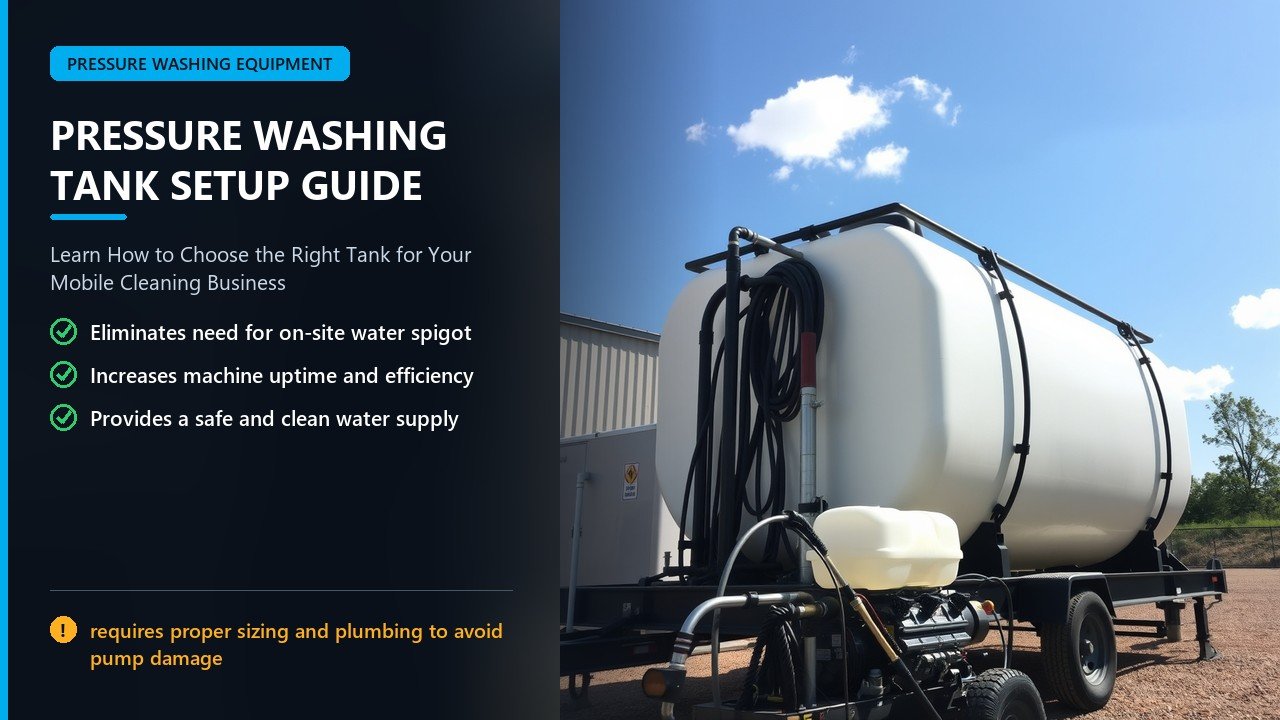
What a Pressure Washing Tank Actually Does
A pressure washing tank is a water reservoir that lets you clean without a municipal supply. It can simply hold the water so your machine draws from it, or it can act as a buffer tank that smooths out an inconsistent supply so the machine never starves. The second role is the one professionals rely on.
Pure holding tank. You fill it, open the drain, and the pump pulls from it. Gravity does the initial feeding. This works only if the tank outlet is well above the pump inlet and the flow is enough, which is often not the case. A heavy axial pump can out-demand a gravity feed and starve, so most real-world setups help the water along.
Buffer tank. A buffer tank sits between the water source and the machine. The source, whether a spigot, a hydrant, or a second tank, refills the buffer; the pump draws from the buffer. The buffer absorbs the difference between what the source provides and what the pump demands, so a weak spigot cannot starve the machine. This is the standard setup on mobile pressure washing rigs and the reason buffer tanks are sold in the sizes they are.
What it is not. A tank does not add pressure and it does not clean anything. It is a supply component. If the tank, the port plumbing, or the fill system is undersized, even a powerful pump will surge, cavitate, and wear out early. The tank protects the machine by protecting the feed.
The Main Tank Types
Pressure washing tanks come in a few configurations, and choosing the right one depends on where the water goes and how it gets there.
Vertical and horizontal feed tanks. Vertical tanks stand tall and drain from the bottom, which helps gravity feeding. Horizontal tanks lie low and are better for fitting under a trailer or in a truck bed, but they need internal baffles and the right pickup to feed well. Shape matters more than it seems, because pump pickup depends on water depth relative to the pump inlet.
Portable skid tanks. These are tanks on a small frame, sometimes with a pump and hose already mounted. They let you run a machine from the back of a truck without building a full trailer rig. A power washer with a water tank in this form is a complete mobile unit you can move with a forklift or a ramp.
Pillow and collapsible tanks. Flexible tanks that lie flat and fill with water, popular where space is tight or the tank must be removed when empty. They are cheaper than rigid tanks and reduce shipping and storage, but they need protection from sharp edges and careful strapping under load.
IBC totes and pressure vessels. Small operators occasionally repurpose a 275-gallon IBC tote for extra capacity. They are cheap and hold a lot, but they need a dedicated plumb and are not built for pressure. If they are ever pressurized, even slightly, they become a hazard. Keep them as gravity-fed reservoirs only.
| Tank Type | Capacity Range | Best For | Main Trade-Off |
|---|---|---|---|
| Vertical feed tank | 25 to 200 gal | Gravity-friendly mounting | Takes up height |
| Horizontal tank | 30 to 100+ gal | Low-clearance trailer rigs | Needs baffles and pickup care |
| Skid-mounted tank | 50 to 200 gal | Truck-bed mobility | Heavier to move |
| Pillow / collapsible | 30 to 100+ gal | Stowable, light duty | Needs protection and straps |
| IBC tote | 275 gal | Large fixed sites | Not for pressure, bulky |
Sizing a Tank to Your Machine
Tank sizing is really two questions: how much does the pump need per minute, and how much do you need per job.
Match the flow, not the shape. The pump draws water at its flow rate in gallons per minute. A machine that moves 3 GPM needs 3 gallons per minute feeding it, or it starves. The tank’s outlet, valves, and any transfer pump must handle at least the pump’s flow and preferably more. Our guide to pressure washer water tank sizing explains the flow math in detail.
Buffer volume in minutes. A useful rule is to size a buffer tank so the machine can run off it alone for a meaningful stretch, which smooths over any pause in the source supply. Many operators run 50 to 100 gallons as a practical middle ground for a 3 to 4 GPM rig, giving roughly fifteen to thirty minutes of buffer time.
Job volume in gallons. A rough estimate is one gallon per minute of run time. An hour of continuous washing is about 60 gallons. If you clean until the tank empties, know that number, because it also tells you refill scheduling. A 50-gallon tank at 3 GPM gives roughly fifteen minutes before it is dry; a 100-gallon tank roughly thirty.
| Machine Flow | Minutes per 50 Gal | Minutes per 100 Gal | Typical Rig |
|---|---|---|---|
| 2.5 GPM | 20 min | 40 min | Mid-size gas |
| 3 GPM | 16 to 17 min | 33 min | Common commercial |
| 4 GPM | 12.5 min | 25 min | Higher-flow gas |
| 5.5 GPM | 9 min | 18 min | Large commercial |
Feeding the Pump Properly
Getting water from the tank to the pump is where most mobile setups go wrong. The pump wants a smooth, steady, unrestricted supply.
Gravity feed rarely suffices. A pump inlet needs pressure and volume. Below a few feet of head, an axial pump can out-demand the feed and cavitate, which sounds like marbles rattling and damages seals. If your pump draws faster than gravity delivers, you must help it along.
Transfer pump when needed. A small 12-volt or powered booster pump moves water from the tank to the machine’s inlet with enough pressure to satisfy the pump. It adds a part to maintain, but it turns any tank into a dependable supply. When you build this, keep the lines short and oversized and filter the water so sediment does not reach the machine.
Keep the intake line big and straight. A long, narrow, or kinked intake line restricts flow just like a small hose. Use a short, large-diameter pickup, place the tank outlet high, and never let the pickup suck air.
The pickup detail. A pickup tube that floats or stays near the surface can draw air as the tank empties. A weighted pickup at the bottom gets the last usable gallons, and a clear tube lets you watch the level. Watch the gauge on any tank setup so you know when to refill before the pump sucks air.
Plumbing and Ports That Matter
A tank is only as good as its fittings. The right ports and valves prevent leaks, air, and frustration.
Fill port. A wide fill opening makes filling fast and gives you access for cleaning. Some tanks have a screened fill that filters debris as it goes in, which protects the pump.
Draw and return port. The outlet that feeds the pump must be sized for flow and placed at the lowest practical point of the tank so you use the full capacity. A ball valve gives you shutoff for service.
Overflow and drain. An overflow keeps the tank from pressurizing if it overfills, and a low drain makes winter and spring cleaning easy. Both are small ports with big jobs.
Pressure and vacuum relief. A vented cap or a dedicated vent at the top lets air in as water leaves so the tank cannot collapse under vacuum. Never run a rigid tank sealed airtight. If any part of the system can pressurize the tank, install a relief valve so the tank never becomes a pressure vessel. Our guide to pressure cleaner systems covers how the tank, fittings, and gun all need to match.
Mounting and Weight Distribution
Water weighs about eight and a third pounds per gallon. A 100-gallon tank adds over 800 pounds when full, and that weight has to sit somewhere safe.
Mount over the axle when possible. On a trailer, put the heavy tank over or just ahead of the axle so the hitch does not get overloaded or the rig does not fishtail. A front-heavy trailer lifts the hitch and shifts weight dangerously.
Reinforce the mounting surface. A tank full of water flexes and sloshes. Strap it down with rated strapping, spread the load with a base plate, and use the tank’s mounting points. Rattling tanks wear holes through their own plastic.
Add baffles or dividers. Baffles inside the tank stop water from sloshing side to side when you drive, which reduces stress on the mounts and makes the rig more stable. Horizontal tanks especially should have them.
Protect the tank from the road. Rocks, vibration, and the elements age plastic tanks. A shield or frame, or a protective blanket on pillow tanks, keeps them from developing leaks that strand you mid-job.
Keeping the Water Clean and Safe
Tank water is your cleaning supply and your pump’s coolant and seal life depends on how clean it is kept.
Filter at the intake. A strainer on the pickup catches grit before it reaches the pump. A cheap in-line filter protects a pump that costs far more than the filter, and it catches the debris that comingles at job sites.
Drain after every job. Stale water grows algae and bacteria. Drain what you do not use, and refill for the next job rather than carrying old water for weeks.
Clean and sanitize periodically. A simple bleach rinse and rinse-out keeps biofilm out of the tank, especially if you use the machine for food service or drinking-adjacent surfaces. Never run sanitizer through the pump if it can be avoided; clean the tank separately and drain.
Watch your water quality. Hard water leaves scale. Silty water wears seals. If you fill from a questionable source, filtering on the way in is cheaper than a rebuild. Protect the pump the same way you would with a fixed high-flow system by keeping the intake clean.
Buying a Tank Rig or Building Your Own
Whether you buy a complete tank system or assemble one yourself depends on how much building you want to do and how much time you have before the first job.
Buying a turnkey rig. If you buy a machine with a tank already mounted, everything is engineered to work together: the pump feed, transfer pump if included, ports, and mount. Turnkey rigs cost more up front, but they save the trial and error that catches owners who build their own first time. For someone starting a business, the premium is often worth it.
Building your own. Buying a tank and plumbing it yourself is cheaper and lets you match every component to your exact machine. The trade is that you own the engineering. Ice up the feed line and the pump cavitates; skip a vent and the tank cracks; overload the trailer and the rig handles badly. If you build, work out the flow before you cut any hose, and confirm the pump’s inlet requirements first. A mistake here is not a planning failure; it is tuition.
Upgrading an existing rig. If you already run a machine from a spigot and want mobile independence, adding a tank to the existing trailer is the most common path. Add the tank, a transfer pump if your machine needs the help, and the vent and drain ports, and keep the rest of your current setup. Our guide to equipment needed for a pressure washing business lists the full system a working rig needs beyond the tank itself.
Accessories That Make a Tank System Painless
A few affordable add-ons turn a plain tank into a dependable piece of the rig.
A fill hose adapter. A standard garden-hose male end on the tank fill lets any spigot refill it fast without a pump. Combined with a wide opening, it cuts refill time to minutes.
A level indicator. A sight glass, a float, or a simple transmitter that shows water level on your phone means you never discover an empty tank mid-pass. It pays for itself the first time it prevents a cavitation episode.
A strainer and in-line filter. The pickup strainer catches the big debris; an in-line filter catches the fine sediment. Together they protect the pump, the nozzles, and your spray pattern.
A wash-down valve. A separate low-pressure outlet with a spray attachment lets you rinse tools, boots, and the rig itself without wasting your high-pressure stream.
A chemical injection point. If you plan to soft-wash with detergents, plumb a tee and injector so you can pull chemical downstream without contaminating the main tank. Clean water stays clean, and the chemical system stays separate and safe.
When a Tank Is More Than a Tank: Soft Wash and Chemical Systems
Once you carry your own water, a tank becomes a platform for more than pressure washing. Soft washing is the natural next step, and it changes what the tank does.
Soft wash basics. Soft washing uses low pressure and high chemistry, spraying a cleaning solution that dwells and dissolves organic growth before a low-pressure rinse. It is gentler than pressure on roofs and delicate siding, and it is the method professionals prefer for mold and algae that pressure alone would smear.
More than one tank. Serious soft-wash rigs run separate tanks for clean water and for drawn chemical concentrate, keeping the two from cross-contaminating. You pour or inject the concentrate and let the sprayer dilute it at the nozzle. That separation is what protects the mixture and keeps the main tank clean.
Pump and injector sizing. Soft wash systems are sized the same way, on flow, but they run lower pressure and higher volume, so the transfer pump and injector are chosen for volume rather than force. Getting the injector ratio right beats adjusting the nozzle and hoping. If you are moving into soft washing, build the chemical side as a deliberate system rather than bolting an injector onto a pressure setup. Our guide to adding soap and detergent correctly covers the plumbing decisions.
Common Tank Mistakes
Undersizing the feed. The most common failure. A pump that out-draws the tank’s feed cavitates and burns seals. Match flow, add a transfer pump, and keep the intake line big and short.
Overloading the trailer. A full tank can exceed a trailer’s rating. Check payload before you bolt on 800 pounds of water.
Running a sealed tank. A rigid tank that cannot vent will collapse or split as water leaves. Always vent.
Letting water sit. Stale water grows growth and smells. Drain after jobs and clean periodically.
Ignoring the transfer pump. A 12-volt pump is a wear item. Carry a spare or service it on schedule, because a dead transfer pump stops a clean job as surely as a dead engine.
Forgetting winter. Tanks freeze and crack. Drain them, leave ports open, and store them where they cannot collect ice. The same habit that protects a pump from freeze damage protects the tank.
Frequently Asked Questions
Do I need a pressure washing tank? If you clean anywhere without a reliable spigot, or on a mobile rig, yes. Even with a tap, a buffer tank stops the machine from starving when the site supply is weak or shared.
What size tank do I need? Size for flow and job. A 50-to-100-gallon tank works for most 3 to 4 GPM rigs. Match it to how many minutes you need to run, about one gallon per minute of use.
Can my pump draw directly from a tank? It can if the feed is strong enough. If the pump out-draws gravity, add a transfer pump and keep the intake line short and wide. Never force the pump to suck from a far, thin line.
Should I get a vertical or horizontal tank? Vertical tanks gravity-feed better and fit where height is available. Horizontal tanks sit low and fit under rigs, but need baffles and careful pickup to feed reliably.
How much does a full tank weigh? Water weighs about 8.3 pounds per gallon, so a 100-gallon tank weighs roughly 830 pounds full. Keep that in mind for payload and mounting.
Can I pressure wash from an IBC tote? As a gravity-fed reservoir, yes, with proper plumbing. Never pressurize an IBC tote. Vent it, feed it, and treat it as a bulk reservoir, not a pressure vessel.
Final Thoughts on the Pressure Washing Tank
The pressure washing tank quietly turns a machine that depends on the site into equipment that depends only on you. It ends the hunt for spigots, smooths over weak supplies, and lets you start the moment you arrive instead of after you fix the water situation. When it is sized, plumbed, and mounted properly, it disappears into the rig and does its job without a second thought.
Match the tank to your machine’s flow and your workday’s volume, choosing 50 to 100 gallons as a practical middle ground. Help the pump feed with a short, wide intake and a transfer pump when gravity falls short. Vent every tank, baffle and strap what moves, and keep the water clean, drained, and frost-free. Do that, and your only question at a job site is where to point the wand, which is exactly how it should be.