Every pressure washer has a part the operator touches more than any other, and it is the part that fails first. The spray gun takes thousands of trigger pulls, seals against thousands of PSI, and lives its life at the end of a swinging hose. When it starts to leak, stick, or dribble, the whole machine feels broken even when the pump and engine are perfect. The good news is that a pressure washer gun replacement is one of the cheapest and easiest repairs on any washer. Match the fittings, match the ratings, and a gun swap turns a miserable machine back into a pleasure to use in under an hour.
This guide explains how a spray gun works, the five checks that decide whether a replacement fits, the difference between an M22 and a quick connect system, how to install a new gun step by step, and how to test it before you trust it on a real job.
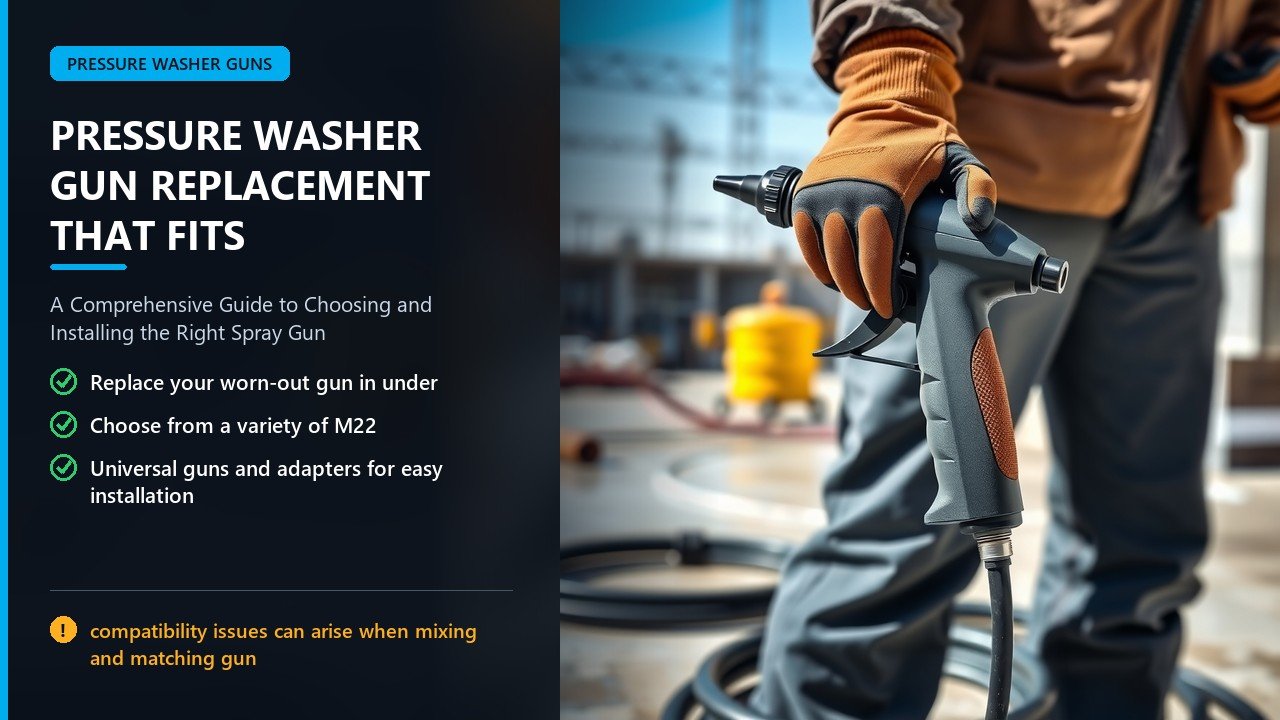
What a Spray Gun Actually Does
A pressure washer gun is a high pressure on off valve with a trigger. Water comes in from the hose, and when you squeeze the trigger, the valve opens and sends water out to the wand and nozzle. When you release the trigger, the valve seats and the flow stops. That simple function happens thousands of times on every job, and it is the reason guns wear out.
Every trigger pull cycles the internal valve seat and its O rings against full operating pressure. Over time those seals wear, the seat degrades, and the gun develops a drip, a dribble after release, or a trigger that sticks. On most consumer grade guns the valve is sealed and not serviceable, which makes replacement the practical answer rather than trying to rebuild it. On professional guns some parts are rebuildable, but even there, many operators prefer to swap in a fresh gun and keep the old one as a spare.
Because the gun is the interface between the operator and the machine, a good gun is also a comfort investment. Contoured grips, padded covers, swivel inlets, and trigger locks all make long sessions easier, and a trigger that takes less effort reduces hand fatigue over a full day of cleaning. Replacing a worn gun is the point where you can upgrade comfort and ergonomics for very little money.
The Five Checks That Decide Compatibility
A replacement gun must match your machine on five separate counts. Missing any one of them makes the gun wrong even if the price and the brand look right.
- The hose side inlet. The connection where the high pressure hose attaches. Common families are M22 threaded, 3/8 inch quick connect, and threaded pipe ports. The exact family, size, and gender must match your hose coupling.
- The wand side outlet. The connection where the wand or accessory attaches. Many guns use a quarter inch quick connect socket, but threaded outlets exist too. Your wand must fit it.
- Pressure. The gun’s maximum rating must cover your machine at full output. An underrated gun is dangerous, not just wrong.
- Flow. The gun must pass your machine’s GPM without choking it. A gun with narrow passages starves a high flow pump and wastes power.
- Temperature. A cold water gun is rated to roughly 140 degrees Fahrenheit. A hot water machine needs a gun rated for the heat, often 200 degrees or more.
Many listings only shout about PSI, and that is the trap. A gun rated for more pressure than your machine is only compatible if its flow, temperature, and both connections also match. A higher pressure rating does not fix a wrong fitting or a cold water limit.
| Check | What to Verify | Common Mistake |
|---|---|---|
| Hose side inlet | M22, 3/8 inch QC, or threaded port | Buying M22 without checking the subtype |
| Wand side outlet | 1/4 inch QC or threaded | Assuming every gun ends in a QC socket |
| Pressure rating | Equal to or above your machine’s PSI | Looking at PSI alone |
| Flow rating | Handles your machine’s GPM | Using a low flow gun on a high flow pump |
| Temperature rating | Rated for hot water if you run heat | Cold water gun on a hot water machine |
| Installed adapters | What is removable versus part of the gun | Confusing an adapter with the base port |
The M22 Trap Everyone Hits
The most common gun connection is the M22 thread, and it looks simple. It is not. The M22 refers to the 22 millimeter diameter of the threaded connection, but the inner plug comes in two sizes, and the difference is tiny, about one millimeter. A 14 millimeter pin is standard on most gas washers and many electric models. A 15 millimeter pin appears on a handful of popular brands. They look almost identical, and they are not compatible. Screw a 15 millimeter fitting into a 14 millimeter gun, or the reverse, and it will leak badly or not seal at all.
That one millimeter difference is the single most common cause of a new gun that leaks. Check the manual, measure the pin on your old fitting, or look up your machine’s spec before you buy. Many replacement guns ship with a brass adapter that bridges the two sizes, which is the safest choice if you are unsure, but never force a fit that is not meant to go together. The threads will thread on and still leak under pressure.
Quick Connect Versus Threaded
Beyond M22, there are quick connect systems, and they use two sizes for different jobs. A 3/8 inch quick connect is common on the hose side of gas and professional machines, while the quarter inch quick connect is the standard on the wand side, where spray tips and accessories snap on and off in a second. A quick connect works when a male plug slides into a female coupler and the collar locks it in place. The rule is simple: you need one male and one female to make the join, and two of the same gender will not connect.
Threaded fittings use tape to seal. Wrap Teflon tape clockwise around the male threads, three or four wraps, and snug with a wrench without overtightening, because overtightening cracks plastic housings and strips threads. Gas washers tend to be more universal with their connections, which makes aftermarket guns a straightforward swap. Electric washers are more often brand specific, and for those, matching the manufacturer’s exact standard or using a clearly rated adapter is the reliable route.
Universal Guns and Adapters
Universal replacement guns exist because so many machines share the same connection families. A quality universal gun ships with the adapters needed to bridge M22 and quick connect, and frequently with both the 14 millimeter and 15 millimeter pin options. One gun that includes those adapters can replace a fitting on a gas washer and, with the right adapter, work on many electric models too.
The word universal does not mean it fits everything with no thought. It means the maker has included the common adapter path, and you still do the matching. Identify the exact connections on your machine, choose the matching adapters from the kit, and confirm the pressure, flow, and temperature ratings cover your washer. Where a machine uses a proprietary system, especially on budget electric models, an aftermarket universal gun may not be the right answer, and using the brand’s own replacement part is the safer choice.
Choosing the Right Gun for You
Once the five checks are satisfied, the next decisions are comfort and capability. The best replacement gun is the one that fits your machine and your hands.
A pistol grip gun with a contoured, padded handle makes long sessions noticeably easier. A swivel inlet at the hose connection lets the hose rotate independently, which keeps it from binding and untwisting as you work around a vehicle or a building. A trigger lock keeps a gun from firing when it should not, and a lockable trigger that requires deliberate pressure reduces fatigue and accidental sprays. Specialty guns add features like adjustable spray patterns or built in extension lances, but the core gun remains the same high pressure valve at heart.
For high output machines, look for a high flow gun with internal passages that match your GPM. A gun rated for 4,000 PSI but built with narrow plumbing will choke a 4 GPM pump and create back pressure, which stresses the pump and wastes fuel. The flow rating deserves the same attention as the pressure rating.
Residential guns and professional guns differ in more than price tag. A consumer gun built for occasional use is lighter and less expensive, and it is adequate for an electric or small gas washer. A professional gun is built from sturdier materials, carries higher flow and temperature ratings, and earns its cost in daily commercial use where it is subjected to long trigger sessions and hot water. If your machine is commercial, buy the gun to match the duty cycle, not the dollar figure.
Accessories the Right Gun Makes Easy
A gun that ends in a standard quarter inch quick connect becomes the hub of your whole accessory system. Wands snap on and off, nozzles swap in seconds, and attachments like surface cleaners and foam cannons connect without adapters. That single standard turns a plain gun into a versatile cleaning station.
It also matters on hot water rigs and soft washing setups. Choose attachments rated for the same pressure and temperature as the gun, keep the quick connect O rings clean so the male fitting seats and seals every time, and never force an attachment that does not click home cleanly. A forced connection is a leak waiting to happen.
Step by Step: Replacing the Gun
The swap is straightforward, and the whole job is under an hour if the fittings match.
- Depressurize the system. Turn the washer off completely, unplug it or kill the engine, and disconnect the water supply. Then squeeze the trigger of the old gun to bleed the trapped pressure from the hose. You should hear the pressure release and see a little water. Never skip this step.
- Disconnect the hose. At the bottom of the gun handle, release the high pressure hose connection. For a quick connect, pull back the collar and remove it. For a threaded M22, hold the gun fitting steady with one wrench and turn the hose fitting with another. The fit may be tight, so use firm steady turns rather than force.
- Remove the wand. Take the wand or lance off the front of the gun. This is usually a threaded fitting or a quarter inch quick connect. Set the old gun aside.
- Prepare the threads. If the new gun has male threaded fittings, wrap them with Teflon tape clockwise, three or four wraps, so the tape does not unwrap as you screw the parts on.
- Attach the wand. Screw the wand into the front of the new gun or click it into the QC socket, hand tighten, then a light quarter turn. Do not overtighten.
- Connect the hose. Attach the high pressure hose to the gun inlet, M22 or quick connect, and snug it properly. Quick connect fittings should click solidly.
- Test before full use. Reconnect the water supply, turn it on fully with the machine still off, and check every connection for drips at static pressure. Then run the machine and squeeze the trigger, watching for a clean start, instant shutoff, and no leak at the trigger.
If your new gun ships with adapters for the M22 pin size or for quick connect conversion, install the correct adapter before you attach anything, and be certain which end is which. The whole point of the process is that each join lands on a sealed, rated connection.
Testing the New Gun
A few minutes of testing prevent the worst kind of surprise, discovering a bad seal halfway up a ladder or in the middle of a customer’s job. Start with the machine off and the water on. Confirm the static connections are dry. Then run the machine and pull the trigger. The spray should start clean and stop instantly when you release, with no dribble or lingering water. Watch all the fittings while the trigger is held, because pressure only reveals a bad seal when the system is live.
Also check the trigger return. It should snap back crisply, and the safety or trigger lock should engage firmly. A gun that will not shut off, or that leaks at the trigger under full pressure, is a safety hazard and should be exchanged, not lived with. A two minute test is cheap insurance against a mid job failure.
Common Gun Problems
Knowing the symptom tells you whether it is fixable or time to replace.
| Symptom | Likely Cause | Fix |
|---|---|---|
| Leak at a fitting | Missing or torn O ring, or under-tightened threads | Replace the O ring or snug the connection |
| Drip at the trigger | Worn internal valve seat | Replace the gun, the valve is not serviceable on most models |
| Trigger will not shut off | Stuck valve or damaged seat | Replace the gun, this is a safety issue |
| Stiff or gritty trigger | Debris or corrosion in the valve | Flush with clean water, replace if it persists |
| Low pressure at the gun | Restricted passage or wrong flow rating | Verify the gun passes your machine’s GPM |
| Leak after connecting new gun | Wrong M22 pin size | Check 14 mm versus 15 mm and use the right adapter |
A gun that leaks at the trigger under full pressure, or one whose trigger sticks open, should never be used. A high pressure stream that does not stop is a danger to everyone in the area. In those cases replacement is not a convenience, it is a safety requirement.
Repair or Replace
Because seals and O rings are the parts that fail, some gun problems are cheap to fix. A quick connect coupler that drips usually needs a fresh O ring, and a weeping thread usually needs a bit of tape and a proper snug. Anything involving the internal valve is a different story, because on most consumer guns the valve is sealed. When it fails, the practical move is a new gun.
Weigh the math honestly. A quality replacement gun costs a fraction of a new machine, and the manual labor is minutes. If your gun leaks, sticks, or dribbles and a seal does not fix it, replace it. Keeping the old gun as a spare, or swapping the fittings if the new gun carries adapters, keeps you prepared for the next failure without a second purchase. The same logic applies to the wand connection: if the outlet side of the gun is damaged or the quick connect socket is worn, accessories will never seat reliably, and the leak it causes undercuts pressure on every job. Replacing the gun resets the whole chain.
Safety Around the Gun
The gun is where the most dangerous part of a pressure washer lives, and respect for it is not optional. Never point the gun at a person or an animal. Never use a finger or palm to test the spray. Never operate a gun whose trigger sticks, and never gulp air into a live gun by squeezing it dry, because running the pump without water damages it quickly.
Use the trigger lock when the machine is on but the gun is idle. Shut the machine down and depressurize before changing any accessory. Watch for overhead power lines whenever you use an extension wand, and never stand on a ladder with a gun in your hand. High pressure water at skin level is a serious injury risk, and the Occupational Safety and Health Administration treats high pressure cleaning as work requiring protective equipment and training. The gun in your hand is the business end of that warning.
Answers to the Questions Owners Ask Most
Is any replacement gun compatible with my pressure washer?
No. The gun must match the hose inlet, the wand or accessory outlet, and the pressure, flow, and temperature ratings. A universal gun is universal in the sense that it ships with the common adapters, but the final match is checked against your specific machine, not assumed.
What size M22 fitting do I have?
Check the inner pin. A 14 millimeter pin is standard on most gas washers and many electric models, and a 15 millimeter pin appears on a handful of brands. They look alike and will not seal with each other. Measure or look up your model before buying.
Can I use a 4,000 PSI gun on a 3,000 PSI washer?
Yes, as long as the connection types, flow, and temperature ratings also match. A higher pressure rating is fine and often preferable; the danger is the reverse, using a gun rated below the machine’s output.
Why does my new gun still leak after I installed it?
Check the O rings and the M22 pin size first. A tiny one millimeter difference in the pin is the classic cause of a leak that threading will not fix. If the leak is at a quick connect, a missing or torn O ring is the usual culprit. If the leak is at the trigger, the gun itself is faulty.
Is a universal gun better than the manufacturer’s replacement?
Often yes, when it is properly rated. A quality universal gun costs less than the OEM part and typically includes the adapters to fit most machines. The catch is the same as any aftermarket part: the ratings and connections must be verified against your machine.
Do I need a special gun for hot water?
Yes. Cold water guns are rated to around 140 degrees Fahrenheit, and a hot water machine needs a gun rated for higher heat. Using a cold water gun on a hot water washer risks seal failure, leaks, and a burst connection.
How do I prevent pressure washer gun leaks?
Keep the O rings clean and replace them at the first sign of wear, snug threaded fittings without overtightening, and never store a gun under pressure. Treat the gun as a wear item with a service life, because its seals wear with every trigger pull.
Can I repair my pressure washer gun?
Some leaks are simple fixes, like a worn O ring in a quick connect or a loose thread that needs tape and a snug. Internal valve failures are not serviceable on most consumer guns. If a seal does not fix the problem, replace the gun rather than fighting a component that seals against full system pressure.
Why does my trigger feel stiff after winter?
Grit and corrosion in the valve cause a grind or stiffness, which is common after cold storage. Flush the gun with clean water, work the trigger gently, and lubricate moving parts if the manufacturer advises it. If the stiffness persists, replace the gun rather than working around a trigger that could stick at pressure.
The Bottom Line
A pressure washer gun replacement is the highest value repair on a washer. It is cheap, fast, and fixes the part you touch the most. The entire job comes down to two connections and three ratings. Match the hose inlet, match the wand outlet, verify pressure, flow, and temperature, and the new gun will fit and perform.
Buy a gun rated above your machine, standardize on a quarter inch quick connect so every tip and accessory clicks on, and choose a contoured, comfortable grip if you clean for long stretches. Take the time to depressurize before you change anything, and test the gun before you rely on it. Do those things and a leaking, sticky gun stops being a frustration and becomes a ten minute fix that upgrades the whole machine. If you pair it with a good wand, which our guide on pressure washer wands explains, and keep the pump and its oil healthy according to our articles on pressure washer pump oil and preventative maintenance, the whole system works as one reliable unit.