On a construction site in late November, a welder watched a pressure cleaning crew run its rig in fifteen-degree weather and noticed what nobody else did: the machine never stumbled. No choke fumbling, no warming up, no complaining. The crew chief shrugged and pointed at the rig. “Diesel engine, diesel burner,” he said. “Starts cold, runs all day, and the water comes out hot enough to cut grease without a second chemical pass.” By the end of the day, the welder understood something the consumer pressure washing aisle never mentions: at the top end of the cleaning world, diesel is not an afterthought. It is often the whole platform, powering both the machine’s engine and the heat that makes hot-water cleaning so effective.
The phrase diesel pressure cleaner describes two different things, and owners confuse them constantly. It can mean a pressure washer powered by a diesel engine rather than a gasoline one, or it can mean a machine whose hot-water burner fires on diesel fuel, or, on many commercial rigs, both at once. The diesel engine brings torque, economy, and longevity; the diesel burner brings hot water, which melts grease, oil, and baked grime that cold water only grinds at. Together they make up the heart of professional-grade cleaning equipment. This guide untangles the two meanings, explains when diesel actually pays off, compares diesel to gasoline honestly, covers the fuel and maintenance realities of diesel ownership, and lays out the buying decision for anyone considering a diesel-powered or diesel-fired cleaning machine.
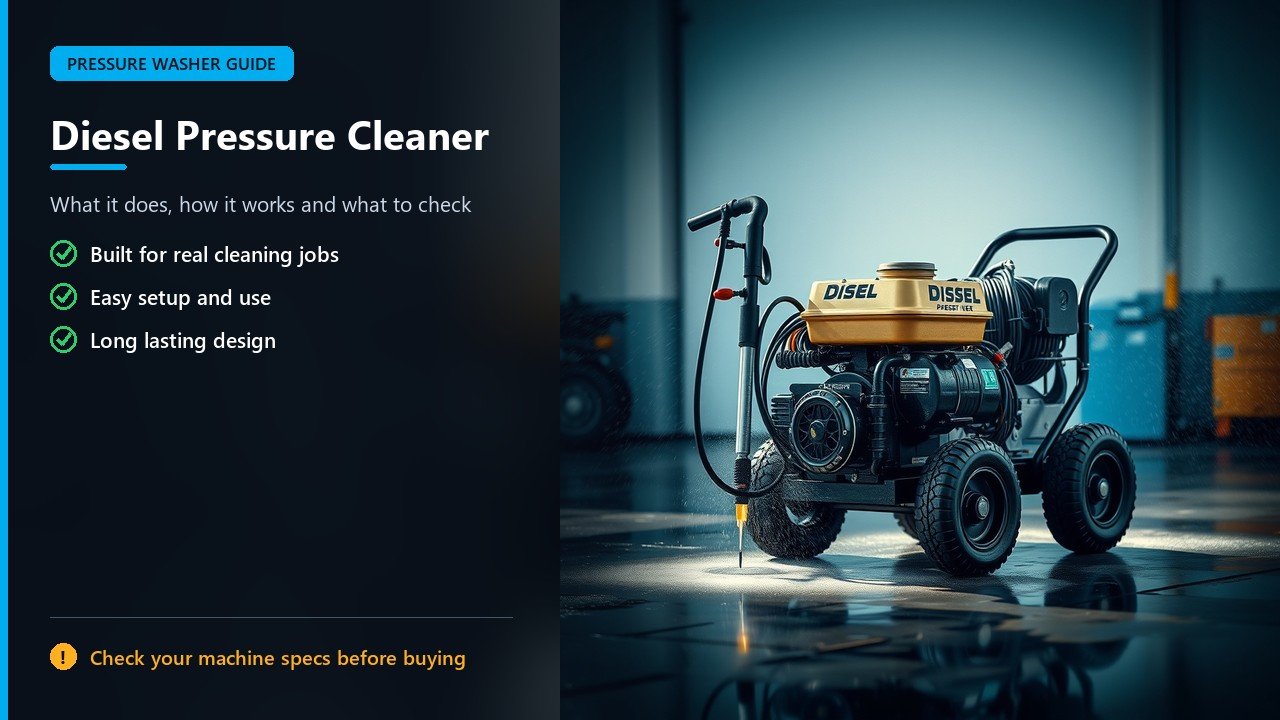
The Two Meanings, Separated
Start by splitting the concept, because the rest of the article depends on knowing which diesel is being discussed.
A diesel engine machine. A pressure washer whose power comes from a compression-ignition diesel engine instead of a spark-ignition gasoline engine. These appear on heavier, higher-duty rigs, often direct-drive or belt-drive, and they trade a higher purchase price and more weight for better fuel economy, greater torque, and longer engine life under continuous load. Typical gasoline pressure washers run small Briggs, Honda, and Kohler engines; diesel-powered units appear as the machine inches toward industrial duty.
A diesel-burner hot-water machine. A pressure washer with a heating coil and a burner that fires on diesel fuel to heat the water. This is the more common use of “diesel” in the cleaning industry, because hot water is the defining feature of professional cleaning rigs. A diesel-fired burner heats recirculating water through a coil, delivering hot water at the wand that melts grease and speeds cleaning. The burner’s fuel is diesel even when the machine’s engine is gasoline.
Both at once on a commercial rig. Many high-end trailer rigs use a diesel engine to drive the pump and a diesel burner to heat the water, often drawing from the same fuel supply. This is the fully diesel platform, and it is the machine most associated with serious pressure washing operations.
Why the confusion matters. A buyer who wants hot water needs a burner, independent of engine type; a buyer who wants engine economy and longevity wants a diesel engine, independent of whether the water is heated. Getting one while thinking you bought the other is an expensive misunderstanding, so clarify which diesel you are shopping for before the invoice.
Diesel Engine Versus Gasoline Engine
When the “diesel” is the engine, the comparison to a gasoline pressure washer engine is a real one.
Torque and load. Diesel engines make their power at lower rpm with more torque, which suits driving a pump under sustained load. A diesel rig tends to hold its output steady through hard, continuous work where a small gasoline engine might labor. This is why heavy-duty and industrial cleaning equipment leans diesel.
Fuel economy and running cost. Diesel engines are more fuel-efficient per unit of work than gasoline engines, which matters on a machine that runs all day, every day. For a commercial operation logging hundreds of hours, the fuel savings offset the higher purchase price over time, and diesel is often cheaper per unit of energy where it is available.
Longevity. Compression-ignition diesel engines are built heavier and are known for long service life under load. For a business that measures a machine in thousands of hours, the diesel engine’s durability is a major part of the value proposition.
The costs. Diesel engines cost more up front, weigh more, run louder, and produce more exhaust odor and particulates than gasoline. They also require diesel-specific maintenance and, on newer units, emissions systems that add complexity and cost. For a homeowner cleaning a driveway, none of this is worth it. Our comparison of diesel versus gas pressure washers across real-world scenarios puts the trade in context.
Diesel-Fired Hot Water and Why It Wins
When the “diesel” is the burner, the comparison is to cold water cleaning, and here the case for diesel is strong in the professional context.
Hot water melts grease. The defining advantage of a hot-water machine is its ability to melt fats, oils, and grease rather than merely blasting at them. On restaurant floors, engine bays, industrial equipment, and baked road grime, hot water cleans faster and more thoroughly than cold, often with less chemical. This is the core reason cleaning professionals invest in a burner at all.
Diesel makes hot water practical in the field. Heating water takes energy, and a diesel burner delivers a lot of heat from a portable fuel source. Diesel burner coils can bring water to high temperatures quickly and sustain that heat through a job, which is what makes a hot-water cleaning rig viable on a trailer and at a remote site. The burner is what turns a pressure washer into a grease-melting machine. Our guide to why the hot-versus-cold answer is often both explains the split use.
The limits of hot water. Hot water is not a universal answer. It uses fuel, adds weight and maintenance, and needs a burner and coil that demand care. For most residential work, cold water with pressure and chemistry does the job, and a hot burner is overkill. The diesel burner earns its place specifically where grease, oil, and industrial grime dominate the job list. Our guide to where cold machines win balances the picture.
When a Diesel Pressure Cleaner Pays Off
The honest answer is that diesel is a professional tool, and the conditions that justify it are specific.
High duty cycles. A machine that runs hundreds of hours a season earns back the diesel premium quickly through fuel efficiency and fewer hours lost to breakdowns. A machine that runs a few hours a month never does. The duty cycle is the first and most important filter.
Grease-dominant work. If the job list is restaurants, fleet maintenance, industrial floors, asphalt, and baked grime, the hot-water burner’s grease-melting power directly reduces time and chemical per job. That is billable efficiency, and it is where a diesel burner’s cost is recovered. Our guide to commercial rig building treats the burner as a core decision for these jobs.
Remote and cold-weather work. Diesel engines start and run reliably in cold conditions where small gasoline engines can be temperamental, and diesel burners keep water hot in the field. For year-round commercial work in cold climates, the diesel platform is genuinely the practical answer.
Mobile and trailer operations. A trailer rig that carries fuel for both engine and burner, drawing from one tank, is a self-contained cleaning operation. Diesel’s energy density makes that practical, and it is the standard at the top of the mobile cleaning world. The mobile rig guide covers the integration.
Where diesel does not pay off. Homeowners, light commercial users, and anyone whose jobs are moss, mildew, dirt, and the occasional oil spot. For them, the gas engine and cold water combination is cheaper, lighter, quieter, and entirely adequate, and the diesel premium buys features they will never use.
| Use Case | Diesel Engine | Diesel Burner |
|---|---|---|
| Home driveway | Overkill | Overkill |
| Light commercial | Optional | Job-dependent |
| Heavy commercial | Strong value | Strong value |
| Grease and industrial | Good | Essential |
| Cold-weather mobile | Best choice | Best choice |
Fuel and Maintenance Realities
Diesel machines demand their own discipline, and owners coming from gasoline should know what changes.
Fuel quality and water. Diesel fuel is more sensitive to water and contamination than gasoline, and dirty or water-laden diesel damages both engines and burner nozzles. Store fuel cleanly, keep water out, and use filters, because diesel systems punish neglect with expensive injector and pump repairs. The EPA’s diesel resources cover fuel and emissions basics that apply to diesel equipment broadly.
Fuel storage and shelf life. Diesel can degrade and grow microbial contamination over long storage, so fresh fuel and treatment matter. A machine that sits with old diesel through a season can develop fuel problems that a gasoline engine would not. Store it properly, treat it, and rotate the fuel.
Engine oil and filters. Diesel engines generally use diesel-rated oils and need their oil and fuel filters serviced on schedule. The intervals and specs are in the manual and differ from gasoline practice, so follow them precisely rather than applying gasoline habits.
Burner care. A diesel burner needs its fuel filter, nozzle, and combustion chamber maintained, and its coil descaled or serviced as the manual directs. A dirty burner nozzle produces poor heat and smoke; a scaled coil transfers heat poorly. Burner maintenance is the price of reliable hot water, and it is what most distinguishes a well-run cleaning rig. Our guide to the annual storage and care routine folds burner care into the schedule.
Emissions and noise. Modern diesel equipment carries emissions systems, and diesel engines are inherently louder and smellier than gasoline. For indoor or residential work, this can be a genuine constraint; for outdoor commercial work, it is usually an accepted cost. Plan the machine’s environment before accepting the diesel character.
Buying a Diesel Pressure Cleaner
The buying decision follows from the job list, and a few questions settle it.
Do you need heat, engine economy, both, or neither? This single question routes the purchase. Heat needs a burner; engine economy and cold-weather reliability need a diesel engine; heavy commercial grease work often needs both; light or home work needs neither. Answer honestly from the actual job list, not from ambition.
What is your duty cycle? Hundreds of hours per season justify diesel’s premium. A few hours per month does not, no matter how appealing the spec sheet. Buy the machine the workload supports, not the one the brochure sells.
Can you service and fuel it? A diesel machine needs clean fuel, diesel-rated maintenance, and, if it has a burner, burner service. If you cannot or will not maintain it, a simpler gasoline or electric machine will serve better. The best machine is the one you will actually care for. Our guide to commercial machine and hose selection pairs with this decision.
What water and power do you have? A diesel burner machine still needs water at the right flow and pressure, and a diesel engine machine still needs fuel logistics. Confirm the supply and the fueling plan before committing to a heavy platform.
Compare total cost, not price. Add purchase, fuel, maintenance, and downtime. A diesel engine and burner raise the price and lower the per-hour cost; over a commercial machine’s life, that math can favor diesel, and for a homeowner it never does. Run the numbers for your real workload, not the average.
How a Diesel Burner Makes Hot Water
Understanding how the burner works explains both its power and its maintenance, and it demystifies the machine’s top-end feature.
The coil is the heater. Water passes through a coiled tube wrapped around or near the burner’s combustion chamber, and the burner’s flame heats the coil from the outside as the water travels through it. The longer and hotter the coil, the hotter the outgoing water. A well-designed coil brings the water to high temperature quickly without scorching the pump upstream.
The burner fires a controlled flame. A diesel burner atomizes fuel through a nozzle and ignites it, producing a hot flame that plays across the coil. The fuel delivery and the air mixture decide the flame’s quality: a clean, hot flame heats efficiently, while a poor flame coats the coil with soot and delivers less heat. This is why a nozzle and air setting matter so much on a burner.
Temperature control protects the machine. A hot-water machine regulates the outgoing temperature so the water is hot enough to clean but not so hot it damages the pump’s seals or the hose. Some machines let the operator set the target temperature; all of them manage the coil’s heat to stay within the system’s rating. Respect that limit, and the machine delivers hot water safely for years.
Heat transfer degrades with scaling. Hard water leaves mineral scale inside the coil over time, and scale insulates the water from the flame, so the machine burns more fuel for less heat. Descaling or servicing the coil restores performance, and it is a normal part of hot-water machine maintenance, not a sign of failure. Our guide to getting the most from a hot water machine covers coil and heat care.
The Diesel Rig in Cold Weather
Cold weather is where the diesel platform earns its strongest reputation, and it is worth understanding why.
Diesel engines start cold. Compression-ignition engines, properly equipped with glow plugs or block heaters where needed, start and run reliably in low temperatures where small gasoline engines can be hard to wake. A commercial cleaning schedule that runs through winter depends on machines that fire up on a frozen morning, and diesel delivers that dependability.
Hot water changes winter cleaning. In cold weather, hot water does more than melt grease; it helps thaw and clean surfaces that cold water struggles with, and it keeps the operator’s equipment responsive. A diesel burner keeps the water hot in the field even when the ambient temperature drops, which is exactly when a cold-water machine loses its edge. Our guide to cold weather pressure washing tactics pairs with the burner’s advantage.
Fuel and gelling. Diesel can gel or cloud in extreme cold if it is not winter-blended or treated, which is the diesel platform’s one significant cold-weather vulnerability. Use winter diesel or an anti-gel additive, keep the fuel clean, and store the machine sensibly. A gelled fuel system stalls a rig as surely as a dead battery stops a gasoline one.
Freeze protection after the job. Even a hot-water diesel machine must be winterized between uses, because the water in the pump, coil, and hoses freezes and cracks components if left to sit. Drain the system after each cold-weather session, or keep the machine in heated storage, and the diesel rig survives the season it was built for. The pump freeze-saver routine applies to the whole hot-water loop.
Why crews buy diesel for winter. Reliability, hot water on demand, and fuel economy under long cold shifts add up to a machine that keeps a commercial operation working when gasoline and cold water would slow it down. That is the real-world reason diesel pressure cleaners dominate year-round professional cleaning in cold climates, and it is the reason the platform exists at all.
Common Diesel Machine Mistakes
Buying diesel for a light job list. Paying for heat and fuel economy a homeowner will never use. Match the machine to the duty cycle.
Confusing engine diesel with burner diesel. Assuming you bought hot water when you bought an engine, or vice versa. Clarify before the invoice.
Neglecting fuel cleanliness. Dirty or watery diesel wrecks injectors and burner nozzles. Filter and store fuel properly.
Skipping burner service. A clogged nozzle and a scaled coil quietly kill heat output. Service the burner on schedule.
Letting diesel sit for a season. Old fuel degrades and contaminates. Treat, rotate, or drain for long storage.
Ignoring the pump. A diesel engine machine still has a pump that needs water habits and oil changes. Two lives, both serviced.
Expecting gasoline quietness. Diesel is louder and smellier by nature. Plan the work environment accordingly.
Frequently Asked Questions
What is a diesel pressure cleaner? It usually means either a pressure washer powered by a diesel engine or one whose hot-water burner fires on diesel fuel, and often a commercial rig with both.
Is a diesel pressure washer better than gas? For heavy commercial and cold-weather work, yes on torque, fuel economy, and longevity. For home and light use, a gas machine is lighter, cheaper, and equal to the job.
Do I need a diesel burner or just a diesel engine? A burner if you need hot water for grease and oil; a diesel engine if you need engine economy and cold-weather reliability. Many commercial rigs use both.
Is a hot water diesel machine worth it? For grease-dominant commercial work, yes, because hot water cleans faster with less chemical. For residential work, the cost and complexity rarely justify it.
What fuel does a diesel burner use? Diesel fuel, typically from the same tank as a diesel engine on a combined rig, supplying the burner’s combustion system.
How do I maintain a diesel pressure cleaner? Clean, treated diesel fuel; diesel-rated engine oil and filters on schedule; burner nozzle, filter, and coil service; and the same pump water and oil care as any machine.
Final Thoughts on the Diesel Pressure Cleaner
The diesel pressure cleaner sits at the working end of the cleaning world, where the machines run hundreds of hours a season and the jobs are dominated by grease, oil, and baked grime. Its two diesel halves, a compression-ignition engine and a diesel-fired hot-water burner, are separate features chosen for separate reasons, and the professional rigs that define the category use both to make cleaning hot, powerful, and economical under heavy use. For that world, diesel is not a gimmick; it is the platform that makes round-the-clock, four-season, grease-cutting cleaning practical.
For everyone else, the honest answer is usually no. A homeowner cleaning a driveway, a small business washing vehicles, a light-duty user with dirt, moss, and mildew on the list, none of them gain from the diesel premium, its weight, its noise, or its maintenance. The good decision is the one made from the actual job list: buy the burner if you need heat for grease, buy the diesel engine if you need economy and cold-weather reliability under long hours, and buy both only if your work genuinely demands the full commercial platform. Match the diesel to the duty cycle it must carry, maintain the fuel, the burner, and the pump as faithfully as any professional crew, and the diesel pressure cleaner becomes what it was built to be: the machine that never flinches through the hardest, greasiest, coldest work a cleaning operation can find.