Trailer Power Washer: Building a Mobile Pressure Washing Rig
A trailer power washer is the point where pressure washing stops being a machine you wheel around and becomes a business you can drive to a job. Instead of hunting for a water tap and an outlet, you tow your own water, your own pump, and often your own heat, then pull up, drop the hose, and start cleaning. For contract cleaners, mobile detailers, municipalities, and anyone with big or remote surfaces to clean, a trailer rig is the difference between being tied to a building and being able to work anywhere. This guide explains what goes into a trailer power washer, how to spec one, and how to build or buy the right rig for the work you actually do.
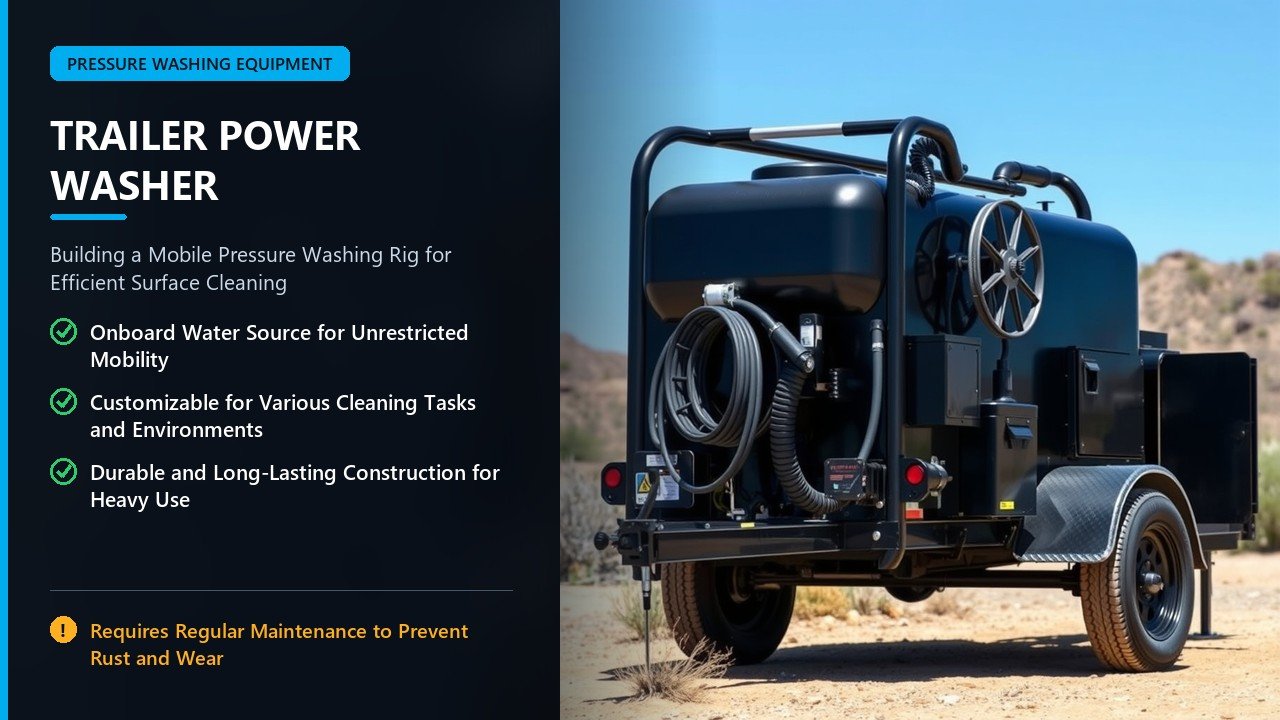
What a Trailer Power Washer Is
At its simplest, a trailer power washer is a pressure washer mounted on a small over-the-road trailer along with a water tank and the plumbing to connect them. The trailer gives the machine mobility and an onboard water source, so the operator is independent of any fixed water supply. Many rigs add a hose reel, a detergent tank, storage boxes, and a heating system for hot water work, turning a basic washer into a complete mobile cleaning station.
The trailer is usually a purpose-built unit with a steel frame, a coupler and safety chains, lights, and a low deck to carry the load. Tanks are often enclosed in a powder-coated steel frame, and the deck may be a solid steel plate rather than open mesh. Custom builders such as American Water Works combine their skid series with a water tank and trailer to create rigs for mines, ranches, construction sites, and municipalities. The result is a compact footprint that balances the machine and water for safe towing, which is why trailer rigs are engineered rather than improvised. If you are weighing a fixed versus a rolling setup, our guide to whether a wall, skid, or trailer mount fits your work covers the trade-offs.
Who Needs a Trailer Power Washer
Trailer rigs make sense whenever mobility and self-sufficiency matter more than price. A cleaning business that visits customers needs to arrive ready to work, without depending on the client’s water or power. A municipality maintaining parks, fleet vehicles, and buildings needs one rig that can serve many sites. A farm or ranch with remote equipment and no handy hydrant needs water it can carry to the job.
They also make sense for the sheer size of the work. When a job involves cleaning multiple large surfaces, a trailer with a big tank and a long hose lets you stay productive without constant refills or repositioning. If you mostly wash one driveway at home, a trailer is overkill and a cart or a plain machine will serve you better. The test is simple: if you regularly travel to the work, or the work is bigger than one tank and one hose can handle, a trailer earns its keep. For the smaller-scale option, see our cart for a pressure washer.
The Core Components
Every trailer rig, from a basic cold-water unit to a fully loaded hot-water system, is built from the same set of parts. Knowing them makes it easy to compare models and to spec a custom build.
- Trailer chassis rated for the loaded weight, with a solid deck, coupler, safety chains, and lights.
- Pressure washer in cold or hot water form, direct or belt driven, usually gas powered.
- Water tank plumbed to the pump inlet, with a drain and often a float or bypass.
- Hose reel and high-pressure hose for reach, plus a supply hose and reel for refilling.
- Detergent tank and injector for applying chemicals.
- Towing hardware such as a ball hitch or lunette ring, and brakes on heavier rigs.
- Storage for guns, wands, nozzles, and tools, often lockable.
The chassis is the foundation. Its load capacity must cover the washer, the water, the fuel, and every accessory, with margin. That is why the weight of the water matters so much in the maths, a point we will come back to when we talk about towing.
Water Tank Sizing
The water tank decides how long you can work between refills, and it is the single most important spec for many buyers. Professional trailers commonly carry tanks in the range of two hundred to five hundred twenty-five gallons, with two hundred, three hundred thirty, and larger sizes being typical. The right size depends on your flow rate, how far you travel from a fill point, and how big the average job is.
A rough way to size the tank is to multiply your machine’s flow in gallons per minute by the minutes you want to run between refills. A four gallon per minute washer running for twenty minutes uses eighty gallons, so a tank near that figure covers a short job, while a longer job or a higher flow rate pushes you toward the larger end. Bigger tanks add weight and cost, so size to your real workload rather than to the biggest number on the spec sheet. Our guide to pressure washer water tank sizes goes deeper, and our look at a portable water tank setup covers the plumbing side.
Cold Water vs Hot Water
Cold water trailers are the simpler and cheaper option. They suit residential cleaning, sidewalk and driveway work, and any job where grease and oil are not the main problem. A cold water rig needs only a pump, a tank, and a hose, which keeps the build light and the price down.
Hot water trailers add a burner and a heating coil, usually heated by diesel or oil, and they transform the kind of work the rig can take on. Heat breaks down grease, oil, and stubborn grime far faster than cold water, so a hot water unit suits fleet washing, industrial cleaning, and food-service work. The trade-off is cost, complexity, and more maintenance, plus a heavier footprint. A hot water skid also needs the coil drained and protected in winter. If most of your jobs involve grease, the extra cost pays back quickly. Our guide to how a hot water machine heats explains the hardware.
Gas vs Diesel Power
Most trailer rigs run on gasoline engines because they are affordable, easy to refuel anywhere, and simple to service. A typical cold water trailer pairs a gasoline engine with an industrial triplex pump. On hot water rigs, the engine drives the pump while a separate diesel or oil burner supplies heat, giving the best of both: familiar gas power and hot water performance.
Diesel engines appear on heavier or more specialised rigs where fuel economy over long hours and durability matter more than initial cost. Other setups use a gasoline engine for the pump and a diesel burner for heat, which is the classic hot water configuration. For most mobile cleaners, a gas engine with a diesel burner is the practical sweet spot. Our comparison of diesel burners versus diesel engine machines walks through when each makes sense.
Single vs Dual Axle
The axle setup follows the weight of the rig. Single-axle trailers suit lighter cold water setups with modest tanks, and they are easier to manoeuvre by hand once unhitched. A customizable example is the Landa single-axle trailer, which pairs a two-hundred-gallon tank with a three-thousand-five-hundred-pound load capacity and a range of hot water options.
Dual-axle trailers carry the heavier hot water rigs and the largest tanks, spreading the load and giving more stability at highway speed. A dual-axle trailer might carry two two-hundred-gallon tanks, a hot water skid, and a full accessory load, with a gross vehicle weight around seven thousand pounds. If your rig is heavy, dual axles plus brakes on at least one axle are the sensible choice. Match axles to the loaded weight, not the empty weight, because the water is what makes these rigs heavy.
Pumps and Power
The pump is the heart of the rig, and trailer systems almost always use industrial triplex plunger pumps rather than the axial cam pumps found on budget machines. A triplex pump stands up to continuous commercial use, runs cooler, and delivers a steadier flow, which matters when the machine works all day. Look for a pump with an external unloader, a thermal relief valve, and a bypass that returns to the tank, all of which protect the pump during trigger-off periods.
Belt-driven pumps are common on commercial rigs because they run at lower pump speeds than direct-drive units, which reduces heat and wear and often provides a smoother, quieter result. Power ratings matter too, but flow and pressure together describe the real cleaning ability. A rig rated around four thousand PSI at four gallons per minute is a serious commercial machine, while hot water skids can push eight to nine and a half gallons per minute for volume work. A classic example is the Simpson 95004 trailer, a 4,200 PSI, 4.0 GPM cold water unit with a Vanguard engine and a CAT triplex pump. Size the pump to the jobs and the tank to the pump.
Hose, Reel, and Reach
Reach is what keeps a rig productive, and it comes down to hose length and reel capacity. Trailer rigs commonly carry a hundred feet of high-pressure hose on a fixed reel, with some setups carrying two hundred feet or a second reel. A long hose lets you clean away from the trailer and reduces how often you move the rig, which is a real time saver on big sites.
Most trailers use a high-pressure hose reel for the working line and an optional supply reel for the water feed. A three-eighths inch hose is standard for this class because it carries the flow without choking it, and a hundred-foot length is the typical starting point. Add a supply hose long enough to reach a hydrant or tap for refilling, and keep a spare jumper hose on hand. Our guide to the hose and reel combo covers the details of matching the two.
Weight, Towing, and GVWR
Water is heavy, and that fact drives the entire towing equation. Water weighs about eight point three four pounds per gallon, so a hundred gallons adds roughly eight hundred thirty-four pounds, and a two-hundred-gallon tank adds over sixteen hundred pounds before you count the machine, fuel, and gear. That is why trailer ratings are quoted for the loaded weight.
Never exceed the trailer’s gross vehicle weight rating or the rating of any single axle, and keep the load balanced so the tongue weight is reasonable. An overloaded trailer can become unstable at speed, which is a safety issue, not just a handling annoyance. Check the tyres are rated for the load, and confirm the tow vehicle can handle the total. Our water tank sizing guide helps you keep the numbers sane.
Remember: Water weighs 8.34 lb per gallon. A full 200-gallon tank is over 1,600 lb of water alone, on top of the washer, fuel, and accessories. Always plan around the loaded weight.
Safety Systems: Chains, Brakes, and Breakaway
Towing a loaded trailer is not the same as towing an empty one, and the safety hardware is there for good reason. Safety chains must be crisscrossed and fastened to the frame of the tow vehicle, not to the hitch unless it has dedicated attachment points. The chains catch the trailer if the coupler ever fails, so their rigging has to be correct every trip.
Heavier trailers use surge or electric brakes, and a breakaway system with its own battery applies the brakes if the trailer separates from the tow vehicle. That system must be in good condition and properly rigged to work when it is needed. Do not carry people or loose cargo on a cleaning trailer, and do not exceed the rated load. A simple pre-tow check of chains, lights, tyres, and load security prevents most problems before they start.
Skid vs Trailer
A skid is a self-contained washer and tank unit without wheels, designed to sit in a truck bed, on a trailer deck, or in a van. The trailer is the skid plus mobility. Some operators buy a skid first and add it to a trailer later, while others buy a complete trailer rig from the start. The skid route offers flexibility, because the same unit can move between vehicles, but it requires a host vehicle and a way to load and unload it.
For full-time mobile work, a dedicated trailer rig is usually the better answer, because the washer, tank, and plumbing are mounted and balanced as one system. A skid shines when you already have a truck and want the power without a second vehicle to tow. Established builders share the same priorities, as Power Line Industries explains when describing how to build a rig that makes money. Our comparison of wall, skid, and trailer mounts helps you choose between them.
Enclosed vs Open Trailers
Open trailers leave the washer, tank, and accessories exposed to the weather and to view, which keeps the weight low and the price down and makes maintenance and access easy. Enclosed trailers wrap the equipment in walls and a roof, protecting it from rain, sun, and theft and providing lockable storage, at the cost of extra weight and cost. For rigs stored outdoors or working in poor weather, the enclosure earns its keep.
The choice often comes down to where the rig lives and what it carries. A business running expensive hot water equipment and storing the trailer outside will value an enclosed unit, while a contractor with secure indoor parking may prefer the simplicity of an open deck. Either way, secure the washer and tank properly, because a bouncing trailer loosens anything that is not fastened down.
Building or Buying
You can buy a turnkey trailer power washer from makers who build complete rigs, or build your own around a trailer and a skid. Turnkey rigs arrive matched and ready, with the tank, reel, and plumbing already sorted, which saves time and removes guesswork. Custom builders will configure a rig to your jobs, choosing the tank, pump, heat, and accessories to suit.
Building your own can save money if you already own a suitable trailer or skid, and it lets you tailor every part. The risk is getting the balance, plumbing, and safety hardware wrong, which is why careful planning matters. A good rule from experienced operators is to plan backwards: decide the work and the customers first, then spec the rig that serves them, rather than buying a machine and hoping the jobs fit. Whether you buy or build, start from the work.
Detergent and Surface Cleaner Add-Ons
A trailer rig becomes far more capable with a few accessories. A detergent tank and downstream injector let you apply cleaning chemicals without a separate sprayer, which speeds up vehicle and building washing. A surface cleaner attachment cleans flatwork like driveways and sidewalks several times faster than a wand, and it is one of the highest-value add-ons for a trailer rig.
Other useful extras include a foam cannon for vehicle work, extra hose reels, wand and nozzle holders, and lockable storage for tools and chemicals. Because a trailer is a working platform, organisation matters: the easier it is to reach each tool, the faster you set up and tear down. A second hose reel, in particular, lets one operator run a long working line while keeping a shorter line handy for tight spots, and a dedicated supply reel keeps the fill hose coiled and out of the way. Build the accessory list around the jobs you do most, and the rig will earn more per hour.
Cost and Return
Trailer rigs span a wide price range, from a modest cold water unit to a fully loaded hot water system with a large tank and dual axles. The simplest way to justify the cost is to compare it against the jobs it unlocks. A rig that can work without a water hookup and clean heavy grease opens commercial and fleet accounts that a basic machine cannot serve, and those accounts pay for the trailer over time.
Budget for more than the sticker price. Insurance, registration, maintenance, fuel, and storage all add up, and a hot water rig costs more to run than a cold one. The operators who do well treat the trailer as a tool that makes money, not as a one-time purchase. If the work is there, the numbers work. If it is not, a cart and a machine will do the same small jobs for less.
Maintenance and Winterizing
A trailer rig lives outdoors and works hard, so maintenance is continuous. Check the tyres, lights, chains, and coupler before every tow, and inspect the deck and tank mounts for looseness. Service the engine and change the pump oil on schedule, keep the reel swivel leak-free, and clean or replace filters that protect the pump from tank debris.
Winter is the season that damages trailer rigs left full of water. Drain the tank, pump, hose, and, on hot water units, the heating coil, and protect the pump with antifreeze or a pump protectant. Trapped water freezing in a coil or pump can crack it, a repair that can cost more than a season of care. Our winter storage guide covers the full routine, including antifreeze for the pump.
Example Rigs
The table below shows how real trailer rigs differ, from a compact single-axle unit to a heavy dual-axle hot water system. Use it as a template for comparing the specs that matter.
| Type | Water tank | Power and axles | Notable spec |
|---|---|---|---|
| Compact cold water | 150 gal | Gas engine, single axle, 2,000 lb | 4200 PSI at 4.0 GPM, 100 ft hose |
| Mid hot water | 200 to 330 gal | Gas engine plus diesel burner, single or tandem | 3500 lb load, hot water options |
| Heavy dual axle | 2 x 200 gal | Gas or diesel, 2 x 3,500 lb axles | 7,000 lb GVW, brakes, under-tank storage |
Notice how the tank, power, and axles scale together. A light cold water rig can ride on a single axle with a modest tank, while a dual-axle machine carries two tanks and a hot water skid. Reading a rig this way tells you in seconds what kind of work it is built for.
Frequently Asked Questions
Do I need a trailer to run a mobile pressure washing business?
Not always, but a trailer helps if you travel to jobs and need your own water and heat. A cart and a machine can handle small residential work, while a trailer rig suits commercial, fleet, and remote cleaning where independence from a water hookup matters.
How big a water tank should a trailer have?
Size it to your flow rate and how long you want to run between refills. Professional trailers commonly carry two hundred to five hundred twenty-five gallons, and a rough guide is to multiply your gallons per minute by the minutes of cleaning you want per fill.
Can I tow a trailer power washer with a normal vehicle?
It depends on the loaded weight. A compact single-axle rig may be within reach of a mid-size vehicle, while a dual-axle hot water rig with a full tank needs a properly rated truck. Always check the trailer gross weight and your vehicle’s tow rating.
Is a skid or a trailer better?
A skid is more flexible because it can move between vehicles, but it needs a host truck and a way to load it. A trailer is a complete, balanced mobile rig. Full-time mobile work usually favours a trailer, while an operator with a truck may prefer a skid.
Do trailer rigs need brakes?
Heavier rigs do. Once the loaded weight climbs, surge or electric brakes help control the trailer, and a breakaway system with its own battery applies the brakes if the trailer separates from the tow vehicle. Always match safety hardware to the load.
How do I winterize a trailer power washer?
Drain the tank, pump, hoses, and, on hot water units, the heating coil, then protect the pump with antifreeze or a pump protectant. Store the rig where it will not freeze if you can, and never leave water in the coil or pump through a cold spell.
The Bottom Line
A trailer power washer turns a pressure washer into a self-contained mobile cleaning business. The formula is a solid chassis sized to the loaded weight, a water tank matched to your flow and job length, a commercial triplex pump, and enough hose and reel to reach the work. Cold water rigs are simple and affordable, while hot water rigs open up grease and fleet work at a higher cost and weight. Add detergent and a surface cleaner, respect the towing limits, and winterize properly. Plan backwards from the jobs you want, and the right trailer rig will pay for itself by letting you clean anywhere you can tow it, season after season.