There is a number every trailer rig owner remembers: eight pounds a gallon. Water at that weight turns a modest 100 gallon tank into an 800-pound job of logistics, and the difference between a great tank day and a nightmare trip is not the tank itself, it is the planning around it. A 100 gallon water tank for pressure washer work carries the sweet spot of the trade, enough water to run a serious machine through a demanding day, balanced against a weight and footprint that still fit a household rig and a weekend of effort.
The story of the 100 gallon tank is the story of scale. A car wash needs a 40 gallon shrug of a tank, a house wash a 100, and a commercial day a 200, and the stepping stone in the middle is the size that most often graduates a driveway hobbyist into confident field work. This guide covers what a 100 gallon tank really holds, how to mount it so it survives the road, how to feed the pump from it, and the honest plan of water, weight, and refill that makes the size work.
Why 100 Gallons Hits the Sweet Spot
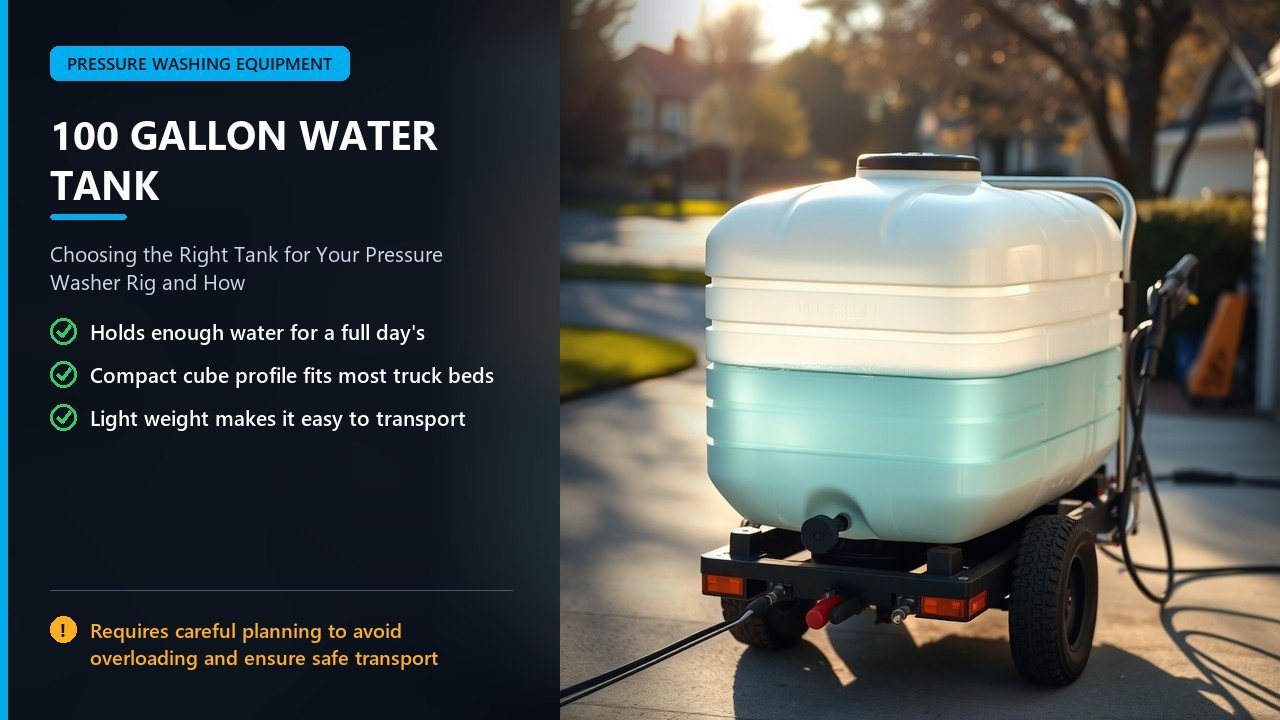
Hundred-gallon capacity matches the math of real jobs. A machine flowing 3 GPM sprays roughly 180 gallons an hour at full trigger, but real washing runs in bursts, and a 100 gallon tank covers a house wash, a long driveway, or a full trailer cleans’ morning without a panic refill. It also fits the dimensions of most truck beds and single-axle trailers, roughly four feet long and three wide in the compact cube profile, so it mounts without remaking the whole rig.
The weight is the honest trade. The tank itself is light, roughly 50 to 80 pounds of rotomolded polyethylene, but 100 gallons of water adds 834 pounds on top, and the combined load shapes every other decision, the trailer’s rating, the springs, the hitch sag, and the spot in the bed where the tank sits. The sizing stays sensible because the operator plans the load; an 800-pound wet tank is handled easily by a half-ton truck bed but asks questions of a light utility trailer, and the answers come before the trip, not during it.
One tank or two? Sometimes the optimal layout is two 50s or a 100 and a separate solution tank, and the choice rides on the plumbing. A single 100 keeps the plumbing short and the design simple, while a separate chemical tank keeps the rinse water dedicated. For the average evolving rig, the 100 gallon cube is the foundation, and dedicated solution tanks bolt on beside it as the jobs grow.
Choosing the Right 100 Gallon Tank
Material settles the first choice. Rotomolded polyethylene dominates the 100 gallon class, tough, UV-stabilized, and impact-resistant, and it is what most portable water tanks for pressure washers are molded from. Aluminum weighs a little less and looks sharper on a custom rig but costs more and dents; steel is cheaper and heavier and rusts, so serious water work passes it by. For the balance of price, weight, and longevity, the poly cube is the standard answer.
Shape follows the mount. A low, wide cube with vertical sides packs a pickup bed or trailer deck efficiently and spreads the weight low, and flat-top cubes double as work surfaces. Vertical cylinders hold the same volume in a taller footprint, which can gravity-feed a low pump better, but slosh harder without baffles. The 100 gallon horizontal and cube shapes dominate because they sit low, stable, and broad, exactly what an 800-pound moving load needs.
Baffles are the detail that separates a safe ride from a scary one. Internal walls slow the water’s momentum when the vehicle turns or stops, and an unbaffled 100 gallon tank lets a half-load surge forward into the divider with enough force to flex the plastic and shove the truck. Look for a factory-baffled tank, add internal baffles or a strap-based divider on a retrofit, and keep the load below half when the road gets windy or curvy, because the surge is the invisible hazard in every tank ride.
Mounting and Securing the Tank
Mounting starts with a flat, solid platform and enough strap points. The tank presses down with its full weight at rest and more under bumps, so it sits on a bed mat or wood frame that spreads the pressure, never on a seam, bolt head, or raised lip that could crease the plastic. Use ratchet straps or bracket mounts rated for the load, crossing them over the top so a full tank cannot shift forward, back, or sideways in a panic, and check the straps each trip, because the plastic breathes and the webbing stretches cold.
The mount height decides the plumbing. A tank mounted so its outlet sits at or above the pump’s inlet gravity-feeds reliably, which is the simplest and most forgiving arrangement; a tank sitting flat on the trailer deck with the pump beside it usually sits above enough to gravity-feed as long as the outlet and the pump inlet stay near the same level. Raising the whole tank a few inches with a stand turns a marginal setup into a dependable one and buys the pump a friendlier suction path.
The load plan covers the rest. Place the tank over the trailer axle or just ahead of it, so tongue weight stays sane and the rig tows straight; a tank hung far behind the axle lifts the tongue and skips the trailer. Recheck the hitch and the tire pressures when the tank is full, since an extra 800 pounds changes the ride, and drive the loaded miles more gently than the empty ones, because the water in a 100 gallon tank does not brake like the truck does.
Plumbing That Feeds the Pump
The tank’s outlet begins the supply train, and the quality of the plumbing decides the pump’s luck. Mount a ball valve right at the outlet so the supply can be isolated for travel and service; run a short, stiff suction hose that cannot collapse; and seat a floating strainer or a lower pickup above the sediment line, so the pump draws the cleanest water and leaves the grit at the bottom. The connection rules are the same as the suction hose guide makes plain, short, sealed, and free of air.
Air is the perennial enemy. Every coupler must seat squarely, the suction line must stay below the water level as the tank drains, and the vent must breathe, because a sealed 100 gallon tank collapses into a vacuum as water leaves and the pump starves in front of a still-full window. A screened vent, a prime-preserving foot valve, and a leak check at each connection keep the column whole from the outlet to the trigger, and a machine that sputters at a full tank is almost always drinking air, not short of water.
When the tank must sit below the pump, a small 12-volt transfer or inline pump restores the lift, and the cost is repaid the first jobsite without a tap in sight. The plumbing discipline is the whole game: outlet low, valve close, hose short, vent open, and the 100 gallon tank behaves like a full-strength faucet wherever the rig parks.
Filling the Tank Without Drama
Refilling 100 gallons is a schedule, not a chore. A standard garden spigot delivers roughly 5 to 10 gallons a minute, so a faithful 100 gallon tank can take ten to twenty minutes from an honest faucet, and the operator plans the top-up around the temperature break rather than a mid-job panic. A bulk-fill fitting that takes a larger hose, or a high-flow adapter at a hydrant where permitted, cuts the time to minutes, and a tank filled overnight from a trickling tap is a full morning of water waiting at dawn.
Where no tap exists, the water comes with the crew. A second, larger tender or a dedicated fill trailer tops up the working 100 gallon tank between jobsites, and hydrant permits and tanker service fill the tank in bulk in regions where delivery is the norm. The water itself matters as much as the schedule, fill from clean sources, screen the inlet, and keep the tank out of the algae season so the pump never drinks grit, growth, or a surprise.
Never plan to empty the tank completely. The pickup floats above the bottom by design, leaving a reserve of a few gallons that keeps sediment out of the pump, and the honest operator budgets that inaccessible heel when sizing the day. A 100 gallon tank is really a 95 usable gallon tank, and planning around the real number means the last corner of the job never runs dry a gallon early.
Splitting the 100 Gallons: Rinse and Solution Tanks
Serious washing separates the rinse supply from the chemical supply, and a 100 gallon rig can split its volume in several ways. The cleanest layout keeps the 100 gallon tank as pure rinse water and bolts a smaller dedicated solution tank beside it to feed a downstream injector, keeping chemicals out of the pump’s world entirely. Where space is tight, a two-compartment 100 gallon tank with a baffled divider and separate outlets lets the same footprint carry both clean water and a wash mixture, each drawn from its own side.
The plumbing respects the split. The rinse side feeds the pump with a short, clean suction line, while the solution side runs to the injector’s pickup on the low-pressure side, sized to the machine’s draw and the job’s chemical percentage. Labels keep the mix honest, and a flush after every chemical session protects the next rinse from a soap hangover. The soap selection guide pairs the right product with the right tank duty, and the tank split simply institutionalizes it.
Soft washing is where the split earns its keep. House siding and roof work need low pressure, high flow, and a bleach-based wash, which a 100 gallon rig delivers from the solution tank while the rinse side sweeps the residue; the chemistry dwells, the pump never gulps foam, and the machine stays healthy. A single clean-water-only 100 gallon tank still soft washes if the injector draws from its own jug, but the dedicated split removes the guesswork and makes the daily flow of the rig a routine.
Growing a Side Business Around the 100 Gallon Tank
The 100 gallon tank is often the milestone that turns a hobby into a paying rig, because it carries enough water for real jobs and enough intervals to run a schedule. A house wash, a fence line, a patio and drive combo, each fits inside one or two full loads, and the operator arrives with water in hand instead of hunting for a spigot. Sites that a smaller tank turned into logistics problems become ordinary stops, and the pricing starts to make sense at a professional pace.
The rig grows in a familiar order. The 100 gallon tank pairs with a pressure adjustment and a real flow rate, then a dedicated solution tank for soft washing, then reels and a longer hose for coverage, and finally a trailer that carries it all with proper axles and brakes. The trailer rig guides on this site map that build-out, and the tank is the quiet center at every stage, the capacity that makes the working day possible.
Business habits follow the water. Book jobs that the usable gallons cover in a single load or two, schedule refills off the clock, and track the water cost into the pricing the way a wise rig tracks fuel. The tank becomes a planning tool, not just a container, and the operator who sizes the day around the water arrives calm and leaves with every corner washed, which is exactly the reputation the side business needs to grow.
Upgrading, Retrofitting, and Selling the Rig
When a bigger job needs more than 100 gallons, the upgrade paths are clean. Add a second 100 gallon tank and manifold the outlets, or step to a single 200 vertical or 250 cube, and the same pump and plumbing scale without a redesign, since the outlet height and the fitting sizes hold steady. The old 100 keeps its value shuttling between sites as a fill tank or carries the solution duty while the new one takes the rinse, and the rig stretches rather than starting over.
Retrofits extend the same tank’s life. Add a heated tank option for winter-only region workflows, fit a larger vent and a bulk fill for faster top-ups, or bolt a sight gauge and a low-level shutoff so the pump never starves on a busy day, and each upgrade is an afternoon with hand tools. A well-maintained 100 gallon rig holds its resale astonishingly well, since the tank, straps, and baffles outlast the machines, and a clean, labeled, drained tank sells a buyer on the whole package.
The honest end of the cycle is knowing when good is enough. A rig that runs a chosen lane of jobs well, houses, driveways, fences, small flats, does not need a 500 gallon behemoth; it needs the 100 gallon tank maintained and the schedule kept. Operators who respect that boundary get years of full, reliable days from a modest tank, and the yielding of the size, exactly matched to the work at hand, is the professional discipline that makes every tank day a winner.
Winterizing and Seasonal Care
Freeze is the 100 gallon tank’s only true enemy. Water expands into ice and a partially drained plastic shell cracks wide, so before hard cold the tank drains completely, the ball valve opens, and any trapped moisture dries. The pump side gets the same ritual, and the complete winterizing guide covers the machine; the tank simply follows the same calendar, drained, vented, and stored dry under a cover.
Algae and sediment are the warm-weather hazards. A tank left half-full in the sun grows green slime that clogs screens and smells, and the fix is draining, scrubbing, and rinsing a few times a season, plus a UV cover or shaded mount to slow the growth. The bottom of the tank collects a fine grit that never fully rinses out on a splash, so a clean-out plug at the lowest point gets periodic service, and the pickup rises above it so the pump stays clean while the sediment sits out of reach.
The check comes before the first load of each season. Inspect the straps, the fittings, and the vent, look for hairline cracks around the seams and the mounting points, and fill-test for an hour on a level surface, watching the seam and the outlet for weeping. A small leak caught in the spring is a patch kit; the same leak found at a busy site is a wasted afternoon and a wet rig.
Common 100 Gallon Tank Mistakes
The loudest mistake is ignoring the weight and hanging the tank off the trailer’s tail, which lifts the tongue, wanders the rig, and ends trips in wallow. The second is skipping the baffles, letting a half-filled tank surge through corners and strain the straps and the divider. The third is sealing the vent and watching a “full” tank starve the pump, the single most confusing amateur failure pattern in the hobby.
The fourth is plumbing contempt, a long, sagging suction hose full of air pockets and quick-swap adapters that leaks pressure and prime in equal measure. The fifth is filling from a questionable source without a screen, giving the pump grit, growth, or a surprise it will later revenge on the internals. The sixth is winterizing the machine but not the tank, and finding a cracked 100 gallon hull in the corner of the shed come spring.
Every one of those mistakes reads clearly on the other side of the lesson, and each has a cheap, permanent fix, mount over the axle, buy the baffled tank, open the vent, plumb short and sealed, screen the water, and drain for winter. A 100 gallon rig handled this way becomes the dependable backbone of a side business or a serious hobby, carrying the water and the workflow to sites that would send a lesser setup home disappointed.
Frequently Asked Questions
How much does a 100 gallon water tank weigh full? Water weighs 8.34 pounds a gallon, so 100 gallons is about 834 pounds of water plus the tank and fittings, close to 900 pounds loaded. That weight shapes the mount, the trailer rating, and the driving style.
Will a 100 gallon tank fit in my truck bed? Most compact cube models measure roughly four feet long, three feet wide, and two feet deep, fitting standard full-size beds easily and many midsize beds. Measure the bed and the tank’s footprint before ordering, and clear the wheel wells.
Do I need a separate pump to feed from the tank? Only if the tank sits too low or too far from the machine. Mount the outlet at or above the pump’s inlet with a short, air-tight suction line, and most machines self-prime; high-flow rigs may still want a 12-volt helper.
How long does it take to fill 100 gallons? A typical spigot flows 5 to 10 gallons a minute, so 10 to 20 minutes at full flow. A bulk high-flow adapter or a larger tender cuts the time to minutes, and an overnight fill from a slow tap is a full morning of supply.
Why does my machine lose pressure from the tank? Air is the usual culprit, a leaking suction joint, a settled pickup above the falling water line, or a blocked vent. Seal the line, keep the pickup submerged, open the vent, and the pump returns to full steady output.
Final Thoughts on the 100 Gallon Tank for Pressure Washer Work
The 100 gallon water tank for pressure washer rigs is the size where a hobby crosses into real capacity, enough water for a full working day, low and broad enough to sit on a household trailer, and heavy enough to demand respect on the road. Its whole story is balance, the volume that covers the jobs against the eight-pounds-a-gallon weight that must be mounted, baffled, and driven like a load. Get the planning right and the tank becomes the quiet guarantee that the pump never starves.
Mount it over the axle on a solid platform with rated straps, choose a baffled poly cube, and keep the outlet, valve, suction, and vent in a tidy, air-free line. Fill on a schedule from a clean source, plan around the usable gallons, and drain it completely for the freeze. Handled the same way season after season, the 100 gallon tank outlasts several machines, and every clean it delivers starts the same way, with the simple promise of enough water riding right behind the rig.