If you are shopping for an affordable gas pressure washer, the Terminator pressure washer is a name that comes up in the budget and mid-range market. Like many value-priced brands, Terminator machines offer solid cleaning power at a low price, but the buyer needs to know what they are getting — and what to watch for.
This guide explains what a Terminator pressure washer is, typical specs and features, how it compares, what to check before buying, and how to keep one running.
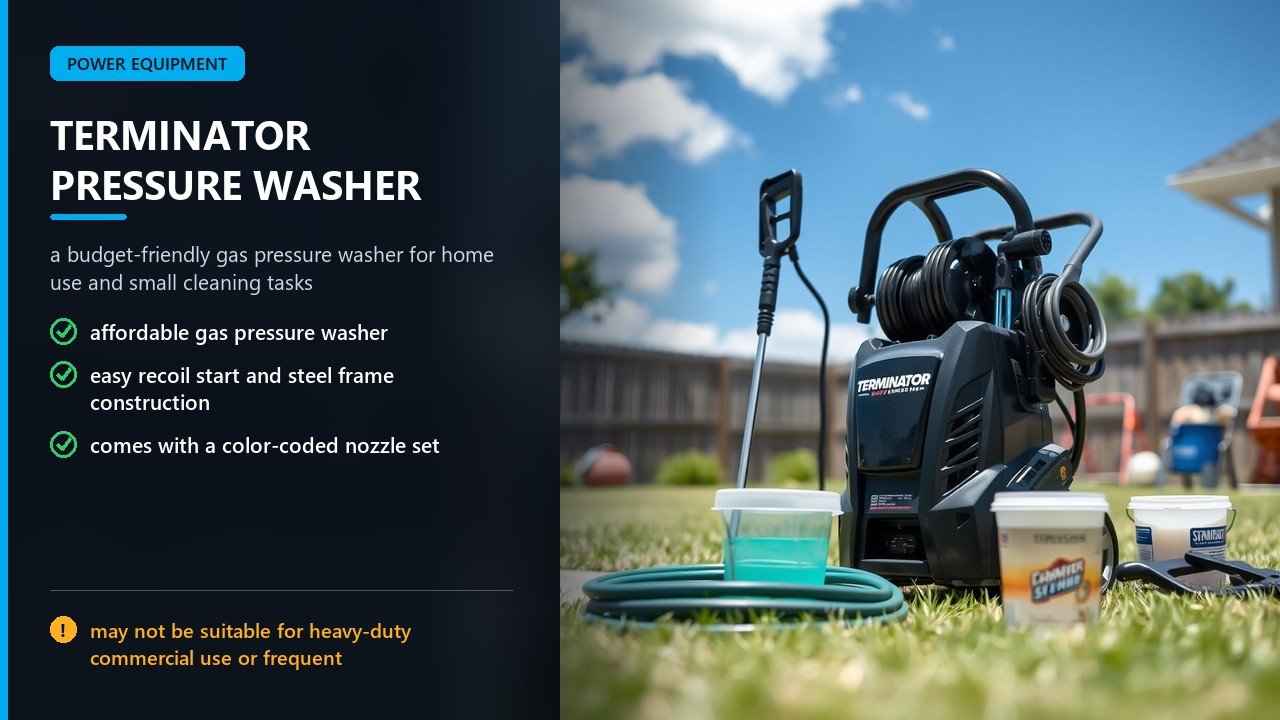
What a Terminator Pressure Washer Is
A Terminator pressure washer is a value-focused gas pressure washer brand, typically sold through retailers and online marketplaces, offering cleaning power at an entry to mid-level price.
- Gas-powered — most models use a small gas engine.
- PSI range — commonly 2,700 to 3,200 PSI.
- Flow — typically around 2.5 GPM.
- Pump type — often axial; some models might use triplex.
- Accessories — nozzles, wand, and hoses included.
- Price — positioned below premium brands.
Quick Note: Terminator is a budget-oriented line, not a premium industrial brand. Buy it for value and home use, not for daily commercial duty.
Typical Specifications
| Spec | Typical Value |
|---|---|
| Pressure | 2,700–3,200 PSI |
| Flow | 2.4–2.8 GPM |
| Engine | Small gas engine (e.g., 160–210 cc class) |
| Pump | Axial (some triplex) |
| Hose | 25–30 ft |
| Nozzles | Color-coded set |
| Warranty | Limited; varies by seller |
Note: Published specs vary by model and seller. Always confirm the exact PSI, GPM, pump type, and warranty for the specific unit.
Features to Expect
| Feature | Details |
|---|---|
| Gas engine | Recoil start; no cord needed |
| Steel frame | Tubular cart with wheels |
| Spray gun | M22 or quick-connect |
| Quick-connect nozzles | 0°, 15°, 25°, 40°, soap |
| Detergent tank | On many models |
| Pneumatic wheels | Easier movement on rough ground |
These are the features common to value gas washers. The Terminator line follows this familiar formula.
Where Terminator Fits in the Market
| Tier | Typical Buyer |
|---|---|
| Budget / value | Occasional home use |
| Mid-range | Regular home and light pro use |
| Premium / commercial | Daily professional duty |
A Terminator generally sits in the budget-to-mid tier: capable for driveways, decks, and vehicles, but not built for all-day commercial work.
What to Check Before Buying
| Check | Why It Matters |
|---|---|
| Exact PSI and GPM | Real cleaning power, not marketing numbers |
| Pump type | Triplex is rebuildable; axial usually is not |
| Engine brand | Known engines are easier to service |
| Parts availability | Can you get nozzles, hoses, and pumps? |
| Warranty terms | Length and what is covered |
| Reviews | Real-world reliability and support |
| Return policy | Protection if the unit is defective |
Warning: Budget listings sometimes overstate PSI. Look for a clear working-pressure figure and honest GPM, not peak burst numbers.
Strengths and Weaknesses
| Strengths | Weaknesses |
|---|---|
| Low purchase price | Shorter lifespan than premium brands |
| Good power for the money | Axial pump is usually not rebuildable |
| Gas engine avoids cords | Engine maintenance required |
| Widely available | Support quality varies by seller |
| Familiar accessory fittings | Some parts may be brand-specific |
Short Note: Value gas washers are a good fit for occasional home use. They are a poor fit for daily commercial cleaning, where a rebuildable triplex machine pays off.
Common Uses
- Driveways and sidewalks — concrete cleaning.
- Decks and fences — wood and composite prep.
- Vehicles — car and truck washing.
- Patios and siding — exterior cleaning.
- Fences and outbuildings — farm and property tasks.
- Equipment — light machinery cleaning.
For these home and light property jobs, a Terminator-class machine delivers real value.
Pump Type and Lifespan
| Pump | Lifespan |
|---|---|
| Axial | A few seasons with care; not rebuildable |
| Triplex | Years; rebuildable with kits |
| Sealed (non-oil) | Shorter; often replaced rather than rebuilt |
If your Terminator has an axial pump, plan on replacing the pump rather than rebuilding it when it wears out. If it has a triplex pump, rebuilding is possible.
Accessories That Fit
| Accessory | Fit |
|---|---|
| Nozzles | Standard quick-connect |
| Turbo nozzle | With matching fitting |
| Surface cleaner | Match GPM and pressure |
| Extension wand | Standard quick-connect |
| Replacement hose | Match M22 or QC fittings |
| Foam cannon | With correct adapter |
Most Terminator-class washers use standard fittings, so common accessories and replacement parts generally fit.
Maintenance Schedule
| Task | Interval |
|---|---|
| Check engine oil | Before each use |
| Check pump oil (if applicable) | Every use |
| Clean air filter | Regularly |
| Change engine oil | Per engine manual |
| Clean inlet filter | Every use |
| Winterize | Before freezing |
A value machine still responds well to basic maintenance. Oil, air, and clean water keep it running.
Troubleshooting Common Problems
| Problem | Likely Cause | Fix |
|---|---|---|
| Engine won’t start | Old fuel, spark plug, air filter | Fresh fuel; service ignition |
| Low pressure | Worn nozzle, air, or unloader | Replace nozzle; bleed air |
| Pulsing spray | Air entering on the suction side | Seal the inlet connections |
| Water in pump oil | Failed pump seals | Rebuild or replace the pump |
| Leak at fittings | Loose or worn O-rings | Reseat; replace O-rings |
Most Terminator-class issues trace to fuel, air, nozzles, or a worn pump — all fixable with basic tools and parts.
Replacing the Pump
| Step | Action |
|---|---|
| 1. Read the pump label | Note model, PSI, and GPM |
| 2. Match the shaft and flange | Ensure a direct fit |
| 3. Order the replacement | Exact-match or compatible pump |
| 4. Remove the old pump | Unbolt and disconnect |
| 5. Fit the new pump | Align, bolt, fill oil, bleed |
| 6. Test | Check pressure and leaks |
Note: On many value machines, replacing the axial pump is cheaper than replacing the whole unit — and an upgrade to triplex may be possible.
Common Mistakes to Avoid
- Buying on PSI claims alone. Check flow and pump type too.
- Using old gas. Ethanol fuel gums up small engines.
- Skipping engine oil checks. A dry engine seizes.
- Running the pump dry. Destroys seals.
- Deadheading. Overheats the pump.
- Leaving water in over winter. Cracks the pump.
- Ignoring the warranty details. Costs you coverage.
Is a Terminator Right for You?
| If You Need… | Verdict |
|---|---|
| Occasional home cleaning | Likely a good value |
| Regular property maintenance | Reasonable; care for the pump |
| Daily commercial duty | Choose a premium rebuildable machine |
| Long-term reliability | Compare against mid-range brands |
Match the machine to the work. A value washer is a great tool for home use and a poor one for commercial demands.
How to Read Pressure Washer Specs
Value brands live or die on their spec sheets. Knowing which numbers matter keeps you from overpaying for marketing and underpaying for real capability.
| Spec | What It Tells You |
|---|---|
| Working PSI | The real cleaning pressure |
| GPM | Speed and rinsing volume |
| Cleaning units | PSI × GPM — total cleaning power |
| Engine cc / HP | Power available to drive the pump |
| Pump type | Rebuildability and lifespan |
| Hose length | Reach before you need an extension |
Note: Some listings quote “max” or “peak” pressure. That is not the same as sustained working pressure, and it is the number that matters for cleaning.
Using a Value Washer Safely
- Wear eye protection and closed-toe shoes.
- Never point the nozzle at people or pets.
- Keep hands clear of the nozzle at all times.
- Use the trigger lock when the gun is set down.
- Match the nozzle to the surface to avoid damage.
- Keep the engine away from water and fumes.
- Let the machine cool before refueling.
Even a budget gas washer produces enough pressure to cause real injury. The basic safety rules still apply.
Storage and Off-Season
| Task | Detail |
|---|---|
| Drain water | Empty pump, hose, and gun |
| Use pump protector | Prevents freeze and corrosion |
| Stabilize fuel | Or drain the tank |
| Change oil | Fresh oil for storage |
| Store covered | Sheltered from weather |
Value machines reward off-season care as much as premium ones. Winterizing and fuel care prevent most storage damage.
Accessory Upgrades Worth Buying
| Upgrade | Benefit |
|---|---|
| Surface cleaner | Faster, even concrete cleaning |
| Turbo nozzle | Extra force on hard surfaces |
| Longer hose | More reach around the property |
| Foam cannon | Better vehicle washing |
| Inline filter | Protects the pump from debris |
A surface cleaner and a turbo nozzle are the two upgrades that change how much a value washer can do.
Warranty and Support Realities
| Item | Reality |
|---|---|
| Coverage length | Often short on value brands |
| What is covered | Excludes wear items and abuse |
| Service access | Varies; may be mail-in |
| Receipt needed | Keep proof of purchase |
Short Note: Keep your receipt and register the product if possible. Warranty support is far easier with proof of purchase in hand.
Value vs Longevity: The Honest Trade-off
- Lower upfront cost means less money at risk.
- Axial pumps generally mean replacement rather than rebuild.
- Shorter life is normal for value machines.
- Good care can still deliver many useful seasons.
- Match to light duty and the math works in your favor.
Buying a value washer is a rational choice when the work is light and occasional. It becomes a mistake only when the work demands commercial endurance.
How Terminator Compares to Other Value Brands
| Comparison | Consideration |
|---|---|
| Vs. store brands | Similar specs; check pump type and warranty |
| Vs. premium brands | Premium costs more but lasts and rebuilds |
| Vs. electric washers | Gas gives more power; electric is quieter |
| Vs. commercial units | Commercial handles daily duty; value does not |
Short Note: The name matters less than the specs, pump type, and support. A well-chosen value machine can outperform a poorly chosen premium one for home use.
Getting the Most From a Value Washer
- Use fresh fuel and add a stabilizer for storage.
- Check engine and pump oil before every use.
- Use the right nozzle for each surface.
- Keep the inlet water clean and abundant.
- Never deadhead or run dry.
- Winterize every year.
- Buy common accessories that fit standard fittings.
- Plan for pump replacement rather than rebuild if it is axial.
With basic care, a value gas washer can serve a household well for many seasons of typical cleaning.
Engine Care for Small Gas Washers
| Item | Interval |
|---|---|
| Engine oil level | Before each use |
| Engine oil change | First 5–8 hours, then per manual |
| Air filter | Clean or replace regularly |
| Spark plug | Inspect and replace as needed |
| Fuel system | Drain or stabilize before storage |
Engines fail more often than pumps on value machines — usually from old fuel and skipped oil changes. Engine care is pump protection by another name.
Frequently Asked Questions
What is a Terminator pressure washer? A value-focused gas pressure washer brand, typically offering 2,700–3,200 PSI at a budget-friendly price.
Are Terminator pressure washers any good? For occasional home use, yes. For daily commercial work, a premium rebuildable machine is a better investment.
What pump do Terminator washers use? Many models use axial pumps, which are usually not rebuildable. Confirm the pump type on the specific unit.
Where can I get parts? Fittings, nozzles, and hoses are standard. Pumps and engine parts may be model-specific, so check availability before buying.
Can I upgrade the pump? Sometimes. If a triplex pump matches the engine shaft and flange, it can be a worthwhile upgrade.
Do Terminator washers have a warranty? Yes, typically limited and dependent on the seller. Read the terms before purchase.
Final Thoughts
A Terminator pressure washer is a value-oriented gas machine aimed at home and light-duty users. It delivers solid cleaning power at a low price, with the trade-off being a mostly non-rebuildable axial pump and variable support.
Buy it for occasional home cleaning, check the real specs and pump type, care for the engine and pump, and set realistic expectations. For related reading, see our guides on the gas engine pressure washer and the pressure washer pump 3000 psi.