Ask a room full of pressure washing contractors what engine they trust to start on the first pull in February and run all day in July, and you will hear the same answer over and over: the Honda GX390. It is the engine that powered Marcus’s first real commercial machine, the one Dana borrowed before she bought her hot water rig, and the one still bolted to thousands of trailers across the country. When a manufacturer wants to signal that a pressure washer is serious, it pairs a triplex pump with a GX390 and puts 4,000 PSI and 4 GPM on the spec sheet.
If you are shopping for a gas pressure washer in the commercial range, you will almost certainly run into the Honda GX390. Understanding what this engine is, why it dominates, what it can realistically power, and how to choose and maintain a machine built around it will help you buy the right unit and get years of hard work out of it. This guide covers all of it in plain language.
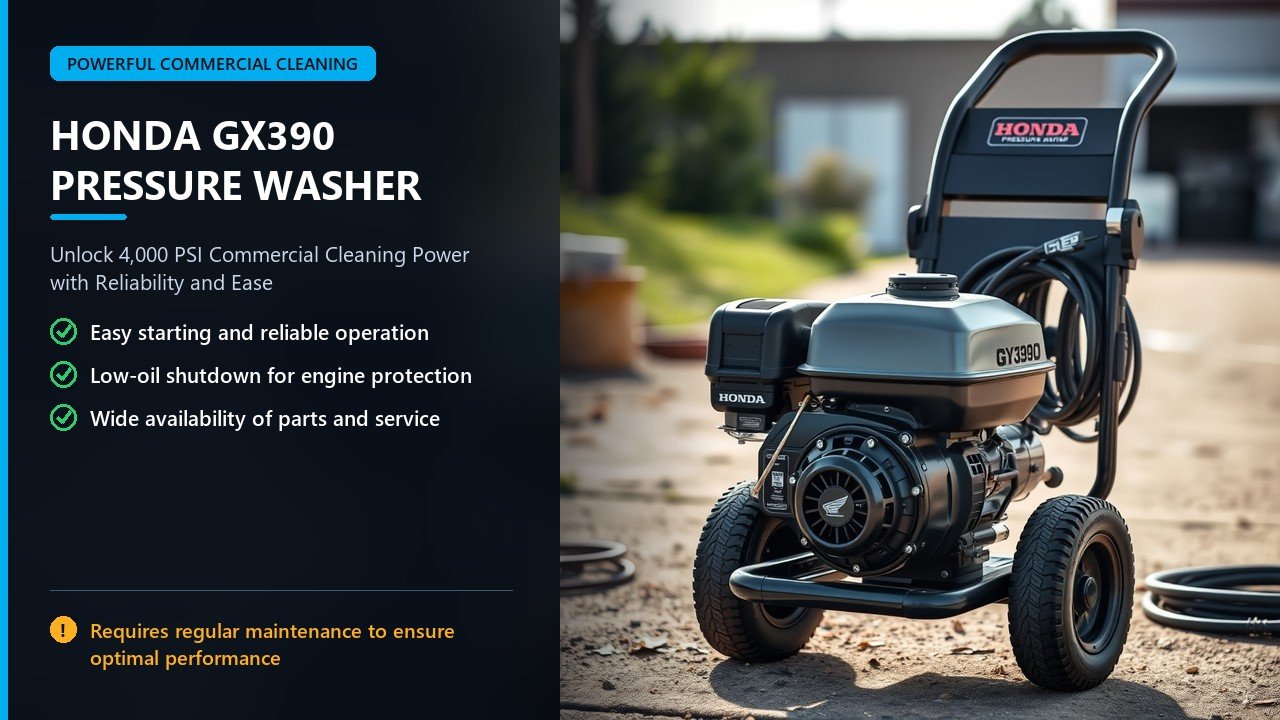
What Is a Honda GX390 Pressure Washer
A “Honda GX390 pressure washer” is simply a pressure washer whose power plant is the Honda GX390 engine. The engine is a 389cc, overhead-valve (OHV), four-stroke, air-cooled, horizontal-shaft commercial engine. It is one of the most widely used small engines in the world, powering not just pressure washers but generators, pumps, go-karts, and construction equipment. That ubiquity is a huge advantage: parts, service knowledge, and accessories are everywhere.
On a pressure washer, the GX390 typically drives a triplex plunger pump through either a direct-drive or belt-drive setup. The engine’s output is matched to a pump that produces roughly 4,000 PSI at 4.0 GPM, though you will also see it on machines rated anywhere from 3,800 PSI up to around 4,500 PSI depending on the pump and setup. That combination, high pressure plus strong flow from a reliable commercial engine, is what defines this class of machine. Machines powered by this engine range from $1,000 direct-drive units to $5,000 belt-drive commercial rigs.
Why the GX390 Dominates Pressure Washers
The GX390 earned its reputation through a few qualities that matter enormously on the job.
Reliability and easy starting
Commercial users do not care about horsepower figures on paper; they care about whether the engine starts and runs when they have a customer waiting. The GX390 is famous for easy cold starts, smooth running, and resistance to the abuse of daily field use. Honda’s OHV design runs cooler and more efficiently than older flathead engines, which contributes to long life.
Low-oil shutdown
Most GX390-powered pressure washers include Honda’s Oil Alert low-oil shutdown, which cuts the engine if oil pressure or level drops too low. On a machine that runs for hours, often on uneven ground or slopes, that protection saves engines from the single most common cause of small-engine death: running low on oil.
Parts and service everywhere
Because the GX390 is so common, you can find air filters, spark plugs, gaskets, carbs, and rebuild parts at nearly any small-engine shop or online. When something wears out, you fix it, not replace the whole machine. That serviceability is a big part of the engine’s total cost of ownership advantage.
Power matched to real cleaning
The GX390 produces roughly 11 to 13 horsepower, enough to drive a triplex pump to 4 GPM at 4,000 PSI without strain. That is a genuinely useful amount of cleaning power for professional work, and it is why so many machines in the “commercial 4 GPM” class use this engine.
Honda GX390 Pressure Washer Specs You Should Know
Here is what to expect from a typical machine built around this engine.
| Specification | Typical Value |
|---|---|
| Engine | Honda GX390, 389cc, OHV, 4-stroke, air-cooled |
| Horsepower | About 11 to 13 HP |
| Starting | Recoil or electric start, depending on model |
| Fuel capacity | About 1.5 to 1.7 gallons |
| Engine oil | SAE 10W-30 or SAE 30, per manual |
| Pressure | Commonly 4,000 PSI (range to about 4,500) |
| Flow | Commonly 4.0 GPM (range about 3.5 to 4.8) |
| Pump | Triplex plunger (CAT, General Pump, Comet, and others) |
| Drive type | Direct or belt drive |
| Cleaning units | About 16,000 (PSI x GPM) |
| Compliance | Many models are 49-state (not for sale in California) |
Every machine built around the GX390 shares the engine, but pressure, flow, pump brand, and frame differ by manufacturer. That is where real value and durability separate one unit from another.
Direct Drive Versus Belt Drive on a GX390 Machine
This choice matters as much as the engine itself, because it affects pump life and machine feel.
Direct drive couples the pump directly to the engine shaft. It is compact, lighter, and less expensive, and it has fewer parts to maintain. The trade-off is that the pump absorbs engine heat and vibration and spins at high RPM, which wears it faster under heavy daily use. Direct-drive GX390 machines are common and perfectly adequate for frequent but not relentless use.
Belt drive uses a belt and pulley system to separate the pump from the engine and reduce its RPM. The pump runs cooler and smoother, which dramatically extends its life, and the belt can be swapped easily. Belt-drive GX390 units are larger, heavier, and cost more, but for a contractor running the machine every day, the longer pump life often justifies the price. Many professional-class machines, including some Karcher commercial units, use this configuration.
What a GX390 Pressure Washer Can Clean
At roughly 4,000 PSI and 4 GPM, a GX390 machine is an all-purpose commercial cleaner.
- Concrete driveways, patios, and sidewalks. Fast, thorough cleaning with a 25-degree tip or a surface cleaner. The 4 GPM flow rinses quickly.
- Decks and fences. Wood restoration and prep with wider tips and reduced pressure.
- Siding and brick. Mildew and grime removal with a 25 or 40-degree tip.
- Vehicles and equipment. Cars, trucks, trailers, and machinery, using wider tips and care around paint and trim.
- Paint and coating prep. Stripping loose coatings and prepping surfaces before finishing.
- Graffiti and heavy staining. The higher pressure handles tough marks on hard surfaces.
It is a cold-water machine, so heavy grease and oil are better served by a hot water unit. For surface-by-surface guidance, our guide to the best PSI for pressure washer tasks helps you match pressure to the job.
Popular Machines That Use the GX390
Because the engine is so widely adopted, you can find GX390 pressure washers from many brands and in many configurations.
- Karcher HD 4.0/40 GB GP. A cold-water commercial unit running 4.0 GPM at 4,000 PSI with a belt-drive GP pump and the GX390 engine, built for serious commercial use.
- Generac commercial 4,000 PSI. A GX390-powered machine with a CAT triplex pump, folding handle, and a three-wheel design for mobility.
- SIMPSON ALH4240. A GX390 machine with a CAT triplex pump on an aircraft-aluminum frame producing 4,200 PSI at 4 GPM. Our ALH4240 pressure washer review covers it in detail.
- APS, BE, and PSI units. Various direct-drive and belt-drive GX390 machines with General, Comet, or CAT pumps, often with electric start and aluminum or steel frames.
Many of these also offer electric-start versions of the GX390 for easier starting, which is a real convenience on commercial jobs.
GX390 Compared to Other Honda Engines
Buyers often weigh the GX390 against smaller and larger Honda engines. The table below puts them in perspective.
| Engine | Displacement | Typical Pressure Washer Output | Best For |
|---|---|---|---|
| Honda GX160 | 163cc | 2,500 to 3,000 PSI, 2.5 GPM | Light residential |
| Honda GX200 | 196cc | 2,700 to 3,200 PSI, 2.5 to 3 GPM | Residential and light use |
| Honda GX390 | 389cc | 4,000 PSI, 4 GPM | Commercial all-purpose |
| Honda GX690 | 688cc | 3,000 to 4,000+ PSI at 8 GPM | High-flow commercial rigs |
The GX390 is the sweet spot for a single-operator commercial machine: far more capable than the small engines, and far more affordable and manageable than the GX690, which is built for high-flow 8 GPM rigs. If your work calls for high flow, compare this engine against the bigger option in our guide to the 13 HP Honda pressure washer and think about how much water you can realistically supply.
Buying a GX390 Pressure Washer
When you shop, look past the engine badge and evaluate the whole package.
- Pump brand and type. A triplex pump from CAT, General Pump, or Comet will outlast a bargain pump. Confirm it is rebuildable.
- Drive type. Direct for lighter duty and lower cost; belt for daily commercial use and longer pump life.
- Frame. Aluminum frames are lighter and resist corrosion; steel frames are heavier but often cheaper. Check the warranty, as some frames carry a lifetime guarantee.
- Starting. Manual recoil is simple and light; electric start is convenient on cold mornings and for larger crews.
- Accessories. Quality hose, gun, wand, and nozzles matter. A steel-braided non-marring hose and a good trigger gun improve the whole experience.
- Unloader and thermal protection. Adjustable unloader and a thermal relief valve protect the pump. Confirm both are present and functional.
- Compliance. Many GX390 machines are 49-state models. If you live in California, confirm the unit is CARB-compliant before buying.
Our Honda GX390 engine performance guide and the best pressure washer wand guide go deeper on the details. Choose the machine, not just the engine.
Maintaining a GX390 Pressure Washer
This engine is durable, but it rewards routine care. Build a schedule and stick to it.
- Engine oil. Check before each use and change per the Honda schedule, typically the first month or 20 hours, then every 50 to 100 hours depending on conditions. Use the recommended 10W-30 or SAE 30.
- Air filter. Clean or replace regularly; a dirty filter robs power and wastes fuel.
- Spark plug. Inspect and replace on schedule for easy starts.
- Pump oil. Check the sight glass and change with the correct non-detergent oil. Our non-detergent pump oil guide explains the type.
- Unloader and thermal valve. Verify they work and do not leak.
- Nozzles and gun. Clear debris, replace worn nozzles, and check o-rings. Our pressure washer gun guide covers replacement options.
- Winterizing. Run the pump dry or use antifreeze before freezing weather. Our winterizing guide walks through it.
Inside the GX390 Engine
Knowing a few engine basics helps you run and maintain the machine with confidence. The GX390 is a single-cylinder, air-cooled, overhead-valve engine. Overhead-valve designs place the intake and exhaust valves in the cylinder head above the piston, which improves airflow and combustion efficiency compared with older flathead designs. That means more power per displacement, better fuel economy, and cooler running.
Air cooling relies on fins on the cylinder and a fan to move air across them, which is why keeping the cooling fins and air filter clean matters so much. A clogged cooling system leads to overheating and shortened engine life. The engine uses a splash lubrication system, meaning oil is thrown around internally to lubricate moving parts, so the oil level must always be correct. The low-oil sensor protects against catastrophic damage, but it is a safety net, not a substitute for checking oil.
Fuel delivery is through a carburetor on most models, though some applications use fuel injection. A manual choke enriches the mixture for cold starts. Because the engine is so common, carburetors, gaskets, and rebuild kits are inexpensive and easy to find. Treat the fuel system well by using fresh gasoline, adding a stabilizer for storage, and avoiding ethanol-heavy fuel where possible, and the carburetor will rarely give you trouble.
Startup, Operation, and Shutdown Routine
A consistent routine protects the engine and pump and keeps the job running smoothly.
Before you start
- Position the machine on level ground, outdoors, away from windows and vents.
- Check engine oil with the dipstick and pump oil at the sight glass.
- Fill the fuel tank with fresh unleaded gasoline and open the fuel valve.
- Connect the water supply and purge air from the system with the trigger pulled.
- Verify all hose connections and the correct nozzle for the job.
Starting and running
- Move the choke to the closed position for a cold start, then start the engine and open the choke as it warms.
- Squeeze the trigger to begin cleaning and adjust pressure with the unloader if the job calls for less power.
- Keep the machine on level ground and never let it run in bypass for more than a minute or two.
Shutdown
- Release the trigger, shut off the engine, and turn off the water supply.
- Relieve pressure by squeezing the trigger once more, then disconnect hoses.
- Flush the detergent system and store the machine protected from freezing.
Cost of Ownership and Value
A GX390 pressure washer costs more than a homeowner machine, but it also delivers far more and lasts longer. The table below gives a rough sense of value across the class.
| Machine Class | Typical Price | Expected Lifespan | Best For |
|---|---|---|---|
| Homeowner gas (axial pump) | $300 to $600 | A few seasons | Occasional residential use |
| Direct-drive GX390 | $1,000 to $2,000 | Several years with care | Frequent residential and light commercial |
| Belt-drive GX390 | $2,500 to $5,000 | Many years, rebuildable | Daily commercial cleaning |
The value equation favors the GX390 class because the pump is rebuildable and the engine parts are cheap and available. Instead of replacing a disposable unit every couple of seasons, you service a machine that keeps working. Add the low-oil protection and reliable starting, and the extra up-front cost is repaid through uptime and longevity. For a business, downtime is the real enemy, and a machine that starts every time is worth a premium.
GX390 Versus Kohler and Budget Engines
The GX390 is not the only engine in this range. Kohler makes solid commercial engines that power comparable machines, and many budget machines use clone engines, sometimes called “Chonda” engines, that imitate the Honda design at a lower price. Our pressure washer Kohler engines article covers the main alternative.
Kohler engines are reputable and often found on quality machines, and choosing between Honda and Kohler is frequently more about which machine and pump you prefer than about the engine brand. Budget clone engines can work well for infrequent residential use, but they typically lack the same level of parts support, build consistency, and resale value. For a professional who depends on the machine, the genuine Honda GX390 remains the safest choice, and it is a large part of why GX390 machines hold value well on the used market.
Common Issues and How to Handle Them
- Won’t start. Check fuel, fuel valve, choke, spark plug, and oil level. Low oil engages the safety shutdown and prevents starting.
- Surges or runs rough. Often a dirty carburetor or stale fuel. Use fresh fuel and a stabilizer, and clean or rebuild the carb if needed.
- Smoking. Usually overfilled oil or a tipped machine. Correct the oil level and let it settle.
- Pump loses pressure. Worn pump valves, seals, or a failing unloader. Rebuild kits are available for triplex pumps.
- Pulsing or surging spray. Air in the lines or a partially clogged inlet filter. Check the water supply and 50-mesh filter.
- Overheating in bypass. Do not idle the machine with the trigger released; shut it down.
Frequently Asked Questions
Is the Honda GX390 good for a pressure washer? Yes. It is one of the best small engines for commercial pressure washers, known for reliable starting, durability, low-oil shutdown protection, and wide parts availability.
What PSI and GPM does a GX390 pressure washer produce? Commonly 4,000 PSI at 4.0 GPM, though pumps and setups vary from about 3,500 to 4,500 PSI and 3.5 to 4.8 GPM.
How many horsepower is the GX390? About 11 to 13 horsepower.
Does the GX390 have low-oil shutdown? Most pressure washers using this engine include Honda’s Oil Alert low-oil shutdown, which protects the engine.
Direct drive or belt drive GX390? Direct drive is lighter and cheaper; belt drive runs the pump cooler and smoother for longer life, which suits daily commercial use.
What oil goes in a GX390 pressure washer engine? SAE 10W-30 or SAE 30, per the engine manual, checked before each use and changed on schedule.
Is a GX390 machine available in California? Many are 49-state models. Check for a CARB-compliant version if you live in California.
What pump should pair with a GX390? A triplex plunger pump from a reputable brand such as CAT, General Pump, or Comet for long service life.
Final Thoughts on the Honda GX390 Pressure Washer
The Honda GX390 has earned its place as the go-to engine for commercial-grade gas pressure washers. Paired with a quality triplex pump, it delivers a genuinely useful 4,000 PSI at 4 GPM, powers through concrete, decks, siding, and equipment, and does it with the reliability that keeps a business moving. Its low-oil shutdown, easy starting, and endless parts availability make it a sensible long-term choice rather than a disposable one.
When you buy, remember that the engine is only half the story. The pump, drive type, frame, and accessories determine how long and how well the machine serves you, and how you maintain the engine and pump determines how many seasons it runs. Choose a GX390 machine with a rebuildable triplex pump, protect it with proper oil changes and winterizing, and it will start on the first pull and clean hard for years, exactly like the ones on all those trailers.
Sources and Further Reading
- Honda Engines, GX390 commercial engine specifications and support: engines.honda.com
- Karcher, HD 4.0/40 GB GP commercial pressure washer with Honda GX390: karcher.com
- Generac, commercial 4,000 PSI pressure washer specification sheet: generac.com
- U.S. Occupational Safety and Health Administration (OSHA), hand and power tool safety: osha.gov