When a storm dropped a big oak across Tom’s back fence, the cleanup was never the hard part. Cutting the trunk was straightforward. The miserable part was the tangle of branches sprouting off it like a stubborn shrub, each one fighting the saw, pinching the bar, and turning a two-hour job into an all-day wrestling match. That day taught him exactly what a dedicated limbing saw is for. A saw that is light, fast, and built to dance through branch after branch is not a luxury; it is the tool that turns a chaotic pile of wood into neat, manageable firewood.
Stihl sits at the center of that conversation because the company makes some of the most trusted limbing and arborist saws in the world. From the compact top-handle models used by professional tree climbers to the lightweight rear-handle saws that homeowners run for storm cleanup, the Stihl lineup covers nearly every limbing job. The trick is knowing which one fits your work, your experience, and your safety comfort level.
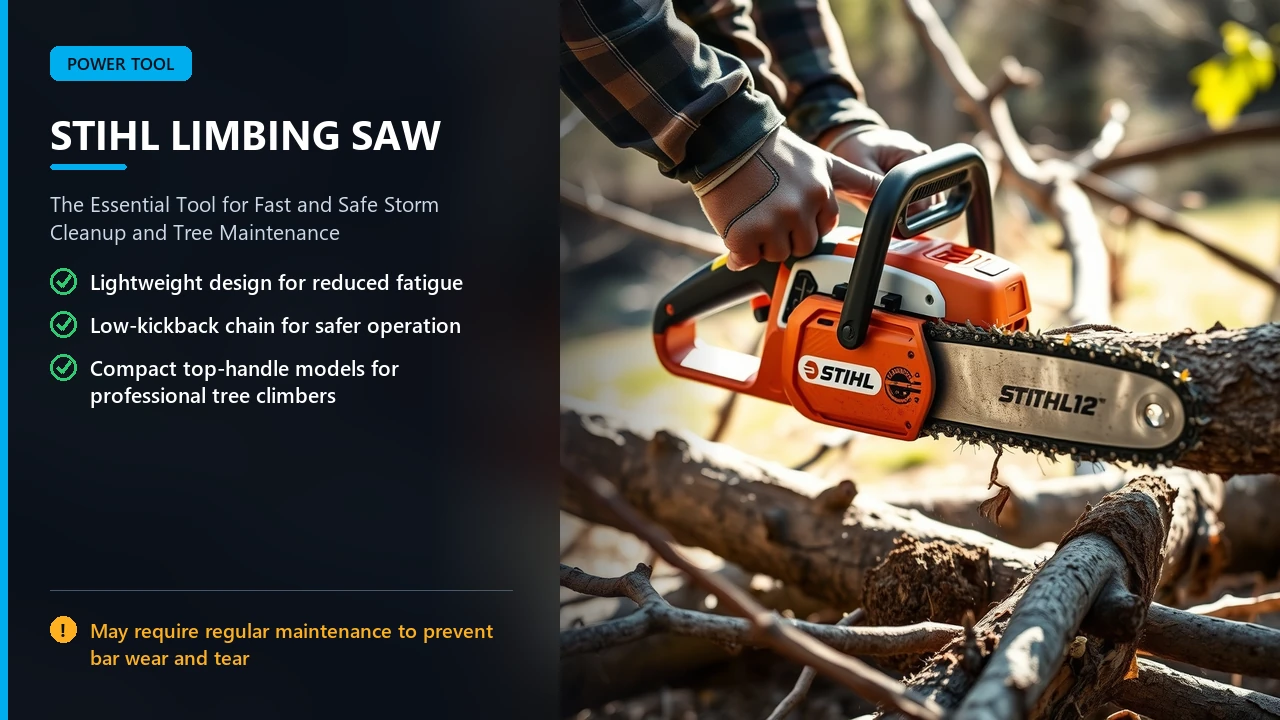
What Makes a Limbing Saw Different
Limbing is the job of cutting the branches off a tree that is already on the ground, or off sections that have already been felled. It is not the same as felling a standing tree or bucking a trunk into rounds, and it rewards a different kind of saw. Where a felling saw benefits from power and a longer bar, a limbing saw benefits from being light, quick to rev, and easy to maneuver in tight, tangled spaces.
That is why the best limbing saws feel almost nimble in the hand. They use small displacement engines or compact electric motors, short guide bars, and narrow chains that slice through green wood with very little effort. The operator holds the saw in many different positions while limbing, sometimes holding it sideways, sometimes reaching across, so weight and balance matter as much as raw horsepower.
A heavy saw tires you fast when you are working through dozens of branches. A light saw lets you keep cutting safely for longer, and safety and fatigue are deeply connected. The saw that keeps you fresh is often the saw that keeps you safe.
Why Stihl for Limbing Work
Stihl has been building chainsaws for nearly a century and dominates the professional arborist market for good reasons. The saws start reliably, hold up to daily abuse, hold their value, and are backed by one of the largest dealer and service networks in the country. For limbing specifically, Stihl offers models that are genuinely light without feeling flimsy, and the company’s Picco chain systems are excellent for the fast, clean cutting that limbing demands.
Stihl also draws a clear line between professional and homeowner equipment, and it enforces that line with its safety guidance. This matters because the most misunderstood tool in the whole catalog is the top-handle saw. You can read Stihl’s official product pages and manuals at Stihl USA, and they are unusually blunt about who should and should not use certain models.
The brand also backs up its safety message with training resources and dealer support, which matters when you are holding a cutting tool near your body. Because limbing puts the saw close to you and sometimes below your waist, good technique and the right saw are not optional.
Top-Handle vs Rear-Handle Limbing Saws
This is the single most important distinction in the whole category, and getting it wrong is genuinely dangerous.
Top-handle saws, often called arborist or in-tree saws, place the rear handle directly on top of the engine. This design lets a climber hold and control the saw with one hand while the other hand manages ropes and positioning in a tree. Stihl’s own product pages state that these saws are for professional in-tree use only. Models like the MS 194 T and MS 201 T C-M fall into this group. Stihl’s manuals are blunt: these saws are not designed for ground cutting such as felling and bucking, and the operator manuals do not even include ground-limbing instructions for them.
Rear-handle saws are the familiar design most people picture, with a rear handle behind the engine and a front handle across the top. They offer more leverage, better two-handed control, and a safer grip for ground work. For limbing a tree that is already down, a lightweight rear-handle saw is the correct and far safer choice for almost everyone.
Stihl Limbing Saw Models at a Glance
Stihl offers a range of saws that work well for limbing depending on your experience and how much you cut. This table highlights the most common choices, from homeowner gas saws to professional arborist models.
| Model | Handle Style | Best Use | Who It Is For |
|---|---|---|---|
| MS 170 | Rear handle | Light limbing, pruning, small cleanup | Homeowners |
| MS 180 | Rear handle | Storm cleanup, branch removal | Homeowners |
| MS 194 C-E | Rear handle | Lightweight limbing and firewood | Homeowners and light pro |
| MS 211 | Rear handle | Frequent limbing and small felling | Property owners, light pro |
| MS 194 T | Top handle | In-tree professional limbing | Trained arborists only |
| MS 201 T C-M | Top handle | Professional in-tree work | Trained arborists only |
For most people who cut branches on the ground, the lightweight rear-handle models make the most sense. The MS 170 and MS 180 are affordable entry points that handle occasional storm cleanup and pruning. The MS 194 C-E and MS 211 step up in capability for people who cut more often or tackle slightly larger wood. The top-handle MS 194 T and MS 201 T C-M are specialized arborist saws and belong only in the hands of trained professionals working aloft.
Bar Length and Chain for Limbing
Two specifications do most of the work in how a limbing saw feels: bar length and chain type. Limbing favors short bars and narrow, fast-cutting chains.
| Specification | Typical Limbing Setup | Why It Helps |
|---|---|---|
| Guide bar length | 12 to 16 inches | Light, balanced, easy to control in tight spots |
| Chain pitch | 1/4 inch or 3/8 inch Picco | Narrow kerf cuts quickly with less engine load |
| Chain type | Low-kickback, green-label | Reduces kickback risk for general use |
| Gauge | Matched to bar and sprocket | Keeps the chain seated and cutting true |
A 12 to 16 inch bar is the sweet spot for limbing. It keeps the saw light and balanced, and the shorter bar is easier to keep clear of the wood and your body. A narrow Picco chain, whether in a fine 1/4 inch pitch or the common 3/8 inch Picco, cuts green branches fast without demanding a big engine. That combination is exactly why professional limbing saws feel so much quicker than their engine size suggests.
Stihl offers several chain families, and matching the chain to the bar and sprocket in pitch and gauge is essential. A mismatched chain will not cut straight and can be dangerous. When you replace a chain, look it up for your exact model rather than guessing, and keep the chain sharp. A dull chain is the single biggest reason a saw feels weak, and it also increases kickback risk because the operator tends to push harder.
How to Limb a Felled Tree Safely
Good technique matters more than the saw in your hands. Limbing has its own set of hazards, and Stihl’s own manuals lay out a careful approach that any operator should follow.
Start at the base and work toward the top. Cutting the branches off from the trunk end toward the crown gives you a clear, predictable path and keeps the log stable. Work from the butt end and move up.
Leave lower limbs as support. Stihl’s guidance is to start limbing by leaving the lower limbs that support the log off the ground. Those branches act like props. Cut them last, once the upper limbs are gone, so the log does not settle unexpectedly and pinch your bar.
Work on the side the branches lean toward. Cutting from the uphill or opposite side keeps the log from rolling onto you and keeps the bar clear of pinches.
Never stand on the log while limbing it. It is tempting when you want reach, and it is dangerous. Keep both feet on stable ground.
Handle tension carefully. Branches bent under tension can spring or snap when cut. Limb upward on the underside first where needed, and never assume a branch will fall the direction gravity suggests.
Kickback and the Nose of the Bar
Every chainsaw guide has to talk about kickback, and limbing raises the risk because the saw tip so often comes close to other limbs and logs.
Kickback happens when the top corner of the guide bar nose contacts wood or another object. The chain grabs, and the saw lurches up and back toward the operator in a fraction of a second. Limbing creates perfect conditions for this because you are working in a tangle where the nose can easily catch a branch you did not even see.
The defenses are simple and proven. Use a low-kickback chain and a reduced-kickback guide bar where appropriate. Keep the nose of the bar clear of other branches. Hold the saw firmly with both hands, keep a firm footing, and cut at full, steady engine speed rather than feathering the trigger. Never reach across with the saw while the chain is moving near your body.
Choosing Between Gas and Battery
Stihl offers both gas and battery-powered saws, and for limbing the battery option deserves serious consideration.
Gas saws like the MS 170 and MS 211 run all day on a tank of fuel and deliver strong power for their weight. They never need a charge and can be refueled in seconds. For long cleanup sessions, or where you are far from power, gas remains the workhorse.
Battery saws start instantly, run quietly, and produce no exhaust fumes, which makes them pleasant for yard work near the house and around neighbors. Modern battery limbing saws cut surprisingly well for pruning and light storm cleanup, and there is no mixing fuel or pulling a starter cord. The tradeoff is run time per battery and the need to manage spare packs for long jobs.
Whichever power source you choose, the limbing principles are identical. Light bar, sharp chain, two-handed grip, and the nose of the bar kept clear of everything that is not the branch you are cutting. If you are weighing a very light electric option for around the yard, our guide on a corded chain saw for homeowners who want real power covers what to expect from plug-in models.
Matching the Saw to the Job
Buying a limbing saw without thinking about what you actually cut is how people end up with the wrong tool. A few questions narrow the field quickly.
How thick are the branches you cut most often? Wrist-thick branches off pines, oaks, and maples are the everyday work of limbing, and a light saw handles them easily. If you also fell small trees or cut firewood trunks, a slightly larger saw like the MS 211 covers both jobs without becoming a heavyweight.
How often do you cut? A homeowner who runs a saw a few weekends a year has different needs than a landscaper who limbed storm damage all spring. Frequent work justifies a saw with better anti-vibration and a professional-grade build.
Are you working aloft? If you are not a trained climber, the answer to this question should steer you firmly toward rear-handle saws. Top-handle saws exist for a specific professional context, not for general use. If you ever buy a used professional saw, that distinction is worth remembering, and our notes on remanufactured chainsaws and the deals to pass on explain why some used professional saws are less beginner-friendly than they look.
Finally, think about the whole system. A limbing saw is only part of a kit that also includes sharpening files, spare chains, a proper fuel can, and personal protective equipment. Getting the support gear right keeps the saw cutting its best.
Keeping a Limbing Saw Cutting Its Best
A well-maintained light saw cuts circles around a neglected powerful one. Limbing puts a saw through green wood full of sap, grit, and hidden tension, and that takes a toll that regular maintenance answers.
| Interval | Task | Why It Matters |
|---|---|---|
| Every use | Check chain tension and oil level | Prevents chain throwing and bar wear |
| Every few uses | Sharpen the chain | A sharp chain is faster and safer |
| Regularly | Clean the air filter and cooling fins | Keeps the engine running cool and strong |
| As needed | Inspect the guide bar and sprocket | Worn bars throw chains and cut crooked |
| Seasonally | Service the spark plug and fuel system | Reliable starting and smooth running |
Chain tension is the single most important daily check. A chain that is too loose can jump the bar and whip back dangerously, while a chain that is too tight strains the engine and wears the bar quickly. Adjust it while the chain is warm, and check it again if the saw has been running hard. Sharpen the cutters often, keeping the depth gauges at the correct height, because a sharp chain demands less force from you and reduces the temptation to push. We cover more outdoor equipment care in our guide on caring for string trimmers and choosing a Trimrite weed eater, and the same diligence applies here.
Safety Gear You Should Not Skip
Limbing is close-quarters work, and the gear that protects you matters as much as the saw itself.
Wear chainsaw chaps or protective trousers rated for your saw’s chain speed. These are designed to jam the chain if it contacts your leg, and they are the single most important piece of protective clothing for ground limbing. Add sturdy boots with good grip, eye and hearing protection, and a hard hat with a face shield and hearing muffs when branches could fall or spring. Gloves help with grip and protect against splinters and vibration.
Good footing is part of your safety gear too. Clear your escape path before you cut, and keep your work area free of tangled branches that can trip you while the chain is running. Most chainsaw accidents happen because someone lost their balance at the wrong moment, not because the saw malfunctioned.
The broader safety rules for chainsaw work are not guesswork. The Occupational Safety and Health Administration publishes requirements for powered hand tool safety and forestry work, and the National Institute for Occupational Safety and Health has studied chainsaw injuries and kickback in depth. Reading even a little of that material makes it clear why the simple habits above, like keeping two hands on the saw and the bar nose clear, prevent most accidents.
Stihl Features Worth Knowing
Beyond the basics, certain Stihl features make limbing easier or safer, and it helps to know what each one actually does before you shop.
Quickstop chain brake. This system stops the chain almost instantly if kickback occurs or if the front hand guard is pushed. It is one of the most important safety features on any chainsaw, and it earns its keep most often in close-quarters limbing.
Anti-vibration system. Limbing involves long sessions of cutting, and vibration fatigues your hands and arms. Good anti-vibration mounting keeps you in control longer and reduces numbness, which matters a great deal when a slip can be dangerous.
Easy2Start and one-touch stop. Some models use a spring-assisted starting system that makes pulling the cord far easier, and a one-touch stop that shuts the engine off with a single press. Less time fighting a starter means more reliable starts and less frustration in the field.
M-Tronic engine management. Found on the professional models, M-Tronic automatically adjusts the fuel mixture for conditions and altitude, so the saw runs consistently without manual carburetor tuning. It keeps power predictable whether you are cutting in cold air or at elevation.
Captive bar nuts and tool-free tensioning. Small conveniences like nuts that stay in the cover during bar changes and tool-free chain tensioning speed up the routine maintenance that keeps a limbing saw cutting well.
None of these features replace good technique, but they all make the work a little safer and a little smoother. When you are comparing two similar saws, the one with better anti-vibration and a reliable chain brake is usually the smarter buy for limbing.
What a Limbing Saw Costs
Stihl prices reflect build quality and the professional nature of the top-handle models, so it helps to set expectations before you walk into a dealer.
Entry-level rear-handle saws aimed at homeowners sit at the affordable end of the range and are perfectly capable of light limbing, pruning, and storm cleanup. Mid-range models cost more but deliver more power and durability for people who cut frequently. The professional top-handle arborist saws sit at the top of the range, and much of that price reflects their specialized design, lighter weight, and professional-grade components.
It is also worth budgeting for the extras that make a saw useful: a spare chain or two, a filing kit, bar oil, and a proper mixing container if you run gas. Those add-ons are modest compared to the saw, but they are what keep it cutting cleanly and safely instead of sitting dull on a shelf. Buying a quality saw and maintaining it well almost always beats buying cheap and replacing often.
Frequently Asked Questions
What Stihl saw is best for limbing? For ground work, a lightweight rear-handle saw such as the MS 170, MS 180, MS 194 C-E, or MS 211 is the right choice. For professional in-tree limbing by trained arborists, the top-handle MS 194 T and MS 201 T C-M are the dedicated tools.
Can I use a top-handle Stihl saw on the ground? Stihl states that its top-handle saws are for professional in-tree use only and are not designed for ground cutting. For safety and control, use a rear-handle saw for limbing trees on the ground.
What bar length is best for limbing? A 12 to 16 inch bar is ideal. It keeps the saw light and balanced, which improves control and reduces fatigue when you cut many branches in close quarters.
What chain does a Stihl limbing saw use? Light rear-handle models commonly run 1/4 inch or 3/8 inch Picco chain. Always match the chain pitch and gauge to your specific machine and guide bar, and use a low-kickback chain for safer everyday cutting.
Is a battery Stihl saw good enough for limbing? For occasional limbing, pruning, and storm cleanup around a home, a battery model can be excellent. For frequent, heavy, all-day limbing, a gas model usually offers more sustained power and longer runtime per fill.
How do I avoid kickback while limbing? Keep the nose of the guide bar clear of other branches, use a low-kickback chain, hold the saw with both hands, maintain firm footing, and cut at full engine speed. These habits prevent the vast majority of kickback incidents.
Final Thoughts
A Stihl limbing saw does one thing beautifully: it turns a chaotic heap of branches into clean, manageable wood. The secret is not raw power but the right combination of a light saw, a short bar, a sharp Picco chain, and safe technique. For ground work, a lightweight rear-handle model gives you control and confidence. For trained arborists working aloft, the top-handle models exist for a reason, and they stay in the hands of professionals for a reason too.
Pick a saw that matches how often and how hard you cut, keep the chain sharp and the tension right, and never rush a cut with the bar nose buried in a tangle. Do those things and your limbing saw will quietly earn its place as one of the most useful outdoor power tools you own. If you are also maintaining other outdoor equipment, our overview of choosing and caring for string trimmers follows the same maintenance mindset.