There is a reason the combination of “4000 PSI” and “Honda” shows up so often in the same sentence. It is the sweet spot where serious cleaning power meets an engine that will actually start every morning for the next decade. For a contractor staring down a summer of driveways, fleets, and commercial lots, that pairing is less a luxury than a survival requirement. A 4000 PSI Honda pressure washer is a machine built to take punishment and keep earning.
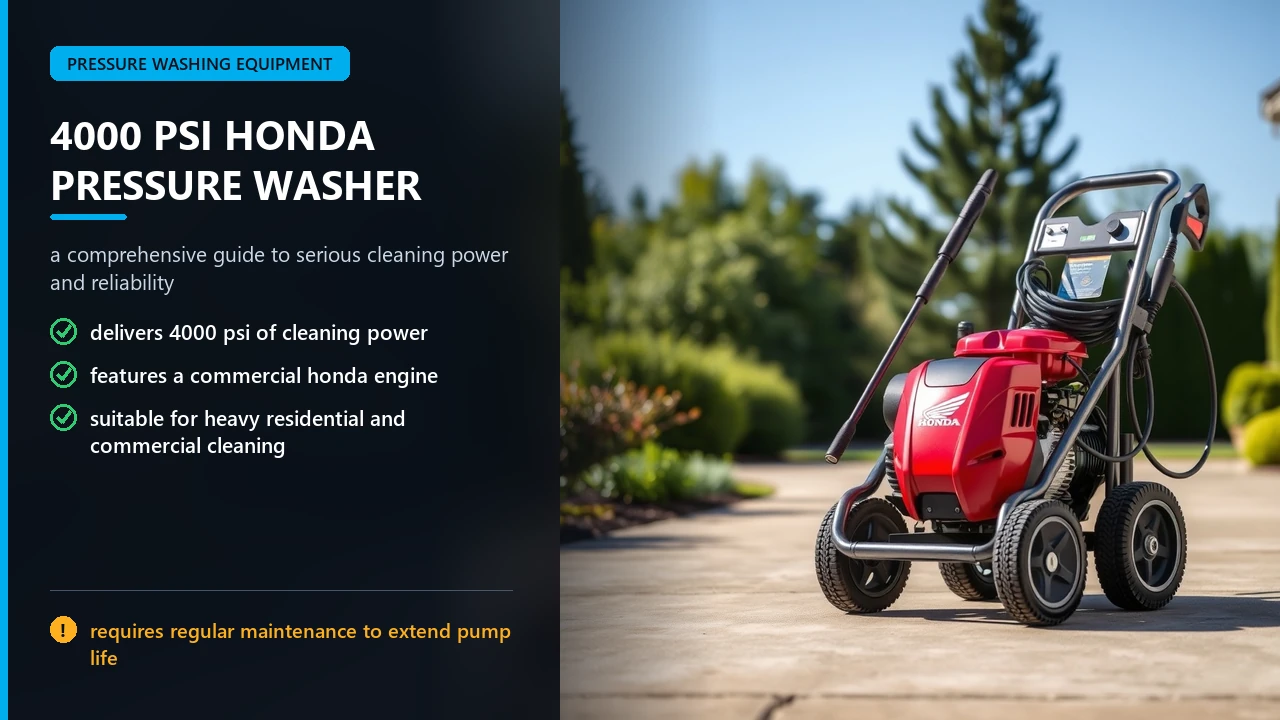
A 4000 PSI Honda pressure washer pairs a Honda gasoline engine, usually the GX390 or a comparable commercial model, with a high-pressure pump rated to deliver 4,000 PSI. That combination produces a machine powerful enough to strip stubborn grime from concrete, restore driveways, clean commercial equipment, and handle the heavy end of residential and commercial work. This guide explains what 4,000 PSI really delivers, how the Honda side of the equation matters, and how to choose, run, and maintain one.
What 4000 PSI Actually Delivers
Pressure, measured in pounds per square inch, determines how hard the water hits the surface. At 4,000 PSI, a pressure washer has enough force to lift caked-on mud, strip years of grime, and clean surfaces that lighter machines only smear. It is squarely in the commercial range, above the typical residential machine and below the extreme pressures used for specialized industrial work.
But pressure is only half the story. Flow, measured in gallons per minute, determines cleaning speed and rinsing power. A 4,000 PSI machine paired with a Honda engine usually runs around 4 GPM, which is a strong balance: enough pressure to blast tough soils and enough flow to rinse large areas efficiently. Together, 4,000 PSI and 4 GPM is a genuinely capable combination for the bulk of professional cleaning. Our guide on the best PSI for pressure washer tasks explains how pressure requirements vary by job.
| Pressure Range | Typical Use |
|---|---|
| 1,300–2,000 PSI | Cars, light patio cleaning, small jobs |
| 2,500–3,000 PSI | Home siding, fences, general residential |
| 3,200–3,600 PSI | Driveways, heavy residential, light commercial |
| 4,000 PSI and up | Concrete, fleets, commercial, equipment |
The practical takeaway is that 4,000 PSI is more than enough for the vast majority of cleaning work, and often more than necessary for delicate surfaces. Its value is on concrete, equipment, and heavy commercial soils, where lower-pressure machines slow to a crawl. For soft surfaces like siding and paint, you simply use a wider nozzle or reduce effective pressure, which is why a machine like this is versatile across a wide range of jobs.
It is also worth understanding where 4,000 PSI sits relative to the extremes. Below it, machines in the 2,500 to 3,500 PSI range handle most home and light commercial work but take longer on heavy soils. Above it, specialized machines reach 5,000 PSI and beyond for industrial applications, at the cost of weight, fuel, and price. The 4,000 PSI Honda machine sits in the productive middle: more than enough for professional cleaning, without the excess of extreme machines that most cleaners never need.
Why the Honda Engine Matters
The Honda engine is what makes a 4,000 PSI machine worth owning rather than regretting. High-pressure cleaning is hard, continuous work, and the engine runs under load for hours. A consumer engine may deliver the pressure for a season and then fail, while a commercial Honda engine is built to keep going. The most common engine here is the Honda GX390, a 389cc commercial engine known for reliable starting, long life, and abundant parts availability.
That reliability is not a small thing on a job site. An engine that starts on the first pull and runs all day keeps your schedule intact, while a fussy engine costs you time, money, and customers. Honda’s GX series is engineered for continuous duty, and because it is so widely used, repairs and parts are rarely a problem. For a machine that must earn its living, that support network is as valuable as the horsepower. Our guide on the Honda GX390 guide to 4,000 PSI commercial cleaning power goes deep on that engine, and the broader look at why contractors trust Honda engines explains the reputation.
What a 4000 PSI Honda Machine Can Clean
At this pressure and flow, the machine handles the heavy end of cleaning work with ease.
Concrete and driveways are the classic job. With a surface cleaner attached, a 4,000 PSI machine restores concrete quickly and evenly, removing stains, tire marks, and embedded grime. Commercial properties like sidewalks, parking areas, dumpster pads, and building exteriors benefit from the combination of power and speed. Fleet and equipment cleaning strips mud, oil, and road film from trucks, trailers, and machinery. Heavy residential work, including decks, brick, and stone patios, is well within its range, with nozzle choice controlling how aggressive the cleaning is on each surface.
Where it excels is anywhere the soil is heavy and the area is large. Pressure washing speed comes from the combination of pressure and flow, and a 4,000 PSI Honda machine has both. For a professional, that means more jobs per day and a machine that can take on work light machines must decline. For a serious homeowner with a large property or tough surfaces, it means a machine that handles everything without upgrade worries.
| Job | How It Performs |
|---|---|
| Driveways and concrete | Fast and thorough with a surface cleaner |
| Commercial lots | Powerful enough for large areas |
| Fleet and equipment | Strips oil, mud, and road film |
| Decks and brick | Effective with the right nozzle and distance |
| Delicate siding | Use wider nozzles and lower effective pressure |
The Pump Is Half the Machine
A 4,000 PSI rating is only as good as the pump delivering it, and this is where cheap machines fall apart.
Look for a triplex pump with ceramic plungers, serviceable valves, and a proper unloader. Triplex pumps are built for continuous high-pressure work and last far longer than axial pumps, which are common on budget machines and tend to fail under commercial use. The pump should be rated to match the engine so the machine runs at its intended output, and it should include a thermal relief valve to protect against heat damage if the gun is shut off with the engine running.
The drive system also affects longevity. Belt drive isolates the pump from engine heat and vibration and typically lasts longer, which is why serious commercial machines favor it. Direct drive is simpler and less expensive but runs the pump hotter and harder. For a machine meant to work daily, belt drive with a quality triplex pump is the combination that delivers on the 4,000 PSI promise year after year. A great engine driving a cheap pump is a machine that will disappoint, so judge the package as a whole.
Water Supply and Nozzles
A 4,000 PSI, 4 GPM machine needs both a steady water supply and correctly sized nozzles to perform.
On the water side, the machine needs enough flow and pressure to keep the pump fed. A weak residential spigot may not keep up at 4 GPM under real conditions, and starving the pump causes cavitation and damage. Many professional machines use a buffer tank or a tank on a trailer to guarantee supply. If you feed from a spigot, use a short, large-diameter hose and confirm the supply can meet demand before relying on it.
Nozzles are equally important. Nozzle size must match the machine’s pressure and flow; an undersized nozzle raises pressure dangerously and can overload the engine, while an oversized nozzle weakens the spray. Color-coded nozzles give you a range from pinpoint (0 degrees) to wide (40 degrees) spray angles, letting you match aggression to surface. For tough concrete, a turbo or rotating nozzle spins a zero-degree jet for faster cleaning. Our guides on choosing the right nozzle size and on hose size for PSI and GPM help you match accessories to the machine.
Hose and reel ratings matter too. The pressure hose and any reel must be rated above 4,000 PSI, or they risk bursting under load. A hose reel rated to handle the pressure keeps the hose organized and protected while giving you reach. Matching every part of the water path to the machine’s output is what keeps a high-pressure setup safe and effective.
Running and Maintaining the Machine
A 4,000 PSI Honda machine lives a hard life, and maintenance keeps it alive.
Change the engine oil at the recommended interval and check it before each use, since clean oil protects the engine for thousands of hours. Service the air filter and spark plug, and use fresh fuel with a stabilizer when the machine sits. On the pump side, check and change the pump oil on schedule, keep the inlet filter clean, and inspect for leaks around fittings and seals. Protect the machine from freezing, because trapped water cracks pumps, coils, and fittings when it freezes.
Grease and check any fittings and connections, inspect hoses for wear and replace them before they fail, and keep the machine clean and covered between jobs. High-pressure machines work hard and reward maintenance more than light machines do. A well-kept 4,000 PSI Honda unit runs for years and holds its value, while a neglected one fails at the worst possible moment. The routine is simple, and it is the difference between a machine that pays for itself and one that becomes a repair bill.
Choosing a 4000 PSI Honda Pressure Washer
With so many machines on the market, a few checks separate a smart buy from an expensive mistake.
Confirm the engine model, since the GX390 is the trusted commercial choice, and verify the pump is a quality triplex rather than a budget axial. Check the drive type, the pressure and flow ratings, and the frame and wheel quality, since the supporting hardware determines how usable the machine is. Look for a machine with a good hose reel, an accessible control layout, and serviceable components, because you will maintain this machine for years.
Decide whether you need cold water only or a hot water option for grease, and whether the machine will live on a trailer with a tank or on the ground fed from a spigot. Match the machine to the work you actually do, not the biggest number available. For broad professional use, a belt-drive, triplex-pump, GX390-powered 4,000 PSI machine is a proven formula. For occasional use, a smaller machine may suit you better and cost far less to run. The right choice is the one that matches your jobs and your water supply.
Cold Water vs Hot Water Honda Machines
Most 4,000 PSI Honda pressure washers are cold water machines, but the same engine also powers hot water units, and the choice changes what work you can take.
A cold water machine at 4,000 PSI handles dirt, mud, and general grime with ease and is the right choice for concrete, driveways, and residential surfaces. A hot water machine adds a burner and heating coil, so it sprays water hot enough to cut through grease, oil, and food soils. For fleet washing, restaurant and industrial work, and anything involving heavy grease, hot water is a major advantage. The tradeoff is added weight, fuel use, and maintenance for the burner and coil.
Both versions benefit from the Honda engine’s durability. On a trailer rig, the hot water machine often carries a water tank and hose reels as well, making it a complete mobile station. For cleaners whose work includes grease, the hot water version of a 4,000 PSI Honda machine opens up jobs a cold machine cannot handle well. Our guide on hot water pressure washer 4000 PSI and why grease cannot hide explores that capability.
What a Machine Like This Costs
A 4,000 PSI Honda pressure washer is a serious purchase, and understanding the cost structure helps you buy wisely.
Costs vary widely with the pump, drive type, frame, and whether the machine is a bare unit or a complete trailer rig. A quality cold water machine with a triplex pump is a substantial but reasonable investment for a professional tool, while a hot water trailer rig costs considerably more. Beyond the machine, budget for hoses, nozzles, a surface cleaner, and possibly a water tank, since these determine how productive the machine is in the field.
| Item | Why It Adds Value |
|---|---|
| Quality triplex pump | Reliability and long service life |
| Belt drive | Cooler pump, smoother operation |
| Surface cleaner | Fast, even concrete cleaning |
| Water tank or buffer | Guarantees supply at 4 GPM |
| Hose reel rated for 4,000 PSI | Organized, safe hose handling |
For a professional, the machine pays for itself through the work it enables and the time it saves. For a serious homeowner, the value is in handling every job on a large property without needing a stronger machine later. The mistake to avoid is buying on price alone and ending up with a weak pump that fails early, which turns a bargain into a repeat purchase. Spend where it counts: the pump, the drive system, and the engine.
Safe Operation Habits
At 4,000 PSI, safety is not optional. These habits prevent the most common injuries and mistakes.
Keep the gun pointed only at the surface you are cleaning, and never at people, pets, or yourself. Wear eye protection and non-slip footwear, since high-pressure spray can send debris flying at speed. Tie back loose clothing and keep your footing stable, because the kickback from a high-pressure gun is significant. Work the spray in controlled passes rather than holding it in one spot, which both cleans better and avoids surface damage. On ladders, avoid overreaching; better to move the ladder than to risk a fall with a live gun.
Be especially careful near electrical outlets, fixtures, and wiring, since water and electricity are a lethal combination. Never clean near a live electrical source, and respect the pressure around windows, doors, and vents, where water can intrude. Treat the machine with the same caution you would any powerful power tool, and it will do its job safely. The Occupational Safety and Health Administration maintains workplace safety guidance relevant to high-pressure cleaning that is worth reviewing for professional use.
For equipment references, official information from Honda Engines covers the engine side, and trade resources from the Cleaning Equipment Trade Association cover pressure washing equipment generally. For pump specifications and ratings, manufacturers such as General Pump provide detailed data to help match a pump to a Honda engine.
Frequently Asked Questions
What can a 4000 PSI Honda pressure washer clean? It handles concrete, driveways, commercial properties, fleets, equipment, decks, and heavy residential surfaces. It is more than enough for nearly all cleaning work and excels on heavy soils and large areas.
What engine comes on a 4000 PSI Honda pressure washer? Most use the Honda GX390, a 389cc commercial engine, though some use comparable Honda commercial models. The GX390 is prized for reliable starting, durability, and easy parts availability.
Is 4000 PSI too much for wood or siding? At full pressure it can damage soft surfaces, so use wider nozzles, keep more distance, and reduce effective pressure for wood, siding, and paint. The machine is versatile as long as you adjust the spray for the surface.
How long will a 4000 PSI Honda pressure washer last? With routine maintenance of both engine and pump, a quality machine with a Honda engine and triplex pump commonly lasts years of professional use, often outlasting cheaper machines by a wide margin.
Can I run a 4000 PSI machine from a garden hose? Sometimes, but only if the supply delivers enough flow to keep up with the pump. Many spigots cannot supply around 4 GPM at pressure, so a buffer tank or trailer tank is a safer choice for professional use.
What maintenance does a 4000 PSI Honda machine need? Regular engine oil changes, air filter and spark plug service, fresh treated fuel, pump oil changes, and keeping the inlet filter clean. Protecting the machine from freezing is also essential.
How much GPM does a 4000 PSI machine have? A 4,000 PSI Honda machine typically produces around 4 GPM, which balances strong pressure with good flow for cleaning speed and rinsing power.
Do I need a special water supply for 4000 PSI? You need enough flow and pressure to keep the pump fed. A weak spigot may not keep up, so many professional machines use a buffer tank or a trailer tank to guarantee supply.
What nozzles work with 4000 PSI? Use nozzles sized to match the machine’s pressure and flow, with color-coded angles from 0 to 40 degrees. A turbo or rotating nozzle works well for tough concrete and flat surfaces.
Is 4000 PSI too much for home use? It can be more than necessary for light jobs, but it is ideal for large properties and tough surfaces. For occasional light work, a smaller machine is usually easier to manage and cheaper to run.
Belt drive or direct drive on a 4000 PSI Honda? Belt drive runs cooler, isolates vibration, and often lasts longer, making it the better choice for heavy professional use. Direct drive is simpler and cheaper but harder on the pump.
Final Thoughts
A 4000 PSI Honda pressure washer is a serious machine built for serious work. The combination of commercial pressure, healthy flow, and a Honda engine that starts and runs reliably makes it a dependable tool for concrete, fleets, and commercial property cleaning. Paired with a quality triplex pump and a proper water supply, it delivers the power and speed professional cleaning demands.
Choose the engine and pump carefully, match nozzles and hoses to the machine, keep the water supply steady, and maintain both engine and pump on schedule. Do those things and a 4,000 PSI Honda machine will work hard for years, turning tough jobs into routine ones and paying for itself many times over. For the heavy end of cleaning work, this combination remains one of the wisest investments you can make.