There is a specific kind of dirt that cold water pressure washers simply cannot beat. It is the baked-on grease on a restaurant dumpster pad, the oil film on a fleet of trucks, the caked grime on a dump truck, the greasy exhaust stains on a building wall. You can blast this grime with all the pressure in the world and it smears instead of lifting. The missing ingredient is heat, and that is what a hot water pressure washer 4000 psi delivers. Heat dissolves the oil and grease that pressure alone only pushes around.
A 4000 PSI hot water machine combines serious cleaning power with a diesel-fired burner that heats the water to as much as 200 degrees Fahrenheit. That combination turns oil and grease from a stubborn enemy into something that rinses away, and it is why commercial cleaning operations that deal with grease consider heat mandatory rather than optional. A cold water machine in that world is a machine that leaves the customer’s concrete still stained.
This guide explains what a 4000 PSI hot water pressure washer is, how the heating system works, why heat makes such a difference on grease, the components to evaluate, the applications that justify the cost, how to maintain one, and who should buy. If you are considering stepping up to hot water, this will tell you whether it is worth it and what to look for.
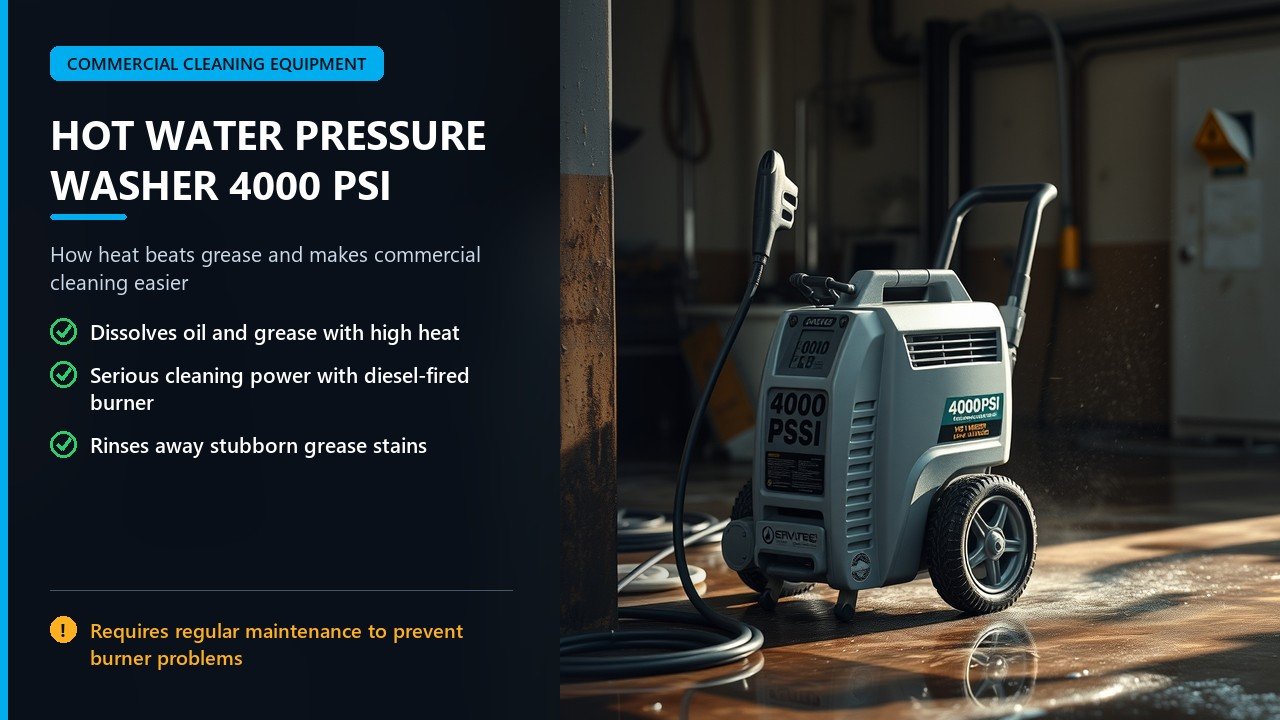
What a 4000 PSI Hot Water Machine Is
A hot water pressure washer is, at its core, a cold water machine with an added heating system. The pump pressurizes the water, and a burner heats it before it reaches the gun. On a 4000 PSI machine, the pump is typically a heavy-duty triplex capable of high pressure and flow, driven by a substantial gas engine, and the burner is often a diesel-fired unit with a heating coil through which the water passes.
The 4000 PSI rating indicates strong cleaning force, and hot water machines at this pressure usually deliver flow in the range of about 3.5 to 4 GPM. That combination of high pressure, good flow, and heat is what makes these machines powerful enough for professional grease and grime removal. Many are mounted on skids or trailers because of their size and weight, and because they are used by mobile cleaning businesses.
| Specification | Typical 4000 PSI Hot Water Machine |
|---|---|
| Pressure | 4000 PSI |
| Flow | About 3.5 to 4 GPM |
| Engine | Commercial gas engine, often 300cc to 400cc or larger |
| Pump | Heavy-duty triplex, belt or direct drive |
| Burner | Diesel-fired, often 12-volt ignition |
| Max temperature | Up to about 200 degrees Fahrenheit |
| Heating coil | Steel coil through which water passes |
| Frame | Heavy steel, often skid or trailer mount |
| Fuel tank | Onboard diesel tank, often 10 to 15 gallons |
The heating system is the defining feature, and understanding how it works helps you maintain it and judge a machine’s quality.
How the Heating System Works
The burner does not heat a tank of water. It heats the water as it flows through a coil, so the machine provides hot water on demand rather than storing it. This is efficient and allows continuous operation as long as fuel lasts.
The fuel system. A diesel tank feeds the burner, which ignites the fuel to create a flame. Diesel is the standard fuel because it burns hot and is widely available. Some machines can run on other fuels, but diesel is the norm.
The ignition. A burner uses a transformer and electrodes, often 12-volt on portable machines, to ignite the fuel. A thermostat controls when the burner fires, maintaining the selected temperature.
The coil. The water passes through a coiled tube, usually steel, that is heated by the burner flame. The coil is where the water picks up heat, and its condition matters for efficiency and safety.
The exhaust. The burner produces exhaust and heat that exit through a stack. This is why hot water machines must be operated outdoors or with proper ventilation, and it is a safety consideration.
The thermostat and control. The operator sets the desired temperature, and the burner fires to maintain it. The ability to control temperature lets you match the heat to the job, from warm water for general washing to near-maximum heat for heavy grease.
Quality matters in every part of this system. Cheap burners, thin coils, and poor controls lead to unreliable ignition, inefficient heating, and maintenance headaches. A well-built hot water machine from a reputable brand uses robust components throughout, which is why it costs more and lasts longer.
Why Heat Beats Grease
The reason hot water matters so much for grease comes down to chemistry. Grease and oil are fats, and fats soften and dissolve as temperature rises. Cold water bounces off greasy surfaces or smears the grease around, because the fat remains thick and sticky. Hot water melts the fat, allowing detergents to break it down and the water to rinse it away.
The difference on a real job is dramatic. A dumpster pad caked with grease that resists a cold water machine can be cleaned efficiently with hot water and the right detergent. A truck coated in road oil and grime rinses clean with heat that would barely touch it otherwise. Restaurant exteriors, dumpster pads, fleet vehicles, equipment, and any surface with oil or cooking grease are transformed by hot water.
Heat also helps with general cleaning beyond grease. It improves detergent action, kills some organisms like mold and mildew more effectively, and speeds up the breakdown of dirt. On many surfaces, hot water simply cleans better and faster than cold, which is why commercial operations prize it despite the added cost and complexity. Our guide to the hot box pressure washer heater units explains the heating component in more detail.
Components That Matter on a 4000 PSI Hot Water Machine
Buying a hot water machine means evaluating both the pressure side and the heat side, and both must be solid.
The pump. A 4000 PSI machine needs a heavy-duty triplex pump capable of continuous high pressure. Look for a name brand, because this is the most abused component and the most expensive to replace. Our guide to a 5000 PSI pressure washer pump covers how to judge high-pressure pumps and match them to a machine.
The engine. The engine drives the pump and must supply enough horsepower to handle the pressure and flow. Commercial engines, and belt drive systems, are common on these machines because they need to run for hours. Belt drive also reduces pump wear, which is valuable on expensive high-pressure pumps.
The burner and coil. This is the heart of the hot water system. A quality burner ignites reliably and a robust coil heats efficiently. Coils can scale and corrode over time, so build quality and part availability matter.
The flow rate. Even at high pressure, flow determines productivity. A hot water machine at 3.5 to 4 GPM cleans efficiently, drives surface cleaners, and supports commercial work. Do not underbuy on flow. Our guide to the GPM pressure washer concept explains why flow is the commercial priority.
The frame and mounting. Hot water machines are heavy, and many are skid or trailer mounted. A solid frame and mounting system matter for a mobile business.
The controls and safety features. A reliable thermostat, a flow switch to prevent the burner from firing without water, and good electrical protection are essential for safe operation.
Applications That Justify Hot Water
Hot water machines cost more and require more maintenance, so they make sense when the work demands heat. These are the applications that justify the investment.
Restaurant and food service exteriors. Grease from cooking, dumpster pads, drive-throughs, and building walls near kitchens all demand hot water to clean effectively.
Fleet washing. Trucks, trailers, and commercial vehicles accumulate road oil, grease, and grime that hot water and detergent remove far faster than cold water.
Equipment and machinery cleaning. Construction and agricultural equipment covered in grease and heavy grime clean far better with heat.
Dumpster pads and trash areas. These are among the worst grease jobs in any commercial property, and hot water is the only practical way to clean them well.
Industrial and manufacturing. Oil and grease are common in industrial settings, and hot water is often required for thorough cleaning.
Commercial property maintenance. Property managers dealing with grease-related complaints find hot water pays for itself in results and reduced callbacks.
If your work regularly involves grease and oil, hot water is not a luxury. It is the difference between a job that satisfies the customer and one that leaves them staring at the stains you could not remove.
What to Check Before You Buy
Use this checklist to evaluate a 4000 PSI hot water machine.
Confirm the burner works reliably. On a used machine, test the burner and confirm it ignites and holds temperature. Burner problems are common and can be expensive.
Inspect the coil. Ask about scale and corrosion, and look for signs of neglect. A scaled coil loses efficiency and can be costly to replace.
Check the pump. Confirm it is a name-brand heavy-duty triplex, check the pump oil, and look for leaks. Rebuildability matters on a machine this expensive.
Prove the engine. Confirm it starts easily and runs smoothly, and check the oil and air filter for signs of maintenance.
Verify flow and pressure. Confirm the rated specs and test under load. A machine that cannot hold pressure or flow is not delivering what it should.
Inspect the fuel system. Check the diesel tank, lines, and filter for leaks and condition, since fuel issues stop the burner.
Check the frame and mounting. On a skid or trailer unit, confirm the structure is sound and suited to how you will move it.
Maintaining a Hot Water Pressure Washer
These machines have the maintenance needs of both a pressure washer and a heating system, so the routine is more involved than for a cold water unit.
Engine and pump. Change engine oil on schedule, keep the air filter clean, use fresh fuel, and check and change pump oil regularly. Never run a triplex pump low, and always purge air before running. Follow the pump maker’s oil recommendations exactly.
Burner and fuel system. Keep the fuel filter clean and change it on schedule. Inspect the burner nozzle and electrodes, and check ignition. Ensure the fuel tank stays clean and free of water and debris, because contaminated diesel causes burner problems.
Coil and descaling. Over time, minerals in the water scale the coil, reducing heat transfer. Descale the coil periodically using the procedure the manufacturer recommends. This maintains efficiency and extends coil life.
Flush and winterize. Flush the machine with clean water after use, and winterize thoroughly, because water freezing in the coil or pump causes serious damage. Our guide on how to winterize a gas pressure washer before the first freeze covers the freeze-protection essentials.
Inspect safety components. Confirm the flow switch, thermostat, and electrical components work correctly, since these prevent the burner from firing dangerously. Never run the burner without water flow.
Who Should Buy a 4000 PSI Hot Water Machine
Buy a 4000 PSI hot water pressure washer if your work involves grease, oil, and heavy grime, and you need commercial-level cleaning power with heat. It suits restaurant cleaning, fleet washing, equipment cleaning, and commercial property maintenance. If you are a business that regularly turns down greasy jobs because a cold water machine cannot handle them, that lost work is the strongest argument for stepping up.
Do not buy it if your work is primarily dirt, mud, mildew, and general grime without grease, because a cold water machine will do that job for far less money and with less maintenance. Also consider whether you truly need 4000 PSI, since some hot water machines run at lower pressure with good flow and handle many grease jobs well. Match the machine to your actual jobs. Our guide to the best pressure washer for commercial use helps you decide where a hot water machine fits in your business.
Hot Water vs Cold Water on Real Jobs
The value of heat becomes obvious when you compare hot and cold water side by side on the same job. Here is how they stack up across common tasks.
| Job | Cold Water | Hot Water |
|---|---|---|
| Dumpster pad grease | Smears, leaves residue | Lifts and rinses clean |
| Restaurant exterior | Partial, requires heavy chemical | Thorough with less detergent |
| Fleet truck road oil | Slow, leaves film | Fast, clean finish |
| Heavy equipment grease | Struggles badly | Effective with detergent |
| General mud and dirt | Adequate | Faster, cleaner |
| Mildew and mold | Good with chemical | Better, heat assists |
The pattern is clear. On grease and oil, hot water is not a small improvement; it is a different result. On regular dirt, hot water is faster and often cleaner, but cold water can still get the job done. That distinction is what should drive your buying decision.
Heat, Pressure, and Chemistry Together
Hot water is powerful, but it reaches its full potential only when combined with the right pressure, flow, nozzles, and detergent. Each element contributes, and the machine that balances all of them outperforms one that leans on a single factor.
Pressure provides the force that breaks dirt loose and drives it into the water stream. Too little pressure leaves grime in place, but too much on delicate surfaces causes damage. Match pressure to the surface.
Flow rinses away what pressure loosens. High flow carries dislodged grease and dirt off the surface so it does not settle back. This is why commercial machines prioritize flow and why surface cleaners rely on it.
Heat dissolves grease and oil and boosts detergent action, turning stubborn fats into something the water can carry away.
Detergent breaks down the bond between grime and surface, and heat makes it work better. Applied correctly and allowed to dwell, detergent multiplies the effect of pressure and heat.
Nozzles shape the stream and control impact. The right nozzle focuses the machine’s power where it is effective without damaging the surface.
When you combine a 4000 PSI hot water machine with good flow, the right nozzle, and a quality detergent, you have a cleaning system, not just a pressure washer. Operators who understand this get far more from their machines. Our guides to the GPM pressure washer concept and to the pressure washer spray tip explain flow and nozzles in depth.
Nozzles and Surface Cleaners for Hot Water Work
The accessories you choose matter even more on a hot water machine, because you want them to survive the heat and make the most of the machine’s capabilities.
Nozzles. Select nozzles rated for hot water, because some nozzles are designed only for cold. Match the nozzle angle to the surface, using wider angles for gentler cleaning and narrower angles for tough spots. A zero-degree nozzle is for the worst stains on durable surfaces only.
Surface cleaners. A rotary surface cleaner is one of the best additions to a hot water machine. It cleans flat concrete far faster and more evenly than a hand wand, contains splash, and prevents stripe marks. Combined with hot water and detergent, it is highly effective on parking lots, drive-throughs, and dumpster pads. Our guide to the hot water surface cleaner covers this pairing.
Hoses and guns rated for heat. Not all hoses are rated for hot water. Use a hose and gun rated for the temperatures your machine produces, or the heat will degrade them quickly. This is a common oversight that shortens component life.
Detergent injectors. Quality downstream injectors or chemical systems apply detergent evenly, which matters on grease jobs where coverage and dwell time drive results.
Burner Problems and How to Prevent Them
The heating system is what makes a hot water machine valuable, and it is also the part most likely to develop problems. Knowing the common failures helps you prevent them.
Burner will not ignite. This is often caused by a dirty or failed fuel filter, a fouled burner nozzle, worn electrodes, or an electrical issue. Clean the fuel system and inspect the ignition components on schedule.
Poor heat or low temperature. A scaled coil, a clogged burner nozzle, low fuel flow, or air in the fuel line can reduce heat. Descaling and fuel system maintenance address most cases.
Burner runs but water stays cold. This may indicate a flow problem, a failed thermostat, or a coil issue. Confirm water is flowing, then check the controls.
Excessive smoke or rough running. Poor fuel quality, a misadjusted burner, or a dirty nozzle causes this. Use clean diesel and maintain the burner per the manufacturer.
Fuel system contamination. Water and debris in the diesel tank cause intermittent problems. Keep the tank clean and change the fuel filter on schedule.
Reliability and Downtime on Commercial Jobs
For a business, reliability is as important as cleaning power. A hot water machine that fails mid-job costs money, reputation, and future work.
Choose a machine built for commercial duty rather than a light-duty design pushed beyond its limits. Heavy-duty triplex pumps, commercial engines, belt drive, and robust burners are all about surviving long hours. Parts availability matters too, because a machine waiting weeks for a part is a machine earning nothing.
Establish a maintenance schedule and follow it. Engine oil, pump oil, fuel filters, burner inspection, and coil descaling are the basics that prevent most breakdowns. Keep spare fuel filters, burner nozzles, and other wear items on hand so a small failure does not stop the day. For anyone running a cleaning business, this proactive approach to maintenance turns a temperamental machine into a dependable one. Our guide on how to store a pressure washer for winter and protect the pump helps protect your investment through the off-season.
Frequently Asked Questions
Do I really need a hot water pressure washer?
If your work involves grease and oil, yes. Hot water dissolves fats that cold water only smears, making grease removal far faster and more thorough. For general dirt and mildew without grease, cold water is usually sufficient.
How hot does a hot water pressure washer get?
Most reach up to about 200 degrees Fahrenheit. This is hot water, not steam. Steam pressure washers are a separate, more specialized category that runs at lower flow and higher temperatures.
What fuel does a hot water pressure washer use?
The burner typically runs on diesel, which burns hot and is widely available. The engine runs on gasoline. So a hot water machine uses two fuels: gas for the engine and diesel for the burner.
What is a 4000 PSI hot water machine used for?
It is used for commercial grease and grime removal, including restaurant exteriors, dumpster pads, fleet washing, equipment cleaning, and industrial applications where oil and grease must be removed effectively.
How much does a 4000 PSI hot water pressure washer cost?
These are substantial machines, typically costing from a couple thousand dollars upward, with skid and trailer-mounted units costing considerably more. The cost reflects the pump, engine, and burner system, and the value comes from the grease-cleaning capability.
Is a hot water pressure washer hard to maintain?
It requires more maintenance than a cold water machine because it has both a pressure side and a heating system. Engine and pump care, fuel filter changes, burner inspection, and coil descaling are all part of the routine.
Can I use a hot water machine for regular cleaning too?
Yes. You can turn the burner off or set a lower temperature and use it like a cold water machine. The heat is there when you need it, and you can dial it down for gentle work.
Final Thoughts
A hot water pressure washer 4000 psi is the tool that defeats grease, and for commercial work involving oil, fats, and heavy grime, it is the difference between clean and almost clean. Pressure breaks dirt loose, but heat dissolves the grease that cold water cannot, and the combination is transformative on the right jobs.
If your work involves grease, choose a machine with a heavy-duty triplex pump, a commercial engine, good flow, and a reliable burner and coil, and maintain all of those systems on a schedule. If your work does not involve grease, save your money and buy a cold water machine. Match the machine to your jobs, and a hot water pressure washer will pay for itself in results and reputation. For related reading, our guide to the best pressure washer for commercial use and our overview of the hot box heater units will help you build the right setup.