The Water Driver series is a family of gas-powered, cold-water pressure washers sold under the DeVilbiss and Excell names. Recognisable by their WVR and WGV model codes, these machines were built for domestic and light-commercial use, and many are still in service today because they are simple, robust, and easy to repair with widely available parts.
This guide looks at what the Water Driver series power washer is, the models and specifications you might find, and how to maintain one so it keeps working for years.
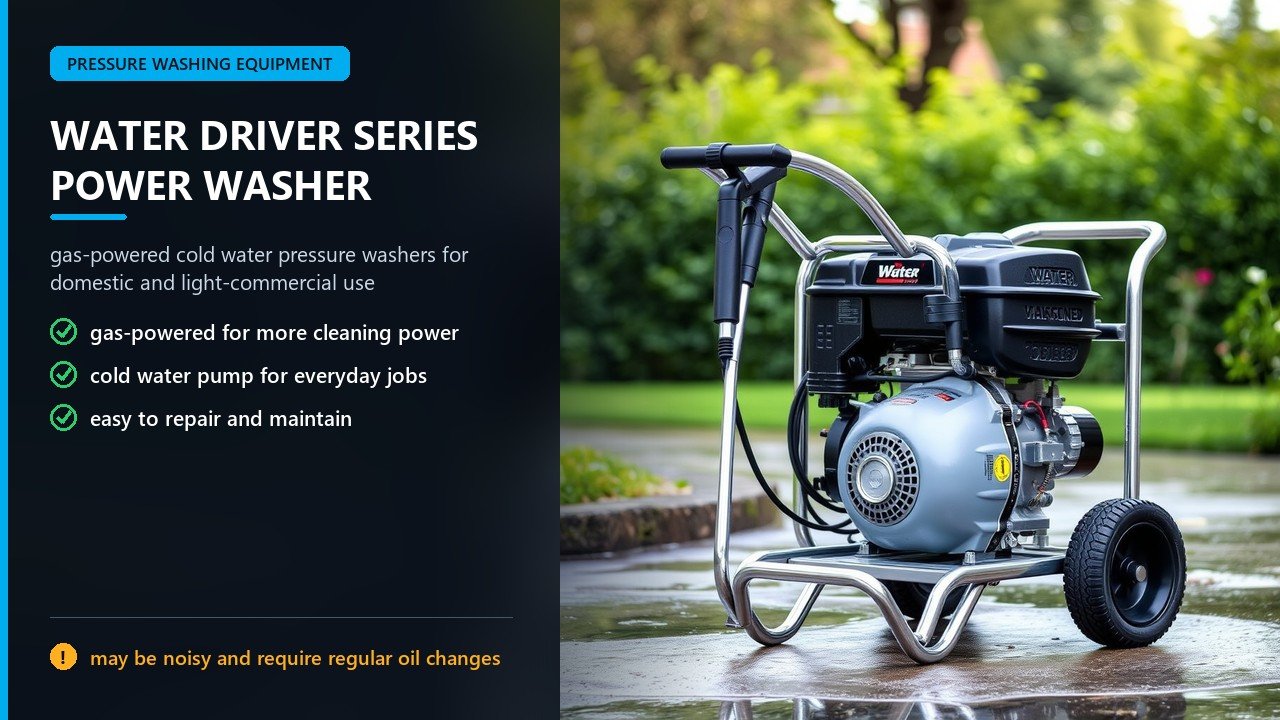
What the Water Driver Series Is
The Water Driver series is a line of gasoline-powered pressure washers, typically with a cold-water pump, a direct-drive piston or axial pump, and a Honda or Briggs & Stratton engine. The name appears with model numbers such as WVR2020, WVR2120, WGV2021, and WGV1721, among others. The machines were produced by Excell, a large pressure washer manufacturer that built washers under several brands, including DeVilbiss.
These washers were aimed at homeowners and light commercial users who wanted more power than an electric machine could give. Their gas engines deliver strong cleaning output without a power cable, and their cold-water pumps cover the usual jobs, from driveways and patios to vehicles, siding, and equipment. They are the classic portable gas pressure washer in form and function.
Although the line is no longer new, it remains relevant because the machines are serviceable. Parts for common models are still sold, from pumps and valves to guns, wands, and hoses, and the basic design is straightforward. A Water Driver washer that is well maintained can outlast many newer machines.
Typical Models and Specs
A common Water Driver machine delivers around 2,400 PSI at a flow near 2.4 GPM, a combination typical of a mid-range residential gas washer. That output is enough for serious cleaning of concrete, siding, and vehicles, with the flow and pressure working together to give a useful cleaning force without being so strong that it damages surfaces easily.
Under the frame, these washers usually pair a gasoline engine, often a Honda or Briggs & Stratton unit of around five to six and a half horsepower, with a piston pump. The pump may be a direct-drive or axial type, and the machine normally includes a thermal-relief valve, a chemical injector for soap, a high-pressure hose, a trigger gun, and a wand with an adjustable nozzle.
Exact specifications vary by model, so confirm the PSI, GPM, engine, and pump type for the specific machine rather than assuming. The data plate or label on the washer and the model-specific owners’ manual are the reliable sources, and the manual also gives the correct maintenance intervals and capacities for that model.
Cold Water, Gas Power
Two features define the Water Driver series. The first is its power source: a gasoline engine, which gives the mobility and output of a gas washer without a mains cable. That suits outdoor work far from a socket, and it is why gas washers like these remain popular for driveways, machinery, and remote jobsites.
The second is its cold-water pump. These machines use an unheated water supply, relying on pressure and flow alone to clean. Cold-water washers handle most everyday and light-commercial tasks well, and they are simpler and cheaper to run than hot-water models, which add a burner and a coil. For grease-heavy work, hot water cleans faster, but for general outdoor cleaning, cold water is entirely adequate.
Knowing which type of machine you have, and what it is designed for, keeps expectations realistic and helps you get the best from it.
Why These Washers Are Still Worth Keeping
The Water Driver series endures because it is repairable. Where a cheap modern washer may use a sealed pump that cannot be serviced, a Water Driver machine’s pump can often be rebuilt with valve kits, seal kits, and replacement parts, and the engine is a standard small engine with all the usual service items. That means a fault rarely condemns the whole machine.
Parts support is the reason. Suppliers stock model-specific parts for the Water Driver line, including pumps, valves, seals, hoses, guns, wands, nozzles, and injectors. Owners can find breakdowns and manuals by model, so identifying and replacing a failed part is practical. This keeps older machines running instead of sending them to scrap.
There is also a practical value in the simplicity. A gas pressure washer with a proven engine and a serviceable pump is easy to understand and to keep working, and its faults tend to be predictable. For a homeowner or small operator, that reliability and repairability is worth more than a slightly higher specification on paper.
Common Maintenance Tasks
Maintaining a Water Driver washer means looking after two separate systems: the engine and the pump. The engine needs its oil checked and changed, its air filter cleaned or replaced, its spark plug serviced, and fresh fuel used. The pump needs its own oil checked and changed, its inlet filter kept clean, and protection from frost.
The pump is where many failures begin, and pump oil is the key. Check the pump-oil level and condition regularly, change it on schedule, and act at once on milky or gritty oil. Keep the water supply clean and unrestricted, and never run the pump dry, because both cavitation and running dry damage the pump’s internal parts and seals.
Winter care matters too. Water left in the pump, hose, or gun can freeze and crack them, so drain the machine, hose, and gun after use in cold weather, or run a pump saver through the system. Proper storage, including fuel care for the engine, prevents a range of faults that appear at the start of the next season.
Common Problems and Fixes
The most common complaint with any gas pressure washer is a loss of pressure, and the Water Driver series is no exception. A sudden drop or no pressure at all often traces to the pump, where worn valves, worn seals, or a failed unloader reduce output. But it can also come from the supply, from a blocked inlet filter, a kinked hose, or a failed pump coupling between engine and pump.
Surging or fluctuating pressure usually points to an unsteady water supply, such as a tap that cannot keep up or a partially blocked filter, rather than to the pump itself. Checking the supply first, then the inlet filter, and then the pump internal parts, follows the likely order of causes and saves unnecessary work.
Other faults follow their own clues. Water leaking from the pump, especially from the area around the seals, points to worn seals and often accompanies milky pump oil. A machine that will not start or runs badly is usually an engine issue, from fuel, spark, or the air filter, and is dealt with as a small-engine fault rather than a pump one.
Repairing and Replacing Parts
Repair begins with identifying the model and the faulty part. The model code and the owners’ manual or a parts breakdown let you order the correct component, whether it is a pump assembly, a valve kit, a seal kit, a thermal-relief valve, a chemical injector, a gun, a hose, or a wand. Buying by model avoids the frustration of an ill-fitting part.
Some jobs are simple and suited to a careful owner, such as replacing a hose, gun, wand, nozzle, or inlet filter. Others, like rebuilding a pump or replacing a thermal-relief valve, call for more care and the right tools and torques. If a job is beyond your confidence, a small-engine or pressure-washer shop can carry it out, and the parts availability makes it worth doing.
When a machine is beyond economic repair, its serviceable parts still have value, and a common upgrade is to fit a new pump to a sound engine or a new engine to a sound pump. With the water-based failures concentrated in the pump and the engine faults in the engine, these two halves can often be kept going independently, which extends the life of the machine.
Using the Washer Well
Good use prevents many faults. Always connect the water supply and turn it on before starting the engine, so the pump never runs dry, and use a clean supply with a filter. Fit the correct nozzle for the job, keep the hose free of kinks and the pump clear of debris, and avoid running the machine against a closed trigger for long periods. The table below sums up the useful habits.
| Habit | Benefit |
|---|---|
| Water on before starting | Prevents dry running and pump damage |
| Clean water and filter | Keeps grit out of the pump and seals |
| Check both oils | Protects engine and pump internals |
| Drain in cold weather | Prevents freeze damage to pump and hose |
| Correct nozzle | Better cleaning and less surface damage |
These habits keep the machine ready whenever you need it.
Frequently Asked Questions
Who made the Water Driver series? The Water Driver line was produced by Excell, a large pressure washer manufacturer, and sold under the DeVilbiss and Excell names, among others, in gasoline-powered cold-water models.
What models are there? Model numbers begin with WVR or WGV, such as WVR2020, WVR2120, WGV2021, and WGV1721. Each has its own specification, so check the plate and manual for the one you own.
Are parts still available? Yes for many models. Model-specific pumps, valves, seal kits, hoses, guns, wands, nozzles, and injectors are stocked by pressure-washer parts suppliers.
What engine do they use? The engines are commonly Honda or Briggs & Stratton units of around five to six and a half horsepower, though the exact engine depends on the model.
Why has my Water Driver washer lost pressure? Often the pump: worn valves, seals, or a failing unloader. It can also be a dirty inlet filter, a kinked hose, or a restricted water supply, so check the simple causes first.
What oil does the pump take? The pump uses its own non-detergent pump oil, separate from the engine oil. Check the manual for the grade and capacity, and keep the two oils apart.
Can I rebuild the pump? Often yes, with a valve kit or seal kit for that model. Water-based failures concentrate in the pump, so rebuilding it can revive an engine that is still sound.
How do I store it for winter? Drain the pump, hose, and gun, or run a pump saver through the system, and prepare the engine fuel as the manual advises, so frost and stale fuel do not cause faults.
Final Thoughts
The Water Driver series power washer is a classic gas-powered, cold-water machine from Excell and DeVilbiss, built around a proven engine and a serviceable pump. Its WVR and WGV models deliver useful cleaning output for homes and light commercial work, and their real strength is that they can be kept going.
With model-specific parts still available and a simple, rugged design, a Water Driver washer rewards maintenance: clean water and a sound supply, correct oil in both the engine and the pump, sensible use, and proper winter storage. Looked after this way, these machines carry on cleaning long after cheaper washers have been thrown away. For related reading, see our guides on a gas engine pressure washer and pressure washer pump parts.