DeWalt Pressure Washer Hose and Gun: Fittings, Replacements, and Upgrades
The hose and gun are the parts of a DeWalt pressure washer you touch most, so they are also the parts that wear out, leak, and get upgraded first. Yet the details that decide whether a replacement fits are easy to miss: thread size, quick-connect style, working pressure, and the difference between the OEM parts that shipped with your machine and the aftermarket equivalents sold online. Get those details right and a new hose or gun restores full power for a fraction of the cost of a new washer; get them wrong and you end up with a leak you cannot seal.
The short version: DeWalt pressure washers use either M22 threaded or 3/8-inch quick-connect fittings, and the gas and electric ranges differ. Match the thread, the connector style, and the pressure rating before you buy any hose or gun. A correctly matched replacement from DeWalt or a quality aftermarket brand performs as well as the original.
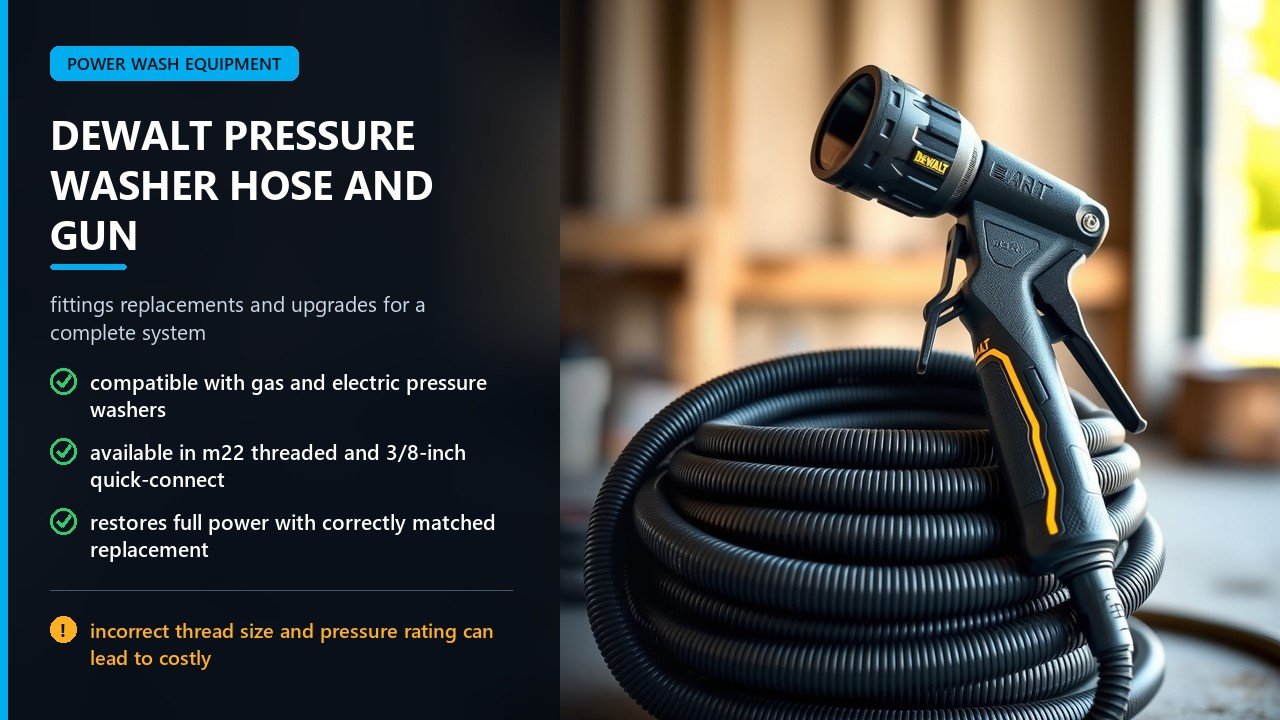
What Ships With a DeWalt Pressure Washer
A DeWalt pressure washer arrives with a high-pressure hose, a spray gun, a spray wand or lance, quick-connect nozzles, and a detergent siphon hose or tank. The hose carries pressurized water from the pump outlet to the gun, the gun controls flow with a trigger, and the wand holds the nozzle that shapes the spray. These four parts form the working end of the machine, and any one of them can fail.
The instruction manual for models such as the DXPW3123 lays out each component and stresses two things owners overlook. First, connections on the hose, gun, and wand should be cleaned and lubricated regularly with light oil or lithium grease to protect the O-rings. Second, if you replace a wand or gun, never use a combination shorter than the original, measured from the nozzle end to the trigger, because a shorter assembly raises fluid-injection risk. The manual states both points directly, and they are worth keeping in mind before you change any part.
The Hose: Sizes and Specs
DeWalt pressure washer hoses come in a few standard configurations, and the two numbers that matter are diameter and working pressure. Many current gas models use a 3/8-inch hose, some older and lighter gas machines such as the DXPW3123 shipped with a 1/4-inch by 35-foot hose, and many electric models use a 1/4-inch hose. The working pressure must meet or exceed your machine’s rated PSI, with a comfortable margin, so the hose does not burst or balloon under load.
DeWalt’s own accessory hose, the DXPA50PH, is a 3/8-inch by 50-foot, 5,000-PSI replacement with a polyester and steel dual-braided inner construction and a polyurethane outer jacket that is far more abrasion resistant than rubber. It uses 3/8-inch one-piece quick-connect socket and plug fittings and carries a maximum temperature of 140 degrees Fahrenheit. That specification is a useful benchmark for any replacement you consider. The DeWalt DXPA50PH hose page lists the full details.
The Gun: What DeWalt Includes
The spray gun is the trigger you squeeze to control water flow, and DeWalt ships a serviceable gun with most machines. It connects to the hose on the inlet side and to the wand on the outlet side, and it incorporates a trigger and often a safety lock. On gas models the gun typically ends in a 3/8-inch quick-connect inlet with an M22 outlet to the lance; on electric models the plumbing is usually M22 threaded throughout.
DeWalt also sells an upgraded universal gun, the DXPA45SG, rated to 4,500 PSI for cold water. It fits standard M22 or quick-connect high-pressure hose connections with a quick-connect adaptor included, and it adds a trigger safety lock-out and a 360-degree rotating side assist handle for control and comfort. It carries a 90-day limited accessory warranty. Details are on the DeWalt DXPA45SG spray gun page.
Threads and Fittings Explained
Fittings are where most fitment mistakes happen. The common thread on pressure washers is M22 by 1.5, a metric thread that appears on both the machine end and the gun end of many hoses, sometimes male and sometimes female. Quick-connect, often abbreviated QC, is a push-and-click system that replaces threaded joints for speed, and it comes in sizes such as 1/4-inch and 3/8-inch. The two systems are not interchangeable without an adapter.
Pressure washer fittings also carry a seal, usually an O-ring or a bonded cone, and the seal is what actually stops the leak, not the thread torque. This is why swapping a hose from one brand to another can leak even when the threads match: the sealing surface differs. Before buying, identify whether your machine uses M22 threaded, quick-connect, or a mix, and confirm the seal type. Our guide to matching hose connectors walks through the identification step by step.
| Fitting | Where it appears | Notes |
|---|---|---|
| M22 x 1.5 | Pump outlet, gun inlet/outlet, many electric models | Metric thread, needs correct cone/O-ring seal |
| 3/8-inch QC | Gas model hoses, gun inlet, upgrade accessories | Push-and-click, common on pro-grade parts |
| 1/4-inch QC | Wands and nozzles, some electric models | Lighter, common at the nozzle end |
How the Hose and Gun Connect
The water path runs from the pump outlet into the high-pressure hose, through the hose to the gun inlet, through the gun to the wand, and out the nozzle. Each joint is a potential leak, so each must be correctly matched and correctly sealed. On a threaded joint you tighten by hand plus a firm quarter turn, never with a wrench that can crush the seal. On a quick-connect you push until it clicks and tug to confirm.
A common mistake is over-tightening threaded fittings to stop a leak, which damages the O-ring and makes the leak worse. If a freshly connected joint drips, the cure is usually a new O-ring or a smear of silicone grease, not more force. Keeping connections clean and lightly greased, as the DeWalt manual advises, prevents most of the leaks owners report. Our article on matching and fixing the gun and wand covers the same discipline at the gun end.
Replacement Hose Options
A 3/8-inch 50-foot hose at 4,500 to 5,000 PSI with quick-connect ends covers current pro-grade gas machines, while a 1/4-inch hose suits older gas models such as the DXPW3123 and many electric machines. Match the diameter to your model, match the working pressure to or above your PSI, and match the end fittings and seal.
You can buy genuine DeWalt hose, the OEM part tied to your model, or a quality aftermarket hose from brands such as Flexzilla, Simpson, or MTM. Genuine parts guarantee fit; reputable aftermarket hose often offers better flexibility and length for less money. The key is to verify the ends and the pressure rating, because a bargain hose rated below your machine’s output will fail early. Our guide to the standard 3/8-inch high-flow hose explains why that size dominates the gas class.
Replacement Gun Options
Replacement guns follow the same logic: match the inlet and outlet, match the pressure rating, and choose a handle that suits your hand. DeWalt’s own DXPA45SG is a direct upgrade path, fitting M22 or quick-connect hoses with an M22 wand and rated to 4,500 PSI. Aftermarket guns from MTM, Suttner, and others offer ergonomic handles, swivels, and higher ratings, and some include a side assist handle for two-handed control.
An upgraded gun is one of the most satisfying pressure washer improvements because it reduces hand fatigue and improves control on a long job. Just confirm the connections: a gun that ends in M22 will not screw onto a hose that ends in quick-connect without an adapter. Our guide to choosing and upgrading a trigger gun helps match the fittings and the feel.
DeWalt OEM vs Aftermarket Parts
DeWalt OEM parts carry the brand and the guarantee of fit, and for odd or model-specific pieces that certainty is worth paying for. Aftermarket parts from established pressure washer brands often cost less and can outperform the original, especially at the hose and gun level where the technology is mature and widely shared. For commodity items such as O-rings, nozzles, and hose, aftermarket is a sensible choice; for a proprietary assembly, OEM is safer.
A practical approach is to buy OEM when you need an exact structural part and aftermarket when you are upgrading a wear item for better performance. Whichever you choose, buy from a source that lists the specifications, and avoid unbranded parts with no pressure rating. A parts diagram for your model, such as the service page for the DXPW3123 on the DeWalt service portal, helps you order the right part number the first time.
Matching PSI and GPM
Hose and gun ratings must cover both the pressure and the flow of your machine, though pressure is the number that causes failures. A hose or gun rated below your washer’s PSI can burst and is a genuine safety hazard, so always leave headroom. Flow matters less for the gun and hose body than for the nozzle, but an undersized hose on a high-flow machine will restrict performance and feel sluggish.
Remember that the cleaning power of a pressure washer reflects both PSI and gallons per minute, and the accessories should not throttle either. A high-PSI hose with a pinched diameter, or a gun with a restrictive inlet, will cost you flow and make the machine feel weaker than it is. Our overview of matching the ends, sizes, and ratings covers how PSI and GPM interact with the hose and gun.
When to Replace the Hose
Replace a pressure washer hose when it develops a bulge, a split, or a persistent kink, or when the outer jacket is worn through to the reinforcement. A bulging hose is about to burst and must never be used, because a high-pressure hose failure can cause serious injury. Leaking at the crimp, where the fitting meets the hose, is also a replacement signal rather than a repair.
Some leaks come from the O-ring rather than the hose, so check the seal first before condemning the whole hose. If the hose is sound and only the fitting drips, a new O-ring or a correctly matched adapter solves it. Our guide to choosing and caring for pressure washer hoses helps you tell a failing hose from a failing seal.
When to Replace the Gun
Replace the gun when the trigger sticks open, the gun leaks internally and loses pressure, the handle cracks, or the inlet or outlet fittings strip or corrode. A gun that will not build or hold pressure, or that keeps spraying after you release the trigger, is both frustrating and unsafe. Internal seals and valves wear over time, and on a modestly priced gun replacement usually beats repair.
Before replacing, rule out a nozzle or O-ring problem, because those are cheaper fixes that can mimic a gun fault. If the machine sprays weakly through every nozzle, or the trigger feels spongy and cannot be freed, the gun is the likely culprit. Our article on gun problems that cause leaks, sticking, and pressure loss diagnoses the symptoms in order.
Troubleshooting the Hose and Gun
Start with the cheapest checks. A leak at a joint is almost always the O-ring or an over-tightened fitting, so inspect the seal and lubricate it. Weak or fluctuating pressure often traces to air in the line, a partially blocked nozzle, or a worn unloader rather than the gun. A gun that sticks is usually a worn trigger valve or grit in the mechanism.
Work through the system methodically: confirm the water supply is full and unrestricted, check the inlet filter, confirm the hose has no kink or bulge, then examine the gun and nozzle. Replace the cheapest matched part first and re-test. Most hose and gun complaints resolve with a new O-ring, a clean nozzle, or a correctly matched replacement, not a new machine. Our guide to gun parts that break lists the usual suspects.
Care and Storage
Care is simple and extends the life of both parts. Rinse and dry the hose and gun after use, lubricate the fittings with light oil or silicone grease, and store the hose coiled loosely, not kinked, out of direct sun. Prolonged UV exposure degrades the outer jacket, and a permanent kink becomes a weak point that fails under pressure.
For winter, drain the hose and gun completely and store them indoors, because trapped water can freeze and split the hose or crack the gun body. Do not leave the hose connected under pressure when the machine is idle for long periods, and relieve pressure before disconnecting. These habits are the same ones that protect the pump, and they cost nothing. Our guide to hose kit selection and installation includes storage advice worth following.
Check the hose and gun before every use rather than only when something fails. A 30-second look for nicks, cracks, and bulges, and a quick squeeze to confirm the trigger releases cleanly, catches problems before they become dangerous failures. Replacing a worn O-ring when you see it is far cheaper than replacing a hose that blew out because a bad seal was ignored.
Quick-Connect vs Threaded Systems
Quick-connect and threaded systems each have a place. Quick-connect is fast and convenient, ideal for swapping wands and nozzles or moving a hose between machines, and it dominates the higher end of the gas market. Threaded, usually M22, is secure and simple, common on electric washers and on the pump and gun of many models, and it relies on a seal rather than a latch.
The two can be joined with adapters, and quality adapters are reliable when they are correctly sealed. Just keep the assembly as short as practical and add no unnecessary joints, because every connection is a potential leak and a pressure loss. For most owners, matching the existing system rather than converting is the simplest and most reliable path. Our overview of matching PSI, GPM, and threads ties the two systems together.
Compatible Brands and Adapters
DeWalt hoses and guns can often be used with other brands and vice versa, provided the fittings and ratings match. The widespread M22 and 3/8-inch quick-connect standards make cross-brand compatibility common, and adapters bridge the remaining gaps. This is good news for buyers, because it widens the pool of replacement parts and upgrades well beyond the DeWalt catalogue.
Compatibility is not automatic, however, because seal types and fitting genders vary between brands and models. Always confirm male or female, thread or quick-connect, and the seal, and prefer an adapter that preserves the seal rather than forcing a mismatched joint. When in doubt, buy the version explicitly listed as compatible with your model, or ask the seller to confirm the fittings before purchase.
Safety: Fluid Injection
A pressure washer is capable of injecting water through skin, and the risk rises when the wand or gun is modified. DeWalt warns against using a wand or gun shorter than the original, and that warning is about fluid injection, a serious injury that can look minor at first. Never point the gun at a person or any part of your body, and never test for leaks with your hand.
Inspect the hose and gun before each use for bulges, cracks, and worn fittings, and stop using any part that is compromised. Relieve pressure before disconnecting anything, and keep the safety lock engaged when the gun is not in use. These rules apply to every pressure washer, and they matter most when you are working with high-pressure parts you have just changed. Our guide to high-pressure gun safety and selection covers the details.
Upgrading Your DeWalt Hose for Longer Reach
One of the most common upgrades is a longer hose, because the 25-to-35-foot hose that ships with many machines forces you to keep moving the washer itself. A 50-foot hose such as DeWalt’s DXPA50PH nearly doubles your working radius and stays within the 140-degree temperature and 5,000-PSI ratings that cover the whole consumer and pro-sumer range. Longer reach means fewer trips to the cart and less hose dragging over the surface you are cleaning.
Length has a cost, though. A longer hose holds more water, adds weight, and creates more places for a kink, so choose the longest length you will genuinely use rather than the longest available. A 50-foot hose is the sensible sweet spot for a typical driveway or fence line; proprietary 100-foot lengths suit commercial use but weigh enough that a reel helps. Our guide to choosing and caring for pressure washer hoses sets out how to balance length, weight, and durability.
The Wand and Lance: Part of the Gun Assembly
DeWalt’s gun and wand work as an assembly, and the wand is the metal lance that carries the spray from the gun to the nozzle. The DeWalt 31-inch 4,500-PSI spray wand is the current accessory, and gas models often ship with a lance that plugs into a 1/4-inch quick-connect nozzle. The wand length matters for safety: a shorter wand raises fluid-injection risk, which is why DeWalt stresses keeping the original length or longer.
When you replace a wand, match its fitting to the gun outlet and its nozzle connection to your nozzles. Most wands end in a 1/4-inch quick-connect that accepts the standard colored spray tips, but some use M22. A wand with a swivel or a turbo end adds function without changing the safety basics. Replacing the gun often means replacing or reusing the wand, and the pair should be rated together for your machine’s pressure. Our guide to matching the gun and wand shows how the two parts fit together.
Sourcing OEM Part Numbers
If you prefer genuine DeWalt parts, start from the parts list for your exact model, because part numbers are specific to each washer. Diagrams for models from the DP series through the current DXPW range are readily available, and the part number page makes ordering a hose, gun, wand, or O-ring simple and avoids guesswork. The OEM number is the ground truth for fit.
OEM hose and wand numbers often follow a pattern per size, so a 3/8-inch by 50-foot 4,500-PSI hose carries a specific number while a 31-inch lance carries another. Once you have the OEM number, you can also search for compatible aftermarket equivalents by comparing the specifications rather than the number. The parts diagrams and service information on DeWalt’s service pages for the DXPW3123 are a reliable starting point for this approach, and confirming the number before you buy prevents a costly mismatch.
Frequently Asked Questions
What size hose does a DeWalt pressure washer use? Most gas models use a 3/8-inch high-pressure hose, while many electric models use a 1/4-inch hose. Always check your model’s manual, because the correct diameter and fitting type vary by machine.
Are DeWalt pressure washer hoses and guns universal? Not strictly. They use common standards such as M22 and 3/8-inch quick-connect, so many aftermarket parts fit, but you must match the fitting style, diameter, seal, and pressure rating.
Can I use any spray gun on a DeWalt pressure washer? You can use any gun whose inlet matches your hose and whose rating meets or exceeds your machine’s PSI. A mismatched fitting will not seal without an adapter, and an under-rated gun is unsafe.
Why does my DeWalt hose leak at the connection? A leak at a fresh connection is usually a damaged or missing O-ring, or an over-tightened threaded fitting. Replace or lubricate the seal and tighten by hand rather than forcing the joint.
What is the M22 fitting on a DeWalt pressure washer? M22 by 1.5 is a metric thread used on pump outlets, guns, and wands, especially on electric models. It seals with an O-ring or cone and is common across many brands.
How often should I replace the hose and gun? Replace them when they fail, not on a schedule. A bulging or split hose, a stuck or leaking gun, or stripped fittings all call for replacement, and better care delays that day.
Can I convert my DeWalt hose to quick-connect fittings? Yes, with a quality adapter that matches the thread size and the quick-connect size. Keep the assembly short and preserve the seal, since every added joint is a potential leak and a small pressure loss.
Do DeWalt electric and gas washers use the same hose? Not usually. Many electric models use a 1/4-inch hose with M22 fittings, while gas models typically use a 3/8-inch hose with quick-connect ends. Confirm the fitting style and diameter on your own machine before buying.
Final Thoughts
DeWalt pressure washer hose and gun parts reward a little homework. Identify whether your machine uses M22 threaded or quick-connect fittings, note the hose diameter and the PSI rating, and match those numbers when you buy. Do that, and a replacement hose or gun restores full cleaning power for far less than a new washer.
Upgrading is equally worthwhile: a longer, more flexible hose and an ergonomic gun with a side assist handle make every job easier and less tiring. Whether you stay with genuine DeWalt parts or choose quality aftermarket equivalents, the fittings and the rating are what matter. Match them carefully, care for the connections, and your hose and gun will serve reliably for years.