Adapter Pressure Washer Guide: Match M22, GHT, and Quick Connect
Few things frustrate a pressure washer owner faster than a fitting that almost fits. The machine is ready, the water is on, and the hose simply will not thread onto the pump, or the new gun clicks onto nothing. Nine times out of ten the answer is an adapter, a small brass or stainless fitting that bridges two different connection standards. The trouble is that adapters come in a confusing array of sizes and thread types, and buying the wrong one wastes time and money. This guide explains the adapter pressure washer owners actually need, how to identify the threads on your machine, and how to match M22, garden hose thread, and quick connect so everything clicks together and holds pressure.
What a Pressure Washer Adapter Does
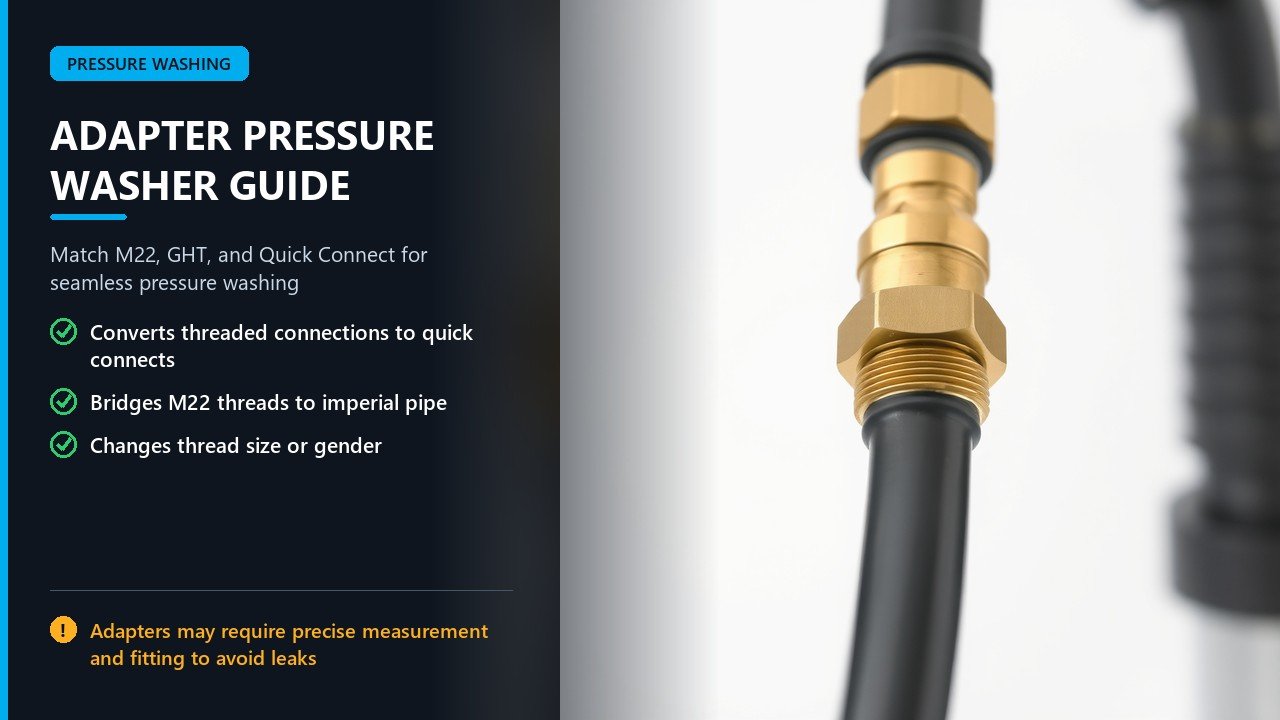
An adapter is a converter. It joins two fittings that use different connection systems, or two that use the same system in different sizes. Pressure washing mixes metric and imperial standards, and no single brand agrees with another on every joint, so adapters are the universal translators that let hoses, guns, wands, pumps, and accessories from different makers work together.
There are three jobs an adapter typically performs. It converts a threaded connection to a quick connect so you can click accessories on and off. It bridges metric M22 threads to imperial pipe or quick connect fittings. And it changes the thread size or gender, turning a male end into a female one or a 14 mm thread into a 15 mm. Once you understand those three tasks, the whole adapter catalogue starts to make sense.
The Three Connection Families
Almost every pressure washer connection belongs to one of three families. Learn them, and you can identify any fitting your machine uses.
- M22 is a metric threaded connection, common on consumer and prosumer machines, spray guns, and hoses. It comes in two neck sizes, 14 mm and 15 mm, which do not interchange.
- GHT, garden hose thread, is the 3/4 inch thread on a standard garden tap and hose. It is used on the water supply side of the machine, where the garden hose feeds the pump inlet.
- Quick connect is the push-and-click system, usually seen in 1/4 inch or 3/8 inch sizes at the working end of the machine, used on nozzles, wands, and some hoses.
The typical pressure washer has a garden hose thread inlet and one or more quick connect or M22 joints on the high-pressure side. Adapters exist to move between any of these, and understanding your machine means tracing which family appears at each point. Our overview of hose fittings and leak-free connections maps the whole system.
M22: The 14 mm and 15 mm Trap
M22 is the most common metric connection on pressure washers, and the most misunderstood. The number 22 refers to the thread diameter, but the critical difference is the inside diameter of the fitting, which comes in two variants: M22-14 mm and M22-15 mm. They look similar and share the same outer thread, but the inner bore differs, and a 14 mm fitting will not seal properly against a 15 mm one.
Most machines made for the North American market use M22-14 mm. Many European and some Asian brands, along with machines sold under names like Sun Joe, AR Blue, and Stanley, use M22-15 mm. If you are joining parts from two different machines and they dribble or will not seat, this mismatch is the likely cause. A dedicated M22-15 mm to M22-14 mm coupler, rated to around 4,500 PSI, is the fix, and it is one of the most useful adapters a multi-brand owner can keep on hand.
Garden Hose Thread (GHT)
On the supply side, the machine takes water from a garden hose, and that connection uses garden hose thread, the familiar 3/4 inch thread on every outdoor tap. Because the inlet is a threaded fitting, it is a natural place to add a quick connect: a GHT-to-quick-connect adapter screws onto the hose end and the machine inlet so you can snap the two together instead of twisting them every time.
Westinghouse sells exactly this kind of fitting, converting the garden hose end or the pressure washer intake into a quick connect so a hose can be clicked on and off in seconds. It is a small upgrade that saves real aggravation, especially if you disconnect the hose after every use. Just remember that the supply side only sees hose pressure, not the high pressure of the pump, so GHT fittings do not need the heavy ratings that the high-pressure adapters do.
Quick Connect: 1/4 Inch vs 3/8 Inch
Quick connect fittings let you swap nozzles, wands, and guns with a push and a click, which is why nearly every modern pressure washer uses them. There are two common sizes, and mixing them up is a frequent mistake. The 1/4 inch quick connect is the standard on most consumer nozzles, wands, and guns. The 3/8 inch quick connect appears on some higher-flow hoses and commercial equipment, and it is not interchangeable with the smaller size.
Adapters bridge the gap. An M22-14 mm to 1/4 inch quick connect set, for instance, lets a threaded hose fit a standard gun, and a 3/8 inch quick connect to M22-14 mm adapts in the other direction. These fittings often carry ratings up to 5,000 PSI and are made from stainless steel and brass for durability. Knowing whether your machine uses 1/4 inch or 3/8 inch quick connect is the first step to buying the right adapter, and our guide to matching connector ends helps you check.
Reading Threads: Male, Female, and Swivel
Beyond the thread type, every connection has a gender. A male fitting has external threads; a female fitting has internal threads. An adapter has a gender at each end, so an M22 male to 1/4 inch quick connect adapter is male at the M22 end and a quick connect plug at the other. When you shop, always note both ends.
A swivel is a female fitting that spins freely on a captive nut, which lets it thread onto a fixed male fitting without turning the hose or gun behind it. Swivels are common on M22 connections because they eliminate the twisting that kinks hoses and loosens joints. If your hose or gun keeps tangling as you connect it, a swivel adapter is the cure, and it is a small detail that makes a big difference. Our guide to couplings that kill the twist explains the principle.
How to Identify Your Fitting
Before buying any adapter, identify what you have. Start by looking at the connection and matching it to the three families. If it is a large threaded nut, it is probably M22. If it is the same thread as your garden tap, it is GHT. If it has a collar you pull back to release, it is quick connect. Then measure or research the specifics.
For M22, measure the inside diameter to tell 14 mm from 15 mm, or check your machine’s manual or brand, which often states the size. For quick connect, compare the fitting to a known 1/4 inch or 3/8 inch plug. For threads, note the gender at each end. If you are unsure, photograph the fitting next to a ruler and compare it to product listings, which usually show dimensions. Getting this right the first time saves a return and a delay, and our thread-matching guide is a useful companion.
The Most Common Conversions
The table below lists the adapters pressure washer owners reach for most often. Recognizing the pattern makes shopping simple.
| Adapter | What it does | Typical use |
|---|---|---|
| M22-14 mm to 1/4 in QC | Converts a metric threaded joint to a click fitting | Fitting a standard gun or wand to a threaded hose |
| M22-14 mm to 3/8 in QC | Bridges metric thread and large quick connect | Commercial hose to standard gun |
| M22-15 mm to M22-14 mm | Joins the two metric bore sizes | Mixing Sun Joe, AR Blue, or Stanley parts with US machines |
| GHT to quick connect | Turns a garden hose end into a click fitting | Fast hookup of the supply hose to the inlet |
| 3/4 in to 1/2 in QC | Steps between garden hose and smaller quick connect | Custom supply and accessory setups |
Most multi-purpose adapter kits bundle several of these together. A typical eight-piece stainless set includes M22-14 swivels to 3/8 inch plugs, 3/8 inch quick disconnects to M22-14 males, and 3/4 inch female to 1/2 inch quick connect fittings, covering a wide range of brands. Established makers offer complete kits, such as the Westinghouse 6-piece quick connect kit, and retailers like SIMPSON accessories list individual adapters alongside guns and hoses.
Adapter Kits vs Single Fittings
Single adapters are ideal when you know exactly which conversion you need, and they keep the cost low. Kits make sense when you are unsure of your sizes, own several machines, or want spares on hand. A well-chosen kit covers the common conversions for most brands, and the extra pieces become useful the moment you add a new accessory or change machines.
The risk of a kit is paying for fittings you never use. A focused kit that covers M22 and quick connect in both 1/4 inch and 3/8 inch, plus a garden hose adapter, hits the sweet spot. Read the contents carefully rather than trusting the piece count, because the value is in the specific conversions, not the number of parts. For a deeper look at building a complete, leak-free set, see our fittings setup guide.
Pressure Ratings Matter
Every adapter on the high-pressure side must be rated for the working pressure of your machine, with margin. A brass fitting rated to 4,500 PSI is fine on a 4,000 PSI washer; a light fitting meant for a garden hose is not. Ratings are usually printed on the packaging or listed online, and quality brands rate their brass and stainless adapters in the several-thousand-PSI range.
The supply-side fittings are the exception, because they carry only hose pressure, but the high-pressure joints, everything from the pump outlet to the nozzle, are under full working pressure. A cheap adapter here can crack, shoot off, or leak at the worst moment. Buy rated parts from reputable makers, and treat the adapter chain as part of the pressure system, because that is exactly what it is. Our guide to threads, sealing, and leak-free plumbing covers the details.
Safety rule: Choose adapters rated above your machine’s working pressure. A brass fitting rated for 4,500 PSI is a safe match for a 4,000 PSI washer. Never put a lightweight garden-hose fitting on the high-pressure side.
Brass vs Stainless Steel
Adapters come in brass, stainless steel, and combinations of the two. Brass is the traditional choice, resistant to corrosion and easy to machine into precise threads, and it seals well against O-rings. Stainless steel adds strength and excellent corrosion resistance, and many premium adapters use a stainless body with brass or stainless internals.
For most home and light commercial use, good brass is entirely adequate and often cheaper. For saltwater, harsh chemicals, or heavy commercial duty, stainless earns its keep. What matters more than the metal is the machining: precise threads and quality seals decide whether an adapter seats cleanly and holds pressure. Forged fittings from a known brand outperform no-name parts with loose tolerances, which is why a slightly higher price is usually money well spent.
Sealing Adapters Correctly
Adapters seal in two ways. Threaded metal joints, like M22 and pipe thread, seal on the threads and often use a rubber washer or O-ring in the fitting or at the base. Quick connect fittings seal on an internal O-ring, which is why they need no tape and should never have any applied. Getting this right prevents the two most common leaks.
For M22 connections, check the washer or O-ring is present and in good condition, and tighten firmly by hand or with a light wrench, never forcing metal against metal without a seal. For garden hose thread, a fresh rubber washer in the female end does the job. For quick connect, keep the O-ring clean and lightly lubricated, and never wrap the fitting in tape, because tape prevents the coupler from seating and causes leaks. Leaking adapters are almost always a missing, worn, or dirty seal. Our guide to the adapters that end leaks and wobble covers troubleshooting.
Adapters for Special Accessories
Many accessories need their own adapter to fit. A foam cannon, a surface cleaner, a telescoping wand, or a downstream injector each connects to the gun or hose, and each may use a different fitting than your machine. This is where adapters prove their worth, letting you add capability without replacing anything.
Foam cannons often use a specific inlet size and benefit from a swivel adapter to stop them twisting. Surface cleaners connect to the gun or a hose end, sometimes requiring a quick connect adapter to swap with the wand. Telescoping wands may need an M22 adapter to match your gun. Before buying any accessory, check its connection against your machine and budget the adapter. Done right, a handful of adapters unlocks a whole shelf of attachments.
Common Adapter Mistakes
Most adapter problems come from a short list of errors. Watch for these when you buy and install.
- Confusing M22-14 mm with M22-15 mm and wondering why it leaks.
- Mixing 1/4 inch and 3/8 inch quick connect fittings.
- Using an unrated fitting on the high-pressure side.
- Wrapping quick connect fittings in tape, which stops them sealing.
- Forgetting the O-ring or washer on a threaded joint.
- Buying a kit without checking the specific conversions it includes.
- Over-tightening and stripping soft brass threads.
Each of these is prevented by five minutes of checking before you buy. Identify the family, size, and gender at each end, confirm the pressure rating, and the adapter will work the first time.
Building a Spare Adapter Kit
A small set of adapters in a toolbox is one of the best cheap upgrades for any pressure washer owner. Keep an M22-14 swivel to quick connect pair, a 1/4 inch and a 3/8 inch quick connect set, a garden hose to quick connect adapter, and an M22 14 mm to 15 mm coupler if you own European or hybrid brands. With those on hand, almost any new hose, gun, or accessory will fit, and you will never be stopped mid-job by a thread that does not match.
The kit also pays off when you mix brands or upgrade parts. Pressure washer fittings are not standardized across the industry, so owning the common translators means you are never locked into one maker’s accessories. It is a modest investment that multiplies the number of parts you can use, and it turns a frustrating mismatch into a non-issue.
Installation Steps
Once you have the right adapter, fitting it is quick if you follow a short routine.
- Confirm the adapter matches at both ends, checking size, thread, and gender.
- Inspect the O-ring or washer and replace it if worn or missing.
- Hand-thread the adapter onto the joint, feeling for a smooth start with no cross-threading.
- Tighten firmly by hand, then a small turn with a wrench if needed, without forcing.
- For quick connect, push the plug into the coupler until it clicks and tug gently to confirm it is locked.
- Run water with the machine off and check for drips before you reach full pressure.
If a joint weeps, stop, remove the adapter, and check the seal and threads before tightening further. Most leaks come from a missing or dirty O-ring rather than a loose nut, so investigate the seal first. Done carefully, a good adapter seats on the first try and stays leak-free for years.
Storing and Labeling Your Adapters
Once you own more than a handful of adapters, telling them apart becomes the next problem, because many look nearly identical until you thread them onto something. A few habits keep the collection usable. Sort the fittings by family, keeping M22 pieces, quick connect pieces, and garden hose pieces separate so you are not guessing under pressure.
Labeling helps, but permanent marker rubs off brass quickly, so a small divided box or a labeled zip bag works better than writing on the metal. If you buy a kit, keep the insert card that lists its contents, since it doubles as an identification chart. Store adapters somewhere dry to keep the brass bright and the O-rings supple, and replace any O-ring that has hardened or flattened, because a five-cent rubber ring is usually the reason a fitting leaks. A tidy adapter drawer turns a frustrating search into a ten-second grab.
Why Standards Don’t Line Up
It helps to understand why adapters are needed at all. Pressure washers grew out of several industries at once, from car washing to agriculture to construction, and makers in Europe, Asia, and North America each developed their own fittings. Metric M22 emerged from European and Asian manufacturing, while imperial quick connect and garden hose thread came from the North American market. Nobody has since forced the whole industry onto one standard, so machines and accessories still speak different languages.
That is not a flaw so much as a fact of the market, and adapters are the practical answer. Rather than replacing a perfectly good hose or gun because its threads differ, you spend a few dollars on a coupler and keep using the parts you like. Understanding that the mismatch is structural, not a defect in your machine, stops a lot of needless worrying and points you straight to the fix.
Adapters and Flow: Keep the Bore Open
An adapter should never choke the flow. Each fitting you add narrows the path slightly, and a chain of undersized adapters on a high-flow machine can cost a little pressure and volume at the nozzle. This rarely matters on a small electric washer, but on a 4 GPM machine it is worth keeping connections as large and few as possible.
Match the adapter bore to the hose and gun it joins, and prefer a single correct adapter over two stacked together to make one conversion. A 3/8 inch hose feeding through a 1/4 inch adapter loses a little performance, so choose the larger size when your equipment is built for flow. Keep the run short and direct, and the adapter becomes transparent rather than a restriction.
Frequently Asked Questions
How do I know which pressure washer adapter I need?
Identify the connection family at each end, then the size and gender. Large nuts are usually M22 (14 mm or 15 mm), the tap thread is garden hose thread, and pull-collar fittings are quick connect (1/4 inch or 3/8 inch). Match both ends and confirm the pressure rating.
What is the difference between M22-14 and M22-15?
Both share the M22 outer thread but differ in inside diameter. M22-14 mm is common on North American machines, while M22-15 mm is common on many European and some Sun Joe, AR Blue, and Stanley models. They do not seal against each other without a dedicated coupler.
Can I use a garden hose adapter on the high-pressure side?
No. Garden hose thread fittings are rated only for hose pressure and will fail under the thousands of PSI a pressure washer produces. Use rated brass or stainless adapters on the high-pressure side and keep GHT fittings for the water supply.
Do quick connect adapters need Teflon tape?
No. Quick connect fittings seal on an internal O-ring, and tape prevents the coupler from seating properly, which causes leaks. Keep the O-ring clean and lightly lubricated instead, and never wrap quick connect threads in tape.
What pressure rating should an adapter have?
Higher than your machine’s working pressure. A washer running at 4,000 PSI needs adapters rated to at least that figure, and many quality brass and stainless adapters are rated to 4,500 or 5,000 PSI. Never use a light, unrated fitting on the high-pressure side.
Why does my adapter leak?
Almost always a seal problem. Check for a missing, worn, or dirty O-ring or washer, confirm the sizes match (especially M22-14 mm versus 15 mm), and make sure quick connect fittings are free of tape. If it still leaks, the threads may be damaged or mismatched.
The Bottom Line
An adapter pressure washer setup is all about translation between standards that were never designed to agree. Learn the three families, M22, garden hose thread, and quick connect, then note the size and gender at each joint, and you can match any hose, gun, wand, or accessory to your machine. Pay attention to the M22-14 mm and 15 mm difference, choose quick connect in the right size, and always buy adapters rated above your working pressure. Keep a small spare kit on hand, seal the joints correctly, and the fitting that would not fit becomes a five-second click. That is the quiet magic of a well-chosen adapter.