Every weekend, Devon fought the same battle. His pressure washer sat in one corner of the garage, his hose lay in a knotted pile in another, and his nozzles lived somewhere in between. Setting up took fifteen minutes, packing up took twenty, and the hose always came out kinked. Then he mounted a reel onto a wheeled cart, plumbed the hose in permanently, and turned the whole mess into one rollable unit. Setup dropped to a minute, the hose never touched the ground, and his back stopped hurting. A pressure washer cart with hose reel sounds like a small upgrade, but it changes how you work almost every time you clean.
This guide explains what these setups are, why the cart and reel belong together, the parts that matter, the ratings you must check, how to mount and plumb a reel correctly, and how to choose between building and buying. If you want faster setup, a longer hose life, and a tidier workspace, this is the upgrade to understand.
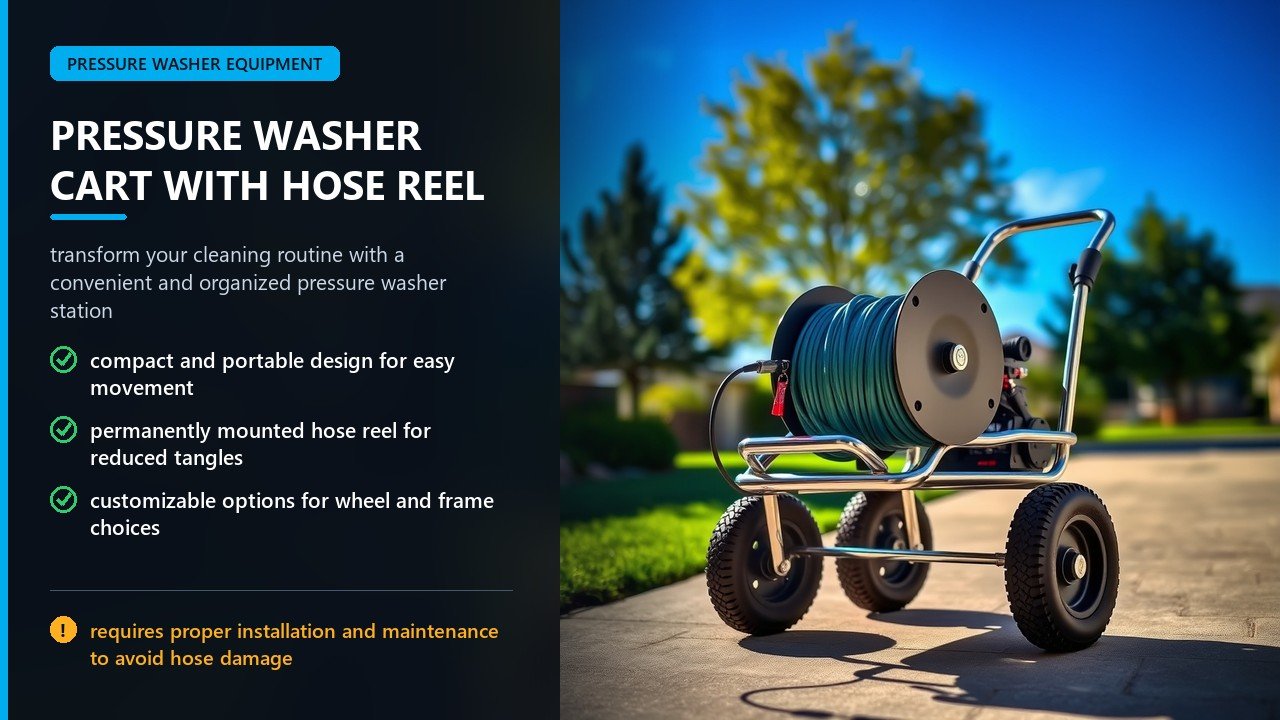
What a Pressure Washer Cart With Hose Reel Is
A pressure washer cart with hose reel is exactly what the name suggests: a wheeled cart that carries your pressure washer and mounts a rotating reel for the high-pressure hose. Instead of dragging a loose hose across the driveway and coiling it by hand, you crank it onto the reel and roll the entire station where you need it.
These setups come in several forms. Some carts are built specifically to hold a compact electric washer and include a reel, like the Active Wash Cart and Hose Reel, which holds up to 100 feet of hose and pairs large rear wheels with locking front casters. Others are essentially high-pressure hose reel carts you can mount any washer onto. The rest are DIY builds that bolt a reel to a utility cart. All three achieve the same goal: one organized, mobile unit.
Why Carts and Reels Belong Together
The reel and the cart solve two different problems that happen to reinforce each other. The reel solves hose management: it stores the hose neatly, prevents kinks and tangles, and protects the hose from the abrasion and UV exposure that shorten its life when it lies on concrete. The cart solves mobility and organization: it carries the machine and keeps everything in one place, so you are not hunting for parts or carrying gear by hand.
Together they remove the two biggest sources of wasted time and frustration on a pressure washing job: setting up and packing away. They also reduce safety hazards. A loose high-pressure hose is a tripping risk and a twist hazard, and a hose that kinks can restrict flow and stress the pump. Our guide to adding a hose reel to your machine covers the basic benefits, and the same logic scales up to a cart. A reel specialist sums it up simply: good hose management protects the hose, prevents tangles and kinks, and keeps the work environment safe and efficient.
The Parts of a Cart-and-Reel Setup
Understanding the components helps you evaluate any cart you consider, because quality varies widely. The frame carries the load, the wheels provide mobility, the reel stores the hose, the swivel lets the reel rotate without leaking at the inlet, and a short jumper or whip hose connects the washer’s pump outlet to the reel inlet. A handle makes pushing and cranking easier, and an accessory bin or basket holds nozzles, guns, and parts.
| Component | What to Look For |
|---|---|
| Frame | Powder-coated steel for strength; welded, not thin bolted sheet |
| Wheels / casters | Pneumatic for rough ground; locking casters for stability |
| Reel | Steel or stainless drum rated for your machine’s PSI and flow |
| Swivel | Brass or stainless, rebuildable, rated above your working pressure |
| Jumper / whip hose | 3/8-inch, matched fittings, short enough to reduce clutter |
| Handle & bin | Crank clearance, comfortable grip, storage for nozzles and gun |
The Ratings That Actually Matter
It is easy to be impressed by a sturdy frame and overlook the parts that carry the pressure. The reel’s swivel and drum are the real limits, and both must be rated at or above your machine’s output. A heavy steel frame means nothing if the swivel inlet is rated to only 2,000 PSI and your gas washer produces 3,500 PSI or more. Check the reel’s pressure rating and flow rating separately, and confirm the hose diameter it accepts.
Hose diameter matters as much as length. Standard 1/4-inch hose suits most electric washers, but gas machines above roughly 2,500 PSI benefit from 3/8-inch hose to move the higher flow without losing pressure. Buy a reel with at least about 20 percent more capacity than your current hose, because a reel packed to its limit does not pay out or wind smoothly. Our breakdown of hose reel types and how to choose digs into rating details.
| Setup | Typical Hose | Rating Note |
|---|---|---|
| Compact electric washer cart | 1/4-inch, 25–50 ft | Reels often rated 2,000–3,000 PSI |
| Gas machine cart | 3/8-inch, 50–100 ft | Swivel and drum must handle 4,000+ PSI |
| Professional reel cart | 3/8-inch, 150–300 ft | Heavy steel or stainless, 5,000 PSI class |
Quick Note: The reel drum, the swivel, and the jumper hose all see full pump pressure. Confirm every one of them is rated for your machine, not just the frame or the hose.
Wheel and Frame Choices
How you move the cart decides how much you will actually enjoy using it. Two-wheel push carts are lighter and easier to store, and they work well on flat concrete. Four-wheel carts with casters, or large pneumatic rear wheels with locking fronts, roll more stably and handle uneven ground, gravel, and curbs better. Pneumatic tires absorb shock and roll over rough terrain far more easily than hard plastic wheels, which is why job-site users prefer them.
Frame material is a trade-off between weight and durability. Steel frames handle the most punishment but add weight, especially once loaded with a machine and a full hose. Aluminum cuts weight substantially with only a small loss in impact resistance, while polymer frames are the lightest but can crack under stress and degrade in sunlight. For daily professional use, steel wins; for occasional and mobile use, aluminum or polymer is practical. In general, match the material to how often and how hard you will work.
Mounting and Plumbing the Reel Correctly
The difference between a reel that works flawlessly and one that leaks or fights you comes down to mounting and plumbing. Mount the reel where the hose feeds out smoothly without rubbing against the machine, wheels, or frame, and leave full clearance for the crank handle to rotate. A loaded reel is heavy, so bolt it to a reinforced surface rather than thin sheet metal. Test the reel in position, pulling hose and cranking it back, before you drill any permanent holes.
On the plumbing side, a short jumper hose connects the pump outlet to the reel inlet, and the high-pressure hose attaches at the drum outlet. Use properly rated fittings, apply sealant or thread tape where needed, and test every connection for leaks before full-pressure use. A professional reel setup guide stresses two points above all: mount the reel on a surface strong enough for the loaded weight, and give the crank handle room to turn fully. Once plumbed, the hose stays permanently connected, so you never push and pull fittings at the start and end of every job.
Build It or Buy It?
You have two paths. Buying a purpose-built pressure washer cart with hose reel gets you a matched frame, wheels, and reel with pre-drilled mounting and known ratings, which is faster and lower-risk. Building your own means choosing a sturdy utility cart and adding a reel, jumper hose, and fittings, which can save money and let you tailor the layout to your equipment.
If you build, start with a cart rated well above your loaded weight, add a reel whose swivel and drum match your machine, and use a short quality jumper hose. A reel types and mounting guide helps you pick, and our overview of wheeled cart and trolley options covers cart selection. If you would rather not tinker, a matched cart saves hours of trial and error. Either way, the goal is one unit that rolls out ready and tucks away tidy.
Matching the Cart to Your Work
Choose the cart and reel to fit your actual jobs. A homeowner washing cars and a patio needs a compact cart with a modest reel and 50 to 100 feet of hose. A mobile detailer needs more hose capacity, locking casters, and organized storage for guns and chemicals. A contractor running a gas machine on commercial properties needs a heavy welded frame, pneumatic wheels, a 3/8-inch hose, and a reel rated for high pressure and flow. If you are deciding between a cart and a fixed mount, our comparison of wall, skid, and trailer mounting explains when a cart is the better choice and when it is not.
Care and Maintenance
Keep the setup working with simple habits. After each use, drain and dry the hose, then wind it evenly onto the drum so it does not bind. Inspect the swivel for leaks and rebuild it if it drips, since a leaking swivel wastes pressure and can spray water at the operator. Check the jumper hose and fittings for wear, and keep the reel’s bearings and swivel threads clean. Tighten frame bolts periodically, especially on home-built carts, because vibration loosens fasteners over time. Store the loaded cart out of freezing temperatures and drain all water before winter. Protect the hose from sun and abrasion by keeping it on the reel rather than on the ground.
Frequently Asked Questions
What is a pressure washer cart with hose reel? It is a wheeled cart that carries your pressure washer and mounts a rotating reel for the high-pressure hose, so the hose stores neatly and the whole setup rolls to the work area as one unit.
Do I need a reel on my cart? A reel is not strictly necessary, but it prevents tangles and kinks, extends hose life, saves setup time, and improves safety, which is why most cart owners add one.
What PSI rating should the reel have? The reel’s swivel and drum should be rated at or above your machine’s output. Consumer carts often handle 2,000 to 3,000 PSI, while professional steel carts are rated to 5,000 PSI and above.
Can I mount a reel on any cart? Yes, provided the cart is strong enough for the loaded weight and you have room for the crank handle to rotate. Use a reinforced mounting surface and secure the reel with proper bolts.
What size hose fits a reel cart? Compact carts usually take 25 to 50 feet of 1/4-inch hose, mid-size carts take 50 to 100 feet, and professional carts handle 150 to 300 feet of 3/8-inch hose. Buy a reel with extra capacity for smooth payout.
Is a retractable reel worth it on a cart? A retractable reel is convenient and fast, but its spring can wear out and its PSI rating may limit high-pressure gas machines. Manual reels are simpler, more durable, and easier to maintain.
Final Thoughts
A pressure washer cart with hose reel turns a scattered pile of gear into one organized, rollable station. It is one of the few upgrades that pays off every single time you clean, because it removes friction from the start and end of every job rather than adding another feature to learn. The reel keeps the hose protected and tangle-free, the cart keeps everything together, and the combined setup cuts setup and cleanup time on every job.
Check the ratings that matter, the reel’s swivel, drum, and jumper hose, and not just the frame. Match the wheels and material to how you move and work, mount and plumb the reel carefully, and maintain the swivel and hose. Do that and the cart stops being a gadget and becomes the backbone of a faster, tidier, more professional pressure washing routine.